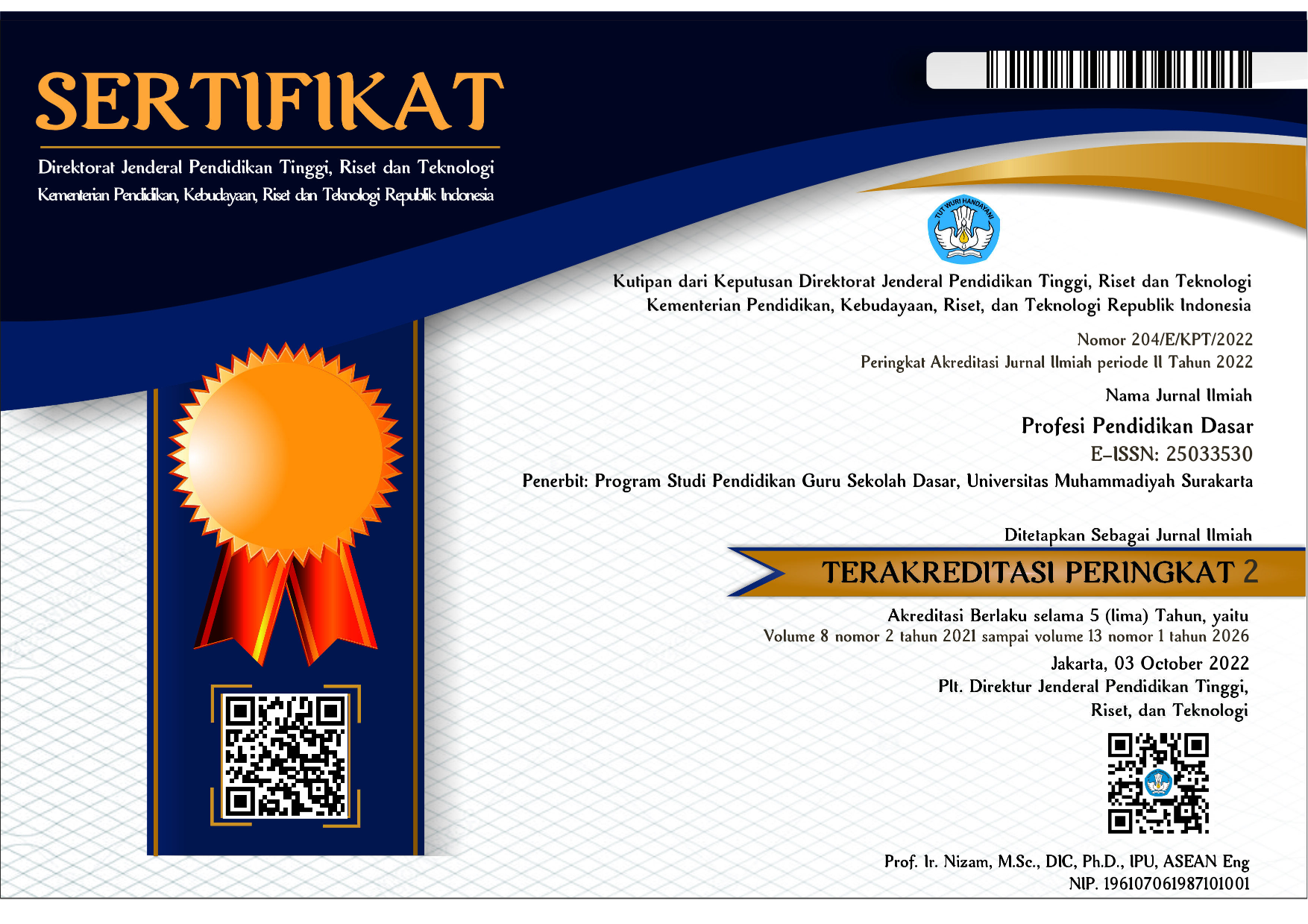
(Vol. 8, No. 2, December 2021 - Vol. 13, No. 1, July 2026)
What does it take to prepare young learners for a world shaped by AI, digital media, and global citizenship? Scholars from eight countries, Indonesia, Malaysia, Nigeria, Greece, South Africa, the Netherlands, the United Kingdom, and the United States, answer this question in seven articles. The issue opens with 6C integrated deep learning for pre-service teachers' social studies understanding and self-recorded video-assisted deep learning for students' speaking skills. It continues with teachers' views on a collaborative literacy ecosystem for early reading, primary teachers' use of search engine technologies, and DIALOGOS, a chatbot that maps science misconceptions. It closes with children's rights awareness as a predictor of social reasoning and a digital STEAM-inquiry module for mathematical literacy.
How can elementary schools raise children who are literate, numerate, and caring citizens in a digital age? Scholars from ten countries, Indonesia, Thailand, Nigeria, Pakistan, Kenya, Malaysia, the Philippines, Greece, the United States, and the Republic of Korea, explore this question in eight articles. The issue opens with a digital library with disaster mitigation content that builds reading literacy and environmental care, followed by comic-based microlearning worksheets that boost numeracy and motivation. It then maps five years of research on ecopedagogy in elementary science, examines how social-emotional learning shapes understanding of digital citizenship, and explores tri-center communication strategies for school branding. It closes with an AI-supported deep learning model for character education, a science e-module for cultural literacy, and RME-based interactive digital worksheets for fractions and numeracy.
How can primary schools honor culture and character while embracing innovation? Scholars from seven countries, Indonesia, Malaysia, Nigeria, Pakistan, the Philippines, South Africa, and the United States, answer in ten articles. The issue opens with a Juz 'Amma memorization board game for Qur'an memorization, an interactive flipbook on regional flagship products, and AI in English language teaching in Pakistan's elementary schools. It continues with a bibliometric review of primary education research, the ADLX Introflex integrated curriculum for religious character, the Sundanese values of Silih Asah, Silih Asih, and Silih Asuh in character education, and ideology in dance learning. It closes with KEBAYA digital comics on cultural diversity, parental preference on K-12 vs. K-10 curricula, and HydroAR for learning the water cycle.
How can culture, technology, and teacher readiness work together to strengthen primary education? Scholars from seven countries, Indonesia, Malaysia, Nigeria, Kazakhstan, Bangladesh, Turkey, and the United States, respond in nine articles. The issue opens with ethno-realistic mathematics education for critical thinking, teacher self-efficacy and acceptance for differentiated learning, and local wisdom-based flipbooks for natural and social studies. It continues with pre-service teachers' attitudes toward and use of AI, a seamless learning framework bridging classroom and home, and children's emotional management in modern life. It closes with a multitier science instrument revealing pre-service teachers' misconceptions, FLITARA, a culture-based flipbook for literacy, and strategies for overcoming dyscalculia.
What shapes how young learners grow, inside and outside the classroom? Scholars from three countries, Indonesia, Australia, and Iran, address this question in six articles. The issue opens with the growing concern of smartphone dependency among young learners and the effect of principal leadership style on teacher performance. It continues with buried compost bin media for environmental awareness and an application-assisted RADEC model for writing skills. It closes with the role of parental support and self-efficacy in learning independence and problem-based learning with CRT and augmented reality for mathematics.
How is digital innovation reshaping the primary classroom? Scholars from two countries, Indonesia and Thailand, explore this question in six articles. The issue opens with multimedia-based interactive media that improves motivation and learning outcomes and a self-efficacy approach to reading and writing instruction for pre-service educators. It continues with digital media innovation for numeracy literacy and an augmented reality application for teaching food chains. It closes with Qur'anic and Hadith elements in Islamic religious education materials and inquiry-based learning with gamified formative assessment for mathematical problem-solving.
What keeps children engaged, disciplined, and in school? Scholars from five countries, Indonesia, Turkey, Kenya, South Africa, and Taiwan, examine this question in six articles. The issue opens with project-based instructional materials for creative thinking in the Society 5.0 era and cognitive academic engagement as a predictor of pupils' intention to complete school in Kenya. It continues with the role of parents in addressing children's discipline problems and Ular Tajir, a flood-themed snakes and ladders game for teaching flood mitigation. It closes with problem-based materials with differentiated approaches and a Kahoot-based Teams Games Tournament for mathematical critical thinking.
How can teachers meet the diverse needs of every learner? Scholars from three countries, Indonesia, Malaysia, and South Africa, take up this question in six articles. The issue opens with madrasah teachers' understanding of differentiated learning training for the Merdeka Curriculum and a value clarification technique with socioscientific issues that builds scientific literacy through role-playing. It continues with a self-directed learning model for pentigraph writing and the contribution of TPACK to differentiated learning. It closes with wellbeing-focused science and social studies learning and pre-service teachers' understanding of join and separate word problems in the Foundation Phase.
How can digital tools and contextual materials make elementary learning more meaningful and inclusive? Scholars from three countries, Indonesia, Malaysia, and the United Kingdom, answer this question in six articles. The issue opens with a contextualized coastal course book for literacy in Bengkulu and AR GeoGebra interactive media for teaching geometry. It continues with a STEAM-inquiry module with Liveworksheets for multiplication and the role of parenting patterns in shaping the behavior of children with ADHD. It closes with project-based Liveworksheets for number operations and Focusky-based learning media in the Merdeka Curriculum.
How can technology and local wisdom raise the standard of primary education? Scholars from three countries, Indonesia, Nigeria, and Malaysia, explore this question in six articles. The issue opens with the Argeo Math app for mathematical problem-solving and local wisdom-based pictorial teaching materials that boost ecoliteracy. It then appraises the factors behind declining primary education standards in Adamawa State, Nigeria, and presents a virtual reality-based game on animal reproduction. It closes with a journalism extracurricular program that builds news writing skills and flipped learning with Nearpod for primary mathematics.
What does it take to turn classroom innovation into real growth for young learners? Scholars from three countries, Indonesia, Malaysia, and South Africa, address this question in six articles. The issue opens with self-control-based class management for developing students' moderation attitudes and Digital Environment Learning (DEL) for creativity within digital literacy. It continues with a two-tier multiple-choice test that identifies fourth graders' science misconceptions and Islamic elementary teachers' uncertainty about distance learning. It closes with an experiment on attitudes and problem-solving in STEM flipped learning and strategies for early grade learners' critical thinking and self-reliance.
Our previous issues are available on our old website. You can access them by visiting the following link: https://journals.ums.ac.id/index.php/ppd/issue/archive
(Vol. 8, No. 2, December 2021 - Vol. 13, No. 1, July 2026)