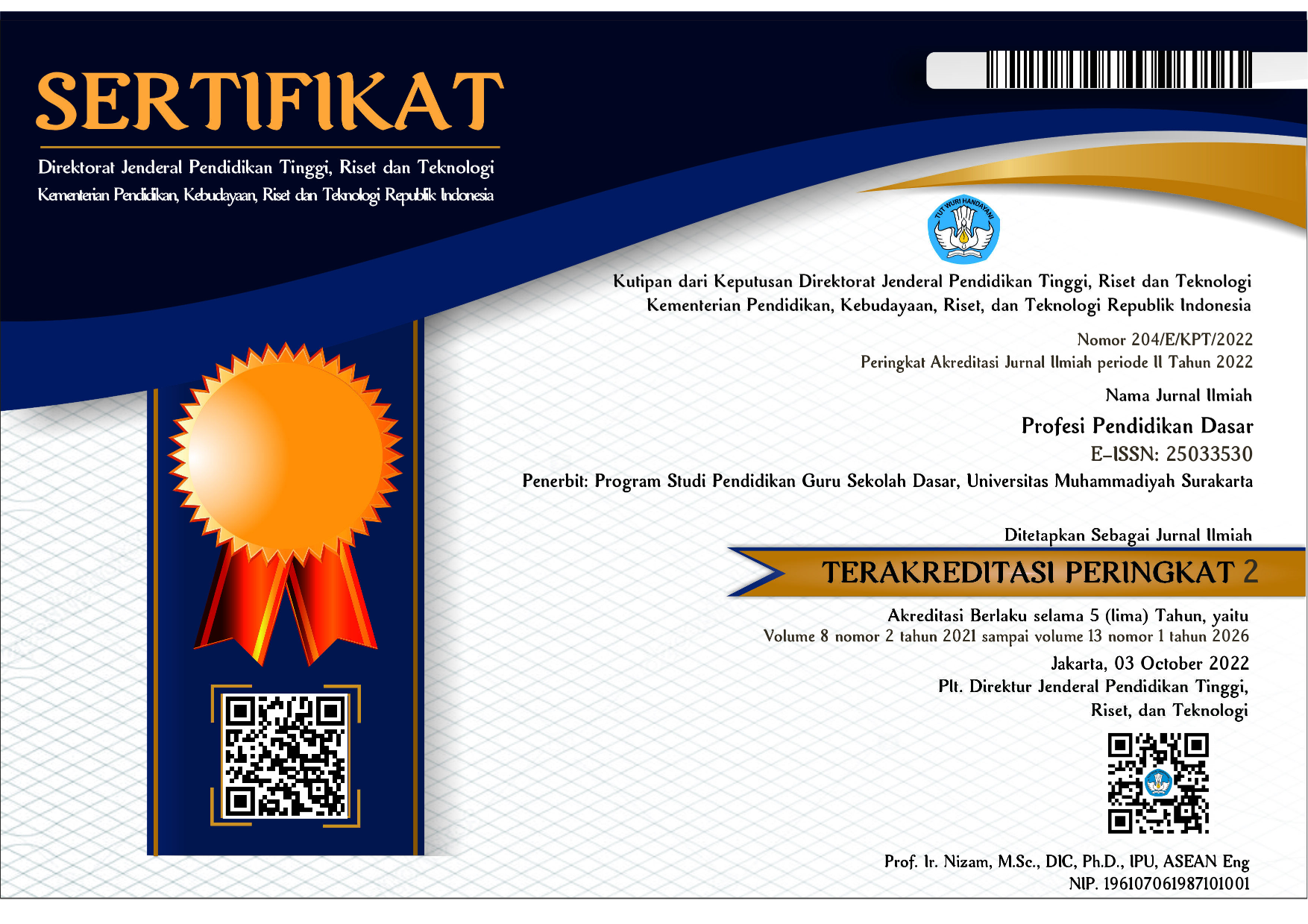
(Vol. 8, No. 2, December 2021 - Vol. 13, No. 1, July 2026)

Profesi Pendidikan Dasar (PPD) upholds the principles of transparency, ethical authorship, and academic rigour. This policy sets out the obligations of authors, reviewers, and editors regarding generative artificial intelligence (AI) and AI-assisted tools in the preparation, review, and editing of manuscripts. It is reviewed periodically as technology and scholarly standards develop.
This policy governs the use of AI in writing, reviewing, and editing. It does not govern AI-based methods used as part of a research design — for example, machine learning applied to analyse data. Such methods are part of the research itself and must be described in full in the Research Methods section.
Disclosure is mandatory. Authors who use generative AI or AI-assisted tools at any stage of manuscript preparation must disclose this in the Use of Artificial Intelligence declaration before the reference list. The declaration must name the tool and version, state which parts of the work it was used for, and confirm that the authors reviewed and take responsibility for the output. Authors who used no such tools must state that explicitly.
Example wording: "The authors used [tool, version] to check grammar and improve readability in the Introduction and Discussion. All content was subsequently reviewed and verified by the authors, who take full responsibility for the final manuscript."
Editors may use AI tools only for limited administrative and language support, such as checking formatting or improving the clarity of correspondence. Editors must not use AI to:
Editors must not upload any manuscript, or any part of one, into an AI tool. Where an editor has used an AI tool in handling a manuscript, this must be disclosed to the Editor-in-Chief and recorded in the submission file. Every editorial decision is made by a named human editor who is accountable for it.
Reviewers are prohibited from using artificial intelligence in peer review. This prohibition covers:
Uploading a manuscript to an AI tool breaches the confidentiality of unpublished work and may expose the authors' intellectual property to third parties. A reviewer who cannot complete a review without such assistance should decline the invitation.
By accepting a review invitation, a reviewer confirms that the review will be their own work and will comply with this policy.
Undisclosed AI use, or any use falling under the prohibitions above, is treated as a breach of academic integrity. Depending on the stage and severity, PPD may require revision and disclosure, reject the manuscript, retract a published article, or remove a reviewer or editor from their role. Cases are handled under our Publication Ethics and Allegations of Research Misconduct policies, following COPE guidance.
For clarification on this policy, contact the editorial team at [email protected].
(Vol. 8, No. 2, December 2021 - Vol. 13, No. 1, July 2026)