Editorial Board Reviewers Peer Review Process Author Guidelines Publication Ethics Generative AI Policies Open Access Policy Plagiarism Policy Focus and Scope Article Processing Charge Abstracting and Indexing Contact Journal Metrics Digital Archiving Scopus Citation
Current Issue
This edition features contributions from authors across Indonesia, Palestine, United Arab Emirates, Malaysia, India, Brunei Darussalam, United Kingdom, Nigeria, and Egypt — reflecting our commitment to global scholarly collaboration.
Articles
- Liquidity Risk in Islamic Banking: Structural Challenges and Shariah-Compliant Mitigation StrategiesAbstract View : 212PDF downloads: 175
- Abstract View : 35PDF downloads: 76
- Abstract View : 15PDF downloads: 44
- Abstract View : 20PDF downloads: 56
- Abstract View : 29PDF downloads: 90
- Abstract View : 30PDF downloads: 59
- Abstract View : 25PDF downloads: 128
- Exploring the Relationship Between Shariah Education and National Identity in Nigeria’s UniversitiesAbstract View : 9PDF downloads: 33
- Abstract View : 26PDF downloads: 95
- Abstract View : 17PDF downloads: 34
- Abstract View : 13PDF downloads: 59
- Abstract View : 19PDF downloads: 62
- Abstract View : 61PDF downloads: 115
- Abstract View : 28PDF downloads: 79
- Abstract View : 20PDF downloads: 66
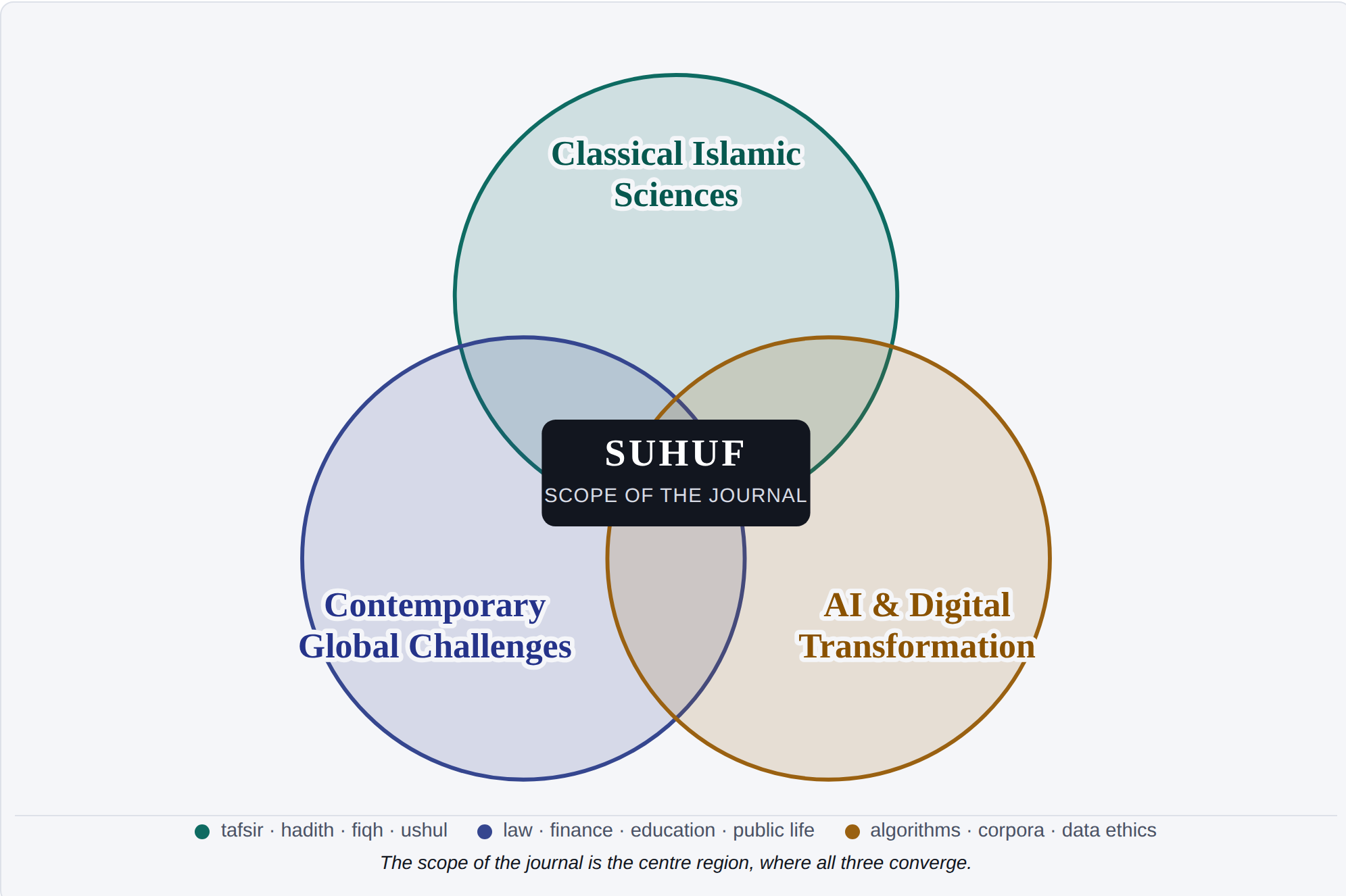
Suhuf: International Journal of Islamic Studies is a rigorously peer-reviewed academic journal published by the Faculty of Islamic Studies, Muhammadiyah University of Surakarta (UMS), Indonesia. The journal is dedicated to advancing specialized, high-impact scholarship at the intersection of classical Islamic sciences and contemporary global challenges.
Unlike generalist Islamic studies journals, Suhuf distinguishes itself through a deep disciplinary focus in five core domains:
- Islamic Economics and Finance: Research in this domain addresses Shariah-compliant financial systems in their classical and contemporary dimensions. Suhuf welcomes scholarship on Islamic social finance, including zakat, waqf, and microfinance, as well as the legal architecture of Islamic financial markets. The journal gives particular attention to the intersection of Islamic finance and digital innovation: algorithmic risk assessment in Shariah-compliant banking, regulatory frameworks for Islamic fintech and cryptocurrency, AI-driven zakat distribution systems, and the application of maqashid al-Shariah to emerging financial technologies.
- Islamic Education: This domain covers pedagogical innovation, institutional transformation, and teacher development within faith-based learning environments. Suhuf publishes empirically grounded research on digital transformation in pesantren and madrasah, including the integration of AI-assisted learning tools, adaptive digital curricula, and technology-mediated Qur'anic literacy. Studies examining the theological and ethical dimensions of digitizing Islamic educational traditions are especially welcome.
- Qur’anic and Hadith Studies: Suhuf features critical scholarship in classical and contemporary exegesis (tafsir), textual hermeneutics, and comparative scriptural interpretation across Muslim-majority and Western academic contexts. The journal also engages with methodological innovations at the frontier of the field: computational approaches to tafsir, corpus linguistics applied to Qur'anic and Hadith texts, digital authentication of hadith chains (isnad), and the epistemological questions raised by algorithmically-assisted Qur'anic analysis.
- Islamic Law (Shariah): This domain encompasses classical jurisprudential principles and their contemporary applications across a broad range of legal fields, Islamic family law, criminal law, financial contracts, and compliance, as well as comparative Shariah studies and the engagement between Islamic law, human rights, environmental ethics, and modern regulatory systems. Suhuf is particularly interested in scholarly analysis of how Islamic legal frameworks address emerging technological realities: fatwa on artificial intelligence and autonomous systems, Shariah governance of data privacy, bioethical questions raised by medical AI, and the fiqh of algorithmic decision-making in judicial and financial contexts.
- Islam in Indonesia: Suhuf offers a dedicated space for nuanced, empirically grounded research on Indonesian Islam in its historical, socio-legal, and intellectual dimensions. This includes the roles of Nahdlatul Ulama, Muhammadiyah, and local ulama networks in shaping religious authority, law, and public life. The journal also engages with contemporary developments: how Indonesian Islamic institutions respond to digital media ecosystems, the role of algorithmic platforms in shaping religious discourse, and Indonesia's distinctive contributions to global conversations on Islam and modernity.
Suhuf does not merely publish descriptive accounts; it prioritizes theoretically informed, methodologically robust research that engages with primary Islamic sources (Qur’an, Sunnah, fiqh, and classical texts) while addressing pressing contemporary issues—from fintech in Islamic banking to bioethics in Islamic law, from digital tafsir to interfaith coexistence in pluralistic societies.
In addition to full-length research articles, the journal features synopses of outstanding theses and dissertations, critical summaries of recent religious research, and keynote addresses by leading scholars, making it a dynamic forum for both established and emerging voices in Islamic academia.
By bridging classical Islamic scholarship with modern academic rigor—and by centering Indonesia as both a case study and a source of intellectual innovation—Suhuf serves as a vital platform for specialized, context-sensitive, and globally relevant Islamic studies.
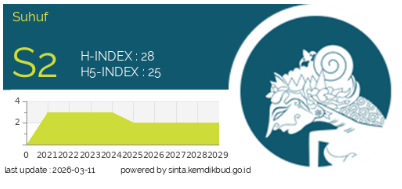
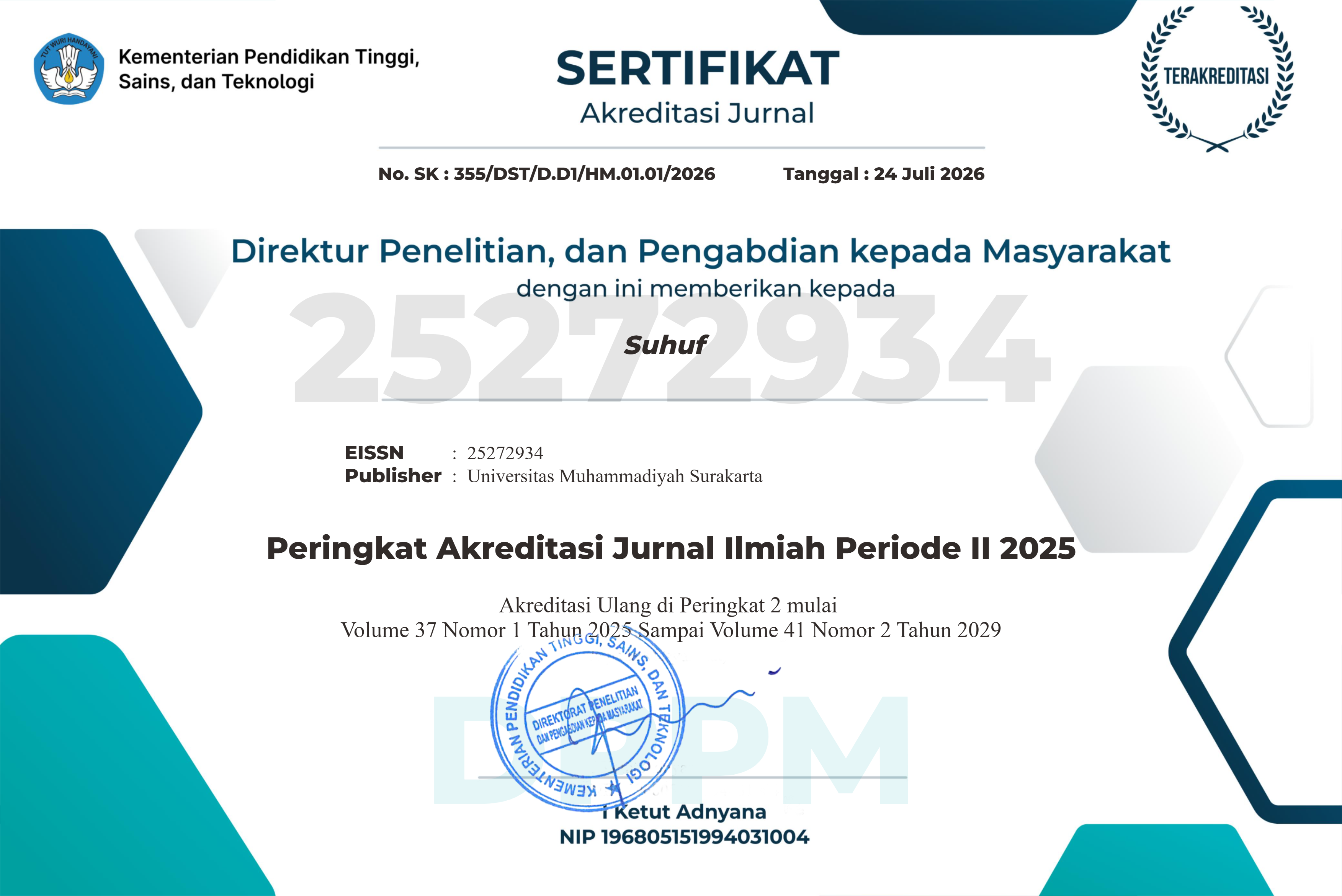
![]() | Title: Suhuf: International Journal of Islamic Studies National Accredited:SINTA 3 (Vol 33, No 2, 2021 - Vol 38, No 1, 2026) |
Why Choose Suhuf: International Journal of Islamic Studies?
|

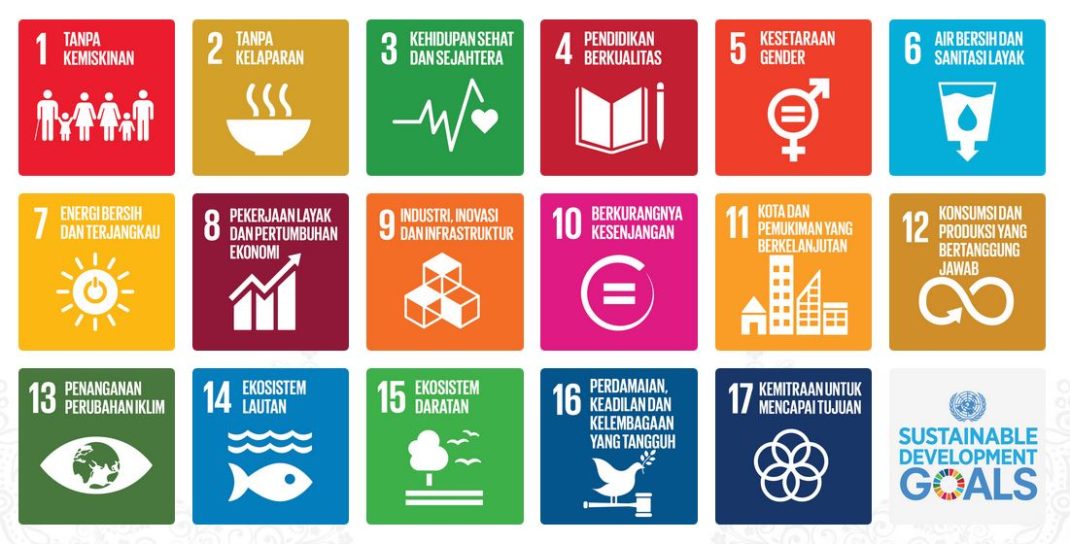
SDG Publishers Compact
![]() | We are proud to be a member of the SDG Publishers Compact, compromising 10 action points that publishers, publishing associations and others can commit to undertaking in order to accelerate progress to achieve the Sustainable Development Goals (SDGs) by 2030. You can learn more about the Publishers Compact and how the scholarly community can embed SDGs into practice. |
This journal is aligned with our goal of sustainable structures and infrastructures. |
The Sustainable Development Goals (SDGs) are a movement to promote well-being while sustainably caring for the surrounding environment. This action represents a global and national commitment encompassing 17 goals.Universitas Muhammadiyah Surakarta, with dedication and consistency, actively executes these 17 goals through various educational and humanitarian activities. |