Islamic Religious Education Through Social Media in Reducing Patriarchal Culture
DOI:
https://doi.org/10.23917/suhuf.v38i1.16647Keywords:
Islamic religious education, Social media, Patriarchy, Digital da’wah, Gender equalityAbstract
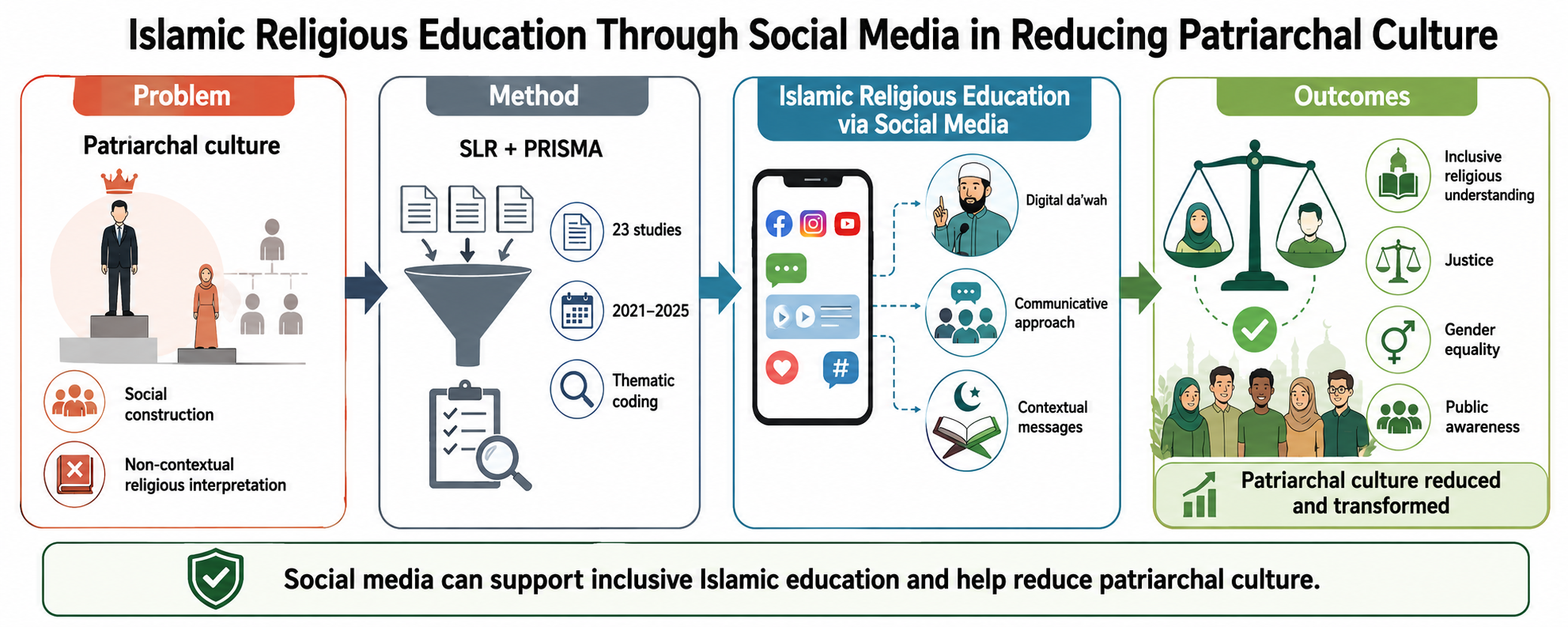
Background: Patriarchal culture remains a social phenomenon that influences gender relations in society, including in educational practices and religious understanding. Objective: This study aims to analyze the role of Islamic religious education through the utilization of social media as an effort to reduce patriarchal culture. Methodology: This study used a Systematic Literature Review with PRISMA, selecting 23 relevant studies from 2021–2025, and analyzed them with thematic coding to identify key findings on social media in Islamic Religious Education and patriarchal culture. Result: The results of the study indicate that patriarchal culture is largely influenced by social constructions and non-contextual interpretations of religious teachings. Islamic religious education delivered through social media has significant potential to foster a more inclusive religious understanding that emphasizes the values of justice and gender equality. Conclusion: Through communicative and contextual digital da’wah approaches, social media can serve as an effective educational medium to enhance public awareness of equitable gender relations from an Islamic perspective. Implications: This study implies the importance of developing inclusive digital da’wah strategies by educators and preachers, as well as the need for further research based on empirical approaches to gain a deeper understanding of digital da’wah practices.
Downloads
References
[1] A. Miri, “In the Name of Muslim Women’s Right to Learn? A Case Study of Moroccan Migrant Mothers in the Belgian ‘Citizenisation’ Context BT - The Palgrave Handbook of Gendered Islamophobia,” Cham: Springer International Publishing, 2024, pp. 255–269. doi: https://doi.org/10.1007/978-3-031-52022-8_15.
[2] S. N. Syifa, A. W. R. Akmal, G. Muzainah, A. Ahmad, and G. H. F. Ali, “Analysis of Fairness in Inheritance Distribution according to Badamai Customs among the Muslim Banjar Community in South Kalimantan,” Suhuf, vol. 37, no. 2, pp. 322–332, Nov. 2025, doi: https://doi.org/10.23917/suhuf.v37i2.13106.
[3] A. Khori, S. Setiawan, B. Said, and M. M. Qulyubi, “Dynamics of Islamic Legal Thought: Comparison of the Concept of Maqashid Al-sharī’ah in Madhhab Zaidiyah and Ja’fariyah,” Suhuf, vol. 37, no. 2, pp. 439–447, Nov. 2025, doi: https://doi.org/10.23917/suhuf.v37i2.11814.
[4] M. N. Maarif, S. Munir, H. Towpek, and I. Zulqarnain, “Optimization of Welfare State Policy for the Development of Halal Industry in the Framework of Sharia Economy,” Suhuf, vol. 37, no. 1, May 2025, doi: https://www.doi.org/10.23917/suhuf.v37i1.9195.
[5] D. O. Abdulsalam, “Revisiting Islamic Da’wah: Principles and the Prophetic Approach to Religious Communication,” Suhuf, vol. 37, no. 2, pp. 394–405, Nov. 2025, doi: https://doi.org/10.23917/suhuf.v37i2.12779.
[6] T. Ilmiati, F. Nurul Barkah, R. Tuahena, and N. Firmansyah, “Literasi Dakwah pada Akun Instagram @mubadalah.id tentang Pemahaman Kesetaraan Gender,” Da’watuna J. Commun. Islam. Broadcast., vol. 2, no. 1, pp. 90–99, 2022, doi: https://doi.org/10.47467/dawatuna.v2i1.6564.
[7] A. B. Ali, M. F. Fi Ardillah, F. Y. Iwanebel, and E. T. Taufik, “Bibliometric Analysis of Living Qur’an Research: A Dimensions Database Exploration (2005-2025) Using R for Statistical Computing and Bibliometrix Software,” Suhuf, vol. 37, no. 2, pp. 417–429, Nov. 2025, doi: https://doi.org/10.23917/suhuf.v37i2.12568.
[8] F. Z. Qoirunnisa, A. N. Kurniawan, F. N. Khalida, M. Afriyanto, and M. Y. Mustofa, “PERAN ULAMA PEREMPUAN DALAM PENDIDIKAN ISLAM: UPAYA MENEMBUS PATRIARKI AGAMA DI ERA DIGITAL,” Istifkar Media Transform. Pendidik., vol. 3, no. 2, pp. 122–138, 2023, doi: https://doi.org/10.62509/ji.v3i2.91.
[9] K. Kambali, M. Muslikh, A. Hidayat, and R. N. Abdurakhman, “Religion in Cyberspace: Islamic Religious Education in Social Media,” Edukasi Islam. J. Pendidik. Islam, vol. 12, no. 01, pp. 1–14, Feb. 2023, doi: https://doi.org/10.30868/ei.v12i01.3886.
[10] F. Syafirna, A. D. Zahrani, M. F. Ni’am, N. R. Zulika, and A. Kunaepi, “Pemanfaatan Media Sosial dalam Pembelajaran Agama Islam di Sekolah Menengah: Implikasi dan Strategi Pengembangan Pembelajaran,” Attaqwa J. Ilmu Pendidik. Islam, vol. 20, no. 2, pp. 97–111, Aug. 2025, doi: https://doi.org/10.54069/attaqwa.v20i2.732.
[11] H. Hairiyah, S. Sirait, and M. Arif, “The Importance of Islamic Education and Gender Equality in Contemporary Schools,” DAYAH J. Islam. Educ., vol. 7, no. 1, pp. 114–125, Jan. 2024, doi: https://doi.org/10.22373/jie.v7i1.21858.
[12] V. N. Vambudi, A. Sutisna, S. Sutomo, A. N. AN, and M. B. Alauddin, “Toward a Qur’anic philosophy of multicultural education: A hermeneutical and ethical approach,” Priviet Soc. Sci. J., vol. 6, no. 1, pp. 13–27, Jan. 2026, doi: https://doi.org/10.55942/pssj.v6i1.1209.
[13] H. Hamdi et al., “Research Trends on the Integration of Science and Character Education: A Bibliometric Analysis Review,” Suhuf Int. J. Islam. Stud., vol. 37, no. 1, pp. 24–36, May 2025, doi: https://doi.org/10.23917/suhuf.v37i1.10022.
[14] A. A. Setiawan, M. Sudi, N. K. W. Matradewi, A. Muslim, A. Saefudin, and K. Saddhono, “Ideological Contestation in Social Media: a Content Analysis of the Promotion of Islamic Education Institutions,” Al-Hayat J. Islam. Educ., vol. 8, no. 1, p. 72, Jan. 2024, doi: https://doi.org/10.35723/ajie.v8i1.445.
[15] N. A. Mekadina, S. Atika, N. Nurbaitillah, M. Muslimin, and Z. Zuhrah, “Deconstructing the Legitimacy of Patriarchy through Qur’anic Reinterpretation and Gender Education: Case Study in Bima’s Muslim Society,” Jurisprudensi J. Ilmu Syariah, Perundang-Undangan dan Ekon. Islam, vol. 17, no. 2, pp. 243–259, Sep. 2025, doi: https://doi.org/10.32505/jurisprudensi.v17i2.11593.
[16] D. Rismayadi, A. Alimuddin, and R. A. Mustaqim, “Patriarchal Dominance as a Contributor to Domestic Violence,” al-Rasῑkh J. Huk. Islam, vol. 14, no. 02, pp. 208–222, Aug. 2025, doi: https://doi.org/10.38073/rasikh.2995.
[17] S., A. T. Prasetyo, F. Arianti, P. A. Saka, S. Hidayati, and N. Nelly, “Islam and the Tradition of Gender: Exploring the Intersection of Religion and Culture in Indonesia,” Int. J. Reli., vol. 5, no. 2, pp. 37–46, 2024, doi: https://doi.org/10.61707/mekpfr87.
[18] T. Saiful, Yaswirman, Yuslim, and A. Fendri, “Gender Equality Perspective and Women Position in Islam BT - Proceedings of the International Conference on Law, Governance and Islamic Society (ICOLGIS 2019),” Paris, France: Atlantis Press, 2020, pp. 1–4. doi: https://doi.org/10.2991/assehr.k.200306.212.
[19] S. S. Karimullah, “Progressive Islamic Religious Education in the Family as a Means of Empowering Women,” AL-AUFA J. Pendidik. DAN Kaji. Keislam., vol. 5, no. 2, pp. 82–103, 2023, doi: https://doi.org/10.32665/alaufa.v5i2.2286.
[20] N. J. Ni’mah, R. F. Anggani, S. N. Fitria, and A. F. Najichah, “Peran dan Kontribusi Pendidikan Agama Islam dalam Pemberdayaan Perempuan di Lingkungan Masyarakat,” Al-Aulia J. Pendidik. dan Ilmu-Ilmu Keislam., vol. 10, no. 1, pp. 37–48, Jun. 2024, doi: https://doi.org/10.46963/aulia.v10i1.1854.
[21] B. M. Chair, Wawaysadhya, and T. U. Oktafiani, “Cyber-Religion and the Issue of Religious Authority: How Indonesian Youth Learn Religion through Social Media?,” Al’Adalah, vol. 27, no. 1, pp. 1–12, Aug. 2024, doi: https://doi.org/10.35719/aladalah.v27i1.440.
[22] M. Minarti, M. Norhidayati Rahmah, K. Khalilurrahman, S. Samsir, and M. Mardiana, “Utilization of social media in Learning Islamic Religion: Its Impact on Strengthening Student Outcomes and Achievements,” Nidhomul Haq J. Manaj. Pendidik. Islam, vol. 8, no. 2, pp. 279–291, Sep. 2023, doi: https://doi.org/10.31538/ndh.v8i2.3930.
[23] A. Abubakar Muhammad, A. Ibrahim, A. A. Yakub, H. Khan, and N. Hamzah, “The Role of Islamic Finance in Promoting Economic Justice and Financial Inclusion among Marginalised Communities,” Suhuf, vol. 37, no. 1, pp. 58–68, May 2025, doi: https://www.doi.org/10.23917/suhuf.v37i1.10167.
[24] Z. H. Prasojo, M. S. Bin Haji Masri, A. Fauzi, and N. Rahmiani, “Religious Identity in the Use of Social Media Within Pontianak Muslim Community,” KARSA J. Soc. Islam. Cult., vol. 28, no. 1, pp. 32–56, Jun. 2020, doi: https://doi.org/10.19105/karsa.v28i1.3284.
[25] A. Adeni, L. Hakim, and S. Hasanah, “Rethinking Islamic Da’wah Model in the Context of Digital Space BT - Proceeding Saizu Int. Conf. Transdiscipl. Relig. Stud.,” 2023, pp. 285–294. doi: https://doi.org/10.24090/icontrees.2023.348.
[26] A. Annisa, D. Y. Anggina, S. Syahrani, and H. P. Sari, “Pendidikan Islam di Era Digital: Respon terhadap Isu Kesetaraan Gender di Media Sosial,” Hidayah Cendekia Pendidik. Islam dan Huk. Syariah, vol. 2, no. 4, pp. 11–23, Dec. 2025, doi: https://doi.org/10.61132/hidayah.v2i4.1445.
[27] U. H. Salsabila, R. A. Fatimah, R. A. Indriyani, F. Dirahman, and Y. Anendi, “Analysis of Technology Involvement in Islamic Religious Education Learning,” Borneo Educ. J., vol. 5, no. 1, pp. 70–77, 2023, doi: https://doi.org/10.24903/bej.v5i1.1167.
[28] T. Tasbih, A. Langaji, S. A. Hafid, A. F. Bakti, and A. G. Haris, “Islamic Feminists’ Rejection of the Textual Understanding of Misogynistic Hadiths for the Advancement of Gender Justice in Makassar, Indonesia,” Samarah J. Huk. Kel. dan Huk. Islam, vol. 8, no. 1, p. 196, Feb. 2024, doi: https://doi.org/10.22373/sjhk.v8i1.19856.
[29] U. Nasri, E. Muliadi, U. Nuha, Y. Indinabila, M. Gufran, and H. D. Aulia, “RELIGIOUS MODERATION: THE FOUNDATION OF INCLUSIVE ISLAMIC EDUCATION,” Tahiro J. Peace Relig. Mederation, vol. 1, no. 1, pp. 17–34, Jul. 2024, doi: https://doi.org/10.20414/tahiro.v1i1.10069.
[30] M. T. Syam, A. Thahir, N. Nurhikmah, and M. Hilmiyah, “Gender Construction in Feminist Da’wah by Women Preachers on Youtube,” J. Dakwah Risal., vol. 32, no. 2, pp. 1–20, Jan. 2022, doi: https://doi.org/10.24014/jdr.v32i2.15322.
[31] H. N. Aulia, K. A. Putri, M. A. T. Latifa, and N. A. P. Firman, “Transformasi Dakwah : Pengaruh Perkembangan Zaman dalam Strategi Penyebaran Agama di Lingkungan Masyarakat,” IHSANIKA J. Pendidik. Agama Islam, vol. 2, no. 4, pp. 225–237, 2024, doi: https://doi.org/10.59841/ihsanika.v2i4.1977.
[32] A. Fitriyah and G. Rahman, “Reinterpreting Gender in the Qur’an: Realizing Inclusive Interpretation in the Modern Era,” An-Nisa J. Kaji. Peremp. dan Keislam., vol. 17, no. 2, pp. 117–132, Dec. 2024, doi: https://doi.org/10.35719/annisa.v17i2.303.
[33] E. N. Lutfiani et al., “Building A Moderate Muslim Diversity Through Digital Islamic Counseling,” TATHO Int. J. Islam. Thought Sci., vol. 2, no. 3, pp. 286–300, Sep. 2025, doi: https://doi.org/10.70512/tatho.v2i3.98.
[34] A. Mufron, T. H. Fata, A. Akib, N. Norlaila, and A. H. Rohmani, “The Concept of Islamic Education Today in the Challenges of the Social Media Era,” Al-Hijr J. Adulearn World, vol. 3, no. 1, pp. 11–28, Mar. 2024, doi: https://doi.org/10.55849/alhijr.v3i1.579.
[35] M. Kurmanaliyev, S. Kerim, A. Almukhametov, and T. Amankul, “American and European Muslim Female Bloggers Increase Their Preaching Efforts in Social Media,” Religions, vol. 15, no. 12, p. 1485, Dec. 2024, doi: https://doi.org/10.3390/rel15121485.
[36] B. Zaid, J. Fedtke, D. D. Shin, A. El Kadoussi, and M. Ibahrine, “Digital Islam and Muslim Millennials: How Social Media Influencers Reimagine Religious Authority and Islamic Practices,” Religions, vol. 13, no. 4, p. 335, Apr. 2022, doi: https://doi.org/10.3390/rel13040335.
[37] A. S. Hidayatulah, M. Sholikah, I. A. Hadi, W. Nugroho, and M. H. Yusuf, “Strategies for Strengthening Digital Islamic Religious Education in Overcoming Religious Disinformation,” J. English Lang. Educ., vol. 10, no. 3, pp. 254–262, May 2025, doi: https://doi.org/10.31004/jele.v10i3.896.
[38] R. G. Putra, N. Yusri, and S. F. Sinaga, “The Role of Social Media in Islamic Religious Education: Challenges and Opportunities in the Digital Era,” JUDIKIS J. Pendidik. Islam, vol. 1, no. 3, pp. 191–199, 2024, doi: https://doi.org/10.70938/judikis.v1i3.70.
Downloads
Submitted
Accepted
Published
How to Cite
Issue
Section
License
Copyright (c) 2026 Aji Abdullah, Viky Nur Vambudi, Malini Ganapathy

This work is licensed under a Creative Commons Attribution 4.0 International License.