Prevalence Level and Strategies of Overcoming Dyscalculia Among Primary School Pupils
DOI:
https://doi.org/10.23917/ppd.v12i2.10704Keywords:
Dyscalculia, Primary School, Prevalence, TeachersAbstract
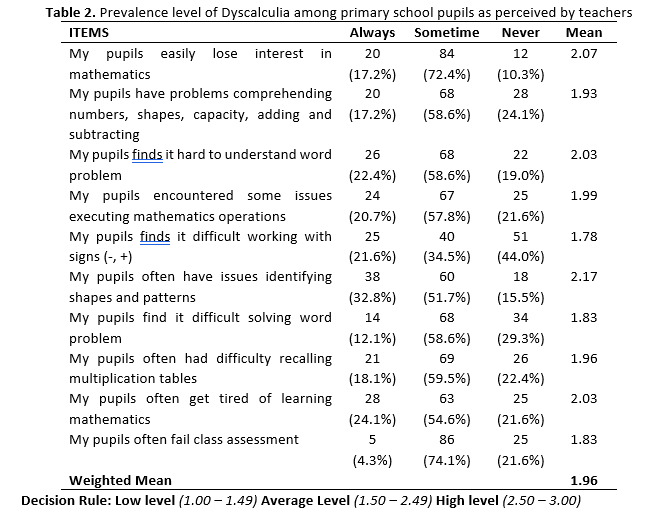
Dyscalculia is a specific learning disability that impairs mathematical abilities. It presents significant challenges to affected individuals, particularly primary school pupils who struggle with basic arithmetic. This study investigated prevalence levels and strategies of overcoming dyscalculia among primary pupils. The study adopted a descriptive survey research design. Simple random sampling techniques were used to select 116 public primary school teachers in Kwara State, Nigeria. A researcher-self-constructed instrument titled “Prevalence Level and Strategies of Overcoming Dyscalculia Questionnaire” (PLSODQ) was used for data collection, with a reliability coefficient of 0.76. Descriptive statistics were used to answer the research question, while an independent sample t-test was used to test the hypothesis. The findings revealed that the prevalence level of dyscalculia among primary school pupils as perceived by teachers is at an average level. Also, the strategies of overcoming dyscalculia among primary school pupils as perceived by teachers. Primary school teachers agreed that dyscalculia could be overcome by exposing pupils to education and employing an individualized teaching method, among others. Finally, there was no significant difference between male and female primary school teachers' perceived prevalence level of dyscalculia among primary school pupils. It was recommended that seminars and conferences should be organized for teachers.
Downloads
Downloads
Submitted
Accepted
Published
How to Cite
Issue
Section
License
Copyright (c) 2025 Jamiu Temitope Sulaimon, Taofeeq Akolade Gbadeyanka , Aysha Olapeju Kolade, Anatri Desstya, Büşra Usluoğlu

This work is licensed under a Creative Commons Attribution-NonCommercial 4.0 International License.