Elucidating the Multi-Target Mechanisms of Camellia sinensis in Human Fertility Disorders Through Network Pharmacology and Molecular Docking
Article Sidebar
Main Article Content
Abstract
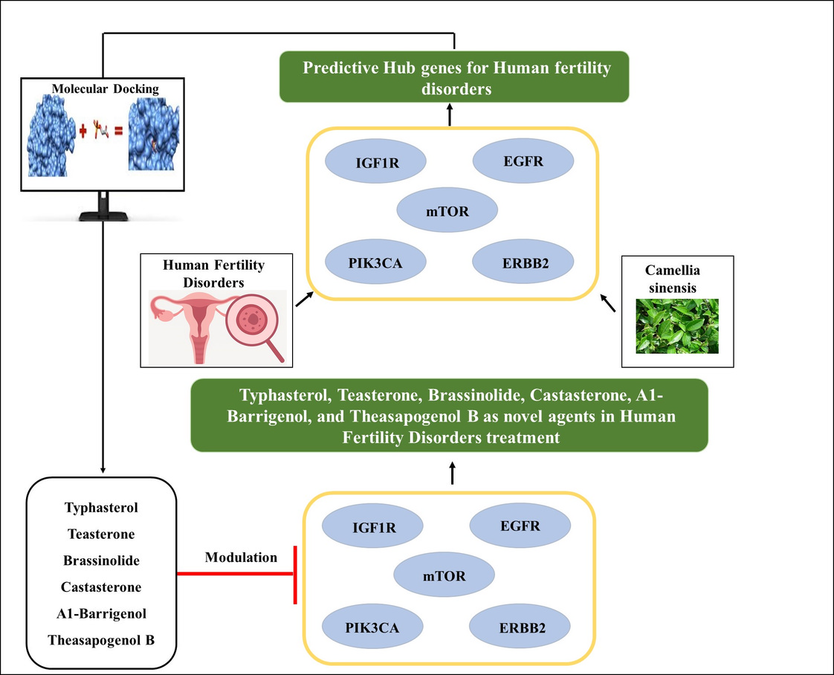
Background: Human fertility disorders (HFDs) are multifactorial reproductive conditions influenced by genetic, hormonal, inflammatory, and environmental factors. Although Camellia sinensis has been widely recognized for its medicinal properties, its molecular mechanisms in fertility regulation remain insufficiently understood. Objective: This study aimed to investigate the therapeutic potential and underlying molecular mechanisms of C. sinensis against HFDs using an integrated approach combining network pharmacology and molecular docking. Method: A total of 123 phytochemicals were retrieved from the IMPPAT database and screened using SwissADME and pkCSM for pharmacokinetic and toxicity evaluation. Targets were predicted using SwissTargetPrediction. Protein–protein interactions network analysis was performed to determine hub proteins, followed by Gene Ontology and KEGG pathway enrichment analyses. Molecular docking was conducted to evaluate the binding affinities of selected compounds with target proteins. Results: 6 compounds—Typhasterol, Teasterone, Brassinolide, Castasterone, A1-Barrigenol, and Theasapogenol B—exhibited favorable pharmacokinetic characteristics and non-toxic profiles. 29 overlapping targets were identified between compound and HFDs-related proteins. PPIs analysis revealed IGF1R, EGFR, PIK3CA, mTOR, and ERBB2 as key regulatory targets. GO and KEGG analyses highlighted significant enrichment of the PI3K/Akt, VEGF, HIF-1, EGFR, and JAK–STAT signaling pathways, which are involved in reproductive regulation, gametogenesis, implantation, and endometrial receptivity. Molecular docking demonstrated strong binding affinities of the compounds toward the hub proteins, with docking scores below −7.0 kcal/mol. Conclusion:C. sinensis may exert therapeutic effects against HFDs through multi-target and multi-pathway mechanisms. These findings provide mechanistic insights into its fertility-regulating potential and support further experimental validation to confirm its therapeutic applicability.
Downloads
Article Details

This work is licensed under a Creative Commons Attribution 4.0 International License.