ChatGPT's Validity and Reliability in Islamic Legal Studies: A Critical Assessment of Waqf for Early Learners
DOI:
https://doi.org/10.23917/suhuf.v37i2.11821Keywords:
Waqf, Islamic Law, Islamic Studies, Islamic Education, Self-Learning, Artificial intelligenceAbstract
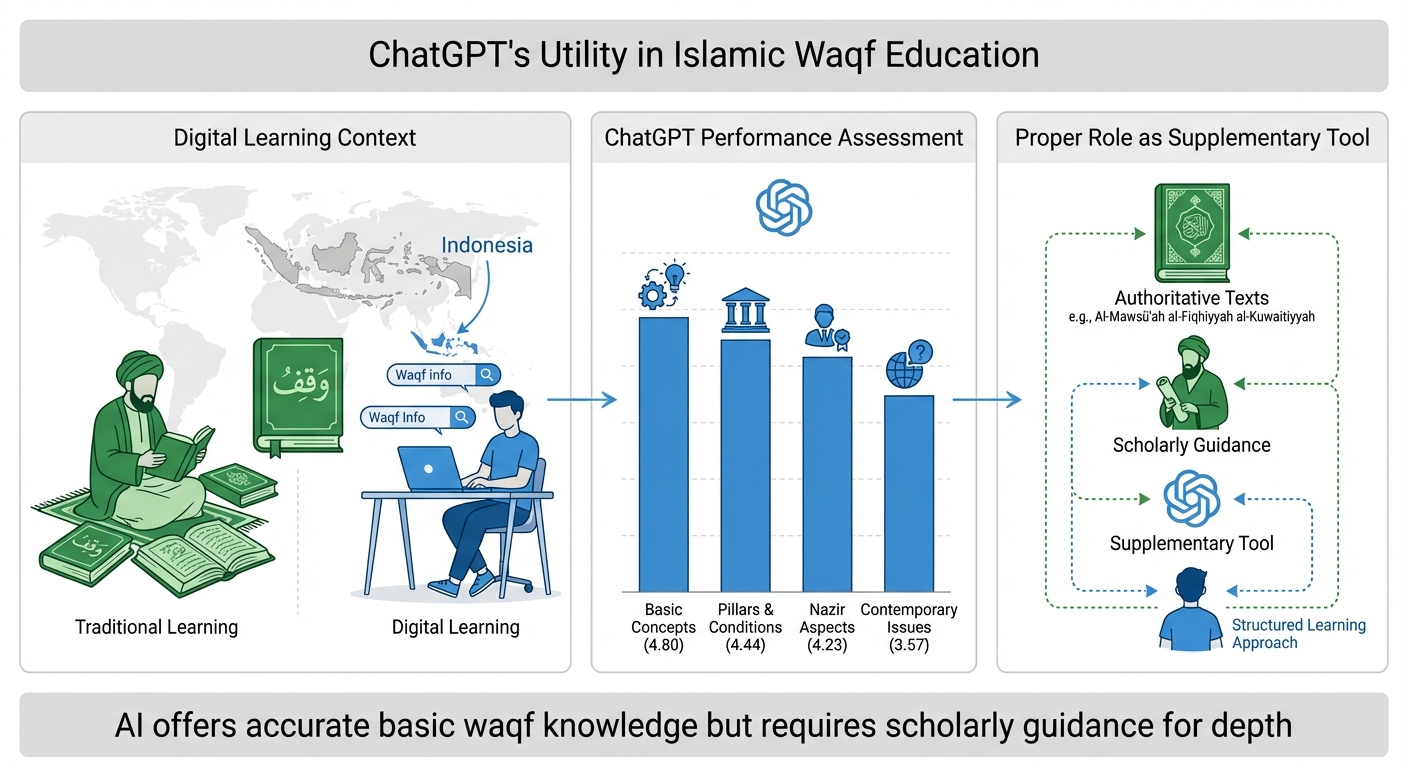
Background: The rapid adoption of generative AI tools for self-directed learning raises concerns about content accuracy in specialized knowledge domains. In Islamic studies, where epistemic authenticity depends on authenticated transmission chains (sanad) and established jurisprudential methodologies, the validity of AI-generated religious content remains largely unexamined. Objective: This study evaluates the validity and information adequacy of ChatGPT-3.5 responses on waqf (Islamic endowment) for early learners without formal Islamic education. Methodology: A qualitative content analysis was conducted using 14 Indonesian-language prompts across four waqf dimensions: basic concepts, pillars and conditions, nazir (trustee), and contemporary issues. Responses were compared against three authoritative references using a five-point rubric-based scoring system. Results: ChatGPT achieved an average validity score of 4.48 and adequacy of 4.03 out of five. Performance peaked in basic concepts (validity 5.00; adequacy 4.67) but declined sharply in contemporary issues (3.50; 2.50), where oversimplifications, inaccurate madhhab attributions, and procedural errors emerged. Conclusion: ChatGPT provides accurate foundational waqf knowledge but lacks the juridical depth and contextual precision required for intermediate or advanced Islamic legal study. Implications: AI tools should function as supplementary learning aids rather than substitutes for sanad-based Islamic education. Digital religious literacy programs and shariah-informed AI development are needed to mitigate epistemic risks in religious knowledge acquisition.
Downloads
References
[1] S. Gulyamov, “Application of Computational Law and Artificial Intelligence Methods for Sharia Compliance Analysis of E-Waste Management Systems Based on Blockchain,” Suhuf, vol. 36, no. 1, pp. 21–32, May 2024, doi: https://www.doi.org/10.23917/suhuf.v36i1.4447.
[2] F. Yavari and N. Pilevari, “Industry revolutions development from Industry 1.0 to Industry 5.0 in manufacturing,” J. Ind. Strateg. Manag., vol. 5, no. 2, pp. 44–63, 2020, [Online]. Available:
https://journals.iau.ir/article_678926_9bc31a86e2f04088ce94ace73f47ce7c.pdf
[3] B. Prasetyo and U. Trisyanti, “Revolusi industri 4.0 dan tantangan perubahan sosial,” IPTEK J. Proc. Ser., no. 5, pp. 22–27, 2018, doi: http://dx.doi.org/10.12962%2Fj23546026.y2018i5.4417.
[4] A. Biswal, “Top 24 Artificial Intelligence Applications and Uses,” Simplilearn Solutions. Accessed: Aug. 20, 2025. [Online]. Available: https://www.simplilearn.com/tutorials/artificialintelligence-tutorial/artificial-intelligence-applications
[5] Y. K. Dwivedi et al., “Opinion Paper: ‘So what if ChatGPT wrote it?’ Multidisciplinary perspectives on opportunities, challenges and implications of generative conversational AI for research, practice and policy,” Int. J. Inf. Manage., vol. 71, p. 102642, Aug. 2023, doi: https://doi.org/10.1016/j.ijinfomgt.2023.102642.
[6] M. Imran and N. Almusharraf, “Analyzing the role of ChatGPT as a writing assistant at higher education level: A systematic review of the literature,” Contemp. Educ. Technol., vol. 15, no. 4, p. ep464, Oct. 2023, doi: https://doi.org/10.30935/cedtech/13605.
[7] L. Lingard, “Writing with ChatGPT: An Illustration of its Capacity, Limitations & Implications for Academic Writers,” Perspect. Med. Educ., vol. 12, no. 1, pp. 261–270, Jun. 2023, doi: https://doi.org/10.5334/pme.1072.
[8] M. Sallam, “ChatGPT Utility in Healthcare Education, Research, and Practice: Systematic Review on the Promising Perspectives and Valid Concerns,” Healthcare, vol. 11, no. 6, p. 887, Mar. 2023, doi: https://doi.org/10.3390/healthcare11060887.
[9] B. Lund and W. Ting, “Chatting about ChatGPT: How May AI and GPT Impact Academia and Libraries?,” SSRN Electron. J., 2023, doi: https://dx.doi.org/10.2139/ssrn.4333415.
[10] M. R. King, “A Conversation on Artificial Intelligence, Chatbots, and Plagiarism in Higher Education,” Cell. Mol. Bioeng., vol. 16, no. 1, pp. 1–2, Feb. 2023, doi: https://doi.org/10.1007/s12195-022-00754-8.
[11] C. K. Lo, “What Is the Impact of ChatGPT on Education? A Rapid Review of the Literature,” Educ. Sci., vol. 13, no. 4, p. 410, Apr. 2023, doi: https://doi.org/10.3390/educsci13040410.
[12] J. R. Lechien, G. Briganti, and L. A. Vaira, “Accuracy of ChatGPT-3.5 and -4 in providing scientific references in otolaryngology–head and neck surgery,” Eur. Arch. Oto-Rhino-Laryngology, vol. 281, no. 4, pp. 2159–2165, Apr. 2024, doi: https://doi.org/10.1007/s00405-023-08441-8.
[13] A. N. Kaftan, M. K. Hussain, and F. H. Naser, “Response accuracy of ChatGPT 3.5 Copilot and Gemini in interpreting biochemical laboratory data a pilot study,” Sci. Rep., vol. 14, no. 1, p. 8233, Apr. 2024, doi: https://doi.org/10.1038/s41598-024-58964-1.
[14] L. Alkhawaja, “Unveiling the New Frontier: ChatGPT-3 Powered Translation for Arabic-English Language Pairs,” Theory Pract. Lang. Stud., vol. 14, no. 2, pp. 347–357, Feb. 2024, doi: https://doi.org/10.17507/tpls.1402.05.
[15] B. Morath et al., “Performance and risks of ChatGPT used in drug information: an exploratory real-world analysis,” Eur. J. Hosp. Pharm., vol. 31, no. 6, pp. 491–497, Nov. 2024, doi: https://doi.org/10.1136/ejhpharm-2023-003750.
[16] F. H. N. Athief, “Sejarah Munculnya Disiplin Ilmu dalam Islam [History of the Emergence of Disciplines in Islam],” Islam. J. Ilmu-Ilmu Keislam., vol. 19, no. 02, pp. 1–15, (Indonesia), Dec. 2019, doi: https://doi.org/10.32939/islamika.v19i02.386.
[17] A. Nakissa, The Anthropology of Islamic Law. Oxford University PressNew York, 2019. doi:
https://doi.org/10.1093/oso/9780190932886.001.0001.
[18] A. Abubakar Muhammad, A. Ibrahim, A. A. Yakub, H. Khan, and N. Hamzah, “The Role of Islamic Finance in Promoting Economic Justice and Financial Inclusion among Marginalised Communities,” Suhuf Int. J. Islam. Stud., vol. 37, no. 1 SE-Articles, pp. 58–68, May 2025, doi:
https://www.doi.org/10.23917/suhuf.v37i1.10167.
[19] F. H. N. Athief, D. Rizki, and A. Pratwindya, “Performa Bank Wakaf Mikro Selama 2017-2021:
Sebuah Studi Literatur Sistematis (Systematic Literature Review) [Performance of Micro Waqf
Banks During 2017-2021: A Systematic Literature Review],” IQTISHADIA J. Ekon. Perbank. Syariah, vol. 9, no. 2, pp. 204–221, (Indonesia), Nov. 2022, doi: https://doi.org/10.19105/iqtishadia.v9i2.6727.
[20] M. S. Apriantoro, M. Muthoifin, and F. H. N. Athief, “Advancing social impact through Islamic social finance: A comprehensive bibliometric analysis,” Int. J. Adv. Appl. Sci., vol. 10, no. 11, pp. 81–89, 2023, doi: https://doi.org/10.21833/ijaas.2023.11.011.
[21] M. F. F. Baharsyah, Y. Yayuli, L. Hakim, and F. H. N. Athief, “Waqf Logo as a Productive Waqf of the Digital Age in the Perspective of Maqashid Sharia,” in Proceedings of the International Conference on Islamic and Muhammadiyah Studies (ICIMS 2022), 2022. doi: https://doi.org/10.2991/assehr.k.220708.044.
[22] F. H. N. Athief, S. Q. Imama, and Y. Yayuli, “Assessing the Implication of Law 41/2004 on Waqf Practice: A Systematic Literature Review,” in International Conference on Law, Technology, Spirituality and Society (ICOLESS), 2024, pp. 81–94. [Online]. Available: https://conferences.uinmalang.ac.id/index.php/ICOLESS/article/view/3060
[23] F. Hanif, N. Athief, L. I. Cahyaningrum, D. Rizki, and A. El Ashfahany, “The Synergy of BWM and
BUMDes as an Alternative for Improving the Welfare of SME,” J. Masharif al-Syariah J. Ekon. dan Perbank. Syariah, vol. 8, no. 30, pp. 71–693, 2023, doi: https://doi.org/10.30651/jms.v8i3.20656.
[24] M. Cizakca, “The waqf, its basic operational structure and development,” INCEIF, 2014. [Online].
Available: https://www.researchgate.net/profile/Lukman-
Raimi/publication/288825661_WAQF_AND_ZAKAH_AS_SOCIAL_SAFETY_NETS_FOR_POVERTY
_REDUCTION_IN_NIGERIA/links/5684370408ae197583937ca1/WAQF-AND-ZAKAH-ASSOCIAL-SAFETY-NETS-FOR-POVERTY-REDUCTION-IN-NIGERIA.pdf#page=15
[25] M. Çizakça, “From Destruction to Restoration – Islamic Waqfs in Modern Turkey and Malaysia,” Endow. Stud., vol. 2, no. 2, pp. 83–106, 2018, doi: https://doi.org/10.1163/24685968-00202001.
[26] M. Cizakca, “Towards a comparative economic history of the waqf system,” J. al-Sajarah, vol. 2, no. 2, pp. 1–28, 1997, [Online]. Available:
https://d1wqtxts1xzle7.cloudfront.net/99181405/TOWARDS_A_COMPARATIVE_ECONOMIC_H ISTORY_OF_THE_WAQF-libre.pdf?1677492169=&response-contentdisposition=inline%3B+filename%3DTowards_a_Comparative_Economic_History_o.pdf&Expir es=1762787282&Signature=KUmfUnLMAc6
[27] Rahmawati, H. Thamrin, S. Guntoro, and S. Kurnialis, “Transformasi Digital Wakaf BWI Dalam Menghimpun Wakaf Di Era Digitalisasi,” J. Tabarru’ Islam. Bank. Financ., vol. 4, no. 2, pp. 532– 540, (Indonesia), Dec. 2021, doi: https://doi.org/10.25299/jtb.2021.vol4(2).8375.
[28] A. Fanani, A. W. Kuncoro, A. B. M. Husni, and E. A. Wijayanti, “The Contribution of Waqf on Poverty Alleviation through Digital Platforms: A Case of Indonesia,” Shirkah J. Econ. Bus., vol. 6, no. 2, Sep. 2021, doi: https://doi.org/10.22515/shirkah.v6i2.386.
[29] Budi Setiadi, N. Nurhasanah, and S. L. Sulistiani, “Perbandingan Efektivitas Penghimpunan Dana Wakaf Melalui Uang Berbasis Online di Global Wakaf dan Dompet Dhuafa [Comparison of the
Effectiveness of Collecting Waqf Funds Through Online-Based Money in Global Waqf and Dompet Dhuafa],” J. Ris. Ekon. Syariah, vol. 1, no. 1, pp. 34–38, Jul. 2021, doi: https://doi.org/10.29313/jres.v1i1.97.
[30] N. H. Laili, K. F. Khairi, and R. Masruki, “The Role of Blockchain Technology in the Management of Waqf,” in Digitalisation: Opportunities and Challenges for Business, 2023, pp. 72–81. doi: https://doi.org/10.1007/978-3-031-26953-0_9.
[31] N. M. Hj. Mohaiyadin, A. Aman, M. R. Palil, and S. Muhamad Said, “Addressing Accountability And Transparency Challenges In Waqf Management Using Blockchain Technology,” J. Islam. Monet. Econ. Financ., vol. 8, pp. 53–80, Dec. 2022, doi: https://doi.org/10.21098/jimf.v8i0.1413.
[32] W. M. B. Wan Ismail, M. S. Bin Abdul Rasool, and A. H. Bin Mohd Noor, “Technology Acceptance and Technology Usage: Importance to Cash Waqf Contribution,” Int. J. Acad. Res. Bus. Soc. Sci., vol. 11, no. 9, pp. 942–953, Sep. 2021, doi: http://dx.doi.org/10.6007/IJARBSS/v11-i9/11082.
[33] F. Niswah, L. Mutmainah, F. Hadyantari, N. Nurwahidin, and N. Huda, Do Indonesian Muslims have intention to participate on cash waqf through Fintech? 2020. [Online]. Available: https://books.google.co.id/books?hl=en&lr=&id=yMhdEAAAQBAJ&oi=fnd&pg=PA97&dq=F.+N iswah,+L.+L.+Mutmainah,+F.+Hadyantari,+N.+Nurwahidin,+and+N.+Huda,+“Do+Indonesian+M uslims+have+intention+to+participate+on+cash+waqf+through+Fintech%3F,”+in+ICSGS+201 9,+2020,
[34] H. Zakariyah, A. O. Salaudeen, A. H. A. Othman, and R. Rosman, “The determinants of financial technology adoption amongst Malaysian waqf institutions,” Int. J. Soc. Econ., vol. 50, no. 9, pp. 1302–1322, Aug. 2023, doi: https://doi.org/10.1108/IJSE-04-2022-0264.
[35] J. W. Creswell and C. N. Poth, Qualitative inquiry and research design: Choosing among five approaches. Sage publications, 2016. [Online]. Available: https://books.google.co.id/books?hl=en&lr=&id=DLbBDQAAQBAJ&oi=fnd&pg=PP1&dq=J.+W. +Creswell+and+C.+N.+Poth,+Qualitative+inquiry+and+research+design:+Choosing+among+fiv e+approaches.+Sage+publications,+2016.&ots=-it29dKQPy&sig=patw8yNUq7BrHMFKsiMS29WiMU&red
[36] M. Bengtsson, “How to plan and perform a qualitative study using content analysis,” NursingPlus Open, vol. 2, pp. 8–14, 2016, doi: https://doi.org/10.1016/j.npls.2016.01.001.
[37] P. Burnard, “Interpreting text: an alternative to some current forms of textual analysis in qualitative research,” Soc. Sci. Heal., vol. 1, no. 4, pp. 236–245, 1995, [Online]. Available: https://www.researchgate.net/publication/313535558_Interpreting_text_an_alternative_to_so me_current_forms_of_textual_analysis_in_qualitative_research
[38] K. Krippendorff, Content analysis: An introduction to its methodology. Sage publications, 2018.
[Online]. Available:
https://books.google.co.id/books?hl=en&lr=&id=nE1aDwAAQBAJ&oi=fnd&pg=PP1&dq=%09K .+Krippendorff,+Content+analysis:+An+introduction+to+its+methodology.+Sage+publications,
+2018.&ots=y_dg-
tkPeC&sig=7I89cmR5yIAIQeZ8oK6CKCqnhG8&redir_esc=y#v=onepage&q=K. Krippe
[39] M. Ridwan, “Wakaf Dan Pembangunan Ekonomi [Waqf and Economic Development],” ZISWAF J. Zakat dan Wakaf, vol. 4, no. 1, pp. 105–124, (Indonesia), 2018, doi: https://doi.org/10.21043/ziswaf.v4i1.3034.
[40] D. D. Susetyo and D. Suheni, “Proyek Percontohan Pemberdayaan Ekonomi Umat Melalui Wakaf Produktif Di Era Khalifah Usman Bin Affan [Pilot Project for Economic Empowerment of the
Ummah through Productive Waqf in the Era of Caliph Usman Bin Affan],” Al-Muamalat J. Huk. Dan Ekon. Syariah, vol. 7, no. 1, pp. 67–79, (Indonesia), 2022, [Online]. Available: https://garuda.kemdiktisaintek.go.id/documents/detail/2864711
[41] J. Abdullah, “Tata Cara Dan Pengelolaan Wakaf Uang Di Indonesia [The Role of the Government in Waqf Legislation],” ZISWAF J. Zakat dan Wakaf, vol. 4, no. 1, pp. 87–104, (Indonesia), 2018, doi: https://doi.org/10.21043/ziswaf.v4i1.3033.
[42] A. Kasdi, “Peran Pemerintah Dalam Regulasi Perundang-Undangan Wakaf [The Role of the Government in Waqf Legislation],” ZISWAF J. Zakat Dan Wakaf, vol. 2, no. 2, pp. 362–379, (Indonesia), 2015, doi: http://dx.doi.org/10.21043/ziswaf.v2i2.1557.
[43] M. Ismail Abdel Mohsin, “Financing through cash-waqf: a revitalization to finance different needs,” Int. J. Islam. Middle East. Financ. Manag., vol. 6, no. 4, pp. 304–321, Nov. 2013, doi: https://doi.org/10.1108/IMEFM-08-2013-0094.
[44] A. Fanani and M. Abduh, “Discussion on Cash Waqf: Perpetuity, Legal Aspect, and Scheme of Investment Between Madzahib and Islamic Scholars,” Al-Iktisab J. Islam. Econ. Law, vol. 7, no. 1, pp. 113–140, Aug. 2023, doi: https://doi.org/10.21111/aliktisab.v7i1.10154.
[45] Muhammad Hamid and Syamsul Bakri, “Urgensi Sanad dalam Meningkatkan Profesionalitas Guru Pendidikan Agama Islam [The Urgency of Sanad in Improving the Professionalism of Islamic Religious Education Teachers],” Indones. J. Islam. Educ. Stud., vol. 1, no. 2, p. (Indonesia), Jul. 2023, doi: https://doi.org/10.61227/injuries.v1i2.18.
[46] Wahono, N. Imsiyah, and A. Setiawan, “Andragogi: paradigma pembelajaran orang dewasa pada era literasi digital [Andragogi: the paradigm of adult learning in the era of digital literacy],” in
Jurnal Proceeding Universitas Muhammadiyah Surabaya, 2020, pp. 517–527, (Indonesia).
[Online]. Available: https://journal.um-surabaya.ac.id/Pro/article/view/4877
[47] F. H. N. Athief, L. Hakim, I. Rosyadi, and A. Rofiqo, “Ending the Debate of Islamic Law
Permissibility of Digital Wallet Through the Lens of Fiqh Adaptation.,” Manchester J. Transnatl.
Islam. Law Pract., vol. 19, no. 3, 2023, [Online]. Available:
https://openurl.ebsco.com/EPDB%3Agcd%3A12%3A21645548/detailv2?sid=ebsco%3Aplink
%3Ascholar&id=ebsco%3Agcd%3A174026165&crl=c&link_origin=scholar.google.com
[48] I. Rosyadi, F. H. N. Athief, and D. Rizki, “Islamic Solution on the Agricultural Land Leasing Problem: Case of Excessive Time Dispute,” J. Ilm. Al-Syir’ah, vol. 20, no. 2, p. 139, Aug. 2022, doi: https://doi.org/10.30984/jis.v20i2.1679.
[49] F. C. Windiastuti and F. H. N. Athief, “Inacoin Cryptocurrency Analysis: An Islamic Law Perspective,” J. Islam. Econ. Laws, vol. 2, no. 2, pp. 152–177, 2019, doi: https://doi.org/10.23917/jisel.v2i2.8585.
[50] Wahid SH. Artificial Intelligence in Islamic Guidance: Assessing Chatbot Performance and Jurisprudential Adherence. J Digit Islam Res [Internet]. 2025 Aug 19;3(1):33–96. Available from: https://brill.com/view/journals/jdir/3/1/article-p33_3.xml
[51] Abdelaal A, Haffar MN Al, Fawzi M, Magdy W. IslamicMMLU: A Benchmark for Evaluating LLMs on Islamic Knowledge. 2026 Jul 11; Available from: http://arxiv.org/abs/2603.23750
[52] Rois, C., & Yazdani, G. (2026). Digital Schism: The Reconstruction of Religious Authority and the Emergence of Islamic Knowledge Elite in the AI Era. Surau Journal of Islamic Studies, 2(1), 96-118. Available from: https://doi.org/10.63919/surau.v2i1.65.
[53] Siregar KT, Zhakypkazy I, Uyuni B. Indonesian Muballigh and Religious Authority: From Sanad to Algorithmic Transformation of Islamic Knowledge Transmission in the Digital Era. J INDO-ISLAMIKA [Internet]. 2025 Dec 26;15(2):298–314. Available from: https://journal.uinjkt.ac.id/indo-islamika/article/view/47052
[54] Chelli M, Descamps J, Lavoué V, Trojani C, Azar M, Deckert M, et al. Hallucination Rates and Reference Accuracy of ChatGPT and Bard for Systematic Reviews: Comparative Analysis. J Med Internet Res [Internet]. 2024 May 22;26:e53164. Available from: https://www.jmir.org/2024/1/e53164
[55] Zaki M, Murdan M, Fahmi S, Hakiki R, Wangsa LTG, Hartawan B, et al. Islamic Educational Epistemology in the Algorithmic Era: A Critical Discourse Analysis of Religious Authority on Digital Social Media. Acad J Teach Learn [Internet]. 2026 Jun 1;5(1):91–9. Available from: http://academicus.pdtii.org/index.php/acad/article/view/116
[56] Elmahjub E, Qadir J, Mushtaq A, Naeem R, Ghaznavi I, Iqbal W. IslamicLegalBench: Evaluating LLMs Knowledge and Reasoning of Islamic Law Across 1,200 Years of Islamic Pluralist Legal Traditions. 2026 Feb 2; Available from: http://arxiv.org/abs/2602.21226
[57] Faizin N, Maarif AS, Hanafi Y. Considering religious moderation in Islamic law through AI ChatGPT and Bahsul Masail of Nahdlatul Ulama. Law, Innov Technol [Internet]. 2025 Jan 2;17(1):271–88. Available from: https://www.tandfonline.com/doi/full/10.1080/17579961.2025.2469351
[58] Maretaniandini ST, Hilmiyah F, Akbar S, Adam Hamid A. Implementation of Advanced Technology in Waqf Management: A Systematic Literature Review. J Islam Econ Laws [Internet]. 2025 Jun 4;8(01):210–36. Available from: https://journals2.ums.ac.id/index.php/jisel/article/view/8518
[59] Augusna WL, Ismail S, Novia A, Wira A, Kamarni N. Systematic literature review of digital waqf research. J Islam Account Bus Res [Internet]. 2025 Aug 21; Available from: https://www.emerald.com/jiabr/article/doi/10.1108/JIABR-05-2024-0167/1275930/Systematic-literature-review-of-digital-waqf
Downloads
Submitted
Accepted
Published
How to Cite
Issue
Section
License
Copyright (c) 2025 Neng Fitri Hedi Susanti, Hendri Tanjung, Trisiladi Supriyanto , Fauzul Hanif Noor Athief, Aminullah Furqoni

This work is licensed under a Creative Commons Attribution 4.0 International License.