
Differentiation, technology, creativity, and equity in gifted mathematics education: A systematic review
Article Sidebar
- Gifted education , Mathematically gifted , Mathematics instruction , Differentiated instruction , Educational technology
Abstract
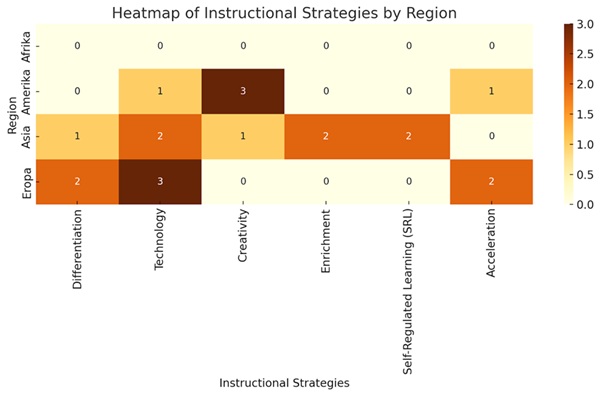
Gifted students in mathematics possess advanced cognitive abilities that often require instructional approaches beyond conventional classroom practices. However, existing mathematics education practices frequently fall short in addressing both the intellectual and affective needs of this population. This study aims to systematically map and synthesize mathematics learning strategies for gifted students reported in the literature over the past decade. Employing a Systematic Literature Review (SLR) guided by the PRISMA protocol, this study analyzed 17 empirical articles published between 2015 and 2025 in Scopus-indexed journals. The analysis combined thematic synthesis and bibliometric techniques to identify dominant instructional approaches, emerging trends, and research patterns. The findings reveal that technology-enhanced learning and differentiated instruction are the most frequently adopted strategies, followed by creativity-oriented instruction, enrichment, self-regulated learning, and acceleration. In addition, recent studies increasingly emphasize equity-sensitive and culturally responsive approaches, particularly in addressing the needs of twice-exceptional students and those from diverse socioeconomic backgrounds. These results highlight the multidimensional nature of mathematical giftedness and underscore the importance of flexible, inclusive, and evidence-based instructional designs. This review provides a conceptual foundation for curriculum development, educational policy, and teacher professional development aimed at optimizing meaningful mathematics learning for gifted students across diverse educational contexts.
Full text article
References
Allotey, G. A., Anamuah-Mensah, J., & Watters, J. J. (2024). Mathematics and science teachers’ cultural beliefs about giftedness and gifted students’ education in Ghana. Gifted Education International, 40(1), 78–93. https://doi.org/10.1177/02614294241247631
Alshareef, K. K. (2019). Twice-exceptional gifted students: Needs, challenges, and questions to ponder. Preprints. https://doi.org/10.20944/preprints201912.0115.v1
Aparicio, A. F., Moscarola, F. C., & Zaccagni, S. (2021). Mathematics camps: A gift for gifted students. Journal of Economic Behavior & Organization, 190, 315–327. https://doi.org/10.1016/j.jebo.2021.09.036
Assmus, D., & Fritzlar, T. (2022). Mathematical creativity and mathematical giftedness in the primary school age range. ZDM – Mathematics Education, 54, 113–131. https://doi.org/10.1007/s11858-022-01328-8
Azimi, E., Jafari, L., & Mahdavinasab, Y. (2023). Using a design-based research methodology to develop and study prompts integrated into GeoGebra to support mathematics learning of gifted students. Education and Information Technologies, 28(7), 9935–9955. https://doi.org/10.1007/s10639-023-11632-9
Bilgic, S., & Baloğlu, M. (2023). A bibliometric analysis of research on giftedness and mathematics. International Journal of Mathematical Education in Science and Technology. https://doi.org/10.1080/0020739X.2023.2236611
Budínová, I. (2024). Risks in identifying gifted students in mathematics: Case studies. Open Education Studies, 6(1), 45–58. https://doi.org/10.1515/edu-2022-0218
Calabrese, J. E., Edmunds, M. M., Sanders, R. M., & Capraro, R. M. (2024). Do great minds think alike? High-ability male and female students’ perceptions of mathematics. Journal for the Education of the Gifted, 47(1), 42–67. https://doi.org/10.1177/01623532231215091
Conde, M. Á., Sedano, F. J. R., Fernández-Llamas, C., Gonçalves, J., Lima, J., & García-Peñalvo, F. J. (2020). RoboSTEAM Project Systematic Mapping: Challenge Based Learning and Robotics. 2020 IEEE Global Engineering Education Conference (EDUCON), 214–221. https://doi.org/10.1109/EDUCON45650.2020.9125103
Dimitriadis, C. (2016). Gifted programs cannot be successful without gifted research and theory: Evidence from practice with gifted students of mathematics. Journal for the Education of the Gifted, 39(3), 221–239. https://doi.org/10.1177/0162353216657185
Doğruer, Ş. (2024). Gifted students’ views on integrating history of mathematics in mathematics lesson: History of mathematics as enrichment for gifted learners. Investigations in Mathematics Learning. Advance online publication. https://doi.org/10.1080/19477503.2024.2409031
Erdogan, A., & Yemenli, E. (2019). Gifted students’ attitudes towards mathematics: A qualitative multidimensional analysis. Asia Pacific Education Review, 20(1), 87–99. https://doi.org/10.1007/s12564-018-9562-5
Gagné, F. (2011). Building gifts into talents: Detailed overview of the DMGT 2.0. Gifted and Talented International, 26(2–3), 34–46.
Gagné, F. (2007). Ten commandments for academic talent development. Gifted Child Quarterly, 51(2), 93–118. https://doi.org/10.1177/0016986206296660
Irving, J. A., Oppong, E., & Shore, B. M. (2016). Alignment of a high-ranked PISA mathematics curriculum and the Parallel Curriculum for gifted students: Is a high PISA mathematics ranking indicative of curricular suitability for gifted learners? Gifted and Talented International, 31(2), 114–131. https://doi.org/10.1080/15332276.2017.1356657
Jurić, P., Brkić Bakarić, M., & Matetić, M. (2021). Detecting students gifted in mathematics with stream mining and concept drift based m-learning models integrating educational computer games. International Journal of Emerging Technologies in Learning (iJET), 16(12), 4–20. https://doi.org/10.3991/ijet.v16i12.21925
Karataş-Aydın, F. İ., & Işıksal-Bostan, M. (2022). Through their eyes: Gifted students’ views on integrating history of mathematics embedded videos into mathematics classrooms. SAGE Open, 12(2), 1-15. https://doi.org/10.1177/21582440221099518
Keleş, T. (2023). A comparison of creative problem solving features of gifted and non-gifted high school students. Pegem Journal of Education and Instruction, 12(2), 19–31. https://doi.org/10.47750/pegegog.12.02.03
Kitchenham, B., & Charters, S. (2007). Guidelines for performing systematic literature reviews in software engineering (EBSE Technical Report EBSE-2007-01). Keele University & Durham University.
Kozlowski, J. S., & Chamberlin, S. A. (2019). Raising the bar for mathematically gifted students through creativitybased mathematics instruction. Gifted and Talented International, 34(2), 134–143. https://doi.org/10.1080/15332276.2019.1690954
Leikin, R. (2021). When practice needs more research: The nature and nurture of mathematical giftedness. ZDM – Mathematics Education, 53(7), 1579–1589. https://doi.org/10.1007/s11858-021-01276-9
Mengist, W., Soromessa, T., & Legese, G. (2020). Method for conducting systematic literature review and meta-analysis for environmental science research. MethodsX, 7, 100777. https://doi.org/10.1016/j.mex.2019.100777
Moher, D., Liberati, A., Tetzlaff, J., & Altman, D. G. (2010). Preferred reporting items for systematic reviews and meta-analyses: the PRISMA statement. International Journal of Surgery (London, England), 8(5), 336–341. https://doi.org/10.1016/j.ijsu.2010.02.007
Paz-Baruch, N., & Hazema, H. (2023). Self-regulated learning and motivation among gifted and high-achieving students in science, technology, engineering, and mathematics disciplines: examining differences between students from diverse socioeconomic levels. Gifted Education International. https://doi.org/10.1177/01623532221143825
Petticrew, M., & Roberts, H. (2006). Systematic reviews in the social sciences: A practical guide. Blackwell. https://doi.org/10.1002/9780470754887
Sheffield, L. J. (2017). Dangerous myths about gifted mathematics students. ZDM Mathematics Education, 49(1), 13– 23. https://doi.org/10.1007/s11858-016-0814-8
Siddaway, A. P., Wood, A. M., & Hedges, L. V. (2019). How to do a systematic review: A best-practice guide for conducting and reporting. Annual Review of Psychology, 70, 747–770. https://doi.org/10.1146/annurev-psych-010418-102803
Spagnolo, C., & Nicchiotti, B. (2023). Interpreting gender gap issues in standardized tests: Definition and application of a theoretical tool. Frontiers in Education, 8, 1303041. https://doi.org/10.3389/feduc.2023.1303041
Thomas, J., & Harden, A. (2008). Methods for the thematic synthesis of qualitative research in systematic reviews. BMC Medical Research Methodology, 8, 45. https://doi.org/10.1186/1471-2288-8-45
Tirri, K., & Kuusisto, E. (2013). How Finland serves gifted and talented pupils. Journal for the Education of the Gifted, 36(1), 84–96. https://doi.org/10.1177/0162353212468066
Topçu, M., & a, O. (2025). Professional competencies for the education of gifted students. Kafkas Eğitim Araştırmaları Dergisi, 12, 70–91. https://doi.org/10.30900/kafkasegt.1533469
Vargas-Montoya, L., Gimenez, G., & Tkacheva, L. (2023). Only gifted students benefit from ICT use at school in mathematics learning. Education and Information Technologies, 29(7), 8301-8326. https://doi.org/10.1007/s10639-023-12136-2
Xu, G., Jiang, P., & Xiong, B. (2024). The impact of online education on gifted mathematics students from different family backgrounds. Sustainability, 16(1), 1–18. https://doi.org/10.3390/su16198444
Authors
Copyright (c) 2026 Zahara Yuyun Nailufar, Budi Usodo, Riyadi Riyadi, Farida Nurhasanah

This work is licensed under a Creative Commons Attribution-NonCommercial 4.0 International License.