
Exploring symmetry concepts through Hindu's weeding rituals: Ethnomathematics and ethnomodelling perspectives
Article Sidebar
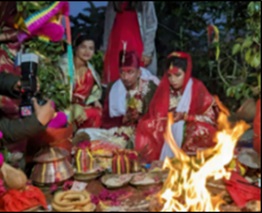
- Ethnomathematics , Ethnomodelling , Hindu Wedding Ritual , Symmetry, Geometry
Abstract
This study explores the concepts of geometric symmetry embedded in Hindu marriage ritual activities. A community-based descriptive ethnographic approach was employed in a Hindu-majority community in Pokhara, Kaski District, using local participants’ experiences and the researchers’ lived observations. Data were collected through observations, field notes, photographs, videos, and reflective insights, and analyzed using a data reduction process to generate meaningful themes. The findings reveal that Hindu marriage rituals incorporate diverse symmetry concepts and properties, including vertical and horizontal lines of symmetry, infinite lines of symmetry, as well as rotational and translational symmetry. These forms of symmetry align with key topics taught in school geometry. The results demonstrate that mathematical ideas, particularly geometric symmetry, naturally emerge from traditional cultural practices, supporting culturally responsive teaching and learning. Integrating Hindu ritual practices into classroom instruction can enhance students’ and teachers’ conceptual understanding through visualization and contextualization, while providing accessible and well-designed learning resources. Furthermore, such integration promotes creativity, critical thinking, and entrepreneurial skills, contributing to engaging and meaningful learning experiences. The study highlights a strong connection between cultural traditions and formal geometric concepts, and have practical implications for teachers, students, and policymakers in developing context-based teaching strategies, curriculum reforms, and professional development programs.
Full text article
References
Abasi, A. U., & George, I. G. (2025). Ethnomathematics and Students’ Interest, Attitude and Academic Performance in Mathematics in Mkpat Enin Local Government Area, Akwa Ibom State, Nigeria. International Journal of Research and Innovation in Social Science, 9(3s), 2430-2444. https://dx.doi.org/10.47772/IJRISS.2025.903SEDU0189
Amidi, Kartono, Mulyono, & Pujiastuti, E. (2025). Enhancing Students’ Mathematical Literacy through Ethnomathematics-Integrated Problem-Based Learning: A Study on Learning Independence. Jurnal Pendidikan Progresif, 15(3), 2007-2027. https://doi.org/10.23960/jpp
Apriandi, D., & Ayuningtyas, A. D. (2022). Mathematics teaching materials are based on the ethnomathematics of the Shiva Temple by applying the" Tri-N" teaching. AL-ISHLAH: JurnalPendidikan, 14(2), 1597-1606. https://doi.org/10.35445/alishlah.v14i2.1180
Baskerville, R. L., & Myers, M. D. (2015). Design ethnography in information systems. Information Systems Journal, 25(1), 23-46. https://doi.org/10.1111/isj.12055
Bjerre-Nielsen, A., & Glavind, K. L. (2022). Ethnographic data in the age of big data: how to compare and combine. Big Data & Society, 9(1), 20539517211069893. https://doi.org/10.1177/20539517211069893
Briones II, S. V., Briones, S. C., & Palmes, M. P. (2023). Linking mathematics and cultural practices of the Agta Tabangnon in the Upland communities of Goa, Philippines. https://doi.org/10.1063/5.0194359
Creswell, J. W., & Poth, C. N. (2016). Qualitative inquiry and research design: Choosing among five approaches. Sage Publications.
Lincoln, Y.S. & Guba, E.G. (1985). Naturalistic Inquiry. Sage Publications, Thousand Oaks. https://doi.org/10.1016/0147-1767(85)90062-8
D'Ambrosio, U. (1990). The role of mathematics education in building a democratic and just society. For the Learning of Mathematics, 10(3), 20-23.
D'Ambrosio, U., & D'Ambrosio, B. S. (2013). The role of ethnomathematics in curricular leadership in mathematics education. Journal of Mathematics Education at Teachers College, 4(1).
Fantinato, M. C., & Leite, K. G. (2023). Indigenous Mathematical Knowledge and Practices: State of the Art of the Ethnomathematics Brazilian Congresses (2000–2016). Indigenous Knowledge and Ethnomathematics, 141-160. https://doi.org/10.1007/978-3-030-97482-4_5
Gay, G. (2013). Culturally responsive teaching principles, practices, and effects. In Handbook of urban education (pp. 391-410). Routledge. https://doi.org/10.4324/9780203094280.ch19
Huang, M. C. (2023). Anthropological dimensions of modern educational culture: theoretical analysis. Journal of Contemporary Philosophical and Anthropological Studies, 1(1). https://doi.org/10.59652/jcpas.v1i1.58
Johnson, G. T., & Moldavan, A. M. (2023). Creative Learning with Music and Mathematics: Reflections on Interdisciplinary Collaborations. The STEAM Journal, Vol. 5(1), Article 4. https://doi.org/10.5642/steam.MJYS8444
Liamputtong, P. (2023). Qualitative research in the social sciences: setting the scene. How to Conduct Qualitative Research in Social Science, 1. https://doi.org/10.4337/9781800376199
Koirala, K. P., & Parajuli, K. (2022). Connecting cultural knowledge with western-based school science: Experiences of marginalized students. KMC Journal, 4(2), 149-166. https://doi.org/10.3126/kmcj.v4i2.47747
Madden, R. 2022. Being Ethnographic: A Guide to the Theory and Practice of Ethnography. 3rd Edition. Thousand Oaks, CA: SAGE Publications. https://doi.org/10.4135/9781036211509
Munthahana, J., & Budiarto, M. T. (2020). Ethnomathematics Exploration in Panataran Temple and Its Implementation in Learning. Indonesian Journal of Science and Mathematics Education, 3(2), 196-209. https://doi.org/10.24042/ijsme.v3i2.6718
Mustika, H., Junedi, B., Ningsih, S.Y., Saragih, I.F.A., Mawarty, K., &Khairiyah, Y.N. (2022). Ethnomathematics Exploration at Air Molek Riau Cultural Hall Air Molek. Indonesian Journal of Ethnomathematics, 1(1), 1-14. http://doi.org/10.48135/ije.v1i1.1-14
Öçal, T. & Öçal, M. F. (2021). “Simetri” Kavramına Yönelik Okul Öncesi Öğretmenleri ve Öğretmen Adaylarının Algıları. Uluslararası Erken Çocukluk Eğitimi Çalışmaları Dergisi, 6(1),1-10. https://doi.org/10.3126/sijssr.v2i1.28909
Orey, D. C., & Rosa, M. (2020). Positionality and Creating Dialogue in Nepal: Connecting Ethnomathematics and Modelling-the Importance of Place Through Ethnomodelling. Social Inquiry: Journal of Social Science Research, 2(1), 82-103. https://doi.org/10.3126/sijssr.v2i1.28909
Orey, D. C., & Rosa, M. (2021). Ethnomodelling as a glocalization process of mathematical practices through cultural dynamism. The Mathematics Enthusiast, 18(3), 439-468. https://doi.org/10.54870/1551-3440.1533
Parajuli, K. D. (2023). Mathematical Knowledge on Changu Narayan Temples’ Arts and Architectures: Ethnomathematics Perspective. Indonesian Journal of Ethnomathematics, 2(1), 21-36.
Parajuli, K. D., & Koirala, B. N. (2022a). Ethnomathematics Exploration in the Rekhi of Mandap and Havankunda: An Ethnography from Hindu Rites and Rituals in Nepal. Indonesian Journal of Ethnomathematics, 1(2), 105-116.
Parajuli, K. D., & Koirala, B. N. (2022b). Learning School Geometry Through Rekhis of Brahmin’s Culture. In Pacio, M. T., Alangui, W. V., & Stathopoulou, C. (Eds.), Two Educational Projects Informed by a Critical Ethnomathematics Perspective: Igorot and Roma Students Under the Shadow of Coloniality. Philippines, Nepal, Indonesia and Papua New Guinea Website: https://icem7. org, 213.
Parajuli, K. D., Koirala, B. N., & Subedi, P. S. (2023). Reciprocal Learning Mathematics through Honeycomb Patterns. JMC Research Journal, 12(1). https://doi.org/10.3126/jmcrj.v12i1.61631
Parajuli, K., & Koirela, R.(2024). Mathematics practices through ethnomodelling on Nepali Dhaka industries patterns. School, 22(2), 14–29. ISGEm, The International Study Group on Ethnomathematics.
Parajuli, K. D. (2023b). Mathematical Knowledge on Changu Narayan Temples’ Arts and Architectures: Ethnomathematics Perspective. Indonesian Journal of Ethnomathematics, 2(1), 21-36. http://doi.org/10.48135/ije.v1i2.105-116
Parajuli, K. D. (February/March, 2024). Mathematics from Hair. Teacher's Monthly, 16(152), 57–58.
Parajuli, K. D., & Koirala, B. N. (2025). Learning mathematics through open lab: Pedagogical action and social justice (Chapter 14, pp. 346–381). In D. C. Orey, M. Rosa, A. M. Fernandes, R. C. Pinheiro, A. D. Castillo, & Z. E. de F. Madruga (Eds.), Polysemic interactions of ethnomathematics as program: Interfaces with pedagogical action, the ethics of diversity, social justice, and total peace: Evidences from the field. https://doi.org/10.29327/5610095.1-14.
Pathuddin, H., & Nawawi, M. I. (2021). Buginese Ethnomathematics: Barongko Cake Explorations as Mathematics Learning Resources. Journal on Mathematics Education, 12(2), 295-312. http://doi.org/10.22342/jme.12.2.12695.295- 312
Prabawati, M. N., & Amarulloh, S. I. (2025). Effectiveness of using culturally responsive teaching-based modules on sequences and series. Jurnal Inovasi Pembelajaran Matematika: PowerMathEdu, 4(1), 49-58. https://doi.org/10.31980/pme.v4i1.2644
Pradhan, J. B., Sharma, T., & Sharma, T. (2021). Ethnomathematics research practices and its pedagogical implications: A Nepalese perspective. Journal of Mathematics and Culture, 15(1), 110-126.
Pradhan, J.B. (2023). Ethnomathematics in Nepal: Research and Future Prospects. In: Borba, M.C., Orey, D.C. (eds) Ubiratan D’Ambrosio and Mathematics Education. Advances in Mathematics Education. Springer, Cham. https://doi.org/10.1007/978-3-031-31293-9_16
Prahmana, R. C. I., &D’Ambrosio, U. (2020). Learning Geometry and Values from Patterns: Ethnomathematics on the Batik Patterns of Yogyakarta, Indonesia. Journal on Mathematics Education, 11(3), 439–456. https://doi.org/10.22342/jme.11.3.12949.439-456
Rosa, M., & Orey, D. C. (2023). Exploring cultural dynamism of ethnomodelling as a pedagogical action for students from minority cultural groups. ZDM–Mathematics Education, 1-12. https://doi.org/10.54870/1551-3440.1533
Rosa, M., Orey, D.C. (2024). Exploring cultural dynamism of ethnomodelling as a pedagogical action for students from minority cultural groups. ZDM- Mathematics Education,56(3), 423-434. https://doi.org/10.1007/s11858-023-01539-7
Sarantakos, S. (2013). Social research. Palgrave Macmillan. https://doi.org/10.1007/978-1-137-29247-6
Scott‐Fordsmand, H. (2025). Ethnographic Philosophy: Qualitative Method for Naturalised Philosophy. Philosophy Compass, 20(3), e70031. https://doi.org/10.1111/phc3.70031
Setiaputra, F. I., Subanti, S., Usodo, B., Triyanto, T., Fitriana, L., & Hendriyanto, A. (2025). A Systematic A Review of Ethnomathematics Research (2019–2023): Cultural Integration in Mathematics Teaching and Learning. Jurnal Pendidikan MIPA, 26(1), 195-211. https://doi.org/10.23960/jpmipa.v26i1.pp195-211
Shockey, T. L., Scott, P., & Silverman, F. (2023). ISGEm and NASGEm: Two Elements of the D’Ambrosio Intellectual Legacy. In Ubiratan D’Ambrosio and Mathematics Education: Trajectory, Legacy and Future (pp. 63-69). Cham: Springer International Publishing. https://doi.org/10.1007/978-3-031-31293-9_5
Soebagyo, J., & Luthfiyyah, F. I. (2023). Ethnomathematics Exploration of The Great Mosque of Al-Barkah, Bekasi City, Through The Learning of Geometry and Transformational Geometry. Indonesian Journal of Science and Mathematics Education, 6(2), 152-164. https://doi.org/10.24042/ijsme.v6i2.17179
Syahnia, S. M., Haenilah, E. Y., Perdana, R., & Caswita, C. (2024). Ethnomathematics-based Problem-Based Learning (PBL) Model to Increase Students’ Critical Thinking in Mathematics Learning. Lectura: Jurnal Pendidikan, 15(2), 571-581. https://doi.org/10.31849/lectura.v15i2.20985
Taherdoost, H. (2022). What are the different research approaches? Comprehensive Review of Qualitative, quantitative, and mixed method research, their applications, types, and limitations. Journal of Management Science & Engineering Research, 5(1), 53-63. https://doi.org/10.30564/jmser.v5i1.4538
Timmermans, S., and I. Tavory. 2022. Data Analysis in Qualitative Research: Theorizing With Abductive Analysis. Chicago, IL: University of Chicago Press. https://doi.org/10.7208/chicago/9780226817729.001.0001
Upadhyay, B., Atwood, E., & Tharu, B. (2021). Antiracist pedagogy in a high school science class: A case of a high school science teacher in an indigenous school. Journal of Science Uygun, T. (2020). An inquiry-based design research for teaching geometric transformations by developing mathematical practices in a dynamic geometry environment. Mathematics Education Research Journal, 1–27. https://doi.org/10.1007/s13394-020-00314-1
Van de Walle, J.A., Karp, K., S.,& Bay-Williams, J.M. (2019). İlkokul ve Ortaokul Matematiği Gelişimsel Yaklaşımla Öğretim. (Çev. Ed. S. Durmuş). Nobel.
Yudianto, E., Febriyanti, R. A., Sunardi, S., Sugiarti, T., & Mutrofin, M. (2021). Eksplorasi Etnomatematika pada Masjid Jami'Al-Baitul Amien Jember. Ethnomathematics Journal, 2(1), 11-20. https://doi.org/10.21831/ej.v2i1.36329
Yusran, Y. A., Reza, M., Suryasari, N., Titisari, E. Y., Kusdiwanggo, S., & Asikin, D. (2024). Ethno-modelling as a Glocalisation Process of Understanding Vernacular.
Authors
Copyright (c) 2026 Kharika Parajuli, Bidya Nath Koirala

This work is licensed under a Creative Commons Attribution-NonCommercial 4.0 International License.