The Process of Forming Sensation-Seeking Behavior in Online Slot Gambling Players
DOI:
https://doi.org/10.23917/indigenous.v9i3.6483Keywords:
Addiction, Online slot gambling, Sensation seeking, QualitativeAbstract
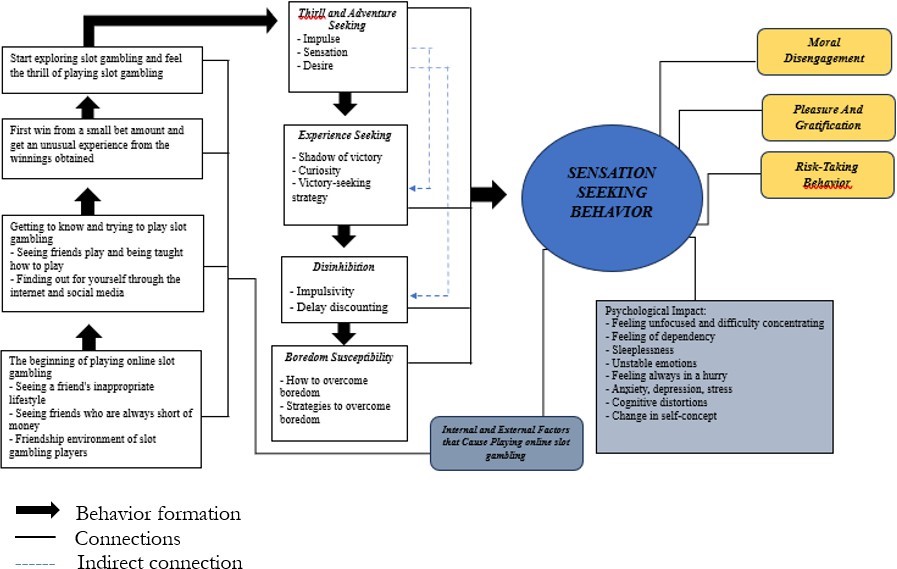
Online slot gambling is a massive case, especially in Indonesia. In this context, individuals tend to develop repetitive habits in using the internet, which can lead to increased frequency of use and potentially trigger addictive behavior. Therefore, the rise of addiction cases in gambling behavior ultimately led to a sensation-seeking behavior in playing gambling. The purpose of this study is to determine sensation seeking behavior in online slot gambling players. This research uses a qualitative approach with a case study method, specifically a holistic single case study conducted by 5 primary and 3 secondary participants. Semi-structured interviews and observations were used as data collection techniques. The data analysis technique uses thematic analysis using NVivo 14 Plus software. The results of this study are that the research participants showed this tendency through the statement that playing online slot gambling provides fun, curiosity, and adrenaline that spurs them to continue to seek these sensations. This research highlights that thrill, adventure-seeking, and disinhibition in online slot gambling players are the most significant aspects in the sensation-seeking behavior of gambling players. It also found components namely moral disengagement, pleasure and gratification, and risk-taking behavior. This research highlights the formation of sensation-seeking behavior in online slot gambling players, as well as its implications for online gambling behavior. This research is expected to be a reference for overcoming online gambling addiction and the dynamics of sensation-seeking in addictive behavior.
References
Addiyansyah, W., & Rofi’ah. (2023). Kecanduan judi online di kalangan remaja desa. MANIFESTO: Jurnal Gagasan Komunikasi, Politik, Dan Budaya, 1(1), 13–22. Retrieved from: https://journal.awatarapublisher.com/index.php/manifesto/article/view/27
Agrippina, F. K., & Nugrahawati, E. N. (2023). Pengaruh peran teman sebaya terhadap gambling intention pada mahasiswa pemain judi slot online di kota Bandung. Bandung Conference Series: Psychology Science, 3(1), 282–290. https://doi.org/10.29313/bcsps.v3i1.5305 DOI: https://doi.org/10.29313/bcsps.v3i1.5305
Ajzen, I. (1991). The theory of planned behavior. Organizational Behavior and Human Decision Processes, 50(2), 179–211. https://doi.org/10.1016/0749-5978(91)90020-T DOI: https://doi.org/10.1016/0749-5978(91)90020-T
Alessi, S. M., & Petry, N. M. (2003). Pathological gambling severity is associated with impulsivity in a delay discounting procedure. Behavioural Processes, 64(3), 345–354. https://doi.org/10.1016/S0376-6357(03)00150-5 DOI: https://doi.org/10.1016/S0376-6357(03)00150-5
Barrault, S., Mathieu, S., Brunault, P., & Varescon, I. (2019). Does gambling type moderate the links between problem gambling, emotion regulation, anxiety, depression and gambling motives. International Gambling Studies, 19(1), 54–68. https://doi.org/10.1080/14459795.2018.1501403 DOI: https://doi.org/10.1080/14459795.2018.1501403
Barton, K. R., Yazdani, Y., Ayer, N., Kalvapalle, S., Brown, S., Stapleton, J., Brown, D. G., & Harrigan, K. A. (2017). The effect of losses disguised as wins and near misses in electronic gaming machines: a systematic review. Journal of Gambling Studies, 33(4), 1241–1260. https://doi.org/10.1007/s10899-017-9688-0 DOI: https://doi.org/10.1007/s10899-017-9688-0
Bhate, S., & Hannam, K. (2014). Experiential gambling: interactions between consumer experiences, emotional engagement, and behavioural settings. Analysis of Gambling Behavior, 8(1). Retrieved from: https://repository.stcloudstate.edu/agb/vol8/iss1 /2/%0Ahttps://repository.stcloudstate.edu/cgi/viewcontent.cgi?article=1130&context=agb
Blaszczynski, A., & Nower, L. (2002). A pathways model of problem and pathological gambling. Addiction, 97(5), 487–499. https://doi.org/10.1046/j.1360-0443.2002.00015.x DOI: https://doi.org/10.1046/j.1360-0443.2002.00015.x
Boyatzis, R. . (1998). Transforming qualitative information: Thematic analysis and code development. Sage Publications, Inc.
Ciccarelli, M., Nigro, G., Griffiths, M. D., Cosenza, M., & D’Olimpio, F. (2016). Attentional biases in problem and non-problem gamblers. Journal of Affective Disorders, 198, 135–141. https://doi.org/10.1016/j.jad.2016.03.009 DOI: https://doi.org/10.1016/j.jad.2016.03.009
Cyrus Model. (2023, Agustus 4). 6 Jenis Judi Online Yang Populer Di Indonesia. Retrieved from: https://cyrusmodels.com/6-jenis-judi-online-populer-ramai-peminatnya-di-indonesia/
Dayan, J., Bernard, A., Olliac, B., Mailhes, A. S., & Kermarrec, S. (2010). Adolescent brain development, risk-taking and vulnerability to addiction. Journal of Physiology-Paris, 104(5), 279–286. https://doi.org/10.1016/j.jphysparis.2010.08.007 DOI: https://doi.org/10.1016/j.jphysparis.2010.08.007
De Caroli, M. E., & Sagone, E. (2014). Mechanisms of moral disengagement: An analysis from early adolescence to youth. Procedia - Social and Behavioral Sciences, 140, 312–317. https://doi.org/10.1016/j.sbspro.2014.04.426 DOI: https://doi.org/10.1016/j.sbspro.2014.04.426
Del Prete, F., Steward, T., Navas, J. F., Fernández-Aranda, F., Jiménez-Murcia, S., Oei, T. P., & Perales, J. C. (2017). The role of affect-driven impulsivity in gambling cognitions: A convenience-sample study with a Spanish version of the Gambling-Related Cognitions Scale. Journal of behavioral addictions, 6(1), 51–63. https://doi.org/10.1556/2006.6.2017.001 DOI: https://doi.org/10.1556/2006.6.2017.001
Dixon, M. J., Graydon, C., Harrigan, K. A., Wojtowicz, L., Siu, V., & Fugelsang, J. A. (2014). The allure of multi-line games in modern slot machines. Addiction, 109(11), 1920–1928. https://doi.org/10.1111/add.12675 DOI: https://doi.org/10.1111/add.12675
Dixon, M. J., Gutierrez, J., Larche, C. J., Stange, M., Graydon, C., Kruger, T. B., & Smith, S. D. (2019). Reward reactivity and dark flow in slot-machine gambling: “Light” and “dark” routes to enjoyment. Journal of Behavioral Addictions, 8(3), 489–498. https://doi.org/10.1556/2006.8.2019.38 DOI: https://doi.org/10.1556/2006.8.2019.38
Dixon, M. J., Harrigan, K. A., Santesso, D. L., Graydon, C., Fugelsang, J. A., & Collins, K. (2014). The impact of sound in modern multiline video slot machine play. Journal of Gambling Studies, 30(4), 913–929. https://doi.org/10.1007/s10899-013-9391-8 DOI: https://doi.org/10.1007/s10899-013-9391-8
Ejova, A. (2019). The illusion of control. The Routledge Handbook of the Philosophy and Psychology of Luck, 32(2), 365–376. https://doi.org/10.4324/9781351258760-33 DOI: https://doi.org/10.4324/9781351258760-33
Flack, M., & Morris, M. (2017). The temporal relationship between gambling related beliefs and gambling behaviour: a prospective study using the theory of planned behaviour. International Gambling Studies, 17(3), 508–519. https://doi.org/10.1080/14459795.2017.1360929 DOI: https://doi.org/10.1080/14459795.2017.1360929
Flick, U., Steinke, I., & von Kardoff, E. (2017). Buku induk penelitian kualitatif. Cantrik Pustaka.
Gainsbury, S. M. (2015). Online Gambling Addiction : the Relationship Between Internet Gambling and Disordered Gambling. Curr Addict Rep, 34(1), 185–193. https://doi.org/10.1007/s40429-015-0057-8 DOI: https://doi.org/10.1007/s40429-015-0057-8
Goldstein, A. L., Vilhena-Churchill, N., Stewart, S. H., Hoaken, P. N. S., & Flett, G. L. (2016). Mood, motives, and money: An examination of factors that differentiate online and non-online young adult gamblers. Journal of Behavioral Addictions, 5(1), 68–76.
https://doi.org/10.1556/2006.5.2016.003 DOI: https://doi.org/10.1556/2006.5.2016.003
Goodie, A. S., Fortune, E. E., & Shotwell, J. J. (2019). Cognitive distortions in disordered gambling. In A. Heinz, N. Romanczuk-Seiferth, & M. N. Potenza (Eds.), Gambling disorder (pp. 49–71). Springer Nature Switzerland AG. https://doi.org/10.1007/978-3-030-03060-5_4 DOI: https://doi.org/10.1007/978-3-030-03060-5_4
Gori, A., Topino, E., Craparo, G., Bagnoli, I., Caretti, V., & Schimmenti, A. (2022). A comprehensive model for gambling behaviors: assessment of the factors that can contribute to the vulnerability and maintenance of gambling disorder. Journal of Gambling Studies, 38(1), 235–251. https://doi.org/10.1007/s10899-021-10024-3 DOI: https://doi.org/10.1007/s10899-021-10024-3
Hardiansyah, S., & Asriwandari, H. (2016). Kegiatan judi online dikalangan pe;ajar dan mahasiswa di kota Pekanbaru (studi tentang judi online pada lima warnet di kelurahan Maharatu, kecamatan Marpoyan Damai. Jurnal Online Mahasiswa Fakultas Ilmu Sosial dan Ilmu Politik Universitas Riau, 3(1), 1–15. Retrieved from: https://jom.unri.ac.id/index.php/JOMFSIP/article/view/9359
Harris, N., Newby, J., & Klein, R. G. (2013). Competitive facets and sensation seeking as predictors of problem gambling among a sample of university student gamblers. Journal of Gambling Studies, 31, 385–396. https://doi.org/10.1007/s10899-013-9431-4 DOI: https://doi.org/10.1007/s10899-013-9431-4
Haw, J. (2008). The relationship between reinforcement and gaming machine choice. Journal of Gambling Studies, 24(1), 55–61. https://doi.org/10.1007/s10899-007-9073-5 DOI: https://doi.org/10.1007/s10899-007-9073-5
Hu, J., Zhen, S., Yu, C., Zhang, Q., & Zhang, W. (2017). Sensation seeking and online gaming addiction in adolescents: A moderated mediation model of positive affective Associations and Impulsivity. Frontiers in Psychology, 8, 1–8. https://doi.org/10.3389/fpsyg.2017. DOI: https://doi.org/10.3389/fpsyg.2017.00699
Ioannidis, K., Hook, R., Wickham, K., & Grant, J. E. (2019). Impulsivity in gambling disorder and problem gambling : A meta-analysis. Neuropsychopharmacology, 44, 1354–1361. https://doi.org/10.1038/s41386-019-0393-9 DOI: https://doi.org/10.1038/s41386-019-0393-9
Lopez-Gonzalez, H., Estévez, A., & Griffiths, M. D. (2018). Controlling the illusion of control: a grounded theory of sports betting advertising in the UK. International Gambling Studies, 18(1), 39–55. https://doi.org/10.1080/14459795.2017.1377747 DOI: https://doi.org/10.1080/14459795.2017.1377747
Maharani, M., & Ampuni, S. (2020). Perilaku anti sosial remaja laki-laki ditinjau dari identitas moral dan moral disengagement. Indigenous: Jurnal Ilmiah Psikologi, 5(1). 53-65. https://doi. org/10.23917/indigenous.v5i1.8706 DOI: https://doi.org/10.23917/indigenous.v5i1.8706
McNicol, M. L., & Thorsteinsson, E. B. (2017). Internet addiction, psychological distress, and coping responses among adolescents and adults. Cyberpsychology, Behavior, and Social Networking, 20(5), 296–304. https://doi.org/10.1089/cyber.2016.0669 DOI: https://doi.org/10.1089/cyber.2016.0669
Mena-Moreno, T., Testa, G., Mestre-Bach, G., Miranda-Olivos, R., Granero, R., Fernández-Aranda, F., Menchón, J. M., & Jiménez-Murcia, S. (2022). Delay discounting in gambling disorder: implications in treatment outcome. Journal of Clinical Medicine, 11(6), 1–14. https://doi.org/10.3390/jcm11061611 DOI: https://doi.org/10.3390/jcm11061611
Mishra, S., Lalumière, M. L., & Williams, R. J. (2010). Gambling as a form of risk-taking: Individual differences in personality, risk-accepting attitudes, and behavioral preferences for risk. Personality and Individual Differences, 49(6), 616–621. https://doi.org/10.1016/j.paid.2010.05.032 DOI: https://doi.org/10.1016/j.paid.2010.05.032
Müller, K. W., Dreier, M., Beutel, M. E., & Wölfling, K. (2016). Is sensation seeking a correlate of excessive behaviors and behavioral addictions? A detailed examination of patients with gambling disorder and internet addiction. Psychiatry Research, 242, 319–325. https://doi.org/10.1016/j.psychres.2016.06.004 DOI: https://doi.org/10.1016/j.psychres.2016.06.004
Murch, W. S., & Clark, L. (2021). Understanding the slot machine zone. Current Addiction Reports, 8(2), 214–224. https://doi.org/10.1007/s40429-021-00371-x DOI: https://doi.org/10.1007/s40429-021-00371-x
Narasi. (2023, September 9). Indonesia peringkat satu pemain judi slot dan gacor di dunia kalahkan Rusia. Retrieved from: https://narasi.tv/read/narasi-daily/indonesia-peringkat-satu-judi-online
Norbury, A., & Husain, M. (2015). Sensation-seeking : Dopaminergic modulation and risk for psychopathology. Behavioural Brain Research, 288, 79–93. https://doi.org/10.1016/j.bbr.2015.04.015 DOI: https://doi.org/10.1016/j.bbr.2015.04.015
PPATK (2023, 27 September). Transaksi Judi Online Sepanjang 2023 Lebih dari Rp 200 T. Retrieved from: https://www.ppatk.go.id/news/read/1373/transaksi-judi online
Quaglieri, A., Pizzo, A., Cricenti, C., Tagliaferri, G., Frisari, F. V., Burrai, J., Mari, E., Lausi, G., Giannini, A. M., & Zivi, P. (2024). Gambling and virtual reality: unraveling the illusion of near-misses effect. Frontiers in psychiatry, 15, 1322631. https://doi.org/10.3389/fpsyt.2024.1322631 DOI: https://doi.org/10.3389/fpsyt.2024.1322631
Ravert, R. D., & Donnellan, M. B. (2021). Impulsivity and sensation seeking: Differing associations with psychological well-being. Applied Research in Quality of Life, 16(4), 1503–1515. https://doi.org/10.1007/s11482-020-09829-y DOI: https://doi.org/10.1007/s11482-020-09829-y
Reardon, K. W., Wang, M., Neighbors, C., & Tackett, J. L. (2019). The personality context of adolescent gambling: Better explained by the Big Five or sensation-seeking?. Journal of Psychopathology and Behavioral Assessment, 41(1), 69–80. https://doi.org/10.1007/s10862-018-9690-6 DOI: https://doi.org/10.1007/s10862-018-9690-6
Rennert, L., Denis, C., Peer, K., Lynch, K. G., Gelernter, J., & Kranzler, H. R. (2014). DSM-5 gambling disorder: Prevalence and characteristics in a substance use disorder sample. Experimental and Clinical Psychopharmacology, 22(1), 50–56. https://doi.org/10.1037/a0034518 DOI: https://doi.org/10.1037/a0034518
Ring, P., Probst, C. C., Neyse, L., Wolff, S., Kaernbach, C., van Eimeren, T., & Schmidt, U. (2022). Discounting behavior in problem gambling. Journal of Gambling Studies, 38(2), 529–543. https://doi.org/10.1007/s10899-021-10054-x DOI: https://doi.org/10.1007/s10899-021-10054-x
Robert, K. Yin. (2018). Case Study Research and Applications (6th ed.). SAGE Publications.
Rogier, G., Beomonte Zobel, S., Marini, A., Camponeschi, J., & Velotti, P. (2021). Gambling disorder and dissociative features: A systematic review and meta-analysis. Psychology of Addictive Behaviors, 35(3), 247–262. https://doi.org/10.1037/adb0000693 DOI: https://doi.org/10.1037/adb0000693
Sitanggang, A. S., Sabta, R., & Hasiolan, F. Y. (2023). Perkembangan judi online dan dampaknya terhadap masyarakat: tinjauan multidisipliner. Triwikrama: Jurnal Ilmu Sosial, 01(05), 50-60. https://doi.org/10.6578/tjis.v1i6.248
Spurrier, M., & Blaszczynski, A. (2014). Risk perception in gambling: a systematic review. Journal of Gambling Studies, 30(2), 253–276. https://doi.org/10.1007/s10899-013-9371-z DOI: https://doi.org/10.1007/s10899-013-9371-z
St Quinton, T. (2020). A reasoned action approach to gambling behavior. Cogent Psychology, 7(1). https://doi.org/10.1080/23311908.2020.1857104 DOI: https://doi.org/10.1080/23311908.2020.1857104
Tani, F., Ponti, L., & Ghinassi, S. (2020). Sensation seeking and gambling behavior in adolescence: Can externalizing problems moderate this relationship?. International Journal of Environmental Research and Public Health, 17(23), 1–11. https://doi.org/10.3390/ijerph17238986 DOI: https://doi.org/10.3390/ijerph17238986
Toneatto T. (1999). Cognitive psychopathology of problem gambling. Substance use & misuse, 34(11), 1593–1604. https://doi.org/10.3109/10826089909039417 DOI: https://doi.org/10.3109/10826089909039417
Vuorinen, I., Oksanen, A., Savolainen, I., Sirola, A., Kaakinen, M., Paek, H. J., & Zych, I. (2021). The mediating role of psychological distress in excessive gambling among young people: A four-country study. International Journal of Environmental Research and Public Health, 18(13), 1–10. https://doi.org/10.3390/ijerph18136973 DOI: https://doi.org/10.3390/ijerph18136973
Weinsztok, S., Brassard, S., Balodis, I., Martin, L. E., & Amlung, M. (2021). Delay discounting in established and proposed behavioral addictions: A systematic review and meta-analysis. Frontiers in Behavioral Neuroscience, 15, 786358. https://doi.org/10.3389/fnbeh.2021.786358 DOI: https://doi.org/10.3389/fnbeh.2021.786358
Williams, R. J., Mishra, S., & Lalumie, M. L. (2016). Gambling , risk-taking , and antisocial behavior : A replication study supporting the generality of deviance. Journal Gambling Study, 33(1), 15–36. https://doi.org/10.1007/s10899-016-9608-8 DOI: https://doi.org/10.1007/s10899-016-9608-8
Zuckerman, M. (1984). Sensation seeking: A comparative approach to a human trait. Behavioral and Brain Sciences, 7(3), 413–434. https://doi.org/10.1017/S0140525X00018938 DOI: https://doi.org/10.1017/S0140525X00018938
Zuckerman, M., & Glicksohn, J. (2016). Hans Eysenck ’ s personality model and the constructs of sensation seeking and impulsivity. PAID, 103, 48–52. https://doi.org/10.1016/j.paid.2016.04.003 DOI: https://doi.org/10.1016/j.paid.2016.04.003
Zuckerman, M., & Kuhlman, D. M. (2000). Personality and risk-taking: Common biosocial factors. Journal of Personality, 68(6), 999–1029. https://doi.org/10.1111/1467-6494.00124 DOI: https://doi.org/10.1111/1467-6494.00124
Zulfia, N., Fitriani, D. A., Hasanah, M. U., & Irawan, R. (2023). Dinamika Judi Di Indonesia : Sejarah Judi Sebagai Dongkrak Perekonomian Indonesia Tahun 1960-1994. Journal Of Multidiciplinary Studies, 7(2). Retrieved from: https://ejournal.uinsaid.ac.id/index.php/ academica/article/view/7418/2412
Submitted
Published
How to Cite
Issue
Section
License
Copyright (c) 2025 Faischa Nadiyah Fiyanda, RR Setyawati, Herdian, Suwarti

This work is licensed under a Creative Commons Attribution 4.0 International License.