Forgiveness Experiences in Early Adult Women with Divorced Parents
DOI:
https://doi.org/10.23917/indigenous.v9i2.5561Keywords:
Broken Home, Divorce, Early Adult Women, ForgivenessAbstract
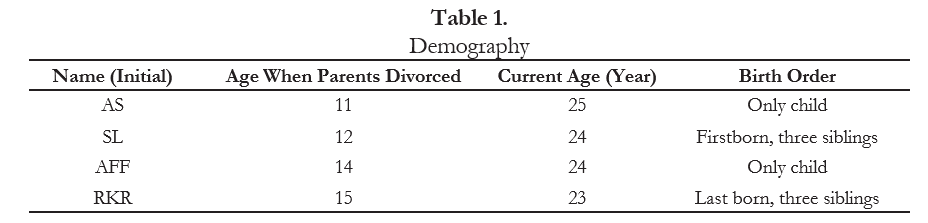
Divorce by parents can be a traumatic experience for children, especially women who are vulnerable to psychological problems in adulthood. A woman whose parents divorced and grew up in a broken home family must find a way to regulate and heal her emotional wounds. This research aims to explore the forgiveness experiences of early adult women with divorced parents. This research uses a qualitative approach with phenomenological methods. This research involved four participants with the following criteria: (1) women aged between 21-30 years, (2) have divorced parents, and (3) live in Yogyakarta which were obtained through social media broadcasts. The data collection was carried out using in-depth interviews. The research results found that the forgiveness experiences of early adult women can be grouped into two major themes, namely (1) the process of forgiving parents, which includes feelings, internal and external factors that encourage the forgiveness process as well as cognitive, emotional and behavioral aspects of forgiveness; and (2) the impact of forgiveness on participants' acceptance and meaning of their parent's divorce as well as participants' trust and hope in romantic relationships. This research offers supporting evidence that the process of forgiving in women with divorced parents can generate positive meaning and foster a sense of trust and hope in future romantic relationships. Furthermore, the results of this study can encourage mental health practitioners, especially in divorce cases, to consider handling relational aspects between children and parents in order to build trust and hope as a provision for their future romantic relationships.
References
Aji, K. S., Kristiana, I. F., & Dewi, E. K. (2023). Marital satisfaction among Husbands of Kawruh Jiwa Suryomentaram Believer Adherent. Indigenous: Jurnal Ilmiah Psikologi, 8(1), 58–69. https://doi.org/10.23917/indigenous.v8i1.20696 DOI: https://doi.org/10.23917/indigenous.v8i1.20696
Auersperg, F., Vlasak, T., Ponocny, I., & Barth, A. (2019). Long-term effects of parental divorce on mental health – A meta-analysis. Journal of Psychiatric Research, 119, 107–115. https://doi.org/10.1016/j.jpsychires.2019.09.011 DOI: https://doi.org/10.1016/j.jpsychires.2019.09.011
Bies, R. J., Barclay, L. J., Tripp, T. M., & Aquino, K. (2016). A Systems Perspective on Forgiveness in Organizations. The Academy of Management Annals, 10(1), 245–318. https://doi.org/10.1080/19416520.2016.1120956 DOI: https://doi.org/10.5465/19416520.2016.1120956
Badan Pusat Statistik. (2023). Catalog : 1101001. Statistik Indonesia 2023, 1101001, 790. https://www.bps.go.id/publication/2020/04/29/e9011b3155d45d70823c141f/statistik-indonesia-2020.html
Brady, D. L., Saldanha, M. F., & Barclay, L. J. (2023). Conceptualizing forgiveness: A review and path forward. Journal of Organizational Behavior, 44(2), 261–296. https://doi.org/10.1002/job.2632 DOI: https://doi.org/10.1002/job.2632
Buehler, C. (2020). Family processes and children’s and adolescents’ well-being. Journal of Marriage, and Family, 82(1), 145–174. https://doi.org/10.1111/jomf.12637 DOI: https://doi.org/10.1111/jomf.12637
Camisasca, E., Miragoli, S., Di Blasio, P., & Feinberg, M. (2019). Co-parenting mediates the influence of marital satisfaction on child adjustment: the conditional indirect effect by parental empathy. Journal of Child and Family Studies, 28(2), 519–530. https://doi.org/10.1007/s10826-018-1271-5 DOI: https://doi.org/10.1007/s10826-018-1271-5
Chen, M., Rizzi, E. L., & Yip, P. S. F. (2021). Divorce trends in China across time and space: an update. Asian Population Studies, 17(2), 121–147. https://doi.org/10.1080/17441730.2020.1858571 DOI: https://doi.org/10.1080/17441730.2020.1858571
Demir-Dagdas, T., Isik-Ercan, Z., Intepe-Tingir, S., & Cava-Tadik, Y. (2018). Parental divorce and children from diverse backgrounds: multidisciplinary perspectives on mental health, parent–child relationships, and educational experiences. Journal of Divorce & Remarriage, 59(6), 469–485. https://doi.org/10.1080/10502556.2017.1403821 DOI: https://doi.org/10.1080/10502556.2017.1403821
Emerson, A. J., Harris, S. M., & Ahmed, F. A. (2021). The impact of discernment counseling on individuals who decide to divorce: experiences of post-divorce communication and coparenting. Journal of Marital and Family Therapy, 47(1), 36–51. https://doi.org/10.1111/jmft.12463 DOI: https://doi.org/10.1111/jmft.12463
Eyo, U. E. (2018). Divorce: Causes and effects on children. Asian Journal of Humanities and Social Studies, 6(5), 172–177. https://doi.org/10.24203/ajhss.v6i5.5315 DOI: https://doi.org/10.24203/ajhss.v6i5.5315
Garriga, A., & Pennoni, F. (2022). The causal effects of parental divorce and parental temporary separation on children’s cognitive abilities and psychological well-being according to parental relationship quality. Social Indicators Research, 161(2–3), 963–987. https://doi.org/10.1007/s11205-020-02428-2 DOI: https://doi.org/10.1007/s11205-020-02428-2
Gustavsen, G. W., Nayga, R. M., & Wu, X. (2016). Effects of parental divorce on teenage children’s risk behaviors: incidence and persistence. Journal of Family and Economic Issues, 37(3), 474–487. https://doi.org/10.1007/s10834-015-9460-5 DOI: https://doi.org/10.1007/s10834-015-9460-5
Hald, G. M., Ciprić, A., Sander, S., & Strizzi, J. M. (2022). Anxiety, depression and associated factors among recently divorced individuals. Journal of Mental Health, 31(4), 462–470. https://doi.org/10.1080/09638237.2020.1755022 DOI: https://doi.org/10.1080/09638237.2020.1755022
Herrero, M., Martínez-Pampliega, A., & Alvarez, I. (2020). Family communication, adaptation to divorce and children’s maladjustment: The moderating role of coparenting. Journal of Family Communication, 20(2), 114–128. https://doi.org/10.1080/15267431.2020.1723592 DOI: https://doi.org/10.1080/15267431.2020.1723592
Hook, J. N., Ramos, M. J., Worthington, E. L., Utsey, S. O., Coy, A. E., Davis, D. E., Van Tongeren, D. R., Gartner, A. L., Jennings, D. J., & Dueck, A. (2015). Negative internal causal attributions of a specific offense and forgiveness. Personal Relationships, 22(3), 449–459. https://doi.org/10.1111/pere.12089 DOI: https://doi.org/10.1111/pere.12089
Istiqomah, N., Anganthi, N. R. N., & Darojat, M. (2015). Strategi coping pada pasangan pernikahan berorientasi nilai-nilai islam. Indigenous: Jurnal Ilmiah Psikologi, 13(2), 47–54. https://journals.ums.ac.id/index.php/indigenous/article/view/2620
Kleiven, T. (2023). Power to forgive: interpersonal forgiveness from an analytical perspective on power. International Journal for Philosophy of Religion, 93(2), 147–162. https://doi.org/10.1007/s11153-022-09857-8 DOI: https://doi.org/10.1007/s11153-022-09857-8
Lestari, T. W. T., & Huwae, A. (2023). Forgiveness and resilience: a case of adolescents with broken home divorce. Counsenesia Indonesian Journal Of Guidance and Counseling, 4(1), 8–21. https://doi.org/10.36728/cijgc.vi.2407 DOI: https://doi.org/10.36728/cijgc.vi.2407
Li, S., Zhang, L., Shangguan, C., Wang, X., Li, X., & Lu, J. (2021). The influence of relationship closeness and desire for forgiveness on interpersonal forgiveness. International Journal of Psychophysiology, 167, 38–46. https://doi.org/10.1016/j.ijpsycho.2021.06.009 DOI: https://doi.org/10.1016/j.ijpsycho.2021.06.009
Lin, Y., Worthington, E. L., Griffin, B. J., Greer, C. L., Opare-Henaku, A., Lavelock, C. R., Hook, J. N., Ho, M. Y., & Muller, H. (2014). Efficacy of REACH forgiveness across cultures. Journal of Clinical Psychology, 70(9), 781–793. https://doi.org/10.1002/jclp.22073 DOI: https://doi.org/10.1002/jclp.22073
Miller, I. (2021). Ending the ‘cult of the broken home: Divorce, children and the changing emotional dynamics of separating British families, c. 1945–90. Twentieth Century British History, 32(2), 165–188. https://doi.org/10.1093/tcbh/hwab003 DOI: https://doi.org/10.1093/tcbh/hwab003
Miralles, P., Godoy, C., & Hidalgo, M. D. (2023). Long-term emotional consequences of parental alienation exposure in children of divorced parents: A systematic review. Current Psychology, 42(14), 12055–12069. https://doi.org/10.1007/s12144-021-02537-2 DOI: https://doi.org/10.1007/s12144-021-02537-2
Qamar, A. H., & Faizan, H. F. (2021). Reasons, impact, and post-divorce adjustment: Lived experience of divorced women in Pakistan. Journal of Divorce & Remarriage, 62(5), 349–373. https://doi.org/10.1080/10502556.2021.1871840 DOI: https://doi.org/10.1080/10502556.2021.1871840
Raj, P., Elizabeth, C. S., & Padmakumari, P. (2016). Mental health through forgiveness: Exploring the roots and benefits. Cogent Psychology, 3(1), 1153817. https://doi.org/10.1080/23311908.2016.1153817 DOI: https://doi.org/10.1080/23311908.2016.1153817
Roper, S. W., Fife, S. T., & Seedall, R. B. (2019). The intergenerational effects of parental divorce on young adult relationships. Journal of Divorce & Remarriage, 61(4), 249–266. https://doi.org/10.1080/10502556.2019.1699372 DOI: https://doi.org/10.1080/10502556.2019.1699372
Saikia, R. (2017). Broken family: Its causes and effects on the development of children. International Journal of Applied Research, 3(2), 445–448. https://www.allresearchjournal.com/archives/?year=2017&vol=3&issue=2&part=G&ArticleId=3214
Salifu Yendork, J., Boadu, S. O., Amankwah-Poku, M., & Osei-Tutu, A. (2022). Forgiveness in Children Placed in Children’s Homes: Understanding, Process and Motivation for Forgiveness. Child Care in Practice, 28(1), 20–42. https://doi.org/10.1080/13575279.2019.1681362 DOI: https://doi.org/10.1080/13575279.2019.1681362
Schaan, V. K., Schulz, A., Schächinger, H., & Vögele, C. (2019). Parental divorce is associated with an increased risk to develop mental disorders in women. Journal of Affective Disorders, 257(1), 91–99. https://doi.org/10.1016/j.jad.2019.06.071 DOI: https://doi.org/10.1016/j.jad.2019.06.071
Schumann, K., & Walton, G. M. (2022). Rehumanizing the self after victimization: The roles of forgiveness versus revenge. Journal of Personality and Social Psychology, 122(3), 469–492 https://doi.org/10.1037/pspi0000367 DOI: https://doi.org/10.1037/pspi0000367
Suwandi, W. H., Putri, D. G. Y., Fauziah, A. M., Putri, D. F. E., Kania, T. P., & Guspa, A. (2023). A case study of the meaning of forgiveness in academic achieving adolescents who have broken home. In Proceedings of the 1st International Conference on Psychology and Health Issues (ICOPHI 2022) (pp. 33-39). Atlantis Press. https://doi.org/10.2991/978-94-6463-212-5_5 DOI: https://doi.org/10.2991/978-94-6463-212-5_5
Thorson, A. R. (2019). Investigating the relationships between unfaithful parent’s apologies, adult children’s third-party forgiveness, and communication of forgiveness following parental infidelity. Journal of Social and Personal Relationships, 36(9), 2759–2780. https://doi.org/10.1177/0265407518799978 DOI: https://doi.org/10.1177/0265407518799978
Van Winkle, Z., & Leopold, T. (2021). Family size and economic wellbeing following divorce: The United States in comparative perspective. Social Science Research, 96, 102541. https://doi.org/10.1016/j.ssresearch.2021.102541 DOI: https://doi.org/10.1016/j.ssresearch.2021.102541
Wulandari, I., & Megawati, F. E. (2020). The role of forgiveness on psychological well-being in adolescents: A review. Proceedings of the 5th ASEAN Conference on Psychology, Counselling, and Humanities (ACPCH 2019). https://doi.org/10.2991/assehr.k.200120.022 DOI: https://doi.org/10.2991/assehr.k.200120.022
Zhou, Y., Zhao, L., Yang, Y., & Liu, X. (2021). Influence of ego depletion on individual forgiveness in different interpersonal offense situations. Frontiers in Psychology, 12. https://doi.org/10.3389/fpsyg.2021.631466 DOI: https://doi.org/10.3389/fpsyg.2021.631466
Submitted
Accepted
Published
How to Cite
Issue
Section
License
Copyright (c) 2024 Anggraeni Rusmahadewi, Zufar Fadhlurrahman, Kartika Nur Fathiyah

This work is licensed under a Creative Commons Attribution 4.0 International License.