Marital Satisfaction Model in the Sasak Tribe of Lombok, Nusa Tenggara: Communication, Emotional Intelligence, and Religiosity as Predictors
DOI:
https://doi.org/10.23917/indigenous.v11i2.17746Keywords:
communication, emotional intelligence, family, marital satisfaction, religiosityAbstract
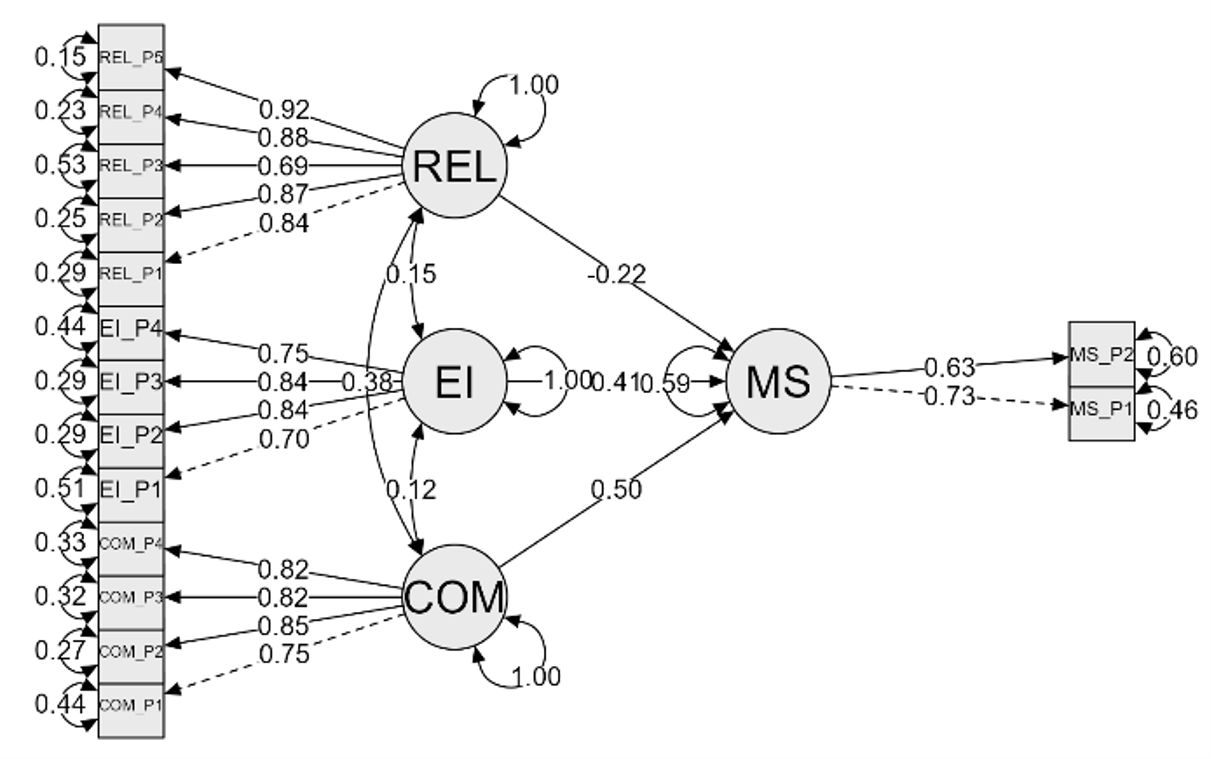
Marital satisfaction serves as a crucial measure of the relationship quality between spouses. Nevertheless, several unresolved issues, including ineffective communication, poor emotional regulation skills, and discrepancies in religious beliefs, can diminish marital satisfaction levels. This research seeks to explore the influence of communication, emotional intelligence, and religiosity on marital satisfaction among married couples in East Lombok Regency. The study utilized a quantitative research method with a correlational design. A sample of 400 married individuals from East Lombok Regency, aged between 18 and 40 years, who had been married for 1 to 5 years, participated by filling out a modified interpersonal communication scale, the TEIQue-SF, CRS-15, and the ENRICH Marital Satisfaction Scale—each of which had been adapted and tested for both validity and reliability in both online and offline formats. Data were analyzed using Structural Equation Modeling (SEM) through the JASP software. The findings revealed that interpersonal communication (β = 0.501, p < 0.001) and emotional intelligence (β = 0.412, p < 0.001) significantly and positively influenced marital satisfaction. In contrast, religiosity (β = −0.218, p < 0.001) exhibited a significant negative impact. In summary, the model accounted for the variation in marital satisfaction, despite one hypothesis not being supported. Overall, the variables accounted for 41% of marital satisfaction, leaving 59% unexplained. Practically, the findings of this study aim to inform the creation of intervention programs to enhance the quality of marital relationships within households.
References
Abreu-Afonso, J., Ramos, M. M., Queiroz-Garcia, I., & Leal, I. (2022). How Couple’s Relationship Lasts Over Time? A Model for Marital Satisfaction. Psychological Reports, 125(3), 1601–1627.
https://doi.org/10.1177/00332941211000651
Abdullah, A. (2020). Menggugat Tradisi Talak Muslim Lombok upaya Mengawal hak-hak perempuan. Al-Mawarid Jurnal Syariah Dan Hukum (JSYH), 2(1), 1–14. Retrieved from https://journal.uii.ac.id/JSYH/article/view/15911
Acar-Bulut, Ö. (2020). The Religious and Spiritual Dimensions of Bowen Family Therapy. Spiritual Psychology And Counseling, 5(1), 65–85. https://doi.org/10.37898/spc.2020.5.1.098
Aji, K. S., Kristiana, I. F., Dewi, E. K. (2023). Marital satisfaction among Husbands of Kawruh Jiwa Suryomentaram Believer Adherent. Indigenous: Jurnal Ilmiah Psikologi, 8(1). 58-69. https://doi.org/10.23917/indigenous.v8i1.20696
Anghel, T. C. (2016). Emotional Intelligence and Marital Satisfaction. Journal of Experiential Psychotherapy, 19(3), 14–23. Retrieved from https://doi.org/https://jep.ro/images/pdf/cuprins_reviste/75_art_3.pdf
Asmuni, Yusdani, Arfaizar, J., & Sulong, J. B. (2025). The erosion of al-mawaddah and ar-rahmah values in Muslim marriages: A socio-religious analysis of marital dynamics in Lombok. Akademika: Jurnal Pemikiran Islam, 30(2), 201-218. https://doi.org/10.32332/akademika.v30i2.11580
Badan Pusat Statistik. (2024). Badan Pusat Statistik Provinsi Nusa Tenggara Barat. (2024). Nikah dan cerai menurut kabupaten/kota (kejadian) di Provinsi Nusa Tenggara Barat. Retrieved from https://ntb.bps.go.id/id/statistics-table/3/VkhwVUszTXJPVmQ2ZFRKamNIZG9RMVo2VEdsbVVUMDkjMw==/nikah-dan-cerai-menurut-kabupaten-kota-di-provinsi-nusa-tenggara-barat–2023.html?year=2024
Bowen, M. (1993). Family therapy in clinical practice. Bloomsbury Publishing PLC.
Bozhabadi, F., Beidokhti, A., Shaghaghi, F., Parimi, A., Kamali, Z., & Gholami, M. (2020). The Relationship between religious orientation and promotion of sexual satisfaction and marital satisfaction in women of reproductive age. Journal of Education and Health Promotion, 9. https://doi.org/10.4103/jehp.jehp_129_19
Brown, J., & Errington, L. (2024). Bowen family systems theory and practice: Illustration and critique revisited. Australian and New Zealand Journal of Family Therapy, 45(2), 135–155. https://doi.org/10.1002/anzf.1589
Bukhari, B., Lintina , S., Mistarija , M., Sabiruddin, S., Ismail, A., & Maisharah, S. (2023). The Mediating Role of Religiosity on the Big Five Personalities and Marital Satisfaction in Indonesia: A Perspective of Da'wah Psychology. Islamic Guidance and Counseling Journal, 6(2). https://doi.org/10.25217/0020236369600
Carlson, D. L., Miller, A. J., & Rudd, S. (2020). Division of Housework, Communication, and Couples’ Relationship Satisfaction. Socius: Sociological Research for a Dynamic World, 6, 2378023120924805. https://doi.org/10.1177/2378023120924805
Chairani, L., Wimbarti, S., Subandi, & Wibirama, S. (2023). Uji validitas konstruk The Centrality of Religiosity Scale (CRS-15) pada sampel Muslim. Psikobuletin: Buletin Ilmiah Psikologi, 4(2), 125–136. https://doi.org/10.24014/pib.v4i2.22609
DeVito, J. A. (2016). The International Communication Book. Pearson Education Limited 2016.
Divorce.com. (2025). Divorce rates by country. Retrieved from https://divorce.com/blog/divorce-rates-in-the-world/
Erwinsya, Handoyono, E., & Arsal, T. (2020). Merariq Tradition of Sasak Tribe in Social Construction and National Law. 9(1), 48-55. Retrieved from https://journal.unnes.ac.id/sju/jess/article/view/43255
Fairiza, A., & Widyatama, R. (2024). Merariq dalam pernikahan suku Sasak: Analisis komunikasi dan dinamika sosial dalam ritual penculikan. Jurnal Analisa Sosiologi, 13(1), 193–218. https://doi.org/10.20961/jas.v13i1.74926
Febriana, S. K. T., & Fajrianthi. (2021). Adapting the Trait Emotional Intelligence Questionnaire Short Form (TEIQUE-SF) into Indonesian Language and Culture Using Confirmatory Factor Analysis. Journal of Educational, Health and Community Psychology, 10(4), 578–603. https://doi.org/10.12928/jehcp.v10i4.21742
Fitriyanti, T. F. (2023). Analysis of Merariq Kodeq Tradition Practiced by Sasak Indigenous People in Lombok Based on Max Weber and Georg Simmel’s Theory. Eduvest - Journal of Universal Studies, 3(6), 1177–1185. https://doi.org/10.59188/eduvest.v3i6.850
Fowers, B. J., & Olson, D. H. (1993). ENRICH Marital Satisfaction Scale: A brief research and clinical tool. Journal of Family Psychology, 7(2), 176–185. https://doi.org/10.1037/0893-3200.7.2.176
Ghaibi, E., Reza, M., Manesh, S., & Dezfouli, H. J. (2022). Comparison of marital satisfaction, emotional divorce and religious commitment among nurses and staff of Ahvaz government hospitals. Zenodo. https://doi.org/10.5281/zenodo.7353470
Gorbanzadeh, F., Gahari, S., Bagdasarian, A., Mohamadi Arya, A., & Rostaie, A. (2013). Marital satisfaction, personality traits and love component. Soc Psychol Res Qyarterly, 9(3), 95-109. Retrieved from https://www.socialpsychology.ir/&url=
Hair, J. F., Risher, J. J., Sarstedt, M., & Ringle, C. M. (2019). When to use and how to report the results of PLS-SEM. European Business Review, 31(1), 2–24. https://doi.org/10.1108/EBR-11-2018-0203
Heidari, M., Shahbazi, S., Ghafourifard, M., & Ali Sheikhi, R. (2017). Prediction of Marital Satisfaction Based on Emotional Intelligence in Postmenopausal Women. Journal of Menopausal Medicine, 23(3), 196. https://doi.org/10.6118/jmm.2017.23.3.196
Heidari, M., & Kumar, G. V. (2021). Influence Of Emotional Intelligence On Marital Satisfaction Among Married Couples. International Journal Of Scientific Research, 61–65. https://doi.org/10.36106/ijsr/2934906
Hocker, J. L., & Willmot, W. W. (2018). Interpersonal Conflict. McGraw-Hill Education.
Huber, S., & Huber, O. W. (2012). The Centrality of Religiosity Scale (CRS). Religions, 3(3), 710–724. https://doi.org/10.3390/rel3030710
Hurlock, E. B. (1980). Developmental psychology: A life-span approach (5th ed). Mc-Graw-Hill.
Hwang, W., Yoon, J., Silverstein, M., & Brown, M. T. (2019). Husband–Wife Religious Discordance, Marital Satisfaction, and Risk of Marital Dissolution in Two Generations. Journal of Family Issues, 40(9), 1201–1223. https://doi.org/10.1177/0192513X19835871
Ibrahim, A. R., Utomo, H. B., & Hanurawan, F. (2025). Adaptasi Alat Ukur ENRICH Marital Satisfaction Scale (EMS) Versi Indonesia. Jurnal Diversita, 11(1), 165–175. https://doi.org/10.31289/diversita.v11i1.14899
Istiqomah, N., Anganthi, N. R. N., & Darojat, M. (2015). Strategi Coping Pada Pasangan Pernikahan Berorientasi Nilai-Nilai Islam. Jurnal Indigenous 13(2), 47-54. https://doi.org/10.23917/indigenous.v13i2.2620
Johnson, M. D., Lavner, J. A., Mund, M., Zemp, M., Stanley, S. M., Neyer, F. J., Impett, E. A., Rhoades, G. K., Bodenmann, G., Weidmann, R., Bühler, J. L., Burriss, R. P., Wünsche, J., & Grob, A. (2022). Within-couple associations between communication and relationship satisfaction over time. Personality and Social Psychology Bulletin, 48(4), 534–549. https://doi.org/10.1177/01461672211016920
Kendhawati, L., & Purba, F. D. (2019). Hubungan kualitas pernikahan dengan kebahagiaan dan kepuasan hidup pribadi: Studi pada individu dengan usia pernikahan 1–5 tahun di Bandung. Jurnal Psikologi, 18(1), 106–115. https://doi.org/10.14710/jp.18.1.106-115
Khairuddin, K. (2024). Fenomena Tren Perceraian di Indonesia: Apa Penyebabnya?. Abdurrauf Science and Society, 1(1), 1–8. https://doi.org/10.70742/asoc.v1i1.95
Komariyah, A. (2024). Kualitas komunikasi interpersonal sebagai mediator pengaruh partner phubbing terhadap kepuasan pernikahan (Master’s thesis, Universitas Muhammadiyah Malang). Retrieved from https://eprints.umm.ac.id/id/eprint/6043
Little, Todd. D., Cunningham, W. A., & Shahar, G. (2002). To Parcel or Not to Parcel: Exploring the Question, Weighing the Merits. Structural Equation Modeling: A Multidisciplinary Journal, 9(2), 151–173. https://doi.org/10.1207/S15328007SEM0902_1
Mäki, M., Hägglund, A. E., Rotkirch, A., Kulathinal, S., & Myrskylä, M. (2025). Stable Marital Histories Predict Happiness and Health Across Educational Groups. European Journal of Population, 41(1), 12. https://doi.org/10.1007/s10680-025-09733-x
Maroufizadeh, S., Hosseini, M., Rahimi Foroushani, A., Omani-Samani, R., & Amini, P. (2018). The relationship between marital satisfaction and depression in infertile couples: An actor–partner interdependence model approach. BMC Psychiatry, 18(1), 310. https://doi.org/10.1186/s12888-018-1893-6
Mehdigholi, M., Dokanei Fard, F., & Jahangir, P. (2022). Presenting a model for predicting marital boredom based on differentiation, emotional intelligence, and mental health mediated by resilience in couples. Applied Family Therapy Journal (AFTJ), 3(4), 347–365. https://doi.org/10.61838/kman.aftj.3.4.19
Muturi, E. (2023). The Impact of Boredom in Marriage on Marital Satisfaction. International Journal of Psychology, 8(3), 43–54. https://doi.org/10.47604/ijp.2120
Narciso I., Costa M. E. (1996). Amores satisfeitos, mas não perfeitos [Satisfied but not perfect loves]. Cadernos de Consulta Psicológica, 12, 115–130. Retrieved from https://hdl.handle.net/10216/15550
Nasim, A., & Pandey, N. D. (2023). The Role of Emotional Intelligence and Communication in Marital Satisfaction. International Journal of Science and Research (IJSR), 12(5), 1291–1295. https://doi.org/10.21275/SR23510175357
Omoboye, M., Eneh, N. E., & Titor-Addingi, M. C. (2024). Communication patterns and marital satisfaction: A review of English language discourse in family counseling. World Journal of Advanced Research and Reviews, 21(2), 1883–1891. https://doi.org/10.30574/wjarr.2024.21.2.0634
Paulino, J. A. (2022). The relationship between rightness, religiosity, and marital satisfaction among Christian spouses in the United States (Doctoral dissertation, Liberty University). Liberty University Scholars Crossing. Retrieved from https://digitalcommons.liberty.edu/doctoral/3991
Petrides, K. V., Vernon, P. A., Schermer, J. A., Ligthart, L., Boomsma, D. I., & Veselka, L. (2010). Relationships between trait emotional intelligence and the Big Five in the Netherlands. Personality and Individual Differences, 48(8), 906–910. https://doi.org/10.1016/j.paid.2010.02.019
Saputri, Y. B., & Handayani, A. (2021). Hubungan antara komunikasi interpersonal dan religiusitas terhadap kepuasan pernikahan pada wanita yang bekerja. Psisula: Prosiding Berkala Psikologi, 3, 204–211. https://doi.org/10.30659/psisula.v3i0.18815
Sari, W., Arif, M., & Elkhairati. (2021). Pemikiran Ibrahim Hosen tentang konsep pernikahan dan kontribusinya terhadap pembaruan hukum perkawinan di Indonesia. Al-Istinbath: Jurnal Hukum Islam, 6(1), 127–144. https://doi.org/10.29240/jhi.v6i1.2540
Selaparang. (2024). Cerai gugat terbanyak, setahun jumlah janda di Lombok Timur 1.363 janda. Retrieved from https://duta-selaparang.com/cerai-gugat-terbanyak-setahun-jumlah-janda-di-lombok-timur-1-363-janda/
Serrat, O. (2017). Understanding And Developing Emotional Intelligence. In: Knowledge Solutions. Springer, Singapore. https://doi.org/10.1007/978-981-10-0983-9_37
Shearin, N. S. (2016). Religiosity and the decreased likelihood to divorce among married Christians in the United States (Doctoral dissertation, Grand Canyon University). Retrieved from https://www.proquest.com/dissertations-theses/religiosity-decreased-likelihood-divorce-among/docview/1767228330/se-2
Soulthana, L., Priyanggasari, A. T. S., & Kartika, F. C. (2023). Komunikasi Interpersonal Terhadap Kepuasan Pernikahan Pada Perempuan Usia Dewasa Awal. Journal Of Indonesian Psychological Science (JIPS), 3(2), 398-415. https://doi.org/10.18860/jips.v3i2.23956
Sugiyono, S. (2013). Metode Penelitian Kuantitatif Kualitatif dan R dan D. Bandung. Alfabeta
Teal, S. (2018). The Association of Attachment and Marital Satisfaction Mediated by Implicit Theories of Relationships. Clinical Psychology Dissertations. 28. Retrieved from https://digitalcommons.spu.edu/cpy_etd/28V
Vazhappilly, J. J., & Reyes, M. E. S. (2016). Couples’ Communication as a Predictor of Marital Satisfaction Among Selected Filipino Couples. Psychological Studies, 61(4), 301–306. https://doi.org/10.1007/s12646-016-0375-5
Vidaña, A. G. (2020). The roles of interpersonal emotion regulation and communication in the relation between posttraumatic stress disorder and substance use risk [Master's thesis, University of Toledo]. Retrieved from http://rave.ohiolink.edu/etdc/view?acc_num=toledo160712296910722
Wang, X., Xie, X., Wang, Y., Wang, P., & Lei, L. (2017). Partner phubbing and depression among married Chinese adults: The roles of relationship satisfaction and relationship length. Personality and Individual Differences, 110, 12–17. https://doi.org/10.1016/j.paid.2017.01.014
Wardhani, N. A. K. (2012). Self Disclosure dan Kepuasan Perkawinan pada Istri di Usia Awal Perkawinan. Calyptra, 1(1), 1-9. Retrieved from https://journal.ubaya.ac.id/index.php/jimus/article/view/68
Wicaksono, I. N. A., & Indrijati, H. (2020). The effect of interpersonal communication on marital satisfaction among wives who married early in Mandangin Islands. In Proceedings of the 3rd International Conference on Psychology in Health, Educational, Social, and Organizational Settings (ICP-HESOS), 133–139. https://doi.org/10.5220/0008586301330139
Wollny, A., Jacobs, I., & Pabel, L. (2020). Trait emotional intelligence and relationship satisfaction: The mediating role of dyadic coping. The Journal of Psychology, 154(1), 75–93. https://doi.org/10.1080/00223980.2019.1661343
Zakiyah, Z. N., & Karyani, U. (2023). Resilience as a Mediator for Relationships Between Religiosity and Social Support With Parents’ Psychological Well-Being. Jurnal Sains Psikologi, 12(1),59-69. http://doi.org/10.17977/um023v12i12023p59-69
Downloads
Submitted
Accepted
Published
How to Cite
Issue
Section
License
Copyright (c) 2026 Indigenous: Jurnal Ilmiah Psikologi

This work is licensed under a Creative Commons Attribution 4.0 International License.