Cyberchondria among University Students: A Scoping Review of Individual Psychological Determinants and Digital Mechanisms
DOI:
https://doi.org/10.23917/indigenous.v11i2.16231Keywords:
cyberchondria, university students, intolerance of uncertainty, reassurance-seeking behaviour, digital mental healthAbstract
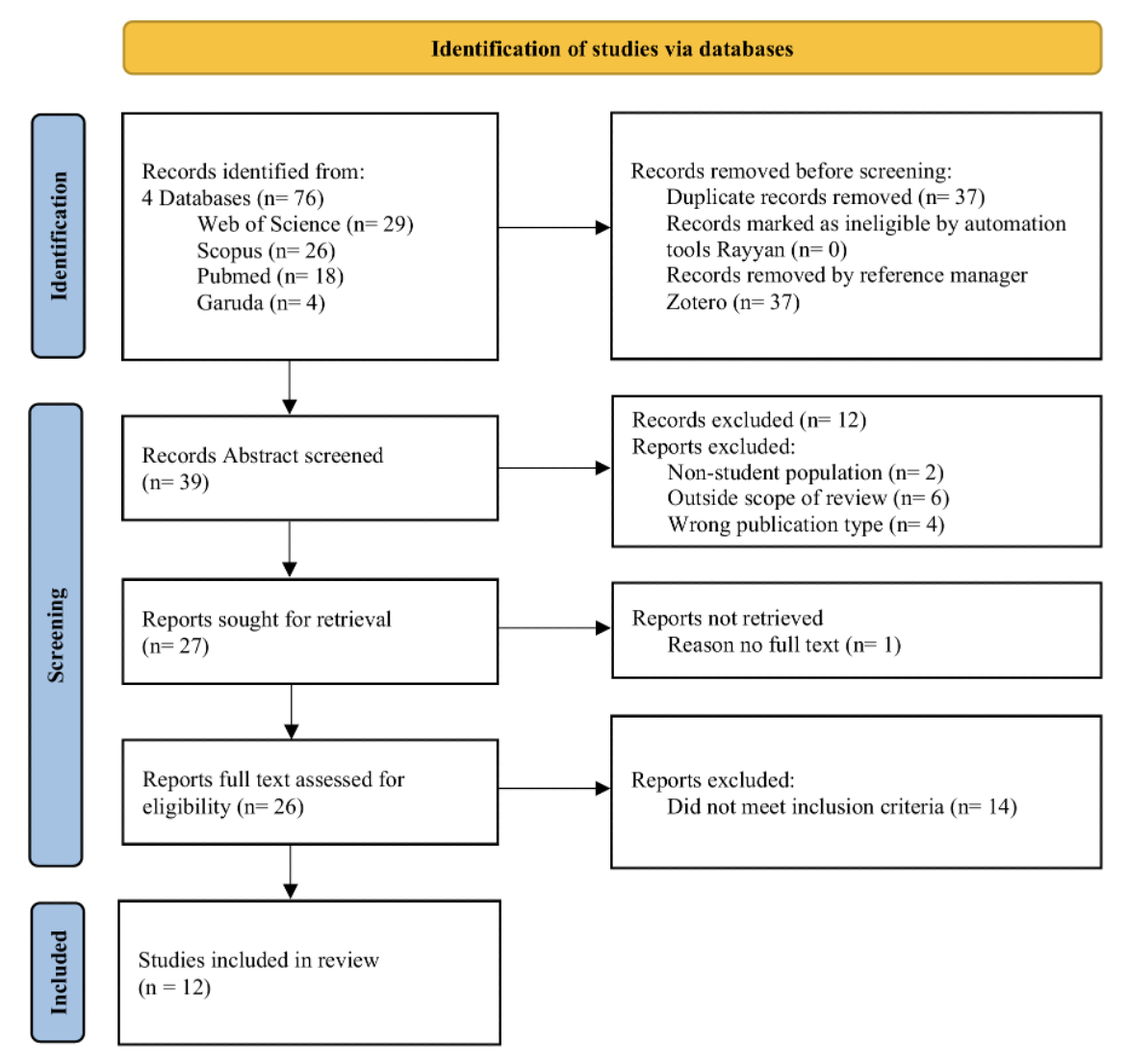
Cyberchondria has emerged as a salient issue among university students, typified by incessant and disproportionate digital seeking of health-related information, culminating in anxiety. The objective of this study is to map scientific findings on the psychological and digital mechanisms that contribute to cyberchondria among university students. A scoping review was conducted according to the Arksey and O'Malley framework and PRISMA-ScR guidelines. A comprehensive literature search was conducted using Web of Science, Scopus, PubMed, and Garuda, yielding 76 initial references. Following screening, 12 studies focusing on university students were selected for inclusion. A thematic and narrative data analysis identified determinants and digital mechanisms. The results indicate that cyberchondria is related to individual psychological factors, including intolerance of uncertainty, health anxiety, anxiety sensitivity, death anxiety, rumination, and individual digital regulation. These vulnerabilities are associated with digital mechanisms, such as online exposure and search patterns, online reassurance-seeking behaviors, echo chambers, and information rabbit holes. Converging factors engender perpetual anxiety, fostering cyberchondria. The findings suggest that cyberchondria occurs as part of a multifactorial phenomenon influenced by interrelated individual psychological determinants and digital mechanisms. This review makes a significant contribution by encouraging the implementation of preventive measures and treatments for university students' mental health in Indonesia.
References
Abu Khait, A., Mrayyan, M. T., Al-Rjoub, S., Rababa, M., & Al-Rawashdeh, S. (2023). Cyberchondria, anxiety sensi-tivity, hypochondria, and internet addiction: Implications for mental health professionals. Current Psychology, 42(31), 27141–27152. https://doi.org/10.1007/s12144-022-03815-3 DOI: https://doi.org/10.1007/s12144-022-03815-3
Akbar, M. F., & Anggraeni, F. D. (2017). Teknologi dalam pendidikan: Literasi digital dan self-directed learning pada mahasiswa skripsi. Indigenous: Jurnal Ilmiah Psikologi, 2(1), 28–38. https://doi.org/10.23917/indigenous.v1i1.4458 DOI: https://doi.org/10.23917/indigenous.v1i1.4458
Ali, S. S., Hendawi, N. E., El-Ashry, A. M., & Mohammed, M. S. (2024). The relationship between cyberchondria and health literacy among first-year nursing students: The mediating effect of health anxiety. BMC Nursing, 23(1), 776. https://doi.org/10.1186/s12912-024-02396-9 DOI: https://doi.org/10.1186/s12912-024-02396-9
Ambrosini, F., Truzoli, R., Vismara, M., Vitella, D., & Biolcati, R. (2022). The effect of cyberchondria on anxiety, depression and quality of life during COVID-19: The mediational role of obsessive-compulsive symptoms and Internet addiction. Heliyon, 8(5), e09437. https://doi.org/10.1016/j.heliyon.2022.e09437 DOI: https://doi.org/10.1016/j.heliyon.2022.e09437
Arksey, H., & O’Malley, L. (2005). Scoping studies: Towards a methodological framework. International Journal of Social Research Methodology, 8(1), 19–32. https://doi.org/10.1080/1364557032000119616 DOI: https://doi.org/10.1080/1364557032000119616
Arnett, J. J. (2000). Emerging adulthood: A theory of development from the late teens through the twenties. American Psychologist, 55(5), 469–480. https://doi.org/10.1037/0003-066X.55.5.469 DOI: https://doi.org/10.1037/0003-066X.55.5.469
Arsenakis, S., Chatton, A., Penzenstadler, L., Billieux, J., Berle, D., Starcevic, V., Viswasam, K., & Khazaal, Y. (2021). Unveiling the relationships between cyberchondria and psychopathological symptoms. Journal of Psychiatric Research, 143, 254–261. https://doi.org/10.1016/j.jpsychires.2021.09.014 DOI: https://doi.org/10.1016/j.jpsychires.2021.09.014
Arumsari, S. R., Akbar, S. N., & Rusli, R. (2025). Peranan problem-focused coping terhadap kecenderungan cyber-chondria pada mahasiswa program pendidikan profesi ners. Jurnal Ecopsy, 11(2), 103. https://doi.org/10.20527/ecopsy.2024.11.009 DOI: https://doi.org/10.20527/ecopsy.2024.11.009
Asosiasi Penyelenggara Jasa Internet Indonesia. (2025). Survei Penetrasi Internet dan Perilaku Penggunaan Internet. Asosiasi Penyelenggara Jasa Internet Indonesia. https://survei.apjii.or.id/survei/group/11
Bahadir, O., & Dundar, C. (2024). The impact of online health information source preference on intolerance to un-certainty and cyberchondria in a youthful generation. Indian Journal of Psychiatry, 66(4), 360–366. https://doi.org/10.4103/indianjpsychiatry.indianjpsychiatry_715_23 DOI: https://doi.org/10.4103/indianjpsychiatry.indianjpsychiatry_715_23
Baralin, A., Boulares, E., Tan, S. C. Y., & Shin, Y. (2025). Identifying strengths and weaknesses in health literacy among medical students: A systematic review. BMC Medical Education, 25(1), 1424. https://doi.org/10.1186/s12909-025-07388-0 DOI: https://doi.org/10.1186/s12909-025-07388-0
Bati, A. H., Mandiracioglu, A., Govsa, F., & Çam, O. (2018). Health anxiety and cyberchondria among Ege Universi-ty health science students. Nurse Education Today, 71, 169–173. https://doi.org/10.1016/j.nedt.2018.09.029 DOI: https://doi.org/10.1016/j.nedt.2018.09.029
Baysan, C., & Palanbek Yavaş, S. (2025). Global research on cyberchondria: Scientometric and visual analysis from 2003 to 2022. Stress and Health, 41(1), e3524. https://doi.org/10.1002/smi.3524 DOI: https://doi.org/10.1002/smi.3524
Bujnowska-Fedak, M. M., & Węgierek, P. (2020). The impact of online health information on patient health beha-viours and making decisions concerning health. International Journal of Environmental Research and Public Health, 17(3), 880. https://doi.org/10.3390/ijerph17030880 DOI: https://doi.org/10.3390/ijerph17030880
Carleton, R. N. (2016). Into the unknown: A review and synthesis of contemporary models involving uncertainty. Journal of Anxiety Disorders, 39, 30–43. https://doi.org/10.1016/j.janxdis.2016.02.007 DOI: https://doi.org/10.1016/j.janxdis.2016.02.007
Chvanova, M. S. (2024). Digital ecosystem for enhancing research and innovation activities of master’s students. Perspectives of Science and Education, 67(1), 659–676. https://doi.org/10.32744/pse.2024.1.37 DOI: https://doi.org/10.32744/pse.2024.1.37
Cinelli, M., De Francisci Morales, G., Galeazzi, A., Quattrociocchi, W., & Starnini, M. (2021). The echo chamber ef-fect on social media. Proceedings of the National Academy of Sciences, 118(9), e2023301118. https://doi.org/10.1073/pnas.2023301118 DOI: https://doi.org/10.1073/pnas.2023301118
Dagar, D., Kakodkar, P., & Shetiya, S. (2019). Evaluating the cyberchondria construct among computer engineering students in Pune (India) Using Cyberchondria Severity Scale (CSS-15). Indian Journal of Occupational and Environmental Medicine, 23(3), 117. https://doi.org/10.4103/ijoem.IJOEM_217_19 DOI: https://doi.org/10.4103/ijoem.IJOEM_217_19
Demi̇Rtepe-Saygili, D., Eşi̇Yok, E., & Turanci, E. (2021). Media usage, health literacy, health anxiety, and health be-haviors of university students during the COVID-19 pandemic. Türkiye İletişim Araştırmaları Dergisi, (38), 19–34. https://doi.org/10.17829/turcom.862102 DOI: https://doi.org/10.17829/turcom.862102
Doherty-Torstrick, E. R., Walton, K. E., & Fallon, B. A. (2016). Cyberchondria: Parsing health anxiety from online behavior. Psychosomatics, 57(4), 390–400. https://doi.org/10.1016/j.psym.2016.02.002 DOI: https://doi.org/10.1016/j.psym.2016.02.002
El-Zoghby, S. M., Zaghloul, N. M., Tawfik, A. M., Elsherbiny, N. M., Shehata, S. A., & Soltan, E. M. (2024). Cyber-chondria and smartphone addiction: A correlation survey among undergraduate medical students in Egypt. Journal of the Egyptian Public Health Association, 99(1), 7. https://doi.org/10.1186/s42506-024-00154-y DOI: https://doi.org/10.1186/s42506-024-00154-y
Fergus, T. A. (2013). Cyberchondria and intolerance of uncertainty: Examining when individuals experience health anxiety in response to internet searches for medical information. Cyberpsychology, Behavior, and Social Net-working, 16(10), 735–739. https://doi.org/10.1089/cyber.2012.0671 DOI: https://doi.org/10.1089/cyber.2012.0671
Fergus, T. A. (2014). The Cyberchondria Severity Scale (CSS): An examination of structure and relations with health anxiety in a community sample. Journal of Anxiety Disorders, 28(6), 504–510. https://doi.org/10.1016/j.janxdis.2014.05.006 DOI: https://doi.org/10.1016/j.janxdis.2014.05.006
Fergus, T. A., & Spada, M. M. (2018). Moving toward a metacognitive conceptualization of cyberchondria: Exami-ning the contribution of metacognitive beliefs, beliefs about rituals, and stop signals. Journal of Anxiety Disor-ders, 60, 11–19. https://doi.org/10.1016/j.janxdis.2018.09.003 DOI: https://doi.org/10.1016/j.janxdis.2018.09.003
Hamid, M. S., Abo Hamza, E., Rivera, R. M., Carballea, D., & Mohamed, N. I. A. (2023). Addiction to medical web-sites post COVID-19 pandemic: A predictor of illness anxiety disorder among Arabian youth. Discover Psy-chology, 3(1), 9. https://doi.org/10.1007/s44202-023-00067-5 DOI: https://doi.org/10.1007/s44202-023-00067-5
Hapsari, D. K., Karyani, U., & Hertinjung, W. (2021). Pelatihan online psikologi positif berbasis nilai islam untuk me-ningkatkan resiliensi mahasiswa. Indigenous: Jurnal Ilmiah Psikologi, 6(3), 36–48. https://doi.org/10.23917/indigenous.v6i3.14043 DOI: https://doi.org/10.23917/indigenous.v6i3.14043
Hsu, W.-C. (2025). eHealth literacy and cyberchondria severity among undergraduate students: Mixed methods study. JMIR Formative Research, 9, e63449–e63449. https://doi.org/10.2196/63449 DOI: https://doi.org/10.2196/63449
Jacobs, W., Amuta, A. O., & Jeon, K. C. (2017). Health information seeking in the digital age: An analysis of health information seeking behavior among US adults. Cogent Social Sciences, 3(1), 1302785. https://doi.org/10.1080/23311886.2017.1302785 DOI: https://doi.org/10.1080/23311886.2017.1302785
Juniar, D., Grasiawaty, N., & Kinanthi, M. R. (2025). Perception and signs of stress among Indonesian university stu-dents: insights from rileks module responses. Indigenous: Jurnal Ilmiah Psikologi, 10(3), 275–293. https://doi.org/10.23917/indigenous.v10i3.10024 DOI: https://doi.org/10.23917/indigenous.v10i3.10024
Kanganolli, S., & N, P. (2020). A cross-sectional study on prevalence of cyberchondria and factors influencing it among undergraduate students. International Journal of Medical Science and Public Health, 9(4), 263–266. https://doi.org/10.5455/ijmsph.2020.01010202020022020 DOI: https://doi.org/10.5455/ijmsph.2020.01010202020022020
Kefeli Col, B., Gumusler Basaran, A., & Genc Kose, B. (2025). The relationship between e-health literacy, health an-xiety, cyberchondria, and death anxiety in university students that study in health related department. Journal of Multidisciplinary Healthcare, 18, 1581–1595. https://doi.org/10.2147/JMDH.S513017 DOI: https://doi.org/10.2147/JMDH.S513017
Khairina, S., Maharani, D., Yavuz, Y., & Setiawati, F. (2021). Use of internet platforms for information about sensi-tive teeth among Indonesian adults: A cross-sectional study. Makara Journal of Health Research, 25(2). https://doi.org/10.7454/msk.v25i2.1285 DOI: https://doi.org/10.7454/msk.v25i2.1285
Kobryn, M., & Duplaga, M. (2024). Cyberchondria severity and utilization of health services in Polish society: A cross-sectional study. BMC Public Health, 24(1), 902. https://doi.org/10.1186/s12889-024-18399-9 DOI: https://doi.org/10.1186/s12889-024-18399-9
Kurcer, M. A., Erdogan, Z., & Cakir Kardes, V. (2022). The effect of the COVID‐19 pandemic on health anxiety and cyberchondria levels of university students. Perspectives in Psychiatric Care, 58(1), 132–140. https://doi.org/10.1111/ppc.12850 DOI: https://doi.org/10.1111/ppc.12850
Mathes, B. M., Norr, A. M., Allan, N. P., Albanese, B. J., & Schmidt, N. B. (2018). Cyberchondria: Overlap with health anxiety and unique relations with impairment, quality of life, and service utilization. Psychiatry Research, 261, 204–211. https://doi.org/10.1016/j.psychres.2018.01.002 DOI: https://doi.org/10.1016/j.psychres.2018.01.002
McElroy, E., & Shevlin, M. (2014). The development and initial validation of the cyberchondria severity scale (CSS). Journal of Anxiety Disorders, 28(2), 259–265. https://doi.org/10.1016/j.janxdis.2013.12.007 DOI: https://doi.org/10.1016/j.janxdis.2013.12.007
McMullan, R. D., Berle, D., Arnáez, S., & Starcevic, V. (2019). The relationships between health anxiety, online health information seeking, and cyberchondria: Systematic review and meta-analysis. Journal of Affective Di-sorders, 245, 270–278. https://doi.org/10.1016/j.jad.2018.11.037 DOI: https://doi.org/10.1016/j.jad.2018.11.037
Miezah, D., Adzakpa, R., Bani, E. M. A., & Obeng, P. (2026). Prevalence and associated factors of cyberchondria: A scoping review. The Scientific World Journal, 2026(1), 9950027. https://doi.org/10.1155/tswj/9950027 DOI: https://doi.org/10.1155/tswj/9950027
Montagni, I., Donisi, V., Tedeschi, F., Parizot, I., Motrico, E., & Horgan, A. (2016). Internet use for mental health in-formation and support among European university students: The e-MentH project. DIGITAL HEALTH, 2, 2055207616653845. https://doi.org/10.1177/2055207616653845 DOI: https://doi.org/10.1177/2055207616653845
Morze, N., Smyrnova‐Trybulska, E., Drlík, M., & Buinytska, O. (2023). Development of advanced digital ecosystems at universities: A study comparing experiences from Ukraine, Poland and Slovakia. European Journal of Edu-cation, 58(4), 647–664. https://doi.org/10.1111/ejed.12588 DOI: https://doi.org/10.1111/ejed.12588
Mrayyan, M. T., Alkhawaldeh, J. M., Alfayoumi, I., Algunmeeyn, A., Abunab, H. Y., Suliman, W. A., Abu Hasheesh, M., & Shudifat, R. (2023). COVID-19 era-related e-learning: A cross-sectional web-scale study of cyber-chondria, internet addiction and anxiety-related symptomatology among university nursing students. BMJ Open, 13(8), e071971. https://doi.org/10.1136/bmjopen-2023-071971 DOI: https://doi.org/10.1136/bmjopen-2023-071971
Muthukrishna, M., Bell, A. V., Henrich, J., Curtin, C. M., Gedranovich, A., McInerney, J., & Thue, B. (2020). Beyond Western, Educated, Industrial, Rich, and Democratic (WEIRD) Psychology: Measuring and mapping scales of cultural and psychological distance. Psychological Science, 31(6), 678–701. https://doi.org/10.1177/0956797620916782 DOI: https://doi.org/10.1177/0956797620916782
Nasiri, M., Mohammadkhani, S., Akbari, M., & Alilou, M. M. (2023). The structural model of cyberchondria based on personality traits, health-related metacognition, cognitive bias, and emotion dysregulation. Frontiers in Psy-chiatry, 13, 960055. https://doi.org/10.3389/fpsyt.2022.960055 DOI: https://doi.org/10.3389/fpsyt.2022.960055
Page, M. J., McKenzie, J. E., Bossuyt, P. M., Boutron, I., Hoffmann, T. C., Mulrow, C. D., Shamseer, L., Tetzlaff, J. M., Akl, E. A., Brennan, S. E., Chou, R., Glanville, J., Grimshaw, J. M., Hróbjartsson, A., Lalu, M. M., Li, T., Loder, E. W., Mayo-Wilson, E., McDonald, S., … Moher, D. (2021). The PRISMA 2020 statement: An up-dated guideline for reporting systematic reviews. BMJ, 372, n71. https://doi.org/10.1136/bmj.n71 DOI: https://doi.org/10.1136/bmj.n71
Patanapu, S. K., Sreeja, C. S., Veeraboina, N., Reddy, K. V., Voruganti, S., & Anusha, P. (2022). Prevalence and ef-fect of cyberchondria on academic performance among undergraduate dental students: An institutional based study. Industrial Psychiatry Journal, 31(2), 228–234. https://doi.org/10.4103/ipj.ipj_272_21 DOI: https://doi.org/10.4103/ipj.ipj_272_21
Pertiwi, E. M., Suminar, D. R., & Ardi, R. (2022). Psychological well-being among Gen Z social media users: Explo-ring the role of self-esteem and social media dependency as mediators and social media usage motives as moderator. Indigenous: Jurnal Ilmiah Psikologi, 7(3), 204–218. https://doi.org/10.23917/indigenous.v7i3.19851 DOI: https://doi.org/10.23917/indigenous.v7i3.19851
Peters, M. D., Godfrey, C., McInerney, P., Munn, Z., Tricco, A. C., & Khalil, H. (2024). Scoping reviews. In E. Aro-mataris, C. Lockwood, K. Porritt, B. Pilla, & Z. Jordan (Eds.), JBI Manual for Evidence Synthesis. JBI. https://doi.org/10.46658/JBIMES-24-09 DOI: https://doi.org/10.46658/JBIMES-24-09
Pratama, A. N. W., Ramani, A., & Mardro Raharjo, A. (2021). Does lockdown affect online health information-seeking behaviour of covid-19 preventive measures among iIndonesians? A Google Trends analysis. Ulum Islamiyyah, 33(2), 93–106. https://doi.org/10.33102/uij.vol33no1.295 DOI: https://doi.org/10.33102/uij.vol33no1.295
Rahman, A., Lima, N. J., Nurunnabi, A. S. M., Rukon, R., Hassan, A., & Sultana, H. (2025). Online health information seeking behaviour and perceived trust on health communication channels among undergraduate students of bangladesh: online health information seeking behaviour. Journal of the Medical College for Women & Hospi-tal, 21(1), 86–94. https://doi.org/10.3329/jmcwh.v21i1.80080 DOI: https://doi.org/10.3329/jmcwh.v21i1.80080
Sabeen Sabir, & Naqvi, I. (2023). Prevalence of cyberchondria among university students: An emerging challenge of the 21st century. Journal of the Pakistan Medical Association, 73(8), 1634–1639. https://doi.org/10.47391/JPMA.7771 DOI: https://doi.org/10.47391/JPMA.7771
Salim, G. T., Chotidjah, S., & Musthofa, M. A. (2024). Hubungan Rumination dan Cyberchondria pada Mahasiswa Rantau. 10(1). https://doi.org/https://doi.org/10.26858/talenta.v10i1.63734
Schäfer, M., Stark, B., Werner, A. M., Tibubos, A. N., Reichel, J. L., Pfirrmann, D., Edelmann, D., Heller, S., Mülder, L. M., Rigotti, T., Letzel, S., & Dietz, P. (2021). Health information seeking among university students before and during the corona crisis—findings from Germany. Frontiers in Public Health, 8, 616603. https://doi.org/10.3389/fpubh.2020.616603 DOI: https://doi.org/10.3389/fpubh.2020.616603
Schenkel, S. K., Jungmann, S. M., Gropalis, M., & Witthöft, M. (2021). Conceptualizations of cyberchondria and rela-tions to the anxiety spectrum: Systematic review and meta-analysis. Journal of Medical Internet Research, 23(11), e27835. https://doi.org/10.2196/27835 DOI: https://doi.org/10.2196/27835
Shailaja, B., Shetty, V., Chaudhury, S., & Thyloth, M. (2020). Exploring cyberchondria and its associations in dental students amid COVID-19 infodemic. Industrial Psychiatry Journal, 29(2), 257–267. https://doi.org/10.4103/ipj.ipj_212_20 DOI: https://doi.org/10.4103/ipj.ipj_212_20
Starcevic, V., & Berle, D. (2013). Cyberchondria: Towards a better understanding of excessive health-related Inter-net use. Expert Review of Neurotherapeutics, 13(2), 205–213. https://doi.org/10.1586/ern.12.162 DOI: https://doi.org/10.1586/ern.12.162
Starcevic, V., Berle, D., & Arnáez, S. (2020). Recent insights into cyberchondria. Current Psychiatry Reports, 22(11), 56. https://doi.org/10.1007/s11920-020-01179-8 DOI: https://doi.org/10.1007/s11920-020-01179-8
Swire-Thompson, B., & Lazer, D. (2020). Public health and online misinformation: Challenges and recommendations. Annual Review of Public Health, 41(1), 433–451. https://doi.org/10.1146/annurev-publhealth-040119-094127 DOI: https://doi.org/10.1146/annurev-publhealth-040119-094127
Szawłoga, T., Soroka, K. D., & Śliwińska, M. (2024). Cyberchondria in students: An eHealth related problem. A re-view. Medical Science Pulse, 18(2), 12–21. https://doi.org/10.5604/01.3001.0054.5653 DOI: https://doi.org/10.5604/01.3001.0054.5653
Timotheou, S., Miliou, O., Dimitriadis, Y., Sobrino, S. V., Giannoutsou, N., Cachia, R., Monés, A. M., & Ioannou, A. (2023). Impacts of digital technologies on education and factors influencing schools’ digital capacity and transformation: A literature review. Education and Information Technologies, 28(6), 6695–6726. https://doi.org/10.1007/s10639-022-11431-8 DOI: https://doi.org/10.1007/s10639-022-11431-8
Tricco, A. C., Lillie, E., Zarin, W., O’Brien, K. K., Colquhoun, H., Levac, D., Moher, D., Peters, M. D. J., Horsley, T., Weeks, L., Hempel, S., Akl, E. A., Chang, C., McGowan, J., Stewart, L., Hartling, L., Aldcroft, A., Wilson, M. G., Garritty, C., … Straus, S. E. (2018). PRISMA Extension for Scoping Reviews (PRISMA-ScR): Check-list and explanation. Annals of Internal Medicine, 169(7), 467–473. https://doi.org/10.7326/M18-0850 DOI: https://doi.org/10.7326/M18-0850
Varma, R., & Singh, T. (2023). Cyberchondria and health: Exploring the linkages. Mind and Society, 12(02), 29–34. https://doi.org/10.56011/mind-mri-122-20233 DOI: https://doi.org/10.56011/mind-mri-122-20233
Vismara, M., Caricasole, V., Starcevic, V., Cinosi, E., Dell’Osso, B., Martinotti, G., & Fineberg, N. A. (2020). Is cy-berchondria a new transdiagnostic digital compulsive syndrome? A systematic review of the evidence. Com-prehensive Psychiatry, 99, 152167. https://doi.org/10.1016/j.comppsych.2020.152167 DOI: https://doi.org/10.1016/j.comppsych.2020.152167
Wang, D., Sun, L., Shao, Y., Zhang, X., Maguire, P., & Hu, Y. (2023). Research and evaluation of a cyberchondria severity scale in a Chinese context. Psychology Research and Behavior Management, Volume 16, 4417–4429. https://doi.org/10.2147/PRBM.S431470 DOI: https://doi.org/10.2147/PRBM.S431470
Wynn, R. (2019). Challenges related to health information on the Internet: A narrative review. International Journal of Integrated Care, 19(4), 391. https://doi.org/10.5334/ijic.s3391 DOI: https://doi.org/10.5334/ijic.s3391
Yang, C., & Xu, R. H. (2025). Impact of cyberchondria on health and quality of life: Scoping review. Journal of Me-dical Internet Research, 27, e77977. https://doi.org/10.2196/77977 DOI: https://doi.org/10.2196/77977
Zhao, Y., & Zhang, J. (2017). Consumer health information seeking in social media: A literature review. Health In-formation & Libraries Journal, 34(4), 268–283. https://doi.org/10.1111/hir.12192 DOI: https://doi.org/10.1111/hir.12192
Zhu, X., Zheng, T., Ding, L., & Zhang, X. (2023). Exploring associations between eHealth literacy, cyberchondria, online health information seeking and sleep quality among university students: A cross-section study. Heliyon, 9(6), e17521. https://doi.org/10.1016/j.heliyon.2023.e17521 DOI: https://doi.org/10.1016/j.heliyon.2023.e17521
Downloads
Submitted
Accepted
Published
How to Cite
Issue
Section
License
Copyright (c) 2026 Indigenous: Jurnal Ilmiah Psikologi

This work is licensed under a Creative Commons Attribution 4.0 International License.