Healing Narratives After Sexual Violence in the Shadow of Sing Beling Sing Nganten
DOI:
https://doi.org/10.23917/indigenous.v11i3.16182Keywords:
balinese cultural values, narrative ethnography, psychological experiences, sexual violence, women survivorsAbstract
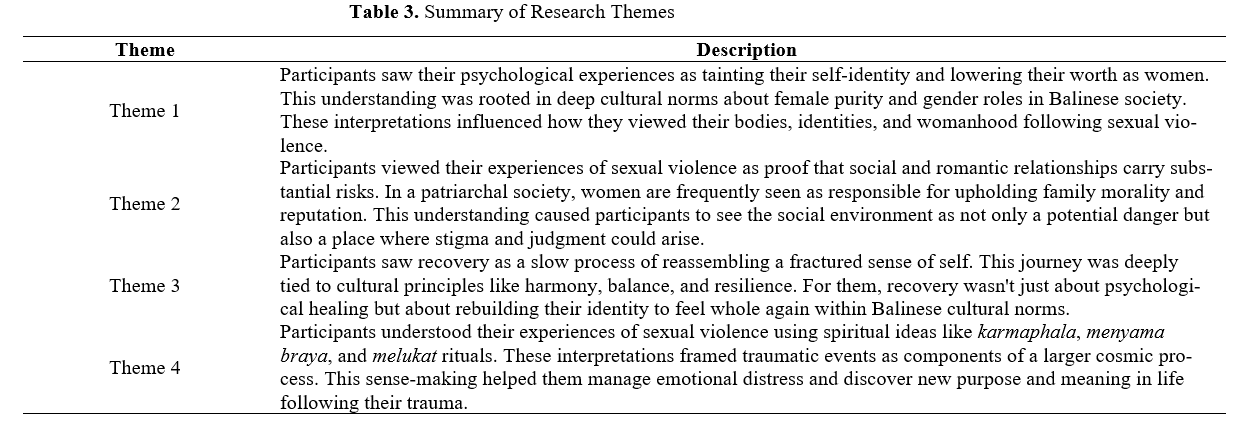
Sexual violence against women in Bali is closely linked to gender inequality sustained by patriarchal cultural values. One cultural phenomenon that contributes to this condition is sing beling sing nganten, which normalizes premarital sexual relations as a marker of fertility and social acceptance, potentially increasing vulnerability to sexual violence and intensifying psychological distress among survivors. This study aims to explore the psychological experiences of Balinese women after sexual violence through an analysis of their personal narratives within the framework of Balinese cultural values. A qualitative study using a narrative ethnographic approach was conducted to examine how culture shapes meaning-making processes, self-perception, and recovery among survivors. The participants consisted of five adult unmarried Balinese women who had experienced sexual violence, recruited through purposive sampling. Data were collected through in-depth interviews, participatory observation, and supplementary interviews with community leaders and religious figures to provide broader cultural perspectives. The data were analyzed thematically to identify recurring patterns and meanings within the narratives. The findings revealed four central themes: psychological trauma within cultural contexts, social relationships and cultural values, processes of self-acceptance within cultural frameworks, and the role of spirituality and Balinese cultural values in recovery. These themes illustrate how survivors negotiate personal suffering, social expectations, and cultural beliefs in reconstructing their sense of self after sexual violence. The study concludes that Balinese cultural values can function both as sources of psychological burden and as potential protective factors in the recovery process. These findings highlight the importance of developing culturally sensitive interventions and contribute to a deeper understanding of sexual violence and healing within the Balinese cultural context.
References
A, M. A., Suryani, N., & Ardianto, D. (2020). Egalitarian society through the value of Tat Twam Asi, a review of local wisdom. Proceedings of the Proceedings of the Third International Seminar on Recent Language, Literature, and Local Culture Studies, BASA, 20-21 September 2019, Surakarta, Central Java, Indonesia. Proceedings of the Third International Seminar on Recent Language, Literature, and Local Culture Studies, BASA, 20-21 September 2019, Surakarta, Central Java, Indonesia. https://doi.org/10.4108/eai.20-9-2019.2296634 DOI: https://doi.org/10.4108/eai.20-9-2019.2296634
Audina, R. (2024). Coping strategy remaja perempuan dalam menghadapi budaya patriarki dan kekerasan seksual (studi kasus remaja perempuan di sentra Paramita Mataram) [UIN Sunan Kalijaga Yogyakarta].Retrieved From https://digilib.uin-suka.ac.id/id/eprint/63475/
Bolger, N. (1990). Coping as a personality process: A prospective study. Journal of Personality and Social Psychology, 59(3), 525–537. https://doi.org/10.1037/0022-3514.59.3.525 DOI: https://doi.org/10.1037/0022-3514.59.3.525
Bryant-Davis, T. (2019). The cultural context of trauma recovery: Considering the posttraumatic stress disorder practice guideline and intersectionality. Psychotherapy, 56(3), 400–408. https://doi.org/10.1037/pst0000241 DOI: https://doi.org/10.1037/pst0000241
Chandra, N. M. T., Susanti, E., & Kinuthia, K. M. (2020). Women’s subordination in premarital pregnancy. Masyarakat, Kebudayaan Dan Politik, 33(3), 238. https://doi.org/10.20473/mkp.v33i32020.238-247 DOI: https://doi.org/10.20473/mkp.V33I32020.238-247
Chynoweth, J., Hosking, J., Jeffery, A., & Pinkney, J. (2020). Contrasting impact of androgens on male and female adiposity, fat distribution and insulin resistance in childhood and adolescence (EarlyBird 75). Pediatric Obesity, 15(12). https://doi.org/10.1111/ijpo.12685 DOI: https://doi.org/10.1111/ijpo.12685
Dania, I. A. (2020). Kekerasan seksual pada anak. Ibnu Sina: Jurnal Kedokteran Dan Kesehatan - Fakultas Kedokteran Universitas Islam Sumatera Utara, 19(1), 46–52. https://doi.org/10.30743/ibnusina.v19i1.15 DOI: https://doi.org/10.30743/ibnusina.v19i1.15
Darmayasa, I. M., & Natanael, R. J. M. (2023). Gangguan stres pasca trauma pada kasus pelecehan seksual: Case Report. Jurnal Kesehatan Reproduksi, 10(2). https://doi.org/10.22146/jkr.78372 DOI: https://doi.org/10.22146/jkr.78372
Darmayoga, I. K. A. (2021). Perempuan dan budaya patriarki dalam tradisi, keagamaan di Bali (studi kasus posisi superordinat dan subordinat laki-laki dan perempuan). Danapati, 1(2), 139–152. Retrieved from https://ekadanta.org/jurnal/index.php/danapati/article/view/136
Dewi, N. K. R. K., Arthani, N. L. G. Y., Sutrisni, N. K., Dewi, P. P. P., & Sari, N. N. D. M. P. (2022). Kedudukan perempuan sebagai korban dalam fenomena Sing Beling Sing Nganten di Bali. Jurnal Hukum Saraswati (JHS), 04(02), 244–254.
Divariani, P., & Widiasavitri, P. N. (2025). The experiences of male adolescents who have been in a toxic relationship. Jurnal Psikologi Ulayat. https://doi.org/10.24854/jpu1013 DOI: https://doi.org/10.24854/jpu1013
Farooqui, U., & Pushkarna, M. (2021). A study exploring post traumatic growth (PTG) in individuals who have undergone traumatic life events. The International Journal of Indian Psychology, 9, 347–374. https://doi.org/10.25215/0903.037
Grant, A. M., & Gerrard, B. (2020). Comparing problem-focused, solution-focused and combined problem-focused/solution-focused coaching approach: Solution-focused coaching questions mitigate the negative impact of dysfunctional attitudes. Coaching: An International Journal of Theory, Research and Practice, 13(1), 61–77. https://doi.org/10.1080/17521882.2019.1599030 DOI: https://doi.org/10.1080/17521882.2019.1599030
Hardianti, R., & Oktariana. (2022). Gambaran Kepercayaan diri pada Korban yang mengalami Kekerasan Seksual. UNES Journal of Social and Economics Research, 7(2), 15–24. Retrieved from https://ojs.ekasakti.org/index.php/UJSCR/article/view/313
Huwaida, J., Maya Tsurayya Alfadla, Siti Anne Barkah Nur Fauziah, Ilham Mulyadi, & Puteri Azka Salsabila. (2025). Social Support as a Form of Stress Coping Mechanism among Students Facing Social Problems in Islamic Boarding Universities. Indigenous: Jurnal Ilmiah Psikologi, 10(1). https://doi.org/10.23917/indigenous.v10i1.6080 DOI: https://doi.org/10.23917/indigenous.v10i1.6080
KEMENPPPA. (2026). SIMFONI-PPA. Retrieved from https://kekerasan.kemenpppa.go.id/ringkasan
Krisiandi. (2023). Polda Bali tangani 260 kasus kekerasan terhadap anak dan perempuan sepanjang 2022. Retrieved from https://regional.kompas.com/read/2023/02/07/124417078/polda-bali-tangani-260-kasus-kekerasan-terhadap-anak-dan-perempuan
Mappe, U. U., & Jusnawati, J. (2022). Budaya patriarki masyarakat migran Bali di Desa kertoraharjo Kecamatan Tomoni Timur Kabupaten Luwu Timur. Sosioreligius: Jurnal Ilmiah Sosiologi Agama, 7(2), 37–49. https://doi.org/10.24252/sosioreligius.v7i2.33760 DOI: https://doi.org/10.24252/sosioreligius.v7i2.33760
Mustaqim, M. (2013). Konstruksi dan reproduksi budaya khitan perempuan: Pergulatan antara tradisi, keberagaman dan kekerasan seksual di Jawa. Palastren, 6(1), 89–105. https://dx.doi.org/10.21043/palastren.v6i1.979
Octaviani, F., & Nurwati, N. (2021). Analisis faktor dan dampak kekerasan seksual pada anak. Humanitas: Jurnal Ilmu Kesejahteraan Sosial Fisip Unpas, 3(2), 56–60. https://doi.org/10.23969/humanitas.v3iii.4118 DOI: https://doi.org/10.23969/humanitas.v3iII.4118
Pandeyana, I. K. M., & Oka Dharma, I. B. G. R. (2024). The concept perspective of karmaphala as the law of cause and effect in the pillars of Hindu religious beliefs. International Journal of Multidisciplinary Sciences, 2(3), 310–320. https://doi.org/10.37329/ijms.v2i3.2333 DOI: https://doi.org/10.37329/ijms.v2i3.2333
Pangestika, A. P., Purnamasari, S. E., & Kurniawan, A. P. (2022). Hubungan antara persepsi budaya patriarki dengan perilaku kekerasan seksual terhadap perempuan pada laki-laki dewasa awal. PSIKOSAINS (Jurnal Penelitian Dan Pemikiran Psikologi), 16(2), 137. https://doi.org/10.30587/psikosains.v16i2.4578 DOI: https://doi.org/10.30587/psikosains.v16i2.4578
Pertiwi, D. A. C., & Scarvanovi, B. W. (2025). The influence of spirituality on the resilience of victims of online gender-based violence in early adulthood: Self-esteem mediation. Indigenous: Jurnal Ilmiah Psikologi, 10(3), 311–325. https://doi.org/10.23917/indigenous.v10i3.10625 DOI: https://doi.org/10.23917/indigenous.v10i3.10625
Polettini, S., Arima, S., & Martino, S. (2024). An investigation of models for under-reporting in the analysis of violence against women in Italy. Social Indicators Research, 175(3), 1007–1026. https://doi.org/10.1007/s11205-023-03225-3 DOI: https://doi.org/10.1007/s11205-023-03225-3
Putra, A. S., Hijjang, P., & Tang, M. (2019). The Role of Social Support in the Ritual Melukat: An Ethnographic Study. Asian Journal of Social Sciences, 2(47), 215–228. https://doi.org/10.47616/jamrsss.v4i3.436 DOI: https://doi.org/10.47616/jamrsss.v4i3.436
Ramadani, N. R., & Rahmasari, D. (2023). Posttraumatic growth pada laki-laki penyintas kekerasan seksual. Character Jurnal Penelitian Psikologi (CJPP), 10(2), 522–544. https://doi.org/10.26740/cjpp.v10i2.53887
Robinson, M. D., Hassija, C. M., & Wellman, J. D. (2024). Trauma-related shame, characterological self-blame, and psychological outcomes among sexual assault survivors. Journal of Loss and Trauma, 29(8), 924–943. https://doi.org/10.1080/15325024.2024.2362695 DOI: https://doi.org/10.1080/15325024.2024.2362695
Setiono, K. (2002). Pengembangan psikologi indigenous di Indonesia. Indigenous: Jurnal Ilmiah Psikologi, 6, 86–90. https://doi.org/10.23917/indigenous.v0i0.4626
Stockman, D., Uzieblo, K., Fomenko, E., Littleton, H., Keygnaert, I., Lemmens, G., & Verhofstadt, L. (2024). Psychological distress and relational intimacy following sexual violence: A longitudinal study. Psychologica Belgica, 64(1), 185–200. https://doi.org/10.5334/pb.1240 DOI: https://doi.org/10.5334/pb.1240
Suadnyana, I. W. S. (2023). 185 perempuan-anak di Bali alami kekerasan dalam 9 bulan. Detik. 185 Perempuan-Anak Di Bali Alami Kekerasan Dalam 9 Bulan. Retrieved from https://www.detik.com/bali/hukum-dan-kriminal/d-6933828/185-perempuan-anak-di-bali-alami-kekerasan-dalam-9-bulan
Sulastri, S., & Nurhayaty, A. (2021). Dinamika psikologis anak perempuan korban kekerasan seksual incest: Sebuah studi kasus. PSYCHE: Jurnal Psikologi, 3(1), 2655–6936. https://doi.org/10.36269/psyche.v3i1.340 DOI: https://doi.org/10.36269/psyche.v3i1.340
Sutariani, N. K. (2023). Perlindungan hukum atas diskriminasi terhadap perempuan akibat pengaruh budaya Patriarkii (Purusha) di Kota Denpasar. Universitas Mahasaraswati Denpasar. Retrieved from https://eprints.unmas.ac.id/id/eprint/4902/
Swandari, N. M., Laksmi Dewi, A. A. S., & Suryani, L. P. (2022). Tinjauan teoritis psikologi terhadap anak yang menjadi korban kekerasan seksual. Jurnal Konstruksi Hukum, 3(1), 184–190. https://doi.org/10.22225/jkh.3.1.4418.184-190 DOI: https://doi.org/10.22225/jkh.3.1.4418.184-190
Urbayatun, S., & Rahman, A. (2022). Kajian literatur kekerasan seksual pada anak laki-laki. Sosio Informa, 8(2), 435–457. https://doi.org/10.31595/inf.v8i2.2990
Viskarini, P. A., & Suharsono, Y. (2023). Pengaruh dukungan sosial terhadap harga diri remaja putri korban pelecehan seksual. Cognicia, 11(1), 47–53. https://doi.org/10.22219/cognicia.v11i1.25003 DOI: https://doi.org/10.22219/cognicia.v11i1.25003
Widhiyana, M. (2024). Pengaruh budaya patriarki terhadap kesetaraan gender dalam keluarga Hindu. Belom Bahadat, 14(1), 83–99. https://doi.org/10.33363/bb.v14i1.1179 DOI: https://doi.org/10.33363/bb.v14i1.1179
Winata, K. (2025). Tahun 2024, ada 383 kasus kekerasan perempuan dan anak terjadi di Bali. Balipost. Retrieved from https://www.balipost.com/news/2025/02/03/440043/Tahun-2024,Ada-383-Kasus...html
Yanti, H., & Abdullah, E. S. P. S. (2021). Gambaran kepercayaan diri pada remaja yang mengalami kekerasan seksual di desa X. JURNAL PSIMAWA, 4(1), 55–60. https://doi.org/10.36761/jp.v4i1.1272 DOI: https://doi.org/10.36761/jp.v4i1.1272
Yosep, I., Suryani, S., Mediani, H. S., Mardhiyah, A., & Hernawaty, T. (2024). A scoping review of nursing interventions to reduce PTSD in adolescents who have been sexually abused. BMC Nursing, 23(1), 470. https://doi.org/10.1186/s12912-024-02130-5 DOI: https://doi.org/10.1186/s12912-024-02130-5
Downloads
Submitted
Accepted
Published
How to Cite
Issue
Section
License
Copyright (c) 2026 Indigenous: Jurnal Ilmiah Psikologi

This work is licensed under a Creative Commons Attribution 4.0 International License.