The Influence of Father’s presence on College Students' Mental Health: The Role of Religiosity as a Mediator and Moderator
DOI:
https://doi.org/10.23917/indigenous.v11i2.16050Keywords:
Father’s presence, religiosity, mental health, mediation, moderationAbstract
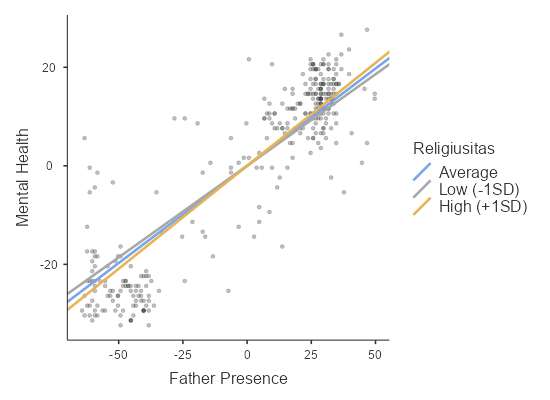
This study aims to examine the effect of Father’s presence on college students' mental health by considering the role of religiosity as a mediating and moderating variable. Increased mental health problems in college students are often associated with academic pressure, emotional instability, and weakened family support, especially from father figures. Religiosity is viewed as a protective factor that can strengthen students' psychological resilience. A total of 330 college students aged 18–24 (M = 20, SD = 1,207) participated in this study through accidental sampling. The instruments used included the Mental Health Continuum–Short Form (MHC–SF), the Centrality of Religiosity Scale (CRS), and the Father’s presence Questionnaire (FPQ). Researchers used regression analysis and Structural Equation Modeling (SEM) to test the mediating and moderating roles using Jamovi software. The results showed that Father’s presence and religiosity significantly improved college students' mental health (R = 0.922; R² = 85%; p < .001). In the mediation model, Father’s presence increased religiosity (β = 0.53; p < .001) and directly improved mental health (β = 0.80; p < .001). Religiosity also positively contributed to mental health (β = 0.20; p < .001) and partially mediated the relationship (indi-rect effect β = 0.10; p < .001). Moderation analysis showed that religiosity strengthened the effect of Father’s presence on mental health (β interaction = 0.00136; p = 0.027). The strongest effect of Father’s presence was seen in students with high levels of religiosity (β = 0.418). These findings confirm that Father’s presence and religiosity are important factors for student mental health.
References
Aaron, S., Esplin, C. R., & Braithwaite, S. R. (2025). Depression and relationship satisfaction among emerg-ing adults. The Family Journal, 10664807251346976. https://doi.org/10.1177/10664807251346976
Aggarwal, S., Wright, J., Morgan, A., Patton, G., & Reavley, N. (2023). Religiosity and spirituality in the prevention and management of depression and anxiety in young people: a systematic review and me-ta-analysis. BMC Psychiatry 23(1), 729. https://doi.org/10.1186/s12888-023-05091-2
Al-Natour, A., Abuhammad, S., & Al-Modallal, H. (2021). Religiosity and stigma toward patients with men-tal illness among undergraduate university students. Heliyon, 7(3), e06565. https://doi.org/10.1016/j.heliyon.2021.e06565
Arnett, J. J. (2000). Emerging adulthood: A theory of development from the late teens through the twenties. American Psychologist, 55(5), 469–480. https://doi.org/10.1037/0003-066X.55.5.469
Atkinson, M., & Hornby, G. (2002). Mental health handbook for schools. Routledge
Auerbach, R. P., Mortier, P., Bruffaerts, R., Alonso, J., Benjet, C., Cuijpers, P., Demyttenaere, K., Ebert, D. D., Green, J. G., Hasking, P., Murray, E., Nock, M. K., Pinder-Amaker, S., Sampson, N. A., Stein, D. J., Vilagut, G., Zaslavsky, A. M., Kessler, R. C., & WHO WMH-ICS Collaborators. (2018). WHO World Mental Health Surveys International College Student Project: Prevalence and distribu-tion of mental disorders. Journal of Abnormal Psychology, 127(7), 623–638. https://doi.org/10.1037/abn0000362
Bosma, E. J. (2024). The impact of religiosity on students' experience at the University of South Dakota (Honors thesis). University of South Dakota. Retrieved from https://red.library.usd.edu/honors-thesis/335
Bronfenbrenner, U. (1979). The ecology of human development: Experiments by nature and design. Harvard university press.
Bukhori, B., Ma’arif, S., Panatik, S. A. binti, Siaputra, I. B., & Al Afghani, A. A. (2022). A study on Mus-lim university students in Indonesia: The mediating role of resilience in the effects of religiosity, so-cial support, self-efficacy on subjective well-being. Islamic Guidance and Counseling Journal, 5(2), 152–171. https://doi.org/10.25217/igcj.v5i2.2972
Eggen, P., & Kauchak, D. (2012). Educational Psychology: Windows on Classrooms. Pearson Education. Retrieved from https://books.google.co.id/books?id=qQ8vAAAAQBAJ
Fabricatore, A. N., Handal, P. J., Rubio, D. M., & Gilner, F. H. (2004). Stress, religion, and mental health: Religious coping in mediating and moderating roles. The International Journal for the Psychology of Religion, 14(2), 91–108. https://doi.org/10.1207/S15327582IJPR1402_2
Fabricatore, A. N., Handal, P. J., & Fenzel, L. M. (2000). Personal Spirituality as a Moderator of the Rela-tionship between Stressors and Subjective Well-Being. Journal of Psychology and Theology, 28(3), 221–228. https://doi.org/10.1177/009164710002800305
Forouhari, S., Hosseini Teshnizi, S., Ehrampoush, M. H., Mazloomy Mahmoodabad, S. S., Fallahzadeh, H., Tabei, S. Z., Nami, M., Mirzaei, M., Namavar Jahromi, B., Hosseini Teshnizi, S. M., Ghani Dehkor-di, J., & Kazemitabaee, M. (2019). Relationship between Religious Orientation, Anxiety, and De-pression among College Students: A Systematic Review and Meta-Analysis. Iranian journal of pub-lic health, 48(1), 43–52. Retrieved from https://pmc.ncbi.nlm.nih.gov/articles/PMC6401585/
Habibah, U., Syakurah, R. A., Ikhsan, D. S., Zulissetiana, E. F., & Aini, S. (2021). Depression, anxiety, and stress among students of Sriwijaya University. Indigenous: Jurnal Ilmiah Psikologi, 6(3), 23–35. https://doi.org/10.23917/indigenous.v6i3.12629
Hapsari, R. (2025). Mindfulness for the Mental Health of Working Women: How Effective Is It and What Are the Challenges? Indigenous: Jurnal Ilmiah Psikologi, 10(1), 96–110. https://doi.org/10.23917/indigenous.v10i1.11733
Hornby, G., & Witte, C. (2010). Parental involvement in secondary schools in New Zealand: Implications for school psychologists. School Psychology International, 31(5), 495–508. https://doi.org/10.1177/0143034310382611
Huber, S., & Huber, O. W. (2012). The Centrality of Religiosity Scale (CRS). Religions, 3(3), 710–724. https://doi.org/10.3390/rel3030710
Huwaida, J., Alfadla, M. T., Fauziah, S. A. B. N., Mulyadi, I., & Salsabila, P. A. (2025). Social Support as a Form of Stress Coping Mechanism among Students Facing Social Problems in Islamic Boarding Universities. Indigenous: Jurnal Ilmiah Psikologi, 10(1). https://doi.org/10.23917/indigenous.v10i1.6080
Islami, F. N., & Renanita, T. (2025). Young families’ financial stress: The importance of financial manage-ment behavior with income as control variable. Indigenous: Jurnal Ilmiah Psikologi, 10(3), 260–272. https://doi.org/10.23917/indigenous.v10i3.12291
Johnson, D. J. (1996). Father's presence matters: A review of the literature. National Center on Fathers and Families.
Karisma, N., Rofiah, A., Afifah, S. N., & Manik, Y. M. (2024). Kesehatan Mental Remaja dan Tren Bunuh Diri: Peran Masyarakat Mengatasi Kasus Bullying di Indonesia. Edu Cendikia: Jurnal Ilmiah Kependidikan, 3(03), 560–567. https://doi.org/10.47709/educendikia.v3i03.3439
Kemenkes. (2023). Survei Kesehatan Indonesia (SKI) 2023. In Badan Kebijakan Pembangunan Kesehatan | BKPK Kemenkes.Retrieved from https://www.badankebijakan.kemkes.go.id/hasil-ski-2023/
Keyes, C. L. M. (2005). Mental illness and/or mental health? Investigating axioms of the complete state mod-el of health. Journal of Consulting and Clinical Psychology, 73(3), 539–548. https://doi.org/10.1037/0022-006X.73.3.539
King, P. E., & Boyatzis, C. J. (2015). Religious and Spiritual Development. In R. M. Lerner, Handbook of Child Psychology and Developmental Science (1), 1–48 . https://doi.org/10.1002/9781118963418.childpsy323
Krampe, E. M. (2009). When Is the Father Really There?: A Conceptual Reformulation of Father Presence. Journal of Family Issues, 30(7), 875–897. https://doi.org/10.1177/0192513X08331008
Krampe, E. M., & Newton, R. R. (2006). The Father's Presence Questionnaire: A new measure of the sub-jective experience of being fathered. Fathering: A Journal of Theory, Research, and Practice about Men as Fathers, 4(2), 159–190. https://doi.org/10.3149/fth.0402.159
Kucukkaragoz, H. (2025). Review of the research literature on the impact of father absence on child devel-opment in alignment with the Sustainable Development Goals (SDGs). SDGs Review, 5, e06117. https://doi.org/10.47172/2965-730X.SDGsReview.v5.n04.pe06117
Li, Y., Sahakian, B. J., Kang, J., Langley, C., Zhang, W., Xie, C., Xiang, S., Yu, J., Cheng, W., & Feng, J. (2022). The brain structure and genetic mechanisms underlying the nonlinear association between sleep duration, cognition and mental health. Nature Aging, 2(5), 425–437. https://doi.org/10.1038/s43587-022-00210-2
Lucchetti, G., Koenig, H. G., & Lucchetti, A. L. G. (2021). Spirituality, religiousness, and mental health: A review of the current scientific evidence. World Journal of Clinical Cases, 9(26), 7620–7631. https://doi.org/10.12998/wjcc.v9.i26.7620
Luvira, V., Nonjui, P., Butsathon, N., Deenok, P., & Aunruean, W. (2023). Family background issues as predictors of mental health problems for university students. Healthcare, 11(3), 316. https://doi.org/10.3390/healthcare11030316
Mahamid, F. A., & Bdier, D. (2021). The association between positive religious coping, perceived stress, and depressive symptoms during the spread of Coronavirus (COVID-19) among a sample of adults in Palestine: A cross-sectional study. Journal of Religion and Health, 60(1), 34–49. https://doi.org/10.1007/s10943-020-01121-5
Mahensa, I. R., Kinanthi, M. R., & Febriani, Z. (2022). Dimensions of a healthy lifestyle among early ado-lescents: The simultaneous contribution of spirituality and family cohesiveness. Indigenous: Jurnal Ilmiah Psikologi, 7(3), 232–245. https://doi.org/10.23917/indigenous.v7i3.19840
Metry, S., Strodl, E., & Sadia, A. (2025). Faith in God as a protective factor against mental illness among university students within Australia. Journal of Spirituality in Mental Health, 27(3), 457–476. https://doi.org/10.1080/19349637.2024.2422312
Misran, R. N., Abdul Khaiyom, J. H., & Razali, Z. A. (2021). The role of religiosity to address the mental health crisis of students: A study on three parameters (anxiety, depression, and stress). Pertanika Journal of Social Sciences & Humanities, 29(4), 2833–2851. https://doi.org/10.47836/PJSSH.29.4.40
Moore, E. C. (2023). The effects of religiosity on college students' anxiety and depression, moderated by church attendance (Doctoral dissertation, Liberty University). Liberty University Scholars Crossing.
Muh. Mu’ads Hasri. (2020). Peran Ayah dalam Proses Pengembangan Anak (Kajian Tafsir Tematik). AN NUR: Jurnal Studi Islam, 12(1), 97–117. https://doi.org/10.37252/an-nur.v12i1.89
Multahada, E., Sombuling, A., Hidayati, P. M., Nuraqmarina, F., & Kurnia Putri, P. (2025). The Beyond the Surface: A screening-based analysis of family health, psychological well-being, and social support in student mental health. Journal An-Nafs: Kajian Penelitian Psikologi, 10(1), 72–91. https://doi.org/10.33367/psi.v10i1.6525
Nathania, K. D. (2025, November 12). Fenomena bunuh diri di kalangan anak dan remaja, psikolog UGM sebut Gen Alpha rentan depresi. Universitas Gadjah Mada. Retrieved from https://ugm.ac.id/id/berita/fenomena-bunuh-diri-di-kalangan-anak-dan-remaja-psikolog-ugm-sebut-gen-alpha-rentan-depresi/
Ou, J., Wang, K., Zuo, M., Chen, D., & Luo, H. (2025). Factors influencing the mental health of first-year college students: Evidence from digital records of daily behaviors. Behavioral Sciences, 15(5), 618. https://doi.org/10.3390/bs15050618
Pargament, K. I. (1997). The psychology of religion and coping: Theory, research, practice. The Guilford Press.
Pedrelli, P., Nyer, M., Yeung, A., Zulauf, C., & Wilens, T. (2015). College students: Mental health problems and treatment considerations. Academic Psychiatry, 39(5), 503–511. https://doi.org/10.1007/s40596-014-0205-9
Pond, E. (2022). Religiosity as a moderator for the relation between mental health risk factors and paternal involvement (Master's thesis, Texas State University). Texas State University.
Pusztai, G., & Fényes, H. (2022). Religiosity as a factor supporting parenting and its perceived effectiveness in Hungarian school children's families. Religions, 13(10), 945. https://doi.org/10.3390/rel13100945
Richards, P. S. (1991). Religious devoutness in college students: Relations with emotional adjustment and psychological separation from parents. Journal of Counseling Psychology, 38(2), 189–196. https://doi.org/10.1037/0022-0167.38.2.189
Sadati, S. Z., & Mahdavi, F. (2023). The effectiveness of spiritual therapy with emphasis on Islamic religious teachings on resilience, religious orientation and life satisfaction of divorced women. Applied Family Therapy Journal (AFTJ) , 4(4), 317-330. https://doi.org/10.61838/kman.aftj.4.4.18
Sarfika, R., Permata, P. I., Mailani, F., Wijaya, N. E., Saifudin, I. M. M. Y., & Efendi, F. (2024). Knowledge and stigma of depression among adolescents in Indonesia: A cross-sectional study. In-ternational Journal of Public Health Science, 13(4), 1578–1588. https://doi.org/10.11591/ijphs.v13i4.24261
Thomas, P. A., Krampe, E. M., & Newton, R. R. (2008). Father's presence, family structure, and feelings of closeness to the father among adult African American children. Journal of Black Studies, 38(4), 529–546. https://doi.org/10.1177/0021934706296195
Tirmidzi, A. Y. A. (2022, December 25). Peran ayah dalam pengasuhan anak perspektif Al-Qur'an. TafsirAlQuran.id. Retrieved from https://tafsiralquran.id/peran-ayah-dalam-pengasuhan-anak-perspektif-alquran/
Van der Jagt-Jelsma, W., de Vries-Schot, M., de Jong, R., Buitelaar, J., et al. (2011). The relationship be-tween parental religiosity and mental health of pre-adolescents in a community sample: The TRAILS study. European Child & Adolescent Psychiatry, 20(5), 253–260. https://doi.org/10.1007/s00787-011-0171-7
Yusof, S. N. M., Abdullah, H. S. L., & Aziz, A. R. A. (2023). Father's presence and involvement in child development: A survey to develop a fatherhood module. International Journal of Academic Research in Business and Social Sciences, 13(13), 32–42. https://doi.org/10.6007/IJARBSS/v13-i13/17943
Zahrotun, Z., & Anwar, M. K. (2023). Dialog Ayah Dan Anak Dalam Al-Qur’an; Analisis Tafsir Maqashidi Terhadap Fenomena Fatherless. Al-Qudwah, 1(2), 202-216. https://doi.org/10.24014/alqudwah.v1i2.27593
Downloads
Submitted
Accepted
Published
How to Cite
Issue
Section
License
Copyright (c) 2026 Indigenous: Jurnal Ilmiah Psikologi

This work is licensed under a Creative Commons Attribution 4.0 International License.