Bridging Generations Through Intergenerational Learning: Understanding Adult Learners’ Experiences, Benefits, and Challenges
DOI:
https://doi.org/10.23917/indigenous.v11i2.15741Keywords:
benefits, generations, intergenerational learning, qualitative studyAbstract
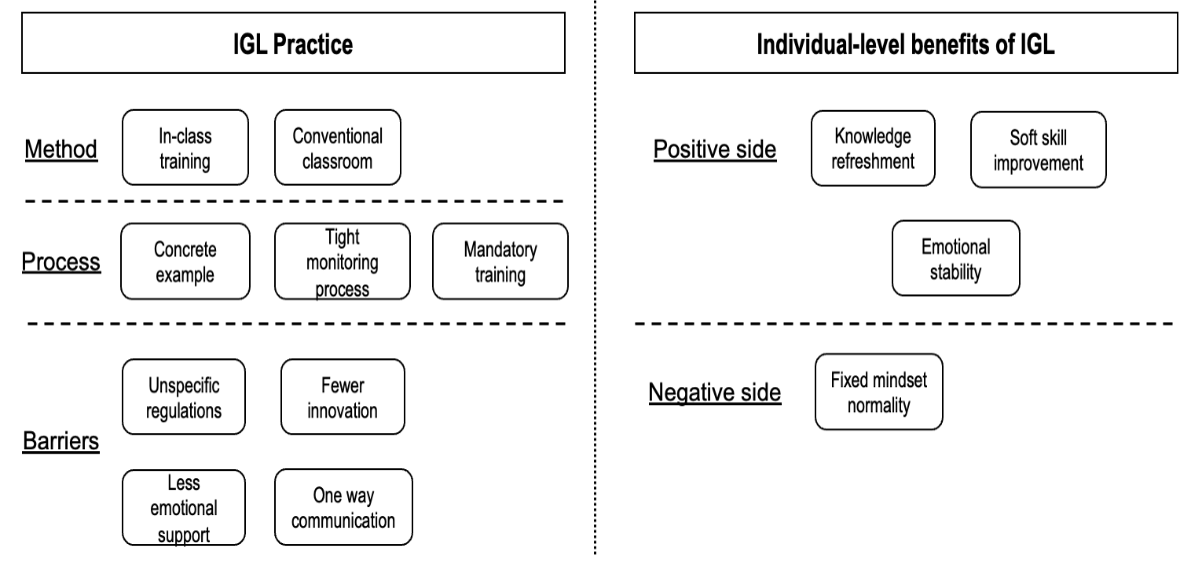
This study aims to explore how intergenerational learning is implemented in organizational settings and to understand its individual-level impacts on adult learners. The study involved eight adult participants drawn from different generations, consisting of older and younger workers, who were recruited using purposive sampling based on their direct involvement in intergenerational learning activities within their organizations. A qualitative research approach was employed, using semi-structured interviews as the primary data collection method. Interview data were analyzed through thematic analysis to identify recurring patterns related to learning practices and individual experiences. The findings reveal that intergenerational learning is practiced as a structured and controlled organizational activity. It is characterized by formal learning methods, regulated processes, and identifiable barriers. At the individual level, intergenerational learning generated both positive and negative impacts. Positive impacts included knowledge improvement, knowledge refreshment, soft skill development, experiential understanding, and emotional stability. However, challenges also emerged, particularly in the existence of a fixed mindset, which constrained learning interactions across generations. This study contributes to the intergenerational learning literature by demonstrating that adult learners experience intergenerational learning not only as a mechanism for knowledge exchange. It also shows as a structured organizational practice that simultaneously generates developmental opportunities.
References
Andayanie, L. M., Adhantoro, M. S., Purnomo, E., & Kurniaji, G. T. (2025). Implementation of Deep Learning in Education: Towards Mindful, Meaningful, and Joyful Learning Experiences. Journal of Deep Learning, 47–56 Retrieved From https://journals2.ums.ac.id/jdl/article/view/11157. DOI: https://doi.org/10.23917/jdl.v1i1.11157
Axelrad, H. (2022). How do employers think about older workers? Qualitative Research In Organizations And Management, 17(2), 201–220. (WOS:000697231000001). https://doi.org/10.1108/QROM-10-2019-1830 DOI: https://doi.org/10.1108/QROM-10-2019-1830
Billett, S. (2023). Relevance of Workplace Learning in Enterprise Transformation: The Prospects for Singapore. Singapore Labour Journal, 02(01), 6–21. https://doi.org/10.1142/S2811031523000128 DOI: https://doi.org/10.1142/S2811031523000128
Bjursell, C. (2015). Organizing for Intergenerational Learning and Knowledge Sharing. Journal of Intergenerational Relationships, 13(4), 285–301. https://doi.org/10.1080/15350770.2015.1108952 DOI: https://doi.org/10.1080/15350770.2015.1108952
Brunton, J., & Buckley, F. (2021). ‘You’re thrown in the deep end’: Adult learner identity formation in higher education. Studies in Higher Education, 46(12), 2696–2709. https://doi.org/10.1080/03075079.2020.1767049 DOI: https://doi.org/10.1080/03075079.2020.1767049
Busetto, L., Wick, W., & Gumbinger, C. (2020). How to use and assess qualitative research methods. Neurological Research and Practice, 2(1), 14. https://doi.org/10.1186/s42466-020-00059-z DOI: https://doi.org/10.1186/s42466-020-00059-z
Caines, V., Crane, M., Noone, J., Griffin, B., Datta, S., & Earl, J. (2020). Older workers: Past, present and future. Australian Journal Of Management, 45(3), 425–448. (WOS:000534924400001). https://doi.org/10.1177/0312896220918912 DOI: https://doi.org/10.1177/0312896220918912
Cheung, J. C.-T., Lou, V. W.-Q., Hu, D.-Y., Pan, N. F. C., Woo, E. M. W., & Cheng, M. S. F. (2023). Eliminating Ageism in Higher Education: An Intergenerational Participatory Co-design Project. Educational Gerontology, 49(11), 966–978. https://doi.org/10.1080/03601277.2023.2187107 DOI: https://doi.org/10.1080/03601277.2023.2187107
Creswell, J. W. (with Poth, C. N.). (2018). Qualitative inquiry & research design: Choosing among five approaches (Fourth edition, international student edition). SAGE.
Creswell, J. W. (2019). Educational research: Planning, conducting, and evaluating quantitative and qualitative research (Sixth edition). Pearson.
Desouza, E. (2007). Intergenerational Interaction Through Reminiscence Processes. Journal of Intergenerational Relationships, 5(1), 39–56. https://doi.org/10.1300/J194v05n01_04 DOI: https://doi.org/10.1300/J194v05n01_04
Emiliussen, J., Engelsen, S., Christiansen, R., & Klausen, S. H. (2021). We are all in it!: Phenomenological Qualitative Research and Embeddedness. International Journal of Qualitative Methods, 20, 1609406921995304. https://doi.org/10.1177/1609406921995304 DOI: https://doi.org/10.1177/1609406921995304
Fan, P., Song, Y., Fang, M., & Chen, X. (2023). Creating an age-inclusive workplace: The impact of HR practices on employee work engagement. Journal Of Management & Organization. (WOS:000961953800001). https://doi.org/10.1017/jmo.2023.18 DOI: https://doi.org/10.1017/jmo.2023.18
Fasbender, U., & Wang, M. (2017). Intergenerational contact and hiring decisions about older workers. Journal of Managerial Psychology, 32(3), 210–224. https://doi.org/10.1108/JMP-11-2016-0339 DOI: https://doi.org/10.1108/JMP-11-2016-0339
Franz, J., & Scheunpflug, A. (2016). A Systematic Perspective on Intergenerational Learning: Theoretical and Empirical Findings. Studia paedagogica, 21(2), Article 2. Retrieved from https://journals.phil.muni.cz/studia-paedagogica/article/view/19024 DOI: https://doi.org/10.5817/SP2016-2-3
Gerpott, F. H., & Fasbender, U. (2020). Intergenerational Learning in Age-Diverse Meetings: A Social Comparison Perspective. In A. L. Meinecke, J. A. Allen, & N. Lehmann-Willenbrock (Eds.), Research on Managing Groups and Teams (pp. 185–206). Emerald Publishing Limited. https://doi.org/10.1108/S1534-085620200000020009 DOI: https://doi.org/10.1108/S1534-085620200000020009
Gerpott, F. H., Lehmann-Willenbrock, N., & Voelpel, S. C. (2016). Intergenerational Learning in Organizations: A Framework and Discussion of Opportunities. In A.-S. Antoniou, R. J. Burke, & S. C. L. Cooper (Eds.), The Aging Workforce Handbook (pp. 241–267). Emerald Group Publishing Limited. https://doi.org/10.1108/978-1-78635-448-820161010 DOI: https://doi.org/10.1108/978-1-78635-448-820161010
Gerpott, F. H., Lehmann-Willenbrock, N., & Voelpel, S. C. (2017). A Phase Model of Intergenerational Learning in Organizations. Academy of Management Learning & Education, 16(2), 193–216. https://doi.org/10.5465/amle.2015.0185 DOI: https://doi.org/10.5465/amle.2015.0185
Gonçalves, M., Hatton-Yeo, A., & Farcas, D. (2016). Overcoming ageism through a new intergenerational learning paradigm: Challenges and findings. Quality in Ageing and Older Adults, 17(4), 239–245. https://doi.org/10.1108/QAOA-04-2015-0016 DOI: https://doi.org/10.1108/QAOA-04-2015-0016
Hartono, L., Milfayetty, S., & Foo, M. (2023). As Getting Older: “Does it Remain Important to Have Work Discipline and Attention to Work Environment?” Indigenous: Jurnal Ilmiah Psikologi, 8(2), 183–200. https://doi.org/10.23917/indigenous.v8i2.21875
Ho, H. C. Y., & Yeung, D. Y. (2021). Conflict between younger and older workers: An identity-based approach. International Journal of Conflict Management, 32(1), 102–125. https://doi.org/10.1108/IJCMA-08-2019-0124 DOI: https://doi.org/10.1108/IJCMA-08-2019-0124
Ho, Y. Y., Yeo, E.-Y., & Wijaya, D. S. B. M. (2023). Turning Coffee Time into Teaching Moments Through Bite-Sized Learning for Adult Learners. The Journal of Continuing Higher Education, 71(2), 183–198. https://doi.org/10.1080/07377363.2021.2024000 DOI: https://doi.org/10.1080/07377363.2021.2024000
Irie, K. (2022). Rethinking the role of classroom communication: Learning from older learners. Innovation in Language Learning and Teaching, 16(2), 107–117. https://doi.org/10.1080/17501229.2021.1884252 DOI: https://doi.org/10.1080/17501229.2021.1884252
Kayi, E. (2024). Transitioning to blended learning during COVID-19: Exploring instructors and adult learners’ experiences in three Ghanaian universities. British Journal Of Educational Technology. (WOS:001219643600001). https://doi.org/10.1111/bjet.13475 DOI: https://doi.org/10.1111/bjet.13475
Knowles, M. S. (Malcolm S., Holton, E. F., & Swanson, R. A. (2015). The Adult Learner: The Definitive Classic in Adult Education and Human Resource Development (Eighth edition.). Routledge.
Kwong, A. N. L., & Yan, E. C. W. (2023). The Role of Quality of Face-to-face Intergenerational Contact in Reducing Ageism: The Perspectives of Young People. Journal of Intergenerational Relationships, 21(1), 136–151. https://doi.org/10.1080/15350770.2021.1952134 DOI: https://doi.org/10.1080/15350770.2021.1952134
Lau, M. H. M. (2023). Intergenerational Interactions, Ageism and Ableism in Community Settings. Journal of Intergenerational Relationships, 0(0), 1–17. https://doi.org/10.1080/15350770.2023.2206387
Leon, R.-D. (2023). Human resources practices for intergenerational learning: A systematic literature review. Knowledge Management Research & Practice, 21(4), 749–764. https://doi.org/10.1080/14778238.2022.2035278 DOI: https://doi.org/10.1080/14778238.2022.2035278
Ng, E. S., & Parry, E. (2016). Multigenerational Research in Human Resource Management. In M. R. Buckley, J. R. B. Halbesleben, & A. R. Wheeler (Eds.), Research in Personnel and Human Resources Management (Vol. 34, pp. 1–41). Emerald Group Publishing Limited. https://doi.org/10.1108/S0742-730120160000034008 DOI: https://doi.org/10.1108/S0742-730120160000034008
Nurani, G. A. (2022). Fixed Mindset vs. Growth Mindset: A Phenomenon in Higher Education to Achieve a Bachelor’s Degree. International Journal of Education and Humanities, 2(4), Article 4. https://doi.org/10.58557/ijeh.v2i4.122 DOI: https://doi.org/10.58557/ijeh.v2i4.122
Ropes, D. (2013). Intergenerational learning in organizations. European Journal of Training and Development, 37(8), 713–727. https://doi.org/10.1108/EJTD-11-2012-0081 DOI: https://doi.org/10.1108/EJTD-11-2012-0081
Sánchez, M., & Kaplan, M. (2014). Intergenerational Learning in Higher Education: Making the Case for Multigenerational Classrooms. Educational Gerontology, 40(7), 473–485. https://doi.org/10.1080/03601277.2013.844039 DOI: https://doi.org/10.1080/03601277.2013.844039
Sholeh, M. M. A., Waston, Nirwana, A., & Mahmudulhassan, M. (2025). The Reasons of Lifelong Education for the Sustainable Development Goals (SDGs): The Islamic Epistemology Perspective. Journal of Lifestyle and SDGs Review, 5(2), e02988–e02988. https://doi.org/10.47172/2965-730X.SDGsReview.v5.n02.pe02988 DOI: https://doi.org/10.47172/2965-730X.SDGsReview.v5.n02.pe02988
Sudarji, S., Panggabean, H., & Marta, R. F. (2022). Challenges of the Sandwich Generation: Stress and coping strategy of the multigenerational care. Indigenous: Jurnal Ilmiah Psikologi, 7(3), 263–275. https://doi.org/10.23917/indigenous.v7i3.19433 DOI: https://doi.org/10.23917/indigenous.v7i3.19433
Taylor, P., Loretto, W., Marshall, V., Earl, C., & Phillipson, C. (2016). The Older Worker: Identifying a Critical Research Agenda. Social Policy And Society, 15(4), 675–689. (WOS:000385357000012). https://doi.org/10.1017/S1474746416000221 DOI: https://doi.org/10.1017/S1474746416000221
UNESCO (Ed.). (2020). Embracing a culture of lifelong learning: Contribution to the futures of education initiative: report: a transdisciplinary expert consultation. UNESCO Institute for Lifelong Learning.
United Nations. (2022). World Population Prospects 2022 Summary of Results. Department of Economic and Social Affairs Population Division. Retrieved from https://www.un.org/development/desa/pd/sites/www.un.org.development.desa.pd/files/wpp2022_summary_of_results.pdf
WHO. (2020). Decade of Healthy Ageing: Baseline Report. World Health Organization. Retrieved from https://www.who.int/publications/i/item/9789240017900
Woodward, I. C., & Vongswasdi, P. (2017). More that unites than divides: Intergenerational communication preferences in the workplace. Communication Research and Practice, 3(4), 358–385. https://doi.org/10.1080/22041451.2017.1275259 DOI: https://doi.org/10.1080/22041451.2017.1275259
Downloads
Submitted
Accepted
Published
How to Cite
Issue
Section
License
Copyright (c) 2026 Indigenous: Jurnal Ilmiah Psikologi

This work is licensed under a Creative Commons Attribution 4.0 International License.