Psychometric Validation of the Workplace Ostracism Scale for Indonesian Generation Z Employees
DOI:
https://doi.org/10.23917/indigenous.v11i1.15423Keywords:
Workplace Ostracism, Cross-Cultural Adaptation, Exploratory Factor Analysis, Confirmatory Factor Analysis, Generation ZAbstract
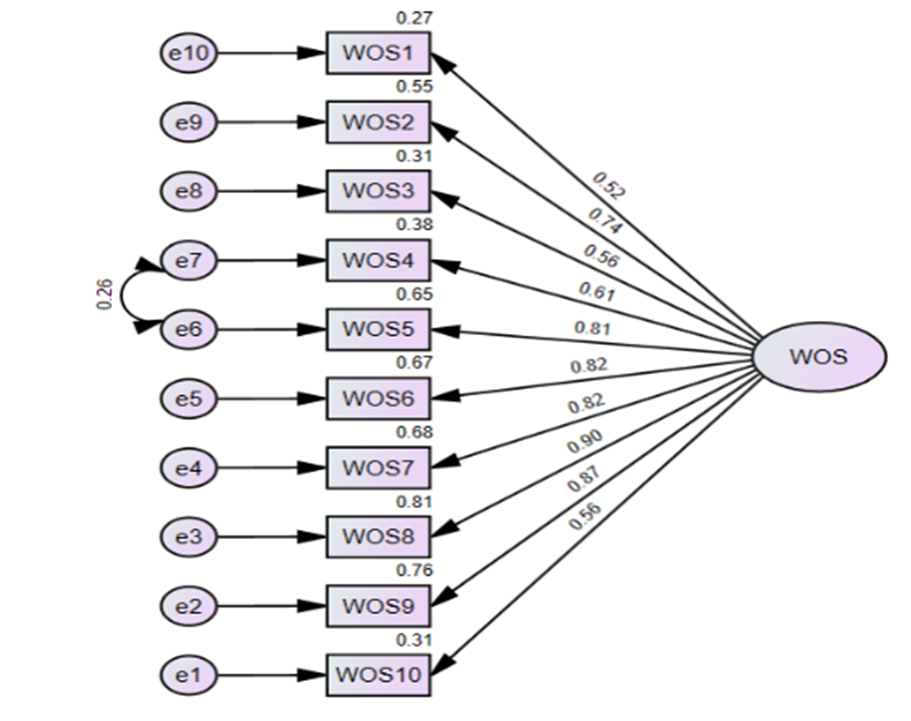
Workplace ostracism refers to employees’ perceptions of being ignored, excluded, or avoided by others in the workplace and has been linked to numerous negative psychological and organizational outcomes. Despite the growing presence of Generation Z in the Indonesian workforce, no validated Indonesian-language instrument currently exists to measure workplace ostracism among this population. The present study aimed to translate and validate the 10-item Workplace Ostracism Scale (WOS) for use among Indonesian Generation Z employees. A systematic back-to-back translation procedure was conducted, followed by a readability assessment with Generation Z participants. Data were collected from 198 Indonesian Gen Z employees aged 18- 28 years using snowball and purposive sampling techniques with at least six months of work or internship experience. Exploratory Factor Analysis (EFA) using SPSS 26 and Confirmatory Factor Analysis (CFA) using AMOS 28 were employed to examine the scale’s factor structure, reliability, and validity. Results supported a unidimensional factor structure, with all factor loadings exceeding .50. The scale demonstrated excellent internal consistency (Cronbach’s α = .912; CR = .919) and adequate convergent validity (AVE = .540). Overall model fit indices indicated a good fit. The findings suggest that the Indonesian version of the WOS is a reliable and valid instrument for assessing workplace ostracism among Generation Z employees, providing a valuable tool for both research and organizational practice in Indonesia.
References
Abubakar, A. M., Yazdian, T. F., & Behravesh, E. (2018). A riposte to ostracism and tolerance to workplace incivility: A generational perspective. Personnel Review, 47(2), 441–457. https://doi.org/10.1108/pr-07-2016-0153 DOI: https://doi.org/10.1108/PR-07-2016-0153
Ahmed, S. K. (2024). How to choose a sampling technique and determine sample size for research: A simplified guide for researchers. Oral Oncology Reports, 12(1), 100662. https://doi.org/10.1016/j.oor.2024.100662 DOI: https://doi.org/10.1016/j.oor.2024.100662
Badan Pusat Statistika. (2021). Perkembangan indeks produksi industri manufaktur 2020. Badan Pusat Statistika. Retrieved from https://www.bps.go.id/id/publication/2021/08/18/0fbecb97aae729e237657dc6/perkembangan-indeks-produksi-industri-manufaktur-2020.html (Original work published Badan Pusat Statistika)
Banerjee, S. (2025). A systematic literature review of workplace ostracism, on employee outcomes. European Economic Letters (EEL), 15(2), 5015–5024. https://doi.org/10.52783/eel.v15i2.3349 DOI: https://doi.org/10.52783/eel.v15i2.3349
Benítez-Márquez, M. D., Sánchez-Teba, E. M., Bermúdez-González, G., & Núñez-Rydman, E. S. (2022). Generation Z within the workforce and in the workplace: A bibliometric analysis. Frontiers in Psychology, 12, 736820. https://doi.org/10.3389/fpsyg.2021.736820 DOI: https://doi.org/10.3389/fpsyg.2021.736820
Çalişkan, A., & Pekkan, N. Ü. (2020). Örgütsel dışlanma: Bir ölçek uyarlama çalışması. Uluslararası İktisadi ve İdari Bilimler Dergisi, 6(1), 51–60. https://doi.org/10.29131/UIIBD.736413 DOI: https://doi.org/10.29131/uiibd.736413
Cha, E. S., Kim, K. H., & Erlen, J. A. (2007). Translation of scales in cross-cultural research: Issues and techniques. Journal of Advanced Nursing, 58(4), 386–395. https://doi.org/10.1111/J.1365-2648.2007.04242.X DOI: https://doi.org/10.1111/j.1365-2648.2007.04242.x
Chen, N. (2024). The impact of workplace ostracism on employee well-being during the COVID-19 pandemic: A study of mediation effects of remote work challenges. Transportation Research Interdisciplinary Perspectives, 26(5), 101174. https://doi.org/10.1016/j.trip.2024.101174 DOI: https://doi.org/10.1016/j.trip.2024.101174
Chen, Z., Tian, Y. (Fiona), Feng, Q., & Poon, K.-T. (2025). Consequences of ostracism and potential interventions to mitigate its negative outcomes. The Journal of Social Psychology, 166(1), 72–82. https://doi.org/10.1080/00224545.2025.2572653 DOI: https://doi.org/10.1080/00224545.2025.2572653
Cheung, G. W., Cooper-Thomas, H. D., Lau, R. S., & Wang, L. C. (2023). Reporting reliability, convergent and discriminant validity with structural equation modeling: A review and best-practice recommendations. Asia Pacific Journal of Management, 41(2), 745–783. https://doi.org/10.1007/S10490-023-09871-Y DOI: https://doi.org/10.1007/s10490-023-09871-y
Colledani, D., De Carlo, A., Falvo, R., & Capozza, D. (2025). Italian validation of the Workplace Ostracism Scale (WOS). Frontiers in Psychology, 16. https://doi.org/10.3389/fpsyg.2025.1584118 DOI: https://doi.org/10.3389/fpsyg.2025.1584118
Costello, A. B., & Osborne, J. (2005). Best practices in exploratory factor analysis: Four recommendations for getting the most from your analysis. Practical Assessment Research & Evaluation, 10(1). https://doi.org/10.7275/JYJ1-4868
Cruchinho, P., López-Franco, M. D., Capelas, M. L., Almeida, S., Bennett, P. M., Miranda da Silva, M., Teixeira, G., Nunes, E., Lucas, P., & Gaspar, F. (2024). Translation, cross-cultural adaptation, and validation of measurement instruments: A practical guideline for novice researchers. Journal of Multidisciplinary Healthcare, 17, 2701–2728. https://doi.org/10.2147/JMDH.S419714 DOI: https://doi.org/10.2147/JMDH.S419714
Dindorf, C., Dully, J., Bartaguiz, E., Menges, T., Reidick, C., Seibert, J.-N., & Fröhlich, M. (2025). Characteristics and perceived suitability of artificial intelligence-driven sports coaches: A pilot study on psychological and perceptual factors. Frontiers in Sports and Active Living, 7, 1548980. https://doi.org/10.3389/fspor.2025.1548980 DOI: https://doi.org/10.3389/fspor.2025.1548980
Farrell, A. M. (2010). Insufficient discriminant validity: A comment on Bove, Pervan, Beatty, and Shiu (2009). Journal of Business Research, 63(3), 324–327. https://doi.org/10.1016/J.JBUSRES.2009.05.003 DOI: https://doi.org/10.1016/j.jbusres.2009.05.003
Ferris, D. L., Brown, D. J., Berry, J. W., & Lian, H. (2008). The development and validation of the Workplace Ostracism Scale. Journal of Applied Psychology, 93(6), 1348–1366. https://doi.org/10.1037/a0012743 DOI: https://doi.org/10.1037/a0012743
Fornell, C., & Larcker, D. F. (1981). Evaluating structural equation models with unobservable variables and measurement error. Journal of Marketing Research, 18(1), 39–50. https://doi.org/10.1177/002224378101800104 DOI: https://doi.org/10.1177/002224378101800104
Gillam, R. B., Serang, S., Montgomery, J. W., & Evans, J. L. (2021). Cognitive processes related to memory ca-pacity explain nearly all of the variance in language test performance in school-age children with and without developmental language disorder. Frontiers in Psychology, 12, 724356. https://doi.org/10.3389/FPSYG.2021.724356/BIBTEX DOI: https://doi.org/10.3389/fpsyg.2021.724356
Gürel, Ö., Demirören, M., & Taşdelen Teker, G. (2024). Evaluation of family medicine residents’ reflection skills. BMC Medical Education, 24(1), 1417. https://doi.org/10.1186/s12909-024-06404-z DOI: https://doi.org/10.1186/s12909-024-06404-z
Habibie, T. A., & Nashori, F. (2024). Cognitive Flexibility as A Moderating Role for Gratitude and Depression in Individuals Who Lost Their Jobs. Indigenous: Jurnal Ilmiah Psikologi, 9(3), 258–274. https://doi.org/10.23917/indigenous.v9i3.6753 DOI: https://doi.org/10.23917/indigenous.v9i3.6753
Haijiang, H., & Rafiq, M. (2026). Workplace ostracism influences hotel employees pro-environmental behaviour through green work engagement. Scientific Reports, 16(1), 7811. https://doi.org/10.1038/s41598-026-38569-6 DOI: https://doi.org/10.1038/s41598-026-38569-6
Hair, J. F., Risher, J. J., Sarstedt, M., & Ringle, C. M. (2019). When to use and how to report the results of PLS-SEM. European Business Review, 31(1), 2–24. https://doi.org/10.1108/EBR-11-2018-0203 DOI: https://doi.org/10.1108/EBR-11-2018-0203
Han, L., & Abdul Rahman, M. N. (2025). Development and validation of the children’s approaches to learning questionnaire from parent ratings in China. International Journal of Early Childhood, 57(3), 57. https://doi.org/10.1007/S13158-025-00430-8 DOI: https://doi.org/10.1007/s13158-025-00430-8
He, J., & van de Vijver, F. (2012). Bias and equivalence in cross-cultural research. Online Readings in Psychology and Culture, 2(2). https://doi.org/10.9707/2307-0919.1111 DOI: https://doi.org/10.9707/2307-0919.1111
Hidayati, I. A., Nurul Aisyah, Farha Isna Nur Abidah, Prima Afifah, Amalia Putri Hasna, & Husain Ali As-Syafi’i. (2025). The Attitude of Birrul Waalidain Javanese Muslim Teenagers. Indigenous: Jurnal Ilmiah Psikologi, 10(1). https://doi.org/10.23917/indigenous.v10i1.6724 DOI: https://doi.org/10.23917/indigenous.v10i1.6724
Howard, M. C. (2016). A review of exploratory factor analysis decisions and overview of current practices: What we are doing and how can we improve? International Journal of Human-Computer Interaction, 32(1), 51–62. https://doi.org/10.1080/10447318.2015.1087664 DOI: https://doi.org/10.1080/10447318.2015.1087664
Islami, F. N., & Renanita, T. (2025). Young families’ financial stress: The importance of financial management behavior with income as control variable. Indigenous: Jurnal Ilmiah Psikologi, 10(3), 260–272. https://doi.org/10.23917/indigenous.v10i3.12291 DOI: https://doi.org/10.23917/indigenous.v10i3.12291
Joshi, A., Dencker, J. C., & Franz, G. (2011). Generations in organizations. Research in Organizational Behavior, 31, 177–205. https://doi.org/10.1016/j.riob.2011.10.002 DOI: https://doi.org/10.1016/j.riob.2011.10.002
Kaiser, H. F., & Rice, J. (1974). Little Jiffy, Mark IV. Educational and Psychological Measurement, 34(1), 111–117. https://doi.org/10.1177/001316447403400115 DOI: https://doi.org/10.1177/001316447403400115
Kamboj, K. P., & Garg, P. (2022). Workplace ostracism scale: Examining the psychometric properties on Indian sample. International Journal of Business Excellence, 28(2), 253–280. https://doi.org/10.1504/IJBEX.2022.126908 DOI: https://doi.org/10.1504/IJBEX.2022.126908
Karakiraz, A., Uslu, O., & Ozsoy, E. (2023). Turkish adaptation of the workplace ostracism scale. Gazi Journal of Economics and Business, 9(2). https://doi.org/10.30855/gjeb.2023.9.2.003 DOI: https://doi.org/10.30855/gjeb.2023.9.2.003
Kwantes, C. T., Kuo, B. C. H., McMurphy, S., & Livingstone, J. (2025). Predictors of generalized trust: A cross-cultural study of Canada, China, Taiwan, and the US. Basic and Applied Social Psychology, 47(6), 391–403. https://doi.org/10.1080/01973533.2025.2529512 DOI: https://doi.org/10.1080/01973533.2025.2529512
Lanier, K. (2017). 5 things HR professionals need to know about Generation Z: Thought leaders share their views on the HR profession and its direction for the future. Strategic HR Review, 16(6), 288–290. https://doi.org/10.1108/SHR-08-2017-0051 DOI: https://doi.org/10.1108/SHR-08-2017-0051
Lazányi, K., & Bilan, Y. (2017). Generetion Z on the labour market – do they trust others within their workplace? Polish Journal of Management Studies, 16(1), 78–93. https://doi.org/10.17512/pjms.2017.16.1.07 DOI: https://doi.org/10.17512/pjms.2017.16.1.07
Li, M., Xu, X., & Kwan, H. K. (2021). Consequences of workplace ostracism: A meta-analytic review. Frontiers in Psychology, 12, 641302. https://doi.org/10.3389/fpsyg.2021.641302 DOI: https://doi.org/10.3389/fpsyg.2021.641302
Li, N., Zhang, H., Zhao, H., Zhang, C., Zhang, H., Ma, F., Tang, X., Wang, C., & Huang, J. (2026). A mediating effect of sense of coherence on the association between work-family conflict and workplace ostracism among medical staff. Frontiers in Psychiatry, 16, 1584004. https://doi.org/10.3389/fpsyt.2025.1584004 DOI: https://doi.org/10.3389/fpsyt.2025.1584004
Lorenzo-Seva, U. (2022). SOLOMON: a method for splitting a sample into equivalent subsamples in factor analysis. Behavior Research Methods, 54(6), 2665–2677. https://doi.org/10.3758/S13428-021-01750-Y DOI: https://doi.org/10.3758/s13428-021-01750-y
Mahensa, I. R., Kinanthi, M. R., & Febriani, Z. (2022). Dimensions of a healthy lifestyle among early adolescents: The simultaneous contribution of spirituality and family cohesiveness. Indigenous: Jurnal Ilmiah Psikologi, 7(3), 232–245. https://doi.org/10.23917/indigenous.v7i3.19840 DOI: https://doi.org/10.23917/indigenous.v7i3.19840
Marrero, R. J., Carballeira, M., & Hernández-Cabrera, J. A. (2020). Does Humor mediate the relationship between positive personality and well-being? The moderating role of gender and health. Journal of Happiness Studies, 21(3), 1117–1144. https://doi.org/10.1007/S10902-019-00121-X DOI: https://doi.org/10.1007/s10902-019-00121-x
Mueller, S., Fountain, J., & Lamb, C. (2011). Generation Y as young wine consumers in New Zealand: How do they differ from Generation X? International Journal of Wine Business Research, 23(2), 107–124. https://doi.org/10.1108/17511061111142981 DOI: https://doi.org/10.1108/17511061111142981
Muhammad, S., Soumyaja, D., Sowmya, C. S., & Krishna, A. (2026). The relationship between workplace ostracism and counterproductive knowledge behavior: An integrative literature review using transaction model of stress and coping. Social Sciences & Humanities Open, 13(3), 102391. https://doi.org/10.1016/j.ssaho.2025.102391 DOI: https://doi.org/10.1016/j.ssaho.2025.102391
Nugrohojati, I. S., & Linando, J. A. (2025). Understanding Generation Z in the Workplace. Selekta Manajemen: Jurnal Mahasiswa Bisnis Dan Manajemen, 3(3). Retrieved from https://journal.uii.ac.id/selma/article/view/42940
Nur, A. R., & Renanita, T. (2025). Adaptation and psychometric properties of the Indonesian version of the financial well-being scale. Indigenous: Jurnal Ilmiah Psikologi, 10(2), 173–191. https://doi.org/10.23917/indigenous.v10i2.11823 DOI: https://doi.org/10.23917/indigenous.v10i2.11823
Pan, D., Xie, H., Zeng, Y., Zhou, Y., Lin, C., Ma, X., Ren, J., Jiao, Y., Wu, Y., Wei, W., & Xue, G. (2024). The development and validation of a tablet-based assessment battery of general cognitive ability. BMC Psychology, 12(1), 12. https://doi.org/10.1186/s40359-024-02283-7 DOI: https://doi.org/10.1186/s40359-024-02283-7
Pataki-Bittó, F., & Kapusy, K. (2021). Work environment transformation in the post COVID-19 based on work values of the future workforce. Journal of Corporate Real Estate, 23(3), 151–169. https://doi.org/10.1108/jcre-08-2020-0031 DOI: https://doi.org/10.1108/JCRE-08-2020-0031
Pertiwi, E. M., Suminar, D. R., & Ardi, R. (2022). Psychological well-being among Gen Z social media users: Exploring the role of self-esteem and social media dependency as mediators and social media usage motives as moderator. Indigenous: Jurnal Ilmiah Psikologi, 7(3), 204–218. https://doi.org/10.23917/indigenous.v7i3.19851 DOI: https://doi.org/10.23917/indigenous.v7i3.19851
Rasool, S. F., Wang, M., Tang, M., Saeed, A., & Iqbal, J. (2021). How toxic workplace environment effects the employee engagement: The mediating role of organizational support and employee wellbeing. International Journal of Environmental Research and Public Health, 18(5), 1–17. https://doi.org/10.3390/ijerph18052294 DOI: https://doi.org/10.3390/ijerph18052294
Saraiva, M., & Nogueiro, T. (2025). Perspectives and realities of disengagement among younger generation Y and Z workers in contemporary work dynamics. Administrative Sciences, 15(4), 133. https://doi.org/10.3390/admsci15040133 DOI: https://doi.org/10.3390/admsci15040133
Sathyanarayana, S., & Mohanasundaram, T. (2024). Fit indices in structural equation modeling and confirmatory factor analysis: Reporting guidelines. Asian Journal of Economics, Business and Accounting, 24(7), 561–577. https://doi.org/10.9734/ajeba/2024/v24i71430 DOI: https://doi.org/10.9734/ajeba/2024/v24i71430
Shinde, A. (2025). Workplace ostracism scale: Psychometric analysis of the workplace ostracism scale among Indian IT professionals. Journal of Information Systems Engineering and Management, 10(36s), 906–913. https://doi.org/10.52783/jisem.v10i36s.6613 DOI: https://doi.org/10.52783/jisem.v10i36s.6613
Singh, S., Subramani, A. K., David, R., & Jan, N. A. (2024). Workplace ostracism influencing turnover intentions: Moderating roles of perceptions of organizational virtuousness and authentic leadership. Acta Psycho-Logica, 243, 104136. https://doi.org/10.1016/J.ACTPSY.2024.104136 DOI: https://doi.org/10.1016/j.actpsy.2024.104136
Siregar, L. D., Wk, W. F., & Herlinda, S. (2023). The Generation Z phenomenon and its implications in the workforce. Jurnal Ekonomi, 12(4). Retrieved from e^journal.seaninstitute.or.id/index.php/Ekonomi/article/view/2898
Ting, H., Memon, M. A., Thurasamy, R., & Cheah, J.-H. (2025). Snowball sampling: A review and guidelines for survey research. Asian Journal of Business Research, 15(1), 1–15. https://doi.org/10.14707/ajbr.250186 DOI: https://doi.org/10.14707/ajbr.250186
Valenti, G. D., & Faraci, P. (2025). Italian adaptation of the Workplace Ostracism Scale: A psychometric analysis based on item response theory. Journal of Health and Social Sciences, 10(1), 56. https://doi.org/10.19204/2025/TLND5
Vui-Yee, K., & Yen-Hwa, T. (2020). When does ostracism lead to turnover intention? The moderated mediation model of job stress and job autonomy. IIMB Management Review, 32(3), 238–248. https://doi.org/10.1016/J.IIMB.2019.10.007 DOI: https://doi.org/10.1016/j.iimb.2019.10.007
Wang, L., Lu, L., Wu, W., & Luo, Z. (2023). Workplace ostracism and employee wellbeing: A conservation of resource perspective. Frontiers in Public Health, 10. https://doi.org/10.3389/fpubh.2022.1075682 DOI: https://doi.org/10.3389/fpubh.2022.1075682
Watkins, M. W. (2021). A step-by-step guide to exploratory factor analysis with SPSS (1st ed.). Routledge. https://doi.org/10.4324/9781003149347 DOI: https://doi.org/10.4324/9781003149347-1
Widiyawati, V. T., Prima, I. R., & Zamralita. (2025). The role of workplace ostracism to work stress in employees Generation Z. Psyche 165 Journal, 158–163. https://doi.org/10.35134/jpsy165.v18i2.530 DOI: https://doi.org/10.35134/jpsy165.v18i2.530
Williams, K. D. (2007). Ostracism: The kiss of social death. Social and Personality Psychology Compass, 1(1), 236–247. https://doi.org/10.1111/j.1751-9004.2007.00004.x DOI: https://doi.org/10.1111/j.1751-9004.2007.00004.x
Williams, K. D. (2009). Ostracism. A temporal need-threat model. Advances in Experimental Social Psychology, 41, 275–314. https://doi.org/10.1016/S0065-2601(08)00406-1 DOI: https://doi.org/10.1016/S0065-2601(08)00406-1
Wolf, E. J., Harrington, K. M., Clark, S. L., & Miller, M. W. (2013). Sample size requirements for structural equation models: An evaluation of power, bias, and solution propriety. Educational and Psychological Measurement, 73(6), 913–934. https://doi.org/10.1177/0013164413495237 DOI: https://doi.org/10.1177/0013164413495237
World Economic Forum. (2021, May 26). Chart: How Gen Z employment levels compare in OECD countries | World Economic Forum. Retrieved from https://www.weforum.org/stories/2021/03/gen-z-unemployment-chart-global-comparisons/
Wu, L., Yim, F. H., Kwan, H. K., & Zhang, X. (2012). Coping with workplace ostracism: The roles of ingratiation and political skill in employee psychological distress. Journal of Management Studies, 49(1), 178–199. https://doi.org/10.1111/j.1467-6486.2011.01017.x DOI: https://doi.org/10.1111/j.1467-6486.2011.01017.x
Xia, Y., & Yang, Y. (2019). RMSEA, CFI, and TLI in structural equation modeling with ordered categorical data: The story they tell depends on the estimation methods. Behavior Research Methods, 51(1), 409–428. https://doi.org/10.3758/s13428-018-1055-2 DOI: https://doi.org/10.3758/s13428-018-1055-2
Yaakobi, E., & Williams, K. D. (2016). Ostracism and attachment orientation: Avoidants are less affected in both individualistic and collectivistic cultures. British Journal of Social Psychology, 55(1), 162–181. https://doi.org/10.1111/bjso.12122 DOI: https://doi.org/10.1111/bjso.12122
Zahra, Y., Handoyo, S., & Fajrianthi, F. (2025). A comprehensive overview of Generation Z in the workplace: Insights from a scoping review. SA Journal of Industrial Psychology, 51(0), a2263. https://doi.org/10.4102/sajip.v51i0.2263 DOI: https://doi.org/10.4102/sajip.v51i0.2263
Zare, Z., Khosravi, M., Marzaleh, M. A., Jalali, F. S., Izadi, R., & Naseh, H. (2025). Psychometric evaluation of an instrument measuring artificial intelligence utilization in decision-making domains of healthcare organizations. Scientific Reports, 15(1), 36698. https://doi.org/10.1038/s41598-025-20753-9 DOI: https://doi.org/10.1038/s41598-025-20753-9
Zhou, X. (2022). Evaluation of the split-data strategy in factor analysis. Retrieved from https://hdl.handle.net/2142/116043
Zhu, Y., & Zhang, D. (2021). Workplace ostracism and counterproductive work behaviors: The chain mediating role of anger and turnover intention. Frontiers in Psychology, 12, 761560. https://doi.org/10.3389/fpsyg.2021.761560 DOI: https://doi.org/10.3389/fpsyg.2021.761560
Downloads
Submitted
Accepted
Published
How to Cite
Issue
Section
License
Copyright (c) 2026 Indigenous: Jurnal Ilmiah Psikologi

This work is licensed under a Creative Commons Attribution 4.0 International License.