Digital Resilience Mediation Model on the Influence of Teacher Self-Efficacy and Technostress on Teacher Well-Being
DOI:
https://doi.org/10.23917/indigenous.v11i1.15032Keywords:
teacher well-being, teacher self-efficacy, technostress, digital resilience, secondary school teachersAbstract
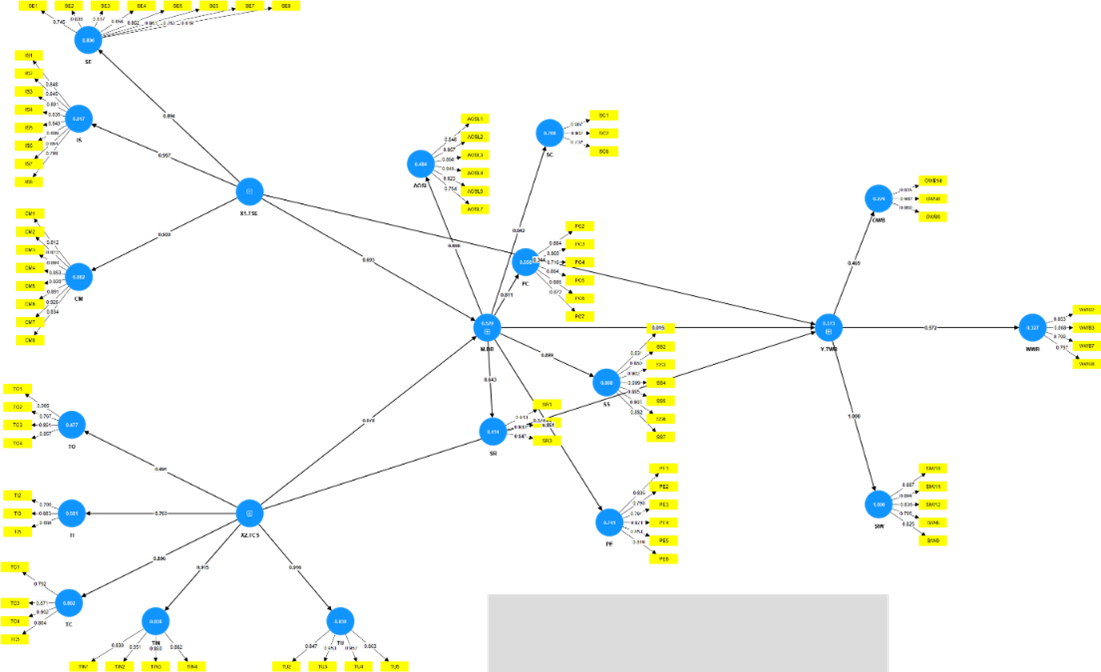
This study was motivated by the increasing demands of digital technology in education, which have the potential to affect teacher well-being, particularly through psychological factors such as teacher self-efficacy, technostress, and digital resilience. This study aims to analyze the influence of teacher self-efficacy and technostress on teacher well-being, as well as to examine the role of digital resilience as a mediator. The study participants consisted of 212 high school teachers recruited using purposive sampling, with the characteristic of being active teachers who use technology in learning. This study used a quantitative approach with a survey method, where data were collected using scales of teacher self-efficacy, technostress, digital resilience, and teacher well-being that had been adapted and tested for validity. Data analysis was performed using Partial Least Squares Structural Equation Modeling (PLS-SEM). The results showed that teacher self-efficacy had a significant effect on digital resilience and teacher well-being, while technostress had a significant effect on teacher well-being. However, digital resilience did not have a significant effect on teacher well-being and did not mediate the relationship between teacher self-efficacy and technostress with teacher well-being. The conclusion of this study confirms that internal factors such as self-confidence play an important role in teacher well-being, while digital adaptation skills do not contribute significantly without the support of a healthy psychological condition and work environment. These findings have important implications for the development of interventions to improve teacher well-being based on strengthening intrapersonal factors in the digital age.
References
Adyani, L., Suzanna, E., Safuwan, S., & Muryali, M. (2019). Perceived Social Support and Psychological Well-Being among Interstate Students at Malikussaleh University. Indigenous: Jurnal Ilmiah Psikologi, 3(2), 98–104. https://doi.org/10.23917/indigenous.v3i2.6591
Alhassan, M. D., & De Klerk, J. (2024). Development of a new measurement scale for user digital resilience. In ICIS 2024 Proceedings. Association for Information Systems. Retrieved from https://aisel.aisnet.org/icis2024/user_behav/user_behav/9/
Alves, R., Lopes, T., & Precioso, J. (2020). Teachers’ Well-Being in Times of Covid-19 Pandemic: Factors That Explain Professional Well-Being. IJERI: International Journal of Educational Research and Innovation, (15), 203–217. https://doi.org/10.46661/ijeri.5120
Bakker, A. B., & Demerouti, E. (2017). Job Demands–Resources Theory: Taking Stock and Looking Forward Arnold. Journal Of Occupational Health Psychology, 22(3), 273–285. https://doi.org/10.1037/ocp0000056
Bandura, A., & Walters, R. H. (1977). Social Learning Theory (Vol. 1). Prentice-Hall Englewood Cliffs, Nj. Retrieved from Https://Www.Asecib.Ase.Ro/Mps/Bandura_Sociallearningtheory.Pdf
Burić, I., & Kim, L. E. (2020). Teacher Self-Efficacy, Instructional Quality, and Student Motivational Beliefs: an Analysis using Multilevel Structural Equation Modeling. Learning and Instruction, 66, 101302. https://doi.org/10.1016/j.learninstruc.2019.101302
Collie, R. J. (2014). Understanding Teacher Well-Being and Motivation: Measurement, Theory, and Change Over Time (T). University of British Colombia. Retrieved from https://open.library.ubc.ca/collections/ubctheses/24/items/1.0165878
Collie, R. J., Malmberg, L.-E., Martin, A. J., Sammons, P., & Morin, A. J. S. (2020). A Multilevel Person-Centered Examination of Teachers’ Workplace Demands and Resources: Links With Work-Related Well-Being. Frontiers in Psychology, (11), 626. https://doi.org/10.3389/fpsyg.2020.00626
Dolighan, T., & Owen, M. (2021). Teacher efficacy for online teaching during the COVID-19 pandemic. Brock Education Journal, 30(1), 95. https://doi.org/10.26522/brocked.v30i1.851
Eraku, S. S., Baruadi, M. K., Anantadjaya, S. P., Fadjarajani, S., Supriatna, U., & Arifin, A. (2021). Digital Literacy And Educators Of Islamic Education. Edukasi Islami: Jurnal Pendidikan Islam, 10(01), 569. https://doi.org/10.30868/ei.v10i01.1533
Ghozali, I. (2021). Partial least squares: Konsep, teknik dan aplikasi menggunakan program SmartPLS 3.2.9 untuk penelitian empiris (3rd ed.). Badan Penerbit Universitas Diponegoro.
Gudmundsdottir, G. B., & Hatlevik, O. E. (2018). Newly Qualified Teachers’ Professional Digital Competence: Implications for Teacher Education. European Journal of Teacher Education, 41(2), 214–231. https://doi.org/10.1080/02619768.2017.1416085
Guillén-Gámez, F. D., Ruiz-Palmero, J., & García, M. G. (2023). Digital Competence of Teachers in the use of ICT for Research Work: Development of an instrument from a PLS-SEM approach. Education and Information Technologies, 28(12), 16509–16529. https://doi.org/10.1007/s10639-023-11895-2
Guillén, F. D., Julio, G., & Almenara, C. (2022). Differential Analysis Of The Years Of Experience Of Higher Education Teachers , Their Digital Competence And Use Of Digital Resources : Comparative Research Methods. Technology, Knowledge And Learning, 27(4), 1193–1213. https://doi.Org/10.1007/S10758-021-09531-4
Hair, J. F., Hult, G. T. M., Ringle, C. M., Sarstedt, M., Danks, N. P., & Ray, S. (2021). Partial Least Squares Structural Equation Modeling (PLS-SEM) Using R: A Workbook. Springer International Publishing. https://doi.org/10.1007/978-3-030-80519-7
Helena, Y., & Sumanti, S. T. (2025). Digital Transformation in Islamic Education, Improving The Quality of Teachers in Islamic Education in Padangsidimpuan City. AJIS: Academic Journal of Islamic Studies, 9(2), 450–458. https://doi.org/10.29240/ajis.v9i2.12247
Izzah, N., Nuraini, S. H., Abyan, S., Syafi’i, I., Ariyanti, W. D., & Haq, Z. Z. (2025). Tantangan dan Strategi Kompetensi Guru Pendidikan Islam dan Adaptasi Teknologi dalam Penguatan Nilai Spiritual. DIKSI: Jurnal Kajian Pendidikan Dan Sosial, 6(2), 114–121. https://doi.org/10.53299/diksi.v6i2.1567
Jara Cerdan, A. S., Medina Sanchez, R. J., & Arbulú Ballesteros, M. A. (2025). Resilience and Work Stress in Educational Institutions of Chepén, 2024: Mediation of Motivation and Time Moderation. Behavioral Sciences, 15(7), 888. https://doi.org/10.3390/bs15070888
König, J., Jäger-Biela, D. J., & Glutsch, N. (2020). Adapting To Online Teaching During Covid-19 School Closure : Teacher Education And Teacher Competence Effects Among Early Career Teachers In Germany. European Journal Of Teacher Education, 43(4), 608–622. https://doi.Org/10.1080/02619768.2020.1809650
Li, S. (2023). The Effect of Teacher Self-Efficacy, Teacher Resilience, and Emotion Regulation on Teacher Burnout: A Mediation Model. Frontiers in Psychology, 14, 1185079. https://doi.org/10.3389/fpsyg.2023.1185079
Mintasih, D., Sukiman, S., & Purnama, S. (2024). Integration of Digital Technology in Islamic Religious Education Learning: A Qualitative Study on Teachers’ Competence and Implementation Models in Secondary Schools. Jurnal Pendidikan Islam, 13(1), 85–96. https://doi.org/10.14421/jpi.2024.131.85-96
Misbah, M., Zamsiswaya, Z., & May, A. (2025). Integration Of Character Education And Islamic Education Values In The Independent Curriculum In Senior High School In Batam City Riau Islands. Dinasti International Journal Of Education Management And Social Science, 6(4), 3261–3269. https://doi.org/10.38035/Dijemss.V6i4.4472
Molino, M., Ingusci, E., Signore, F., Manuti, A., Giancaspro, M. L., Russo, V., Zito, M., & Cortese, C. G. (2020). Wellbeing Costs of Technology Use during Covid-19 Remote Working: An Investigation Using the Italian Translation of the Technostress Creators Scale. Sustainability, 12(15), 5911. https://doi.org/10.3390/su12155911
Na’imah, T., Tjahjono, H. K., & Madjid, Abd. (2021). Development of the Dimensions of the Teacher’s Workplace Well-Being in Islamic School: Proceedings of the 4th International Conference on Sustainable Innovation 2020–Social, Humanity, and Education (ICoSIHESS 2020). https://doi.org/10.2991/assehr.k.210120.111
Nasa’, M. D. S., Distriani, D., Sholihah, J. N., Bagayoko, O., & Kholifah, A. (2024). Peran guru di era teknologi: Tantangan dan peluang dalam pendidikan global. Jurnal Pendidikan dan Kebudayaan (JURDIKBUD), 4(2), 30–42. https://doi.org/10.55606/jurdikbud.v4i2.3313
Saputra, M. N. D., Distriani, D., Sholihah, J. N., Bagayoko, O., & Kholifah, A. (2024). Peran guru di era teknologi: Tantangan dan peluang dalam pendidikan global. Jurnal Pendidikan dan Kebudayaan (JURDIKBUD), 4(2), 30–42. https://doi.org/10.55606/jurdikbud.v4i2.3313
Pagán-Garbín, I., Méndez, I., & Martínez-Ramón, J. P. (2024). Exploration of stress, burnout and technostress levels in teachers. Prediction of their resilience levels using an artificial neuronal network (ANN). Teaching and Teacher Education, 148, 104717. https://doi.org/10.1016/j.tate.2024.104717
Pamukti, A., Nuqul, F. L., & Mangestuti, R. (2025). The Development Of Workplace Well-Being Measurement Tools In The Context Of Islamic Boarding Schools. Indigenous: Jurnal Ilmiah Psikologi, 10(1), 32–47. https://doi.org/10.23917/indigenous.v10i1.7191
Panisoara, I. O., Lazar, I., Panisoara, G., Chirca, R., & Ursu, A. S. (2020). Motivation and Continuance Intention towards Online Instruction among Teachers during the COVID-19 Pandemic: The Mediating Effect of Burnout and Technostress. International Journal of Environmental Research and Public Health, 17(21), 8002. https://doi.org/10.3390/ijerph17218002
Pusvitasari, R., Viriyavejakul, C., & Sumettikoon, P. (2023). The impact of leadership on teacher well-being and student achievement in Islamic private schools in Southern Thailand. Journal of Positive Psychology & Wellbeing, 7(1), 701-715. Retrieved from https://journalppw.com/index.php/jppw/article/view/15691
Ragu-Nathan, T. S., Tarafdar, M., Ragu-Nathan, B. S., & Tu, Q. (2008). The Consequences Of Technostress For End Users In Organizations: Conceptual Development And Validation. Information Systems Research, 19(4), 417–433. https://doi.org/10.1287/Isre.1070.0165
Ram, R., & Kannaujiya, S. (2025). A Study Of Relationship Techno Stress And Well Being Among Primary School Teachers. The Voice Of Creative Research, 7(1), 248–255. https://doi.org/10.53032/tvcr/2025.v7n1.36
Reppa, G., Mousoulidou, M., Tzovla, E., Koundourou, C., & Christodoulou, A. (2023). The impact of self-efficacy on the well-being of primary school teachers: A Greek-Cypriot study. Frontiers in Psychology, 14, 1223222. https://doi.org/10.3389/fpsyg.2023.1223222
Shao, G. (2023). A Model of Teacher Enthusiasm, Teacher Self-Efficacy, Grit, and Teacher Well-Being among English as a Foreign Language Teachers. Frontiers in Psychology, 14, 1169824. https://doi.org/10.3389/fpsyg.2023.1169824
Shi, Q., Xu, X., Zhang, Y., & Hu, B. (2025). Research on Psychological Resilience, Digital Competence, and Self-Efficacy in Online TCFL Teachers. Behavioral Sciences, 15(3), 366. https://doi.org/10.3390/bs15030366
Sokal, L., Trudel, L. E., & Babb, J. (2020). Canadian Teachers’ Attitudes Toward Change, Efficacy, and Burnout During the COVID-19 Pandemic. International Journal of Educational Research Open, 1, 100016. https://doi.org/10.1016/j.ijedro.2020.100016
Sugiyanto, S., Ahyani, N., & Kesumawati, N. (2021). Teacher Professionalism In Digital Era. Jpgi (Jurnal Penelitian Guru Indonesia), 6(2), 586–590. https://doi.org/10.29210/021093jpgi0005
Sun, H., Yuan, C., Qian, Q., He, S., & Luo, Q. (2022). Digital Resilience Among Individuals in School Education Settings: A Concept Analysis Based on a Scoping Review. Frontiers in Psychiatry, 13, 858515. https://doi.org/10.3389/fpsyt.2022.858515
Syaharuddin, Arifin, A., Fathurrijal, Rahmawati, E., & Ishanan. (2025). Literasi Digital Guru Dalam Konteks Pendidikan Islam : Analisis Sistematis Atas Kesiapan Sdm Dalam Menghadapi Era Pendidikan 5.0 Teachers’ Digital Literacy In The Context Of Islamic Education: A Systematic Analysis Of Human Resource Readiness In Facin. Ta’limuna: Jurnal Pendidikan Islam, 14(2), 208–221. https://doi.org/10.32478/hf5wx931
Syvänen, A., Mäkiniemi, J.-P., Syrjä, S., Heikkilä-Tammi, K., & Viteli, J. (2016). When Does the Educational use of ICT Become a Source of Technostress for Finnish Teachers? Seminar.Net, 12(2). https://doi.org/10.7577/seminar.2281
Tarafdar, M., Cooper, C. L., & Stich, J. (2019). The Technostress Trifecta ‐ Techno Eustress, Techno Distress and Design: Theoretical Directions and an Agenda for Research. Information Systems Journal, 29(1), 6–42. https://doi.org/10.1111/isj.12169
Tarafdar, M., Maier, C., Laumer, S., & Weitzel, T. (2020). Explaining The Link Between Technostress And Technology Addiction For Social Networking Sites: A Study Of Distraction As A Coping Behavior. Information Systems Journal, 30(1), 96–124. https://Doi.Org/10.1111/Isj.12253
Thursina, F., & Rusdi, M. (2024). Teachers Challenges and Strategies in Facing the Digitalization Era in Islamic Education in Madrasahs in West Java Region. West Science Islamic Studies, 2(04), 184–190. https://doi.org/10.58812/wsiss.v2i04.1348
Tohirin, T., & Nurfuadi, N. (2024). The Role of Islamic Religious Education Teachers in Moral Development in Schools. Journal on Education, 6(4), 20167-20180. https://doi.org/10.31004/joe.v6i4.6045
Tondeur, J., Van Braak, J., Ertmer, P. A., & Ottenbreit-Leftwich, A. (2017). Understanding the Relationship Between Teachers’ Pedagogical Beliefs and Technology use in Education: A systematic Review of Qualitative Evidence. Educational Technology Research and Development, 65(3), 555–575. https://doi.org/10.1007/s11423-016-9481-2
Tschannen, M., & Woolfolk, H. (2001). Teacher Efficacy: Capturing And Elisive Construct. Teaching And Teacher Education, 17, 783–805. https://doi.org/10.1016/S0742-051X(01)00036-1
Tu, L., Rao, Z., Jiang, H., & Dai, L. (2025). Technostress, Burnout, and Job Satisfaction: An Empirical Study of STEM Teachers’ Well-Being and Performance. Behavioral Sciences, 15(7), 992. https://doi.org/10.3390/bs15070992
Tugade, M. M., & Fredrickson, B. L. (2004). Resilient Individuals Use Positive Emotions To Bounce Back From Negative Emotional Experiences. Journal Of Personality And Social Psychology, 86(2), 320–333. https://doi.org/10.1037/0022-3514.86.2.320
Viac, C., & Fraser, P. (2020). Teachers’ Well-Being: A framework for Data Collection and Analysis. OECD Education Working Papers, 213. https://doi.org/10.1787/c36fc9d3-en
Wang, X., Gao, Y., Wang, Q., & Zhang, P. (2024). Relationships between Self-Efficacy and Teachers’ Well-Being in Middle School English Teachers: The Mediating Role of Teaching Satisfaction and Resilience. Behavioral Sciences, 14(8), 629. https://doi.org/10.3390/bs14080629
Yang, L., García, A., Fernando, H., & Abad, M. (2023). Digital Competence Of K ‑ 12 Pre ‑ Service And In ‑ Service Teachers In China : A Systematic Literature Review. Asia Pacific Education Review, 24(4), 679–693. https://doi.org/10.1007/S12564-023-09888-4
Yuniasanti, R., Hutagalung, F. D., Sahrah, A., & Fitriana, N. (2024). Differences in the Role of Psychological Well-Being and Subjective Well-Being in Predicting Work Engagement. Indigenous: Jurnal Ilmiah Psikologi, 9(1), 87–106. https://doi.org/10.23917/indigenous.v9i1.3165
Zee, M., & Koomen, H. M. Y. (2016). Teacher Self-Efficacy and Its Effects on Classroom Processes, Student Academic Adjustment, and Teacher Well-Being: A Synthesis of 40 Years of Research. Review of Educational Research, 86(4), 981–1015. https://doi.org/10.3102/0034654315626801
Downloads
Submitted
Accepted
Published
How to Cite
Issue
Section
License
Copyright (c) 2026 Indigenous: Jurnal Ilmiah Psikologi

This work is licensed under a Creative Commons Attribution 4.0 International License.