Impulsive Behavior and Petty Corruption in Higher Education: A Psychologically Informed Prevention Model
DOI:
https://doi.org/10.23917/indigenous.v11i1.13937Keywords:
impulsive behavior, petty corruption, BIS-11, administrative decision making, psychologically informed prevention modelAbstract
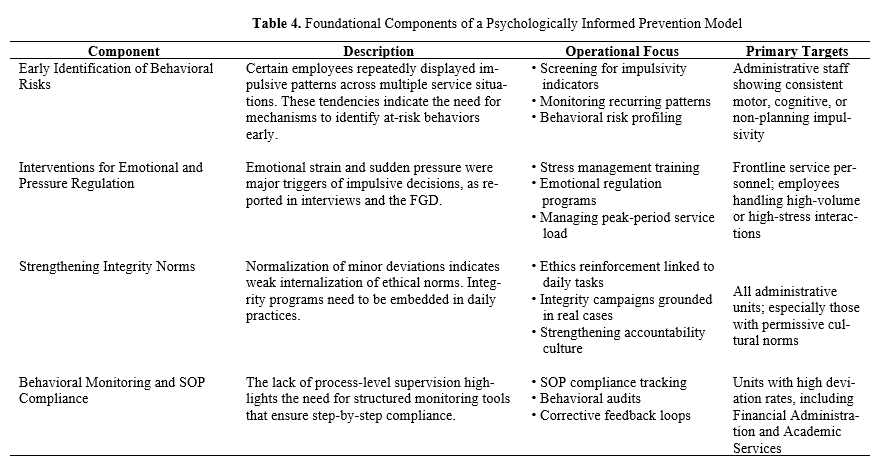
Petty corruption remains a persistent issue in higher education administrative services, yet its behavioral foundations are not well understood. This qualitative case study examines how impulsive behavior among administrative employees appears to be associated with petty deviations at Universitas Negeri Manado. Data were gathered through twenty-one working days of participatory observation, fifteen semistructured interviews, a focus group discussion, and document analysis. Impulsivity was examined using the Barratt Impulsiveness Scale (BIS-11), encompassing motor, cognitive, and non-planning dimensions. Motor impulsivity was associated with bypassing Standard Operating Procedures, cognitive impulsivity with emotionally driven shortcuts, and non-planning impulsivity with inconsistent workflow patterns. These behaviors were shaped by service pressure, emotional strain, relational expectations, and permissive cultural norms. The study provides a nuanced understanding of impulsivity as a proximal psychological mechanism influencing administrative decision making. A psychologically informed prevention model is proposed, emphasizing emotional regulation training, integrity-oriented cultural reinforcement, and process-focused supervision as pathways to strengthening integrity and reducing petty corruption in university administrative settings
References
Juridica Portucalense, 2705(36), 135–162. https://doi.org/10.34625/issn.2183-2705(36)2024.ic-6
Alowais, A. A., & Suliman, A. (2025). When the Darkness Consolidates: Collective Dark Triad Leadership and the Ethics Mirage. Merits, 5(4), 21. https://doi.org/10.3390/merits5040021 DOI: https://doi.org/10.3390/merits5040021
Bohlens, C. (2025). Corruption in Accreditation at HEIs: When Corruption Erodes Trust in Higher Learning. In M. Kayyali (Ed.), Navigating Quality Assurance and Accreditation in Global Higher Education (pp. 165–192). IGI Global Scientific Publishing. https://doi.org/10.4018/979-8-3693-6915-9.ch007 DOI: https://doi.org/10.4018/979-8-3693-6915-9.ch007
Boufounou, P., Eriotis, N., Kounadeas, T., Argyropoulos, P., & Poulopoulos, J. (2024). Enhancing Internal Control Mechanisms in Local Government Organizations: A Crucial Step towards Mitigating Corruption and Ensuring Economic Development. Economies, 12(4), 78. https://doi.org/10.3390/economies12040078 DOI: https://doi.org/10.3390/economies12040078
Chakrabarti, G., & Chatterjea, T. (2020). Ethics and Deviations in Decision-making. Springer. DOI: https://doi.org/10.1007/978-981-15-0687-1
De Almeida, M. P., Caldas, L. F., da Silva França, B. M. B., Vasconcelos, L. A., & Sandaker, I. (2024). Behavioral Systems Analysis in Understanding Models of Corruption Control. Behavior and Social Issues, 33(2), 850–879. https://doi.org/10.1007/s42822-024-00175-4 DOI: https://doi.org/10.1007/s42822-024-00175-4
De Simone, S., Cicotto, G., Pinna, R., & Giustiniano, L. (2016). Engaging public servants: Public service motivation, work engagement and work-related stress. Management Decision, 54(7), 1569–1594. https://doi.org/10.1108/MD-02-2016-0072 DOI: https://doi.org/10.1108/MD-02-2016-0072
Di Stefano, G., Scrima, F., & Parry, E. (2019). The effect of organizational culture on deviant behaviors in the workplace. The International Journal of Human Resource Management, 30(17), 2482–2503. https://doi.org/10.1080/09585192.2017.1326393 DOI: https://doi.org/10.1080/09585192.2017.1326393
Fenneman, J., Frankenhuis, W. E., & Todd, P. M. (2022). In which environments is impulsive behavior adaptive? A cross-discipline review and integration of formal models. Psychological Bulletin, 148(7–8), 555. https://doi.org/10.1037/bul0000375 DOI: https://doi.org/10.1037/bul0000375
Gould, D. J., Sawarynski, K., & Mohiyeddini, C. (2022). Academic Management in Uncertain Times: Shifting and Expanding the Focus of Cognitive Load Theory During COVID-19 Pandemic Education. Frontiers in Psychology, 13(647904). https://doi.org/10.3389/fpsyg.2022.647904 DOI: https://doi.org/10.3389/fpsyg.2022.647904
Gaitán-Aguilar, L., Hofhuis, J., Bierwiaczonek, K., & Carmona, C. (2022). Social media use, social identification and cross-cultural adaptation of international students: A longitudinal examination. Frontiers in Psychology, 13, 1013375. https://doi.org/10.3389/fpsyg.2022.1013375 DOI: https://doi.org/10.3389/fpsyg.2022.1013375
Gross, J. J. (2015). Emotion Regulation: Current Status and Future Prospects. Psychological Inquiry, 26(1), 1–26. https://doi.org/10.1080/1047840X.2014.940781 DOI: https://doi.org/10.1080/1047840X.2014.940781
Hamilton, C., & De Vries, G. J. (2025). The structural transformation of transition economies. World Development, 191, 106977. https://doi.org/10.1016/j.worlddev.2025.106977 DOI: https://doi.org/10.1016/j.worlddev.2025.106977
Harvey, W. S., Arora, N., Currie, G., & Spyridonidis, D. (2025). Why Individuals Commit Professional Misconduct and What Leaders Can Do to Prevent It. California Management Review, 67(3), 144–163. https://doi.org/10.1177/00081256241305815 DOI: https://doi.org/10.1177/00081256241305815
Hofmann, W., Friese, M., & Strack, F. (2009). Impulse and Self-Control From a Dual-Systems Perspective. Perspectives on Psychological Science, 4(2), 162–176. https://doi.org/10.1111/j.1745-6924.2009.01116.x DOI: https://doi.org/10.1111/j.1745-6924.2009.01116.x
Hofmann, W., Baumeister, R. F., Förster, G., & Vohs, K. D. (2012). Everyday temptations: An experience sampling study of desire, conflict, and self-control. Journal of Personality and Social Psychology, 102(6), 1318–1335. https://doi.org/10.1037/a0026545 DOI: https://doi.org/10.1037/a0026545
Hortal, A., & Pérez Martínez, A. (2024). Behavioral strategies for reducing corruption: from regulation to choice architecture. Behavioural Public Policy, 1–18. https://doi.org/10.1017/bpp.2024.48 DOI: https://doi.org/10.1017/bpp.2024.48
Indonesian Corruption Watch. (2024). Refleksi Hari Pendidikan Nasional: Korupsi Sektor Pendidikan Masih Tinggi. https://antikorupsi.org/index.php/id/refleksi-hari-pendidikan-nasional-korupsi-sektor-pendidikan-masih-tinggi
Jugl, M., Veenendaal, W., Corbett, J., & Ng Shiu, R. (2026). How does population size influence administrative performance? Evidence from Malta, Samoa, and Suriname. Public Policy and Administration, 41(1), 90-108. https://doi.org/10.1177/09520767241238426 DOI: https://doi.org/10.1177/09520767241238426
Kaptein, M. (2023). A Paradox of Ethics: Why People in Good Organizations do Bad Things. Journal of Business Ethics, 184(1), 297–316. https://doi.org/10.1007/s10551-022-05142-w DOI: https://doi.org/10.1007/s10551-022-05142-w
Kessler, J., & Sabel, C. (2021). The Uncertain Future of Administrative Law. Daedalus, 150(3), 188–207. https://doi.org/10.1162/daed_a_01867 DOI: https://doi.org/10.1162/daed_a_01867
Kock, N., & Moqbel, M. (2021). Social Networking Site Use, Positive Emotions, and Job Performance. Journal of Computer Information Systems, 61(2), 163–173. https://doi.org/10.1080/08874417.2019.1571457 DOI: https://doi.org/10.1080/08874417.2019.1571457
Kressmann, K., & Mueller-Seeger, J. (2026). A systematic review of organizational culture change from the micro-macro perspective. Management Review Quarterly, 76(1), 913-953. https://doi.org/10.1007/s11301-025-00498-5 DOI: https://doi.org/10.1007/s11301-025-00498-5
Lauriola, M., & Weller, J. (2018). Personality and Risk: Beyond Daredevils— Risk Taking from a Tempera-ment Perspective. In M. Raue, E. Lermer, & B. Streicher (Eds.), Psychological Perspectives on Risk and Risk Analysis (pp. 3–36). Springer International Publishing. https://doi.org/10.1007/978-3-319-92478-6_1 DOI: https://doi.org/10.1007/978-3-319-92478-6_1
Leib, M., Köbis, N., Soraperra, I., Weisel, O., & Shalvi, S. (2021). Collaborative dishonesty: A meta-analytic review. Psychological Bulletin, 147(12), 1241–1268. https://doi.org/10.1037/bul0000349 DOI: https://doi.org/10.1037/bul0000349
Lombardo, E., Waters, N., & Elzy, M. (2023). Behavioral inhibition and emotional invalidation in the context of personality impairment. Current Psychology, 42(17), 14403–14413. https://doi.org/10.1007/s12144-022-02705-y DOI: https://doi.org/10.1007/s12144-022-02705-y
Mugellini, G., Della Bella, S., Colagrossi, M., Isenring, G. L., & Killias, M. (2021). Public sector reforms and their impact on the level of corruption: A systematic review. Campbell Systematic Reviews, 17(2), e1173. https://doi.org/10.1002/cl2.1173 DOI: https://doi.org/10.1002/cl2.1173
Obschonka, M., Stuetzer, M., Newman, A., Gibson, C. B., Gosling, S. D., Rentfrow, P. J., & Potter, J. (2023). Corruption revisited: the influence of national personality, culture, and wealth. Journal of International Business Studies, 54(8), 1577–1587. https://doi.org/10.1057/s41267-023-00632-z DOI: https://doi.org/10.1057/s41267-023-00632-z
Oleksiyenko, A. V. (2022). World-class universities and the Soviet legacies of administration: Integrity dilemmas in Russian higher education. Higher Education Quarterly, 76(2), 385–398. https://doi.org/10.1111/hequ.12306 DOI: https://doi.org/10.1111/hequ.12306
Onyango, G. (2021). Whistleblowing behaviours and anti-corruption approaches in public administration in Kenya. Economic and Political Studies, 9(2), 230–254. https://doi.org/10.1080/20954816.2020.1800263 DOI: https://doi.org/10.1080/20954816.2020.1800263
Oprea, A. (2024). Behind anti-corruption, the transformations of society—investigation into the politicization of “illegal personal enrichment” in Romania. Frontiers in Political Science, 6,1393060. https://doi.org/10.3389/fpos.2024.1393060 DOI: https://doi.org/10.3389/fpos.2024.1393060
Sharma, N., Agrawal, M., Rushi, Ayyub, S., & Rai, D. (2025). Mindfulness-based Interventions for Emotional Dysregulation in Adolescents: A Systematic Review. Annals of Neurosciences, 09727531251355311. https://doi.org/10.1177/09727531251355311 DOI: https://doi.org/10.1177/09727531251355311
Siahaan, M., Suharman, H., Fitrijanti, T., & Umar, H. (2024). When internal organizational factors improve detecting corruption in state-owned companies. Journal of Financial Crime, 31(2), 376–407. https://doi.org/10.1108/JFC-11-2022-0292 DOI: https://doi.org/10.1108/JFC-11-2022-0292
Singh, D. (2021). Anticorruption, Cultural Norms, and Implications for the APUNCAC. Laws, 10(2), 23.https://doi.org/10.3390/laws10020023 DOI: https://doi.org/10.3390/laws10020023
Soleha Hamka, A., Wahyu Yuniarti, K., & dan Uichol Kim, M. (2015). Who makes adolescents happy? An explorative study using the indigenous psychology approach. Jurnal Indigenous, 13(2), 19–32. https://journals.ums.ac.id/index.php/indigenous/article/view/2599/1707
Sosnowski, M. J., & Brosnan, S. F. (2023). Under pressure: the interaction between high-stakes contexts and individual differences in decision-making in humans and non-human species. Animal Cognition, 26(4), 1103–1117. https://doi.org/10.1007/s10071-023-01768-z DOI: https://doi.org/10.1007/s10071-023-01768-z
Tamara, Y. (2024). The Influence of The Big 5 Personality, Financial Perceptions, and External Factors on Impulsive Buying Tendencies in Live Streaming. Asian Journal of Engineering, Social and Health, 3(9), 1956–1970. https://doi.org/10.46799/ajesh.v3i9.397 DOI: https://doi.org/10.46799/ajesh.v3i9.397
Tian, S., & Zhao, L. (2024). Tolerance for corruption and descriptive social norm: An experimental study of embezzlement. PLOS ONE, 19(5), e0303558. https://doi.org/10.1371/journal.pone.0303558 DOI: https://doi.org/10.1371/journal.pone.0303558
Tummers, L. L. G., Bekkers, V., Vink, E., & Musheno, M. (2015). Coping During Public Service Delivery: A Conceptualization and Systematic Review of the Literature. Journal of Public Administration Research and Theory, 25(4), 1099–1126. https://doi.org/10.1093/jopart/muu056 DOI: https://doi.org/10.1093/jopart/muu056
Van Rooij, B., & Fine, A. (2018). Toxic Corporate Culture: Assessing Organizational Processes of Deviancy. Administrative Sciences, 8(3), 23. https://doi.org/10.3390/admsci8030023 DOI: https://doi.org/10.3390/admsci8030023
Waldman, D. A., & Bowen, D. E. (2016). Learning to Be a Paradox-Savvy Leader. Academy of Management Perspectives, 30(3), 316–327. https://doi.org/10.5465/amp.2015.0070 DOI: https://doi.org/10.5465/amp.2015.0070
Weißmüller, K. S., & Zuber, A. (2023). Understanding the micro-foundations of administrative corruption in the public sector: Findings from a systematic literature review. Public Administration Review, 83(6), 1704–1726. https://doi.org/10.1111/puar.13699 DOI: https://doi.org/10.1111/puar.13699
Xie, P., Huang, C., Xu, T., & Cui, J. (2025). How personality traits influence impulsive buying through the sequential mediation of family dynamics and self control. Scientific Reports, 15(1), 16423. https://doi.org/10.1038/s41598-025-94564-3 DOI: https://doi.org/10.1038/s41598-025-94564-3
Ye, Y., Liu, Y., & Zhang, X. (2021). The Public Servants’ Response When Facing Pandemic: The Role of Public Service Motivation, Accountability Pressure, and Emergency Response Capacity. Healthcare, 9(5), 529. https://doi.org/10.3390/healthcare9050529 DOI: https://doi.org/10.3390/healthcare9050529
Yuwono, S. (2021). Organizational support and job satisfaction: Meta-analysis study. Indigenous: Jurnal Ilmiah Psikologi, 6(3), 12–22. https://doi.org/10.23917/indigenous.v6i3.14079 DOI: https://doi.org/10.23917/indigenous.v6i3.14079
Downloads
Submitted
Accepted
Published
How to Cite
Issue
Section
License
Copyright (c) 2026 Indigenous: Jurnal Ilmiah Psikologi

This work is licensed under a Creative Commons Attribution 4.0 International License.