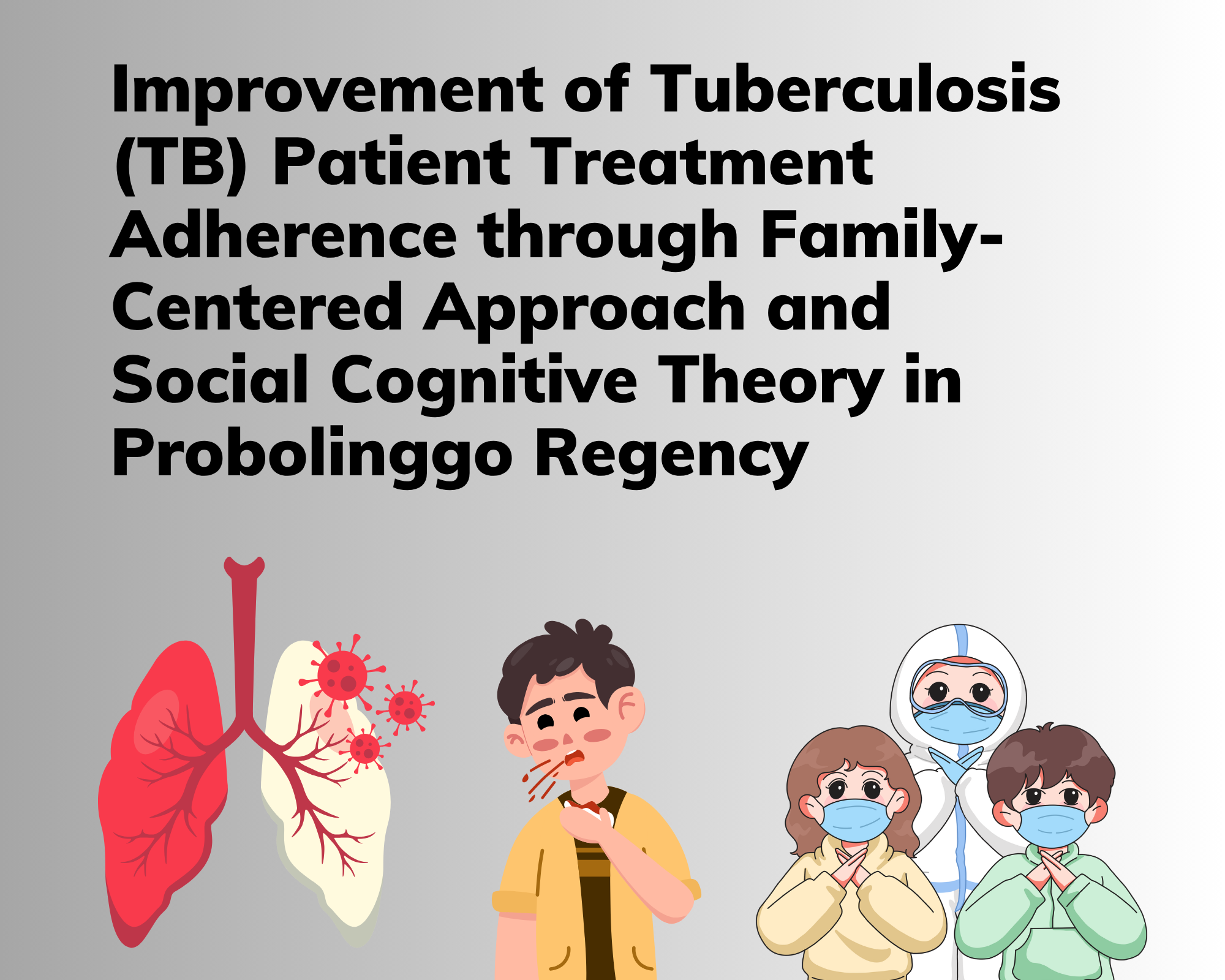
Improvement of Tuberculosis (TB) Patient Treatment Adherence through Family-Centered Approach and Social Cognitive Theory in Probolinggo Regency
DOI:
https://doi.org/10.23917/bik.v19i2.14292Keywords:
compliance, Tuberculosis (TB), patient treatment, patient treatment adherence, family-based approach, social cognitive theoryAbstract
Tuberculosis (TB) is still a public health problem. The existence of TB prevention programs involving the community has increased the discovery of TB suspects, but it has not been followed by treatment adherence of TB patients. The purpose of this study is to determine the improvement of treatment adherence of tuberculosis (TB) patients through a family-centered approach and social cognitive theory in Probolinggo Regency. This study is a quasi-experimental study using a pretest-posttest nonequivalent control group design. The population comprised all adherence TB patients in Probolinggo Regency (112 people); the sample comprised partially adherent TB patients, including family members, according to the inclusion criteria, using a cluster random sampling technique to select 80 respondents, divided into two groups: 40 in the intervention group and 40 in the control group. Patients in the intervention group received a family-based approach and social cognitive which focuses on interaction. The personal factors (knowledge, increased self-efficacy, medication-taking behavior) and the environment (family support) are important parts of care. The focus is not solely on the individual patient but on the relationship among behavior, environment, and mindset, applying theory through education twice a week for 60 minutes over 2 months. The control group received standard health services without additional intervention. Data were collected using a questionnaire, the Morisky Medication Adherence Scale (MMAS-8), which has undergone validity and reliability testing (Cronbach's alpha: 0.80), and a family-based nursing module. Data analysis with the help of SPSS nonparametric test, Wilcoxon W. Data processed on September 16, 2025. The results showed that, in the intervention group, the average non-adherence was 62.5%, and in the control group, 47.5%. Post-test showed that the average t adherent reached 77.5%, while the control group was non-adherent at 47.5%. The results of the independent-samples t-test show that in the intervention group, the mean rank is 56.3, and in the control group, it is 24.6, with a significant difference (P-value: 0.000 < α = 0.005). and results Mann-Whitney test significant (P-value: 0.000 < α = 0.005). There is a difference between the intervention and control groups. This means there is an increase in average adherence to family-based methods compared with standard health service methods. A family-centered approach, grounded in education and social cognitive theory, increases self-efficacy, and observational learning can improve adherence among patients with TB.
Downloads
References
Adima, F., & Arini, M. (2025). The influence of healthcare workers’ social support on compliance to medication in multidrug-resistant tuberculosis patients at the Regional General Hospital of Dr. Saiful Anwar. Clinical Epidemiology and Global Health, 31(June 2024), 101890. https://doi.org/10.1016/j.cegh.2024.101890
Akram, H., & Abdelrady, A. H. (2025). Examining the role of the ClassPoint tool in shaping EFL students’ perceived E-learning experiences: A social cognitive theory perspective. Acta Psychologica, 254(November 2024), 104775. https://doi.org/10.1016/j.actpsy.2025.104775
Alene, K. A., Hertzog, L., Gilmour, B., Clements, A. C. A., & Murray, M. B. (2024). Interventions to prevent post-tuberculosis sequelae: a systematic review and meta-analysis. EClinicalMedicine, 70, 102511. https://doi.org/10.1016/j.eclinm.2024.102511
Andargie, A., Molla, A., Tadese, F., & Zewdie, S. (2021). Lost to follow-up and associated factors among patients with drug-resistant tuberculosis in Ethiopia: A systematic review and meta-analysis. PLoS ONE, 16(3 March), 1–18. https://doi.org/10.1371/journal.pone.0248687
Asriwati, Yeti, E., Niakurniawati, & Usman, A. N. (2021). Risk factors analysis of non-compliance of Tuberculosis (TB) patients taking medicine in Puskesmas Polonia, Medan, 2021.
Ciaravino, G., Espluga, J., Moragas-Fernández, C., Capdevila, A., Freixa, V., López i Gelats, F., Vergne, T., & Allepuz, A. (2023). Improving the communication between farmers and veterinarians to enhance the acceptability of bovine tuberculosis eradication programs. Preventive Veterinary Medicine, 220(October). https://doi.org/10.1016/j.prevetmed.2023.106046
Dinas Kesehatan Kabupaten Probolinggo. (2025). Data penemuan dan pengobatan semua kasus tb tahun 2025 (per 18 maret 2025). 2025.
Fetensa, G., Wirtu, D., Etana, B., Wakuma, B., Tolossa, T., Gugsa, J., Gobena, D., Fekadu, G., Ragasa, M. T., & Ejeta, E. (2024). Tuberculosis treatment delay and contributing factors within tuberculosis patients in Ethiopia: A systematic review and meta-analysis. Heliyon, 10(7), e28699. https://doi.org/10.1016/j.heliyon.2024.e28699
Fonseka, N., Khan, Z., Lewis, M., Kibria, Z., Ahmad, F., Khan, M. F., Ul-Haq, M., Ul-Haq, Z., Sanauddin, N., Majid, M., Rahim, M., Naeem, F., Butt, M., Ashraf, S., Komproe, I., Mallen, C., Kellar, I., Yadegarfar, G., Milner, A., … Farooq, S. (2024). Cognitive therapy for depression in tuberculosis treatment: protocol for multicentre pragmatic parallel arm randomised control trial with an internal pilot. BMJ Open, 14(6). https://doi.org/10.1136/bmjopen-2023-083483
Hassani, S., Mohammadi Shahboulagi, F., Foroughan, M., Tabarsi, P., Ghaedamini Harouni, G., Jamaati, H., Varahram, M., Mohammad Seyedmehdi, S., & Alireza Nadji, S. (2024). Relationship of family caregivers’ associated factors with medication adherence among elderly with tuberculosis in Iran. Journal of Clinical Tuberculosis and Other Mycobacterial Diseases, 37(October), 100488. https://doi.org/10.1016/j.jctube.2024.100488
Ismail, N., Moultrie, H., Mwansa-Kambafwile, J., Copas, A., Izu, A., Moyo, S., Skinner, D., Ismail, F., Gosce, L., Omar, S. V., Abubakar, I., & Madhi, S. A. (2025). Effects of conditional cash transfers and pre-test and post-test tuberculosis counselling on patient outcomes and loss to follow-up across the continuum of care in South Africa: a randomised controlled trial. The Lancet Infectious Diseases, 1–11. https://doi.org/10.1016/S1473-3099(24)00816-8
Jiang, Y., Chen, J., Ying, M., Liu, L., Li, M., Lu, S., Li, Z., Zhang, P., Xie, Q., Liu, X., & Lu, H. (2023). Factors associated with loss to follow-up before and after treatment initiation among patients with tuberculosis: A 5-year observation in China. Frontiers in Medicine, 10(April), 1–9. https://doi.org/10.3389/fmed.2023.1136094
Juliasih, N. N., Sakinah, L. F., Sari, R. M., Winarso, H., Siahaan, S. C. P. T., & Gunawan, E. J. (2024). Determinants of transmission prevention behavior among Tuberculosis patients in Surabaya, Indonesia. Infection Prevention in Practice, 6(4), 100404. https://doi.org/10.1016/j.infpip.2024.100404
Karat, A. S., Jones, A. S. K., Abubakar, I., Campbell, C. N. J., Clarke, A. L., Clarke, C. S., Darvell, M., Hill, A. T., Horne, R., Kunst, H., Mandelbaum, M., Marshall, B. G., McSparron, C., Rahman, A., Stagg, H. R., White, J., Lipman, M. C. I., & Kielmann, K. (2021). “You have to change your whole life”: A qualitative study of the dynamics of treatment adherence among adults with tuberculosis in the United Kingdom. Journal of Clinical Tuberculosis and Other Mycobacterial Diseases, 23, 100233. https://doi.org/10.1016/j.jctube.2021.100233
Kemenkes RI. (2023). Laporan Program Penanggulangan Tuberkulosis Tahun 2022. Kemenkes RI, 1–147.
Kementerian Kesehatan RI. (2023). Survei Kesehatan Indonesia (SKI).
Keter, A. K., Heerden, A. Van, Decroo, T., Boyles, T., Bosman, S., Madonsela, T., Msimango, L. I., Naiken, L., Kiyan, C., Kamele, M., Ayakaka, I., Reither, K., Mario Jacobs, B. K., & Lynen, L. (2025). Estimation of therapeutic threshold for tuberculosis using adapted nominal group technique and clinical vignettes in clinical and community settings in Southern Africa. Journal of Clinical Tuberculosis and Other Mycobacterial Diseases, 40(April), 100529. https://doi.org/10.1016/j.jctube.2025.100529
Kustin, Anugrah, F. dwi, & Ro’isah. (2024). Metodologi Penelitian. PT. Blambangan scholar.
Lourenço, G., Bernardi, F., Francisco, J., & Lima, V. (2025). ScienceDirect Data Quality in Laboratory Indicators and Tuberculosis Control : A Case Study from the State of São Paulo. Procedia Computer Science, 256, 1022–1029. https://doi.org/10.1016/j.procs.2025.02.208
Ro’isah, Anies, Sakundarno, M., & Jazuli, N. (2021). The Role of the Tuberculosis (TB) Community in Detecting TB Suspects in Probolinggo Regency, East Java. E3S Web of Conferences, 317. https://doi.org/10.1051/e3sconf/202131704018
Ro’isah, Anies, Sakundarno, M., & Jazuli, N. (2022). TB community empowerment model instruments in finding tuberculosis (TB) suspects. Bali Medical Journal, 11(2), 551–554. https://doi.org/10.15562/bmj.v11i2.3116
Sugiono. (2020). Penelitian Kuntitatif dan Kualitatif. Bandung : Alfabeta.
Tang, Y., Yan, Y., Mao, J., Ni, J., & Qing, H. (2023). Navigating Food Insecurity in Higher Education: Using the Social Cognitive Theory to Identify Key Influences and Effective Intervention. Ageing Research Reviews, 101865. https://doi.org/10.1016/j.advnut.2025.100451
Welbeck, D. N. O., Amponsah-Bediako, K., Welbeck, J. N. O., Amoani, E. M. T., & Tetteh, A. (2025). The mediating effect of thought leadership on self-awareness, self-regulation, and job performance among managers of SMEs. Cogent Business and Management, 12(1). https://doi.org/10.1080/23311975.2024.2441539
WHO. (2024). 2024 Global tuberculosis report.
Zary, M., Mohamed, M. S., Kafie, C., Chilala, C. I., Bahukudumbi, S., Foster, N., Gore, G., Fielding, K. L., Subbaraman, R., & Schwartzman, K. (2024). The performance of digital technologies for measuring tuberculosis medication adherence: a systematic review. BMJ Global Health, 9(7), e015633. https://doi.org/10.1136/bmjgh-2024-015633
Downloads
Submitted
Accepted
Published
How to Cite
Issue
Section
License
Copyright (c) 2026 Ro’isah Ro’isah; Erna Handayani, Yulia Rachmawati Hasanah

This work is licensed under a Creative Commons Attribution 4.0 International License.