Finding Ease in Hardship: An Analysis of Individual Reflections on Implementation of Quranic Verse
DOI:
https://doi.org/10.23917/ajip.v2i2.17327Keywords:
Implementation of Quran, Hardship, Emotional Coping, Spiritual Resilience, Psychological Well-beingAbstract
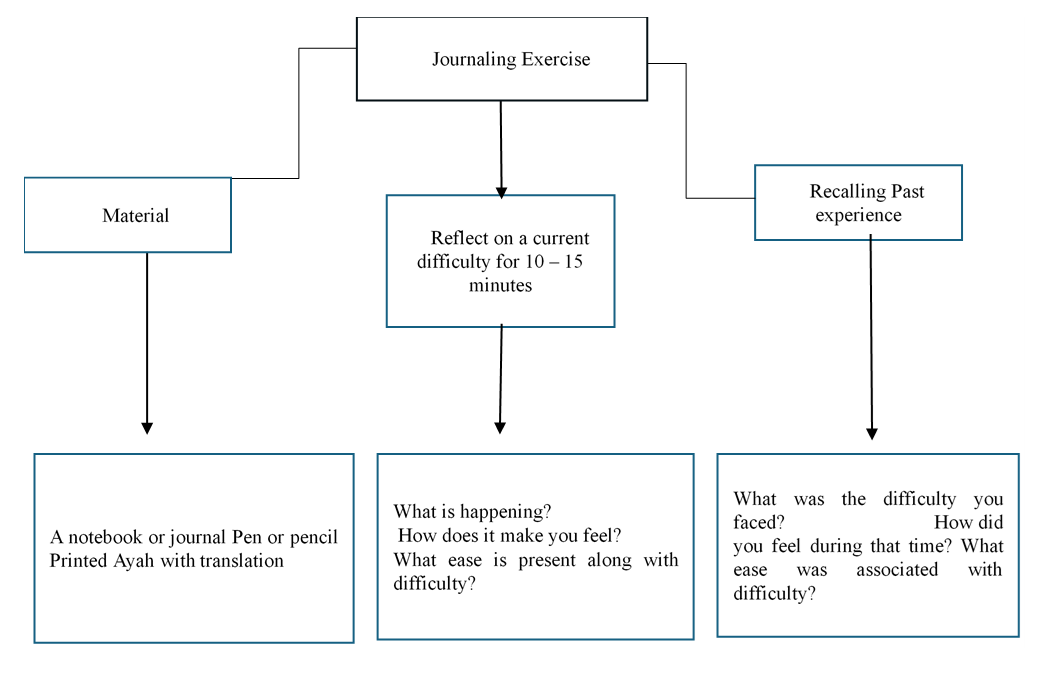
The Holy Quran guides us how to think rationally during tough times. This consequently lowers the stress caused by hardships. One such verse of Surah Al-Inshirah “with hardship, comes ease” (Qur’an 94:6) gives solace when days seem dark. It encourages us find the blessings associated with hurdles. So, the present study was aimed to examine how individuals interpret and apply the Quranic verse during challenging times. Study Design: This was a qualitative research where interpretative phenomenology was employed. Sampling: the research utilized purposive sampling. The interviews of 17 females were included in research. Data Collection: Face to face interviews were conducted. Participants were first given a short session on the understanding of Quranic verse and taught to use it as cognitive restructuring. Then they were instructed to recall a recent stressful incident and find ease associated with that incident in the context of Quranic verse. The researcher assisted participants during the process of finding ease. The participants were given a card on which original Arabic verse along with Urdu translation was printed. Participants were then instructed to write down their responses. Analysis: Based on written responses, systematic coding was done and major themes were derived. There were 5 categories of Hardships including Daily Hassles, Traumatic Events, Physical Illnesses, Financial Problems, and Relationship Challenges. Similarly, 3 central themes of Ease were identified which were Spiritual Growth, Personal Development Skills, Life Management Skills. Findings: The study highlights the significant role of Quranic teachings in promoting psychological well-being. Further research should study this verse’s effectiveness by using experimental design and Longitudinal research methods.
Downloads
References
Abdulraouf Y. Lamoshi, “Religion as a Resilience Tool to Manage Stress in Adolescents: Islamic Approach,” Global Journal of Human-Social Science: H Interdisciplinary, vol. 15, no. 3 (United States: Global Journal Inc., 2015), 5-8.
Abu-Raiya, H., & Pargament, K. I. (2022). Religious coping among Muslims: A review of the literature and empirical studies. Journal of Muslim Mental Health, 16(1), 45–62. https://doi.org/10.3998/jmmh.1834
Ahmadi, F., Park, C. L., & Khosravi, M. (2022). Islamic religious coping and mental health outcomes: A systematic review and meta-analysis. International Journal for the Psychology of Religion, 32(3), 210–228. https://doi.org/10.1080/10508619.2021.1983214
Al-Bāḥisīn, Y. ᶜA.W. (2001). Rafᶜ al-ḥaraj fī al-sharīᶜah al-Islāmiyyah: Dirāsah uṣūliyyah ta’ṣīlyyah (4th ed.). Maktabat al-Rushd.
Al-Qāsimī, M. J. D. (1957). Maḥāsin al-Ta’wīl (1st ed.). n. p.: n. p.
Al-Zamakhsharī, M. I. (n. d.). Al-Kashshāf ᶜan ḥaqā’iq al-tanzīl.
Che Rahimi, A. (2021). Do religiosity and religious coping matter? Healthcare, 9(11), 1535.
Dolcos, F., Hohl, K., Hu, Y., & Dolcos, S. (2021). Religiosity and resilience: Cognitive reappraisal and coping self-efficacy mediate the link between religious coping and well-being. Journal of religion and health, 60(4), 2892-2905.
Folkman, S. (2020). Stress, coping, and positive emotion: Reframing meaning-focused coping in contemporary psychology. Current Opinion in Psychology, 32, 85–89.
Gassner, L., Zechmeister-Koss, I., & Feltz, A. (2022). Cognitive reappraisal as a tool for stress reduction and emotional regulation. Frontiers in Psychology, 13, 893412. https://doi.org/10.3389/fpsyg.2022.893412
Ibn Kathir, I. (2000). Tafsir Ibn Kathir (S. Al-Mubarakpuri, Ed. & Trans.; 10 vols.). Darussalam Publications. (Original work published 1373)
Ibn Kathīr.Tafsīr Surah Ash-Sharh, Ayah 6. Quran.com. Retrieved July 31, 2026, from https://quran.com/94:6/tafsirs/en-tafisr-ibn-kathir
Ibrahim, E., Jani, M., Alias, A., Yasin, R. & Zakariyah, L. (2015). Interaction with the Qur’an and Self-Regulated Learning Vis-à-Vis Academic Achievement of Undergraduate Students. International Journal of Current Research and Academic Review, 3(9), 189-197.
Jaffar, N., Faizal, S. M., Selamat, Z., & Alias, N. (2023). Muslim young adults’ financial strain and financial stress during the COVID-19 pandemic: The moderating role of religiosity. Heliyon, 9(10).
Kannan, M. A. (2022). A review of the holy Quran listening and its neural and emotional effects. Heliyon.https://doi.org/10.1016/j.heliyon.2022.e09881
Koenig, H. G. (2012). Religion, spirituality, and health: The research and clinical implications. International Scholarly Research Notices, 2012(1), 278730.
Mahdi Pourkord, Fazlollah Mirdrikvand, and Amir Karami, “Predicting Resilience in Students Based on Happiness, Attachment Style, and Religious Attitude,” Health, Spirituality and Medical Ethics, vol. 7, no. 2 (June 2020): 27–34.
Malti, T., Peplak, J., & Zhang, L. (2018). The development of respect in children and adolescents. Child Development Perspectives, 12(2), 85–90. https://doi.org/10.1111/cdep.12265
McRae, K., & Gross, J. J. (2020). Emotion regulation: Emotion strategies and psychological well-being. Nature Reviews Psychology, 1(2), 81–90. https://doi.org/10.1038/s44159-021-00007-1
Moulaei, K. (2023). The effect of the holy Quran recitation and listening on anxiety, stress and depression: A review. Health Science Reports. https://doi.org/10.1002/hsr2.1234
Ozcan, O., Hoelterhoff, M. & Wylie, E. (2021). Faith and spirituality as psychological coping mechanism among female aid workers: a qualitative study. Int J Humanitarian Action 6, 15.
Pargament, K. I., Feuille, M., & Burdzy, D. (2011). The Brief RCOPE: Psychometric evaluation of a revised measure of religious coping. Psychology of Religion and Spirituality, 3(1), 51–65. https://doi.org/10.1037/a0021263
Umarji, O., Mahmood, A. A., Raza, L., & Awaad, R. (2023). Religiosity, Coping, and Mental Health: An Empirical Analysis of Muslims Across the COVID-19 Pandemic. In Islam, Muslims, and covid-19 (pp. 114-149). Brill
Ushama, T. (2015). Is Islam a Religion of Ease or Hardship? An Analysis of the Muslim Scripture and Patterns of Prophet Muhammad (Peace Be upon Him). Asian Social Science, 11(1), 51.
Wahyudin, D., & Hamzah, T. A. H. (2020). معاني ألفاظ اليسر والعسر وما يشتق منهما في القرآن الكريم. لســـانـنــا (LISANUNA): Jurnal Ilmu Bahasa Arab dan Pembelajarannya, 10(2), 291-306
Whiteman, S. D., McHale, S. M., & Soli, A. R. (2011). Theoretical perspectives on sibling relationships. Journal of Family Theory & Review, 3(2), 124–139. https://doi.org/10.1111/j.1756-2589.2011.00087.x
Zhang, H., Hook, J. N., Van Tongeren, D. R., Davis, E. B., Aten, J. D., McElroy-Heltzel, S., ... & Captari, L. E. (2021). Spiritual fortitude: A systematic review of the literature and implications for COVID-19 coping. Spirituality in Clinical Practice, 8(4), 229.
Downloads
Submitted
Accepted
Published
How to Cite
Issue
Section
License
Copyright (c) 2026 Ayesha Sagheer, Sehrish Wazir, Ariba Sarwar

This work is licensed under a Creative Commons Attribution 4.0 International License.