When Worship is Not Enough: Muraqabah as a Psychospiritual Mediator in Addressing Academic Stress Among Online Students.
DOI:
https://doi.org/10.23917/ajip.v2i2.16593Keywords:
muraqabah, reverence of Tahajjud prayer, academic stress, psychospiritual, online studentsAbstract
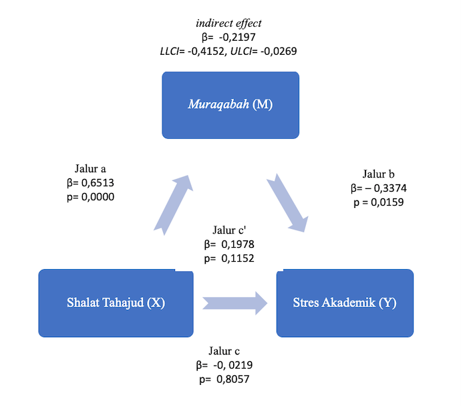
Academic stress phenomena have significantly increased among university students in the post-pandemic era, primarily due to online learning systems that impose new psychological pressures. This study aims to analyze the role of muraqabah as a psychospiritual mediator in the relationship between the khushu’ (reverence) of Tahajjud prayer and academic stress among online learners. The research employs a non-experimental quantitative approach with a correlational design and path analysis. The sample consists of 102 students obtained through convenience sampling. Research instruments include the Tahajjud Prayer Reverence Scale, the Muraqabah Scale, and the Academic Stress Scale (PASS). Data analysis was conducted using the Hayes PROCESS Macro Model 4 with a bootstrapping method of 5,000 iterations. The results indicate that the khushu’ of Tahajjud prayer does not have a direct effect on reducing academic stress (p > 0.05). However, it exerts a significant indirect effect through the enhancement of muraqabah (β = 0.65; p = 0.000). Consequently, psychological tranquility in students is not achieved solely through ritual worship, but through the internalization of profound spiritual awareness regarding Allah’s surveillance.
Downloads
References
Al-Ghazali, I. (2020). Ihya’‘Ulumuddin 10. Nuansa Cendekia.
Aldahadha, B. (2023). Developing a jordanian measure of reverence in muslim praying (‘khushoo’): content validity, factor structure and reliability. Journal of Religion and Health, 62(5), 3664–3686.
Aristovnik, A., Keržič, D., Ravšelj, D., Tomaževič, N., & Umek, L. (2020). Aristovnik. Sustainability (Switzerland), 12(20), 1–34.
Badri, M. (2018). Contemplation: An Islamic psychospiritual study (new edition). International Institute of Islamic Thought (IIIT).
Bedewy, D., & Gabriel, A. (2015). Examining perceptions of academic stress and its sources among university students: The Perception of Academic Stress Scale. Health Psychology Open, 2(2), 2055102915596714.
Cohen, J. (2016). A power primer.
Coman, C., Țîru, L. G., Meseșan-Schmitz, L., Stanciu, C., & Bularca, M. C. (2020). Online teaching and learning in higher education during the coronavirus pandemic: Students’ perspective. Sustainability, 12(24), 10367.
Doufesh, H., Ibrahim, F., & Safari, M. (2016). Effects of Muslims praying (Salat) on EEG gamma activity. Complementary Therapies in Clinical Practice, 24, 6–10.
Folkman, S. (2013). Stres: appraisal and coping. In Encyclopedia of behavioral medicine (pp. 1913–1915). Springer.
Folkman, S., Lazarus, R. S., Dunkel-Schetter, C., DeLongis, A., & Gruen, R. J. (1986). Dynamics of a stressful encounter: cognitive appraisal, coping, and encounter outcomes. Journal of Personality and Social Psychology, 50(5), 992.
Hair, J. F., Black, W. C., Babin, B. J., Anderson, R. E., & Tatham, R. L. (2019). Multivariate data analysis. Cengage learning Hampshire.
Matin, N. S. (2018). Tahajjud Therapy for Stress Coping: Psychoneuroimmunological Perspective. 231(Amca), 617–619. https://doi.org/10.2991/amca-18.2018.171
Pargament, K. I. (2011). Spiritually integrated psychotherapy: Understanding and addressing the sacred. Guilford Press.
Rokayah, C., Sholihah, E. F., & Herdian, F. (2022). Overview of students’ academic stress levels on online learning during the COVID-19 pandemic. Indones. J. Glob. Heal. Res, 4(1), 145–150.
Susanty, R., & Hawadi, L. (2020). Relationship between Self-Regulated Learning and Muraqabah with Academic Dishonesty of Muslim Graduate Students. https://doi.org/10.4108/eai.18-9-2019.2293321
Wahyu Rahmanto, S., Fachrunisa, R. A., & Suseno, B. (2023). Khushoo In Salah: An Overview of Nafs (Islamic Psychological Perspective). Asian Journal of Islamic Psychology, 1(1), 8–14. https://doi.org/10.23917/ajip.v1i1.3708
Downloads
Submitted
Accepted
Published
How to Cite
Issue
Section
License
Copyright (c) 2026 Metty Hidayanthi, Evi Afifah Hurriyati

This work is licensed under a Creative Commons Attribution 4.0 International License.