Digital workload and anxiety among Tahfizh preschool teachers: Self-efficacy in Islamic psychology
DOI:
https://doi.org/10.23917/ajip.v2i2.16577Keywords:
Digital Workload , Digital Anxiety, Self-Efficacy, Islamic Psychology, PAUD Tahfizh TeachersAbstract
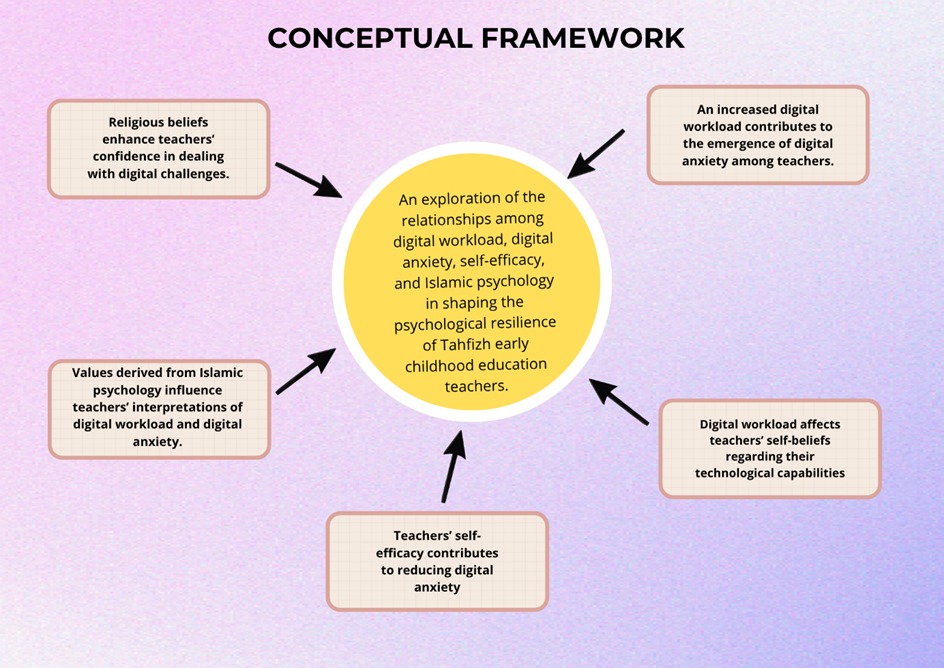
Digital transformation in education has substantially reshaped teachers’ roles and responsibilities, including those of early childhood Qur’anic education teachers. The integration of digital technology into instructional activities, administrative tasks, and school–parent communication requires continuous adaptation, potentially increasing digital workload and triggering digital anxiety. This study hypothesizes that strong self-efficacy grounded in Islamic psychology values enables teachers to manage digital work pressures more effectively. The research aims to explore the forms of digital workload and digital anxiety experienced by early childhood Qur’anic education teachers and to examine the role of self-efficacy in addressing these demands.
This study employed a qualitative approach using a case study design at an Islamic early childhood education institution in Bekasi, Indonesia. Data were collected through in-depth interviews, classroom observations, and document analysis involving purposively selected teachers and were analyzed thematically. Findings reveal that digital workload manifests in technology-based administrative requirements, digital instructional media use, and intensive online communication with parents. These conditions contribute to digital anxiety related to technological competence, time constraints, and sustained performance expectations. Self-efficacy, strengthened by niyyah, ṣabr, ikhlāṣ, and tawakkul, functions as an adaptive coping mechanism in managing digital challenges.
Downloads
References
Al-Jauziyyah, I. Q. (2009). Ad-dā’ wa ad-dawā’: Macam-macam penyakit hati yang membahayakan dan resep pengobatannya (A. Kurniawan, Trans.; Tim Pustaka Imam Asy-Syafi’i, Ed.). Pustaka Imam Asy-Syafi’i.
Andryan, A. A., & Suminar, D. R. (2024). Tinjauan literatur sistematis: Hubungan antara technostress dengan burnout. Al-Kharaj: Jurnal Ekonomi, Keuangan & Bisnis Syariah, 6(12), 8079–8093. https://doi.org/10.47467/alkharaj.v6i12.4656
Asosiasi Psikologi Islam. (2020). Psikologi Islam: Kajian teoritik dan penelitian empirik (A. Rusdi & Subandi, Eds.). Asosiasi Psikologi Islam bekerja sama dengan Arti Bumi Intaran.
Azmi, Q. T., & Salsabilah, S. (2024). Regulasi kecemasan dengan dzikir dalam sudut pandang psikologi tasawuf. Al-Tarbiyah: Jurnal Ilmu Pendidikan Islam, 2(4), 121–128. https://doi.org/10.59059/al-tarbiyah.v2i4.1434
Bakker, A. B., & Demerouti, E. (2007). The Job Demands-Resources model: State of the art. Journal of Managerial Psychology, 22(3), 309–328. https://doi.org/10.1108/02683940710733115
Bandura, A. (1997). Self-Efficacy: The Exercise of Control. New York: W.H. Freeman and Company.
Bora, S., & Neelakandan, R. (2025). Relationship between digital anxiety, digital stress and digital well-being among late adolescents. International Journal of Innovation Studies, 9(1), 1–10.
Creswell, J. W., & Poth, C. N. (2018). Qualitative inquiry and research design: Choosing among five approaches (4th ed.). Sage.
Farooq, N. (2024). The Impact of Salah (Prayer) and Dhikr on Stress Reduction and Emotional Regulation. International Journal of Islamic Psychology, 1(2), 34–44.
Fischer, T., Pehböck, A., Riedl, R., & lainnya. (2021). The Digital Stressors Scale: Development and Validation of a New Survey Instrument to Measure Digital Stress Perceptions in the Workplace Context. Frontiers in Psychology, 12, 607598.
Fitriyah, Q. F., Rahman, F., Fatmarizka, T., Susilo, T. E., Astuti, H., Nurjanah, L. S., & Rahayu, P. (2024). Impact of Self-Efficacy and Digital Pedagogy on Teaching Readiness of Digital Immigrant Childhood Teachers. Jurnal Obsesi : Jurnal Pendidikan Anak Usia Dini, 8(5), 869–878. https://doi.org/10.31004/obsesi.v8i5.6102
Inayah, N., & Arroisi, J. (2024). Coping Discrepancy Between Rationality and Religiosity: Balancing Model in Islamic Psychology. Kıbrıs Türk Psikiyatri ve Psikoloji Dergisi, 6(1), 69–75. https://doi.org/10.35365/ctjpp.24.4.08
Kementerian Agama Republik Indonesia. (2019). Al-Qur'an dan Terjemahannya: Edisi Penyempurnaan 2019. Lajnah Pentashihan Mushaf Al-Qur'an, Badan Litbang dan Diklat Kementerian Agama Republik Indonesia.
Khlaif, Z. N., Sanmugam, M., Joma, A. I., Odeh, A., & Barham, K. (2023). Factors influencing teacher’s technostress experienced in using emerging technology: A qualitative study. Technology, Knowledge and Learning, 28, 865–899. https://doi.org/10.1007/s10758-022-09607-9
Kusumawardani, C. T., & Dimyati, D. (2021). Penerapan E-learning pada Pendidikan Anak Usia Dini di Masa Pandemi Covid-19. Jurnal Obsesi: Jurnal Pendidikan Anak Usia Dini, 5(2), 1254–1263. https://doi.org/10.31004/obsesi.v6i2.1002
Li, H., He, H., Luo, W., et al. (2024). Early Childhood Digital Pedagogy: A Scoping Review of Its Practices, Profiles, and Predictors. Early Childhood Education Journal. https://doi.org/10.1007/s10643-024-01804-8
Maslach, C., & Leiter, M. P. (2016). Understanding the burnout experience: Recent research and its implications for psychiatry. World Psychiatry, 15(2), 103–111. https://doi.org/10.1002/wps.20311
Muslim, I. (n.d.). Ṣaḥīḥ Muslim. Kitab al-Zuhd wa al-Raqā'iq, Hadith No. 2999.
Robbins, S., Judge, T. A., Millett, B., & Boyle, M. (2013). Organisational behaviour. Pearson Higher Education AU.
Salmela-Aro, K., Upadyaya, K., & Hietajärvi, L. (2022). Teachers’ digital stress and work engagement during COVID-19. Teaching and Teacher Education, 109, 103556. https://doi.org/10.1016/j.tate.2021.103556
Saputra, A., Kadar, K., & Shofiah, V. (2022). Sabar dan tawakkal sebagai solusi dalam mengatasi stres guru sekolah luar biasa. Jurnal Psikologi, 18(1), 73-80.
Saunders, N., & Stephenson, Z. (2024). Reviewing the Use of the Brief Religious Coping Scale (Brief RCOPE) Across Diverse Cultures and Populations. Journal of Religion and Health, 63, 3926–3941.
Selwyn, N. (2021). The human labour of school data: Exploring the production of digital data in schools. Oxford Review of Education, 47(3), 353–368. https://doi.org/10.1080/03054985.2020.1835628
Selwyn, N., Nemorin, S., & Johnson, N. F. (2017). High-tech, hard work: An investigation of teachers' work in the digital age. Learning, Media and Technology, 42(4), 390–405. https://doi.org/10.1080/17439884.2016.1252770
Siddiqui, S., Arif, I., & Hinduja, P. (2023). Technostress: A catalyst to leave the teaching profession—A survey designed to measure technostress among teachers in Pakistan during COVID-19 pandemic. E-Learning and Digital Media, 20(1), 53–79. https://doi.org/10.1177/20427530221107506
Surahman, H. S., Pd, M., Nugroho, M. T., Pd, M., Nanda, R. P., Rahmayanti, W., ... & Pd, M. (2025). Kompetensi Guru di Era Digital: Menjadi Pendidik Cakap Teknologi dan Inovatif. PENERBIT KBM INDONESIA.
Tu, L., Rao, Z., Jiang, H., & Dai, L. (2025). Technostress, Burnout, and Job Satisfaction: An Empirical Study of STEM Teachers’ Well-Being and Performance. Behavioral Sciences, 15(7), 992.
Wang, X., Zhang, R., Wang, Z., & Li, T. (2021). How Does Digital Competence Preserve University Students' Psychological Well-Being During the Pandemic? An Investigation From Self-Determined Theory. Frontiers in Psychology, 12, 652594.
Warmansyah, J., Amalina, & Febriyani, E. (2022). Analisis korelasi self-efficacy guru PAUD dalam penggunaan teknologi dengan kesiapan mengajar secara online. Jurnal Manajemen Pendidikan Islam, 7(1), 1–10. https://ejournal.uinib.ac.id/jurnal/index.php/MAp/article/view/4143
Winarti, W., Nurhayati, S., Rukanda, N., Rohaeti, E., et al. (2023). Analisis Kompetensi Digital Guru PAUD dalam Mengelola Pembelajaran Daring Anak Usia Dini. Obsesi: Jurnal Pendidikan Anak Usia Dini, 6(6), Artikel 3111. https://doi.org/10.31004/obsesi.v6i6.3111 mail.obsesi.or.id
Windayani, N. L. I., & Sudarma, I. K. (2025). Strategi kepemimpinan kepala PAUD dalam menghadapi tantangan era digital. Jurnal Ilmiah Pendidikan Citra Bakti, 12(1). http://jurnalilmiahcitrabakti.ac.id/jil/index.php/jil
Yin, R. K. (2024). Case study research and applications: Design and methods (6th ed.). Thousand Oaks, CA: Sage.
Downloads
Submitted
Accepted
Published
How to Cite
Issue
Section
License
Copyright (c) 2026 Sri Hartini, Heru Susanto

This work is licensed under a Creative Commons Attribution 4.0 International License.