Immersive Virtual Reality Improves Vocational Students’ Industry-Based Building Material Design Skills
DOI:
https://doi.org/10.23917/varidika.v39i1.17780Keywords:
building construction, design skill, immersive, virtual reality, vocational educationAbstract
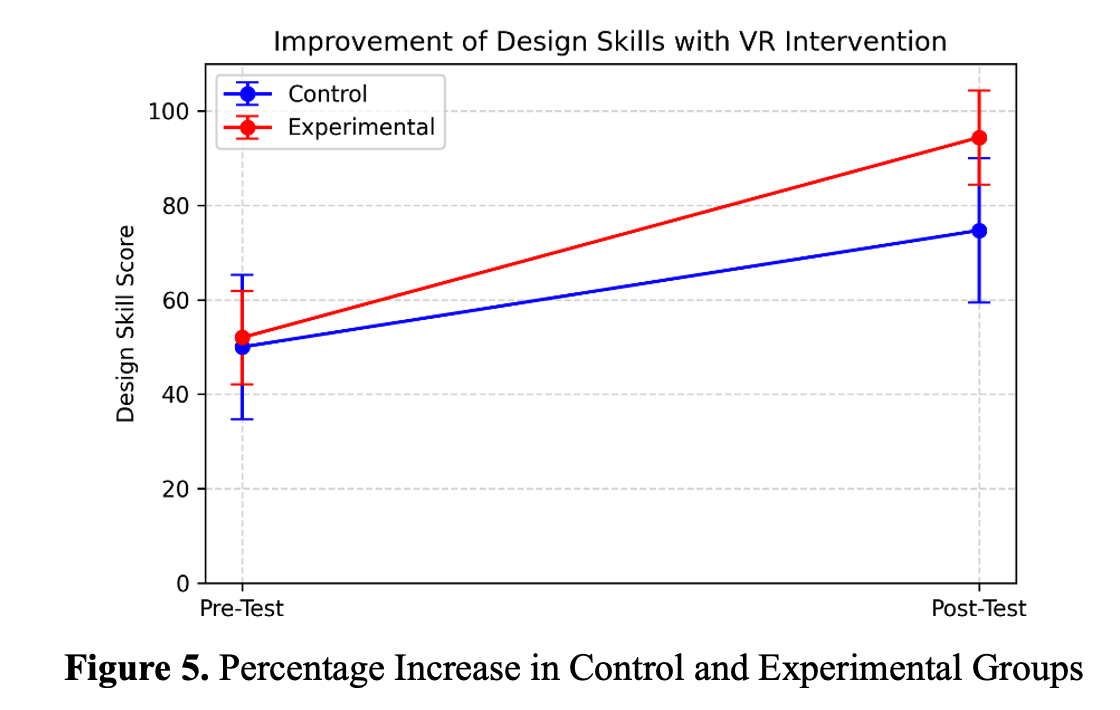
The rapid advancement of immersive technology has reshaped vocational education, emphasizing the need for effective learning strategies to enhance industry-based design skills. Virtual Reality (VR) offers an immersive, interactive environment that bridges academic learning and industry requirements. This study aims to the effectiveness of VR simulation media in building construction for improving design skills. A quasi-experimental pretest–posttest design was used involving 84 students from the Civil Engineering and Planning Education Study Program, Yogyakarta State University, divided into experimental and control groups of 42 students each. Data were collected through observation, tests, and portfolio assessments based on VR simulation activities, and analyzed using a t-test. The results show that the use of VR-based building construction simulation media in construction design courses was effective in enhancing students’ design competencies, which was confirmed by the t-test analysis results (sig. < 0.05). Students’ design abilities were further developed through various design experiments carried out using the VR simulation outputs.
Downloads
References
Arika Pusparini, L., Silitonga, L. M., & Senowarsito. (2025). Artificial Intelligent Supported Duolingo: Enhancing Students’ Speaking Skills and Reducing Speaking Anxiety in Vocational Education. Jurnal VARIDIKA, 91–112. https://doi.org/10.23917/varidika.v37i1.10431
Basham, K. (2006). The effects of 3-dimensional CADD modeling software on the development of the spatial ability of ninth grade technology discovery students [Doctor of Philosophy, Louisiana State University and Agricultural and Mechanical College]. https://doi.org/10.31390/gradschool_dissertations.875
Damayanti, D. A., Utami, P. D., Sutanto, A. B., Ishartono, N., & Lestari, D. N. (2025). Gamifying Cooperative Learning: The Impact of Team Games Tournament and Wordwall Media on Student Engagement in Elementary Science Education. Jurnal VARIDIKA, 113–130. https://doi.org/10.23917/varidika.v37i2.8986
Daryono, R. W., Ramadhan, M. A., Kholifah, N., Isnantyo, F. D., & Nurtanto, M. (2023). An empirical study to evaluate the student competency of vocational education. International Journal of Evaluation and Research in Education (IJERE), 12(2), 1079. https://doi.org/10.11591/ijere.v12i2.22805
Gómez-Cambronero, Á., Miralles, I., Tonda, A., & Remolar, I. (2023). Immersive Virtual-Reality System for Aircraft Maintenance Education: A Case Study. Applied Sciences, 13(8), 5043. https://doi.org/10.3390/app13085043
Hartman, N., Connolly, P., Gilger, J., & Bertoline, G. (2006). Developing A Virtual Reality Based Spatial Visualization Assessment Instrument. 2006 Annual Conference & Exposition Proceedings, 11.433.1-11.433.19. https://doi.org/10.18260/1-2--122
Hendra Jaya, Muhammad Farid, Sapto Haryoko, M. Mahdinul Bahar, Edy Sabara, & Saharuddin. (2025). Integration of Virtual Reality (VR) technology to enhance practical skills and professionalism in engineering training. World Journal of Advanced Engineering Technology and Sciences, 15(2), 1653–1663. https://doi.org/10.30574/wjaets.2025.15.2.0678
Husamah, H., Rahardjanto, A., Permana, T. I., & Shukri, A. A. M. (2025). Integration of Digital Technologies in Environmental Education: A Systematic Review of Trends, Impacts, and Future Directions. Jurnal VARIDIKA, 30–47. https://doi.org/10.23917/varidika.v37i1.9908
Imaniar Purbasari. (2023). Bamboo Woven Websites for Elementary School Students through Social Collaborative Learning Approach. Journal of Advanced Research in Applied Sciences and Engineering Technology, 31(1), 315–325. https://doi.org/10.37934/araset.31.1.315325
Jacobs, R. L. (2019). National Occupational Standards. In R. L. Jacobs, Work Analysis in the Knowledge Economy (pp. 113–128). Springer International Publishing. https://doi.org/10.1007/978-3-319-94448-7_8
Kartikasari, M., Fitriana, L., & Nurhasanah, F. (2023). The special education teachers’ ability to develop an integrated learning evaluation of Pancasila student profiles based on local wisdom for special needs students in Indonesia. Kasetsart Journal of Social Sciences, 44(2). https://doi.org/10.34044/j.kjss.2023.44.2.23
Kartikasari, M., Triyanto, Fitriana, L., & Nurhasanah, F. (2025). Using Interactive Teaching Materials to Improve Indonesian Students’ Numeracy Skills: A Systematic Literature Review. Jurnal VARIDIKA, 1–13. https://doi.org/10.23917/varidika.v37i1.8336
Laal, M., & Laal, M. (2012). Collaborative learning: What is it? Procedia - Social and Behavioral Sciences, 31, 491–495. https://doi.org/10.1016/j.sbspro.2011.12.092
Merchant, Z., Goetz, E. T., Cifuentes, L., Keeney-Kennicutt, W., & Davis, T. J. (2014). Effectiveness of virtual reality-based instruction on students’ learning outcomes in K-12 and higher education: A meta-analysis. Computers & Education, 70, 29–40. https://doi.org/10.1016/j.compedu.2013.07.033
Mulders, M., Buchner, J., & Kerres, M. (2024). Virtual Reality in Vocational Training: A Study Demonstrating the Potential of a VR-based Vehicle Painting Simulator for Skills Acquisition in Apprenticeship Training. Technology, Knowledge and Learning, 29(2), 697–712. https://doi.org/10.1007/s10758-022-09630-w
Nasri, M., Narayan, U., Sonbudak, M. F., Simonson, A., Chiu, M., Donati, J., Sivak, M., Kosa, M., & Harteveld, C. (2024). Designing a Virtual Reality Training Apprenticeship for Cold Spray Advanced Manufacturing (Version 1). arXiv. https://doi.org/10.48550/ARXIV.2411.08859
N.I.P. Pratama, G., Triyono, M. B., Hasanah, N., B. Kenzhaliyev, O., N. Kosherbayeva, A., K. Kassymova, G., & Azman, M. N. A. (2022). Development of Construction Engineering Teaching Course by using VR-AR: A Case Study of Polytechnic in Indonesia. International Journal of Interactive Mobile Technologies (iJIM), 16(14), 93–106. https://doi.org/10.3991/ijim.v16i14.30539
N.I.P. Pratama, G., Triyono, M. B., Widodo, S., Kohler, T., Syamsudin, R. N., & Dinata, C. (2026). The Effectiveness of Collaborative Learning with BIM-AR in Improving DesignSkills and Higher-Level Thinking Skills. Journal of Advanced Research Design, 138(1), 192–204. https://doi.org/doi.org/10.37934/ard.138.1.192204
Norhasyimah Hamzah, Normah Zakaria, Arihasnida Ariffin, & Siti Nur Kamariah Rubani. (2024). The Effectiveness of Collaborative Learning in Improving Higher Level Thinking Skills and Reflective Skills. Journal of Advanced Research in Applied Sciences and Engineering Technology, 42(1), 191–198. https://doi.org/10.37934/araset.42.1.191198
Oroh, R. R., Attaufiq, M. M., Daud, M., & Roring, R. F. (2023). Analysis of Vocational Student Performance Criteria on Work Skills Based on Industry Needs: An Analysis for Students’ Skill Test Instruments. International Journal of Learning, Teaching and Educational Research, 22(10), 174–189. https://doi.org/10.26803/ijlter.22.10.10
Radianti, J., Majchrzak, T. A., Fromm, J., & Wohlgenannt, I. (2020). A systematic review of immersive virtual reality applications for higher education: Design elements, lessons learned, and research agenda. Computers & Education, 147, 103778. https://doi.org/10.1016/j.compedu.2019.103778
Refdinal, R., Adri, J., Prasetya, F., Tasrif, E., & Anwar, M. (2023). Effectiveness of Using Virtual Reality Media for Students’ Knowledge and Practice Skills in Practical Learning. JOIV : International Journal on Informatics Visualization, 7(3), 688–694. https://doi.org/10.30630/joiv.7.3.2060
Shiratuddin, M. F., Kok, W. W., & Rai, S. (2024). ViCubeLab-An Integrated Platform Using VR to Visualise and Analyse Road Traffic Conditions. Journal of Advanced Research in Applied Sciences and Engineering Technology, 49(2), 176–186. https://doi.org/10.37934/araset.49.2.176186
Smirnova, A., Zaychenko, I., Bagaeva, I., & Gorshechnikova, P. (2020). Digital technologies in the industry: Application of immersive training technologies in the oil and gas complex. SHS Web of Conferences, 84, 03003. https://doi.org/10.1051/shsconf/20208403003
Sugiyono, P. (2017). Metode penelitian bisnis: Pendekatan kuantitatif, kualitatif, kombinasi, dan R&D (87th ed.). Penerbit CV. Alfabeta.
Sumandya, I. W., Widana, I. W., Suryawan, I. P. P., Handayani, I. G. A., & Mukminin, A. (2023). Analysis of understanding by design concept of teachers’ independence and creativity in developing evaluations of mathematics learning in inclusion schools. Edelweiss Applied Science and Technology, 7(2), 124–135. https://doi.org/10.55214/25768484.v7i2.382
Tiwari, A. S., Bhagat, K. K., & Lampropoulos, G. (2024a). Designing and evaluating an augmented reality system for an engineering drawing course. Smart Learning Environments, 11(1), 1. https://doi.org/10.1186/s40561-023-00289-z
Tiwari, A. S., Bhagat, K. K., & Lampropoulos, G. (2024b). Designing and evaluating an augmented reality system for an engineering drawing course. Smart Learning Environments, 11(1), 1. https://doi.org/10.1186/s40561-023-00289-z
Totuk, O. H., Selvi, Ö., & Akar, S. (2025). Fused filament fabrication in CAD education: A closed-loop approach. International Journal of Mechanical Engineering Education, 53(1), 167–188. https://doi.org/10.1177/03064190231215307
Wulandari, T., Susanti, E., & Hiltrimartin, C. (2026). Students’ Perceptions of Augmented Reality Based Student Worksheets on Circle Geometry. Jurnal VARIDIKA. https://doi.org/10.23917/varidika.v38i2.13592
Downloads
Submitted
Accepted
Published
Versions
- 08/10/2026 (2)
- 08/02/2026 (1)
Issue
Section
License
Copyright (c) 2026 Galeh Nur Indriatno Putra Pratama, Mochammad Bruri Triyono, Candra Dinata, Thomas Koehler, Mario Gandra, Basanta Prasad Adhikari, Dias Aziz Pramudita

This work is licensed under a Creative Commons Attribution 4.0 International License.