Needs Analysis of a Meta-Ethnoscience Learning Model Assisted by 3D Augmented Reality to Enhance Science Literacy and Analytical Ability of PGSD Students in Eastern Indonesia
DOI:
https://doi.org/10.23917/varidika.v39i1.17687Keywords:
science literacy, analytical ability, meta-ethnoscience, augmented reality, pre-service teacher educationAbstract
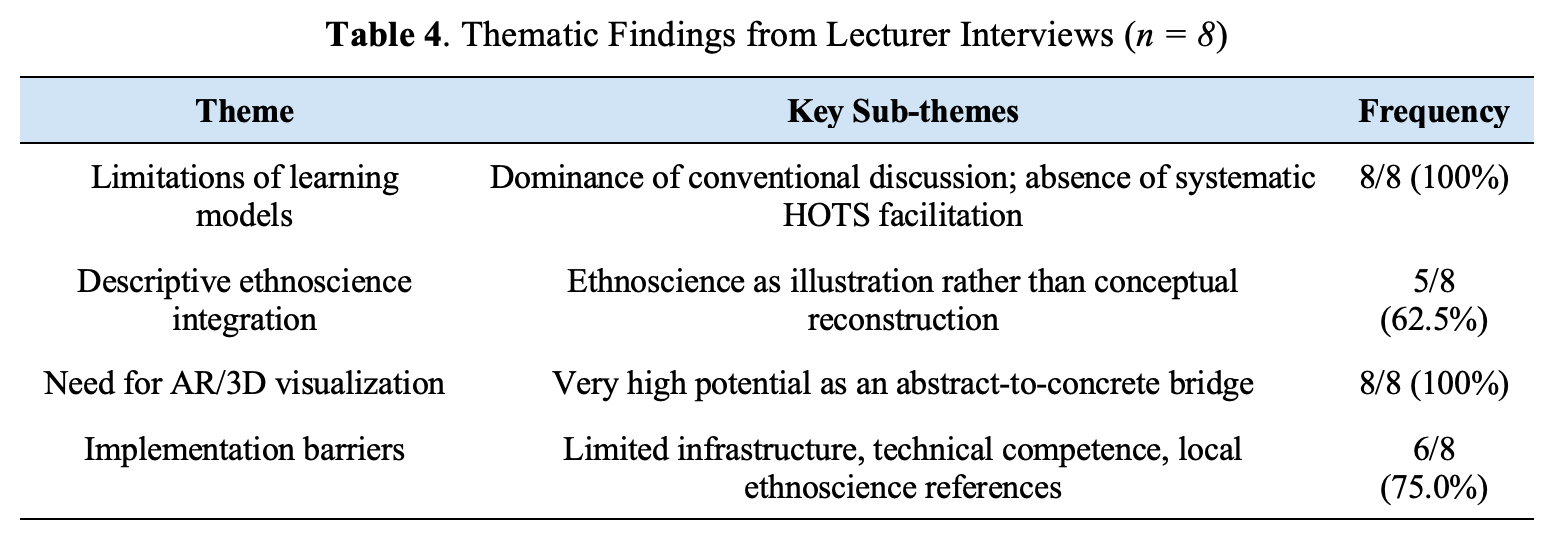
Elementary teacher education in Indonesia, particularly in regions of high cultural diversity such as Bima and Dompu, confronts a dual gap that remains unresolved: the absence of a learning model that systematically integrates metacognitive reflection on local knowledge systems with the abstraction of formal scientific concepts, and the non-utilization of 3D technology as cognitive scaffolding within teacher education programs. This study aimed to: (1) map the profiles of science literacy, analytical ability, learning experience, and science learning difficulties among PGSD students; (2) analyse the structural relationships among these variables; (3) identify pedagogical gaps through the perspectives of lecturers and programme coordinators; and (4) construct an empirical and conceptual justification for the development of an AR-assisted meta-ethnoscience model. An explanatory sequential mixed-methods design was employed, involving 170 PGSD students from four institutions in Bima and Dompu, eight lecturers, and four programme coordinators. Descriptive analysis revealed that 64.7% of students exhibited science literacy and analytical ability at low to very low levels, with mean scores of 3.25 and 3.21, respectively, on a 1–5 scale. Pearson correlation analysis across institutions confirmed a very strong relationship between science literacy and analytical ability (r = 0.772–0.899; mean r = 0.816), while learning experience functioned as a critical structural mediator (mean r = 0.787 with learning difficulties). Qualitative findings identified three systemic gaps: the dominance of conventional discussion-based pedagogy that does not systematically facilitate higher-order thinking skills (HOTS), the descriptive rather than conceptual nature of ethnoscience integration, and the complete absence of AR throughout the learning process. This study provides a robust empirical and conceptual justification for the development of an interactive 3D AR-assisted meta-ethnoscience learning model that dialectically connects the Dana Mbojo local knowledge system with abstract scientific concepts, thereby offering a new pedagogical framework for culturally responsive science teacher education in Indonesia.
Downloads
References
Bilotserkovets, M., Fomenko, T., Kobzhev, A., Berestok, O., Shcherbyna, Y., Krekoten, O., & Kurinnyi, A. (2021). Dual nature of students’ knowledge formation in the pandemic period: pedagogical and psychological aspects. Revista Romaneasca Pentru Educatie Multidimensionala, 13(3), 246–261.
Brabazon, T., Hunter, N., & Quinton, J. (2023). Universalizing science literacy: How to transcend deficit models of teaching and learning. Journal of Languages and Translation, 3(2), 1–29.
Chen, J., Zhou, Y., & Zhai, J. (2023). Incorporating AR/VR-assisted learning into informal science institutions: A systematic review. Virtual Reality, 27(3), 1985–2001. https://doi.org/10.1007/s10055-023-00789-w
Chiu, J. L., DeJaegher, C. J., & Chao, J. (2015). The effects of augmented virtual science laboratories on middle school students’ understanding of gas properties. Computers & Education, 85, 59–73. https://doi.org/10.1016/j.compedu.2015.02.007
Devolder, A., van Braak, J., & Tondeur, J. (2012). Supporting self-regulated learning in computer-based learning environments: systematic review of effects of scaffolding in the domain of science education. Journal of Computer Assisted Learning, 28(6), 557–573. https://doi.org/10.1111/j.1365-2729.2011.00476.x
Ekström, S., & Pareto, L. (2022). The dual role of humanoid robots in education: As didactic tools and social actors. Education and Information Technologies, 27(9), 12609–12644.
Elfrida, E., Nursamsu, N., Mahyuny, S. R., & Manurung, B. (2023). Development project based learning model with performance assessment based ethnoscience to improve students’ critical thinking. Jurnal Penelitian Pendidikan IPA, 9(8), 6406–6414. https://doi.org/10.29303/jppipa.v9i8.4799
Evagorou, M., Erduran, S., & Mäntylä, T. (2015). The role of visual representations in scientific practices: from conceptual understanding and knowledge generation to ‘seeing’ how science works. International Journal of STEM Education, 2(1), 11. https://doi.org/10.1186/s40594-015-0024-x
Evitasari, A. D., Wilujeng, I., Tohani, E., Trisnani, N., & Hermansyah, A. K. (2025). Prospective elementary teachers’ pedagogical understanding in science: a qualitative study from Indonesia. Cogent Education, 12(1), 2556621. https://doi.org/10.1080/2331186X.2025.2556621
Faisal, & Martin, S. N. (2019). Science education in Indonesia: past, present, and future. Asia-Pacific Science Education, 5(1), 1–29. https://doi.org/10.1186/s41029-019-0032-0
Fensham, P. J. (2009). Real world contexts in PISA science: Implications for context-based science education. Journal of Research in Science Teaching, 46(8), 884–896. https://doi.org/10.1002/tea.20334
Fitria, D., Asrizal, A., & Lufri, L. (2025). Enhancing 21st-Century Skills through Blended Problem-Based Learning with Ethnoscience Integration: A Mixed-Methods Study in Indonesian Junior High Schools. International Journal of Learning, Teaching and Educational Research, 24(1), 464–480. https://doi.org/10.26803/ijlter.24.1.23
Habsari, A. F., Sumarni, W., Widiarti, N., & Subali, B. (2026). Systematic literature review: Technology-based and contextual science literacy in elementary school science education. Journal of Science Education Research, 10(1), 26–37. https://doi.org/10.21831/jser.v10i1.91249
Hernández-Martínez, A., Cuartas-Agudelo, Y. S., Herrera-Almanza, L., Est, M. D. R.-T., & Est, L. M. M.-S. (2022). Ethno-education: Health education based on cultural diversity cultural diversity. City, 3(2), 1–10.
Hou, H.-T. (2023). Learning Science through Cloud Gamification: A Framework for Remote Gamified Science Learning Activities Integrating Cloud Tool Sets and Three-Dimensional Scaffolding. Information, 14(3), 165. https://doi.org/10.3390/info14030165
Khasanah, K., & Irsadi, A. (2025). The Effect of Double Loop Problem Solving Integrated Jelajah Alam Sekitar to Improve Students’ Scientific Literacy and Critical Thinking. Journal of Biology Education. https://doi.org/10.15294/ujbe.v14i2.1414
Kindlinger, M. (2021). Meta-reflexivity and epistemic cognition in social science teacher education. JSSE-Journal of Social Science Education, 20(3).
König, J., & Pflanzl, B. (2016). Is teacher knowledge associated with performance? On the relationship between teachers’ general pedagogical knowledge and instructional quality. European Journal of Teacher Education, 39(4), 419–436.
Koponen, I. T., & Mäntylä, T. (2006). Generative role of experiments in physics and in teaching physics: A suggestion for epistemological reconstruction. Science & Education, 15(1), 31–54. https://doi.org/10.1007/s11191-005-3199-6
Lammassaari, H., Hietajärvi, L., Lonka, K., Chen, S., & Tsai, C.-C. (2024). Teachers’ epistemic beliefs and reported practices in two cultural contexts. Educational Studies, 50(5), 781–805.
Lauermann, F., & ten Hagen, I. (2021). Do teachers’ perceived teaching competence and self-efficacy affect students’ academic outcomes? A closer look at student-reported classroom processes and outcomes. Educational Psychologist, 56(4), 265–282.
OECD. (2023). PISA 2022 results (Volume I): The state of learning and equity in education. PISA, OECD Publishing. https://doi.org/10.1787/53f23881-en
Osborne, J. (2023). Science, scientific literacy, and science education. In Handbook of research on science education (pp. 785–816). Routledge. https://doi.org/10.4324/9780367855758-30
Osborne, J., & Pimentel, D. (2023). Science education in an age of misinformation. Science Education, 107(3), 553–571.
Plomp, T. (2013). Educational design research: An introduction. In T. Plomp & N. Nieveen (Eds.), Educational design research: Part A: An introduction (pp. 11–50). SLO.
Schneider, M. (2020a). Epistemological obstacles in mathematics education. In Encyclopedia of mathematics education (pp. 276–279). Springer. https://doi.org/10.1007/978-3-030-15789-0_57
Schneider, M. (2020b). Epistemological obstacles in mathematics education. In Encyclopedia of mathematics education (pp. 276–279). Springer.
Southerland, S. A. (2000a). Epistemic universalism and the shortcomings of curricular multicultural science education. Science & Education, 9(3), 289–307. https://doi.org/10.1023/A:1008676109903
Southerland, S. A. (2000b). Epistemic universalism and the shortcomings of curricular multicultural science education. Science & Education, 9(3), 289–307.
Teo, T. (2008). From speculation to epistemological violence in psychology: A critical-hermeneutic reconstruction. Theory & Psychology, 18(1), 47–67. https://doi.org/10.1177/0959354307086922
Valio, F. A., Safira, L., Aulliyah, U. A., & Suwarna, I. (2025). Development of a Science Literacy Test for Junior High School Students Based on the PISA 2025 Framework. Jurnal Pendidikan MIPA. https://doi.org/10.23960/jpmipa.v26i3.pp1377-1405
Verawati, N. N. S. P., & Wahyudi, W. (2024). Raising the issue of local wisdom in science learning and its impact on increasing students’ scientific literacy. International Journal of Ethnoscience and Technology in Education, 1(1), 42–54. https://doi.org/10.33394/ijete.v1i1.10881
Vygotsky, L. S. (1978). Mind in society: The development of higher psychological processes. Harvard University Press.
Weinberger, Y. (2018). Strategies for effecting system-wide pedagogical change: identifying and addressing the gap between organizational and pedagogical implementation. Professional Development in Education, 44(1), 47–61. https://doi.org/10.1080/19415257.2017.1345776
Yusof, N., Yaqin, L. N., Aliudin, P. M. R. P., & Mahali, S. N. (2024). The integration of ethnoscience and technology: A review. International Journal of Ethnoscience and Technology in Education, 1(2), 131–154. https://doi.org/10.33394/ijete.v1i2.11334
Zeidler, D. L. (2016). STEM education: A deficit framework for the twenty first century? A sociocultural socioscientific response. Cultural Studies of Science Education, 11(1), 11–26. https://doi.org/10.1007/s11422-014-9578-z
Submitted
Accepted
Published
Issue
Section
License
Copyright (c) 2026 Rizalul Fiqry, Trianik Widyaningrum, Dian Artha Kusumaningtyas

This work is licensed under a Creative Commons Attribution 4.0 International License.