External vs. Internal Didactic Transposition of the Definition of Limit in Calculus
DOI:
https://doi.org/10.23917/varidika.v39i1.17312Keywords:
External Didactic Transposition, Internal Didactic Transposition, Limit of Function, Calculus Learning, Knowledge TransformationAbstract
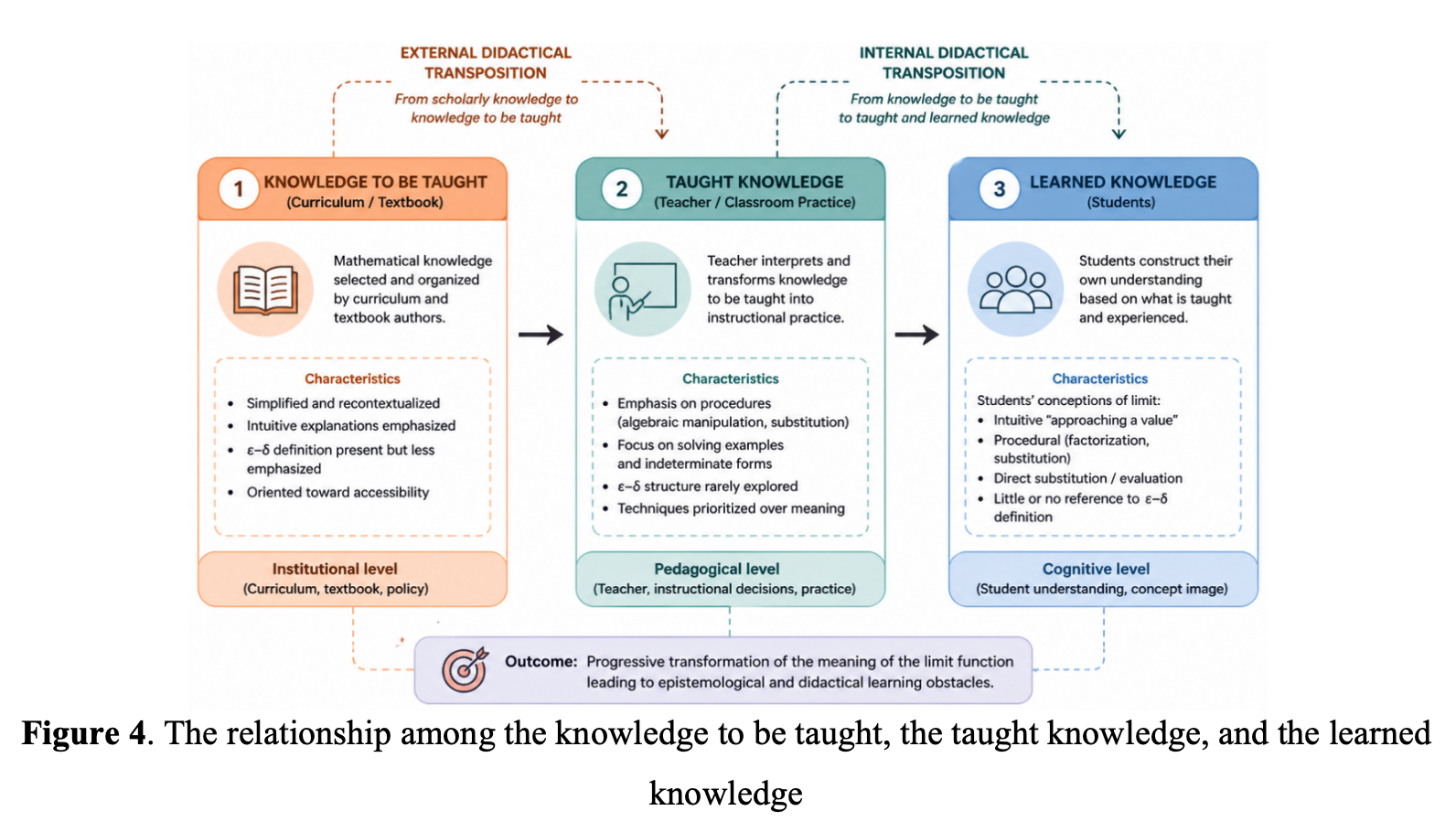
The limit of a function is a foundational concept in calculus, yet its transition from scholarly knowledge into knowledge to be taught, taught knowledge, and learned knowledge may produce shifts in meaning that affect students’ conceptual understanding. Limited studies have examined how these shifts occur through external and internal didactical transposition. This study examines how the meaning of the limit definition is transformed through these stages and how such transformations are reflected in students’ understanding. A qualitative approach was employed through document analysis of calculus textbooks, analysis of students’ lecture notes to reconstruct the lecturer’s taught knowledge, and analysis of students’ responses to a diagnostic task. Using purposive sampling, 25 undergraduate students enrolled in a Calculus course were selected as participants. The findings show that, through external didactical transposition, the formal ε–δ definition is simplified into intuitive and procedural forms in textbooks, thereby reducing its epistemological scope. Through internal didactical transposition, this simplification is further reinforced in the taught knowledge reconstructed from students’ lecture notes, which predominantly emphasize algebraic manipulation and direct substitution. Consequently, students’ understanding is expressed through three main response patterns: interpreting the limit as approaching a value, applying procedural techniques, and equating the limit with direct substitution. These findings reveal a shift from the formal mathematical meaning of the limit toward intuitive and procedural interpretations. The study highlights the need for didactical designs that explicitly connect intuitive representations and procedural techniques with the formal ε–δ definition.
Keywords: External didactical transposition, internal didactical transposition, limit of function, calculus learning, knowledge transformation
Downloads
References
Adhikari, K. P. (2021). Difficulties and misconceptions of students in learning limit. Interdisciplinary Research in Education, 5(1–2), 15–26. https://doi.org/10.3126/ire.v5i1-2.34731
Artigue, M. (2000). Teaching and learning calculus: What can be learned from education research and curricular changes in France? In E. Dubinsky, A. H. Schoenfeld, & J. J. Kaput (Eds.), Research in collegiate mathematics education IV (pp. 1–15). American Mathematical Society. https://doi.org/10.1090/cbmath/008/01
Artigue, M. (2014). Didactic engineering in mathematics education. In S. Lerman (Ed.), Encyclopedia of mathematics education (pp. 159–162). Springer. https://doi.org/10.1007/978-94-007-4978-8_44
Barbé, J., Bosch, M., Espinoza, L., & Gascón, J. (2005). Didactic restrictions on the teacher’s practice: The case of limits of functions in Spanish high schools. Educational Studies in Mathematics, 59(1–3), 235–268. https://doi.org/10.1007/s10649-005-5889-z
Baye, M. G., Ayele, M. A., & Wondimuneh, T. E. (2021). Implementing GeoGebra integrated with multi-teaching approaches guided by the APOS theory to enhance students’ conceptual understanding of limit in Ethiopian universities. Heliyon, 7(5), Article e07012. https://doi.org/10.1016/j.heliyon.2021.e07012
Brousseau, G. (1997). Theory of didactical situations in mathematics: Didactique des mathématiques, 1970–1990 (N. Balacheff, M. Cooper, R. Sutherland, & V. Warfield, Eds. & Trans.). Kluwer Academic Publishers. https://doi.org/10.1007/0-306-47211-2
Chevallard, Y. (1991). La transposition didactique: Du savoir savant au savoir enseigné (2nd ed.). La Pensée Sauvage. https://revue-rdm.com/ouvrage/la-transposition-didactique/
Chevallard, Y. (2019). Introducing the anthropological theory of the didactic: An attempt at a principled approach. Hiroshima Journal of Mathematics Education, 12, 71–114. https://doi.org/10.24529/hjme.1205
Chevallard, Y., & Bosch, M. (2014). Didactic transposition in mathematics education. In S. Lerman (Ed.), Encyclopedia of mathematics education (pp. 170–174). Springer. https://doi.org/10.1007/978-94-007-4978-8_48
Chevallard, Y., & Bosch, M. (2020). Didactic transposition in mathematics education. In S. Lerman (Ed.), Encyclopedia of mathematics education (2nd ed., pp. 214–218). Springer. https://doi.org/10.1007/978-3-030-15789-0_48
Cornu, B. (1991). Limits. In D. Tall (Ed.), Advanced mathematical thinking (pp. 153–166). Kluwer Academic Publishers. https://doi.org/10.1007/0-306-47203-1_10
Cottrill, J., Dubinsky, E., Nichols, D., Schwingendorf, K., Thomas, K., & Vidakovic, D. (1996). Understanding the limit concept: Beginning with a coordinated process scheme. The Journal of Mathematical Behavior, 15(2), 167–192. https://doi.org/10.1016/S0732-3123(96)90015-2
Creswell, J. W., & Poth, C. N. (2018). Qualitative inquiry and research design: Choosing among five approaches (4th ed.). SAGE Publications. https://collegepublishing.sagepub.com/products/qualitative-inquiry-and-research-design-4-246896
Fischbein, E. (1987). Intuition in science and mathematics: An educational approach. D. Reidel Publishing. https://doi.org/10.1007/0-306-47237-6
Grabiner, J. V. (1983). Who gave you the epsilon? Cauchy and the origins of rigorous calculus. The American Mathematical Monthly, 90(3), 185–194. https://doi.org/10.1080/00029890.1983.11971185
Hong, D. S. (2023). Examining opportunities to learn limit in widely used calculus textbooks. International Journal of Science and Mathematics Education, 21(3), 881–898. https://doi.org/10.1007/s10763-022-10273-7
Katz, M. G., & Sherry, D. (2013). Leibniz’s infinitesimals: Their fictionality, their modern implementations, and their foes from Berkeley to Russell and beyond. Erkenntnis, 78(3), 571–625. https://doi.org/10.1007/s10670-012-9370-y
Nardi, E. (2008). Amongst mathematicians: Teaching and learning mathematics at university level. Springer. https://doi.org/10.1007/978-0-387-37143-6
Özmantar, M. F., Akkoç, H., Bingölbali, E., Demir, S., & Ergene, B. (2010). Pre-service mathematics teachers’ use of multiple representations in technology-rich environments. Eurasia Journal of Mathematics, Science and Technology Education, 6(1), 19–36. https://doi.org/10.12973/ejmste/75224
Pocalana, G., & Robutti, O. (2025). Mathematics teacher educators’ documents, praxeologies, and beliefs: A holistic model. Journal of Mathematics Teacher Education, 28(2), 291–314. https://doi.org/10.1007/s10857-024-09656-0
Schmidt, K., & Winsløw, C. (2021). Authentic engineering problems in service mathematics assignments: Principles, processes and products from twenty years of task design. International Journal of Research in Undergraduate Mathematics Education, 7(2), 261–283. https://doi.org/10.1007/s40753-021-00133-0
Sebsibe, A. S., & Feza, N. N. (2020). Assessment of students’ conceptual knowledge in limit of functions. International Electronic Journal of Mathematics Education, 15(2), Article em0574. https://doi.org/10.29333/iejme/6294
Sfard, A. (1991). On the dual nature of mathematical conceptions: Reflections on processes and objects as different sides of the same coin. Educational Studies in Mathematics, 22(1), 1–36. https://doi.org/10.1007/BF00302715
Stewart, J. (2016). Calculus (8th ed.). Cengage Learning. https://www.cengage.com/c/calculus-8e-stewart/9781285740621/
Sulastri, R., Suryadi, D., Prabawanto, S., Cahya, E., & Fitriani, F. (2022). Zone of concept image differences in infinite limits at undergraduate level. Jurnal Didaktik Matematika, 9(1), 1–21. https://doi.org/10.24815/jdm.v9i1.24709
Tall, D. (1993). Students’ difficulties in calculus. In Proceedings of Working Group 3 on Students’ Difficulties in Calculus, ICME-7 (pp. 13–28). https://homepages.warwick.ac.uk/staff/David.Tall/pdfs/dot1993k-calculus-wg3-icme.pdf
Tall, D. (2004). Thinking through three worlds of mathematics. In M. J. Høines and A. B. Fuglestad (Eds.), Proceedings of the 28th Conference of the International Group for the Psychology of Mathematics Education (Vol. 4, pp. 281–288). International Group for the Psychology of Mathematics Education. https://eric.ed.gov/?id=ED489653
Tall, D., & Katz, M. G. (2014). A cognitive analysis of Cauchy’s conceptions of function, continuity, limit, and infinitesimal, with implications for teaching the calculus. Educational Studies in Mathematics, 86(1), 97–124. https://doi.org/10.1007/s10649-014-9531-9
Tall, D., & Vinner, S. (1981). Concept image and concept definition in mathematics with particular reference to limits and continuity. Educational Studies in Mathematics, 12(2), 151–169. https://doi.org/10.1007/BF00305619
Tonra, W. S., Suryadi, D., Mulyaning, E. C., & Kusnandi. (2025). Learning obstacles and the didactical design for teaching the limit of function in a calculus course. Journal on Mathematics Education, 16(1), 153–172. https://doi.org/10.22342/jme.v16i1.pp153-172
Topphol, V. (2023). The didactic transposition of the fundamental theorem of calculus. REDIMAT—Journal of Research in Mathematics Education, 12(2), 144–172. https://doi.org/10.17583/redimat.11982
Varberg, D., Purcell, E. J., & Rigdon, S. E. (2007). Calculus (9th ed.). Pearson Prentice Hall.
Viirman, O., Vivier, L., & Monaghan, J. (2022). The limit notion at three educational levels in three countries. International Journal of Research in Undergraduate Mathematics Education, 8(2), 222–244. https://doi.org/10.1007/s40753-022-00181-0
Williams, S. R. (2001). Predications of the limit concept: An application of repertory grids. Journal for Research in Mathematics Education, 32(4), 341–367. https://doi.org/10.2307/749699
Winsløw, C. (2007). Didactics of mathematics: An epistemological approach to mathematics education. The Curriculum Journal, 18(4), 523–536. https://doi.org/10.1080/09585170701687969
Winsløw, C. (2011). Anthropological theory of didactic phenomena: Some examples and principles of its use in the study of mathematics education. In M. Bosch, J. Gascón, A. Ruiz Olarría, M. Artaud, A. Bronner, Y. Chevallard, G. Cirade, C. Ladage, & M. Larguier (Eds.), Un panorama de la TAD (pp. 117–138). Centre de Recerca Matemàtica https://researchprofiles.ku.dk/en/publications/anthropological-theory-of-didactic-phenomena-some-principles-of-i/
Downloads
Submitted
Accepted
Published
Issue
Section
License
Copyright (c) 2026 Wilda Syam Tonra, Dewi Amiroh, Windia Hadi, Hasan Basri, Winda Syam Tonra, Dahlan Wahyudi, Muhammad Ikhsan

This work is licensed under a Creative Commons Attribution 4.0 International License.