Learning Analytics in Low-Connectivity Educational Environments: A Systematic Review of Offline-First and Edge Architectures
DOI:
https://doi.org/10.23917/varidika.v39i1.17273Keywords:
edge computing, learning analytics, offline-first architecture, PRISMA 2020, systematic literature reviewAbstract
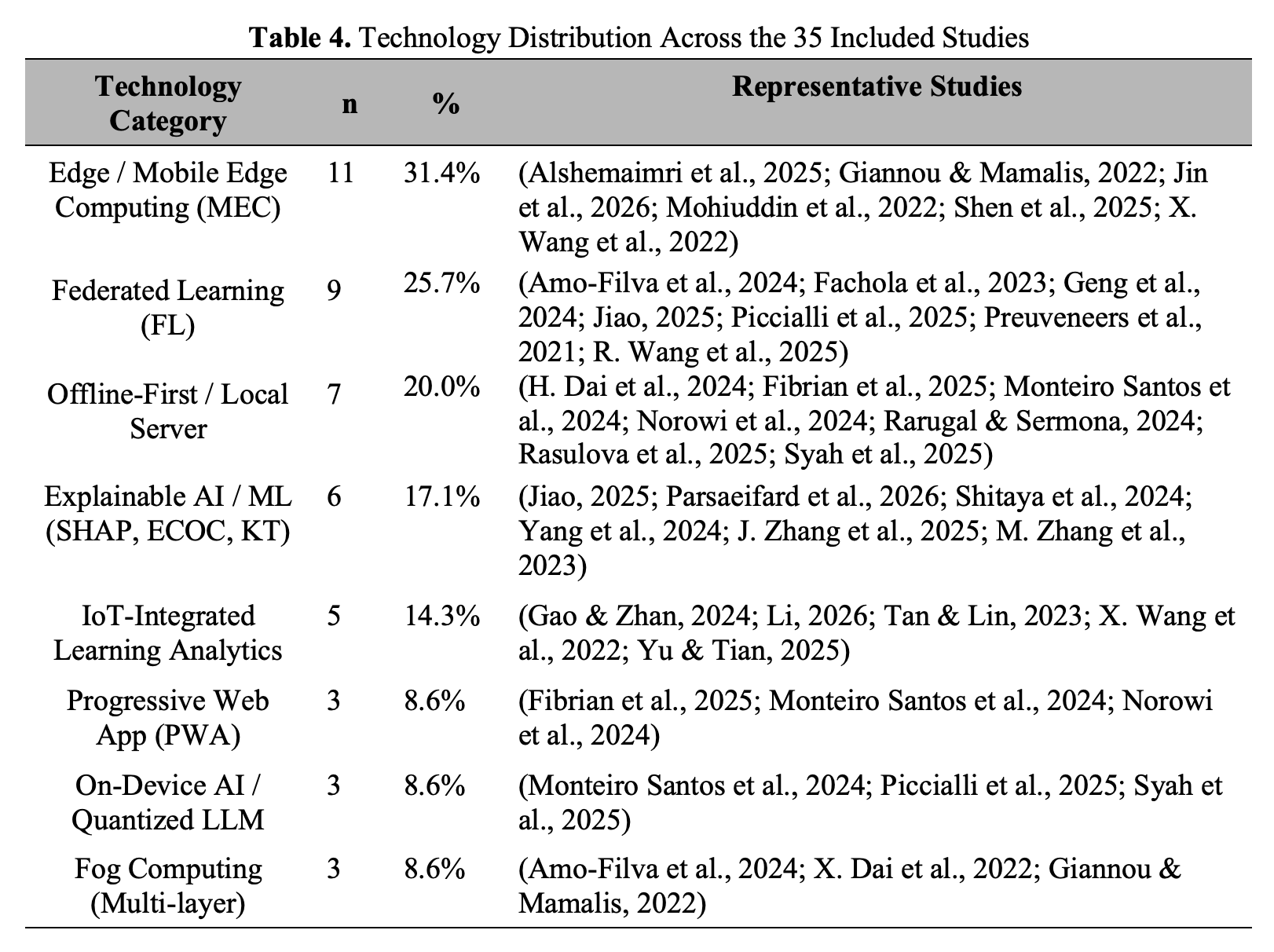
Learning Analytics (LA) in low-connectivity educational environments remains severely underdeveloped, despite growing evidence that offline-capable infrastructure is critical for equity in the Global South. While a growing body of research explores offline-first and edge architectures for LA, these approaches remain fragmented and lack formally specified, end-to-end pipelines required for deployment in zero-connectivity environments. The dominant LA literature continues to treat reliable cloud connectivity as a design premise rather than a variable, leaving students in rural and marginalized regions without data-driven educational support during offline periods. This systematic literature review (SLR) examines peer-reviewed evidence on the integration of LA with offline-first and edge computing architectures in low-connectivity educational settings. Conducted in accordance with the PRISMA 2020 framework, a structured search across Scopus, IEEE Xplore, and ScienceDirect covering the period 2020 to 2026 yielded 1,539 records; after deduplication, screening, and full-text assessment, 35 studies were included in the final synthesis. Three research questions guided the review: (RQ1) identification of offline-first and edge-based architectural paradigms; (RQ2) evaluation of synchronization and data integrity mechanisms; and (RQ3) assessment of LA algorithms in resource-constrained contexts. Results reveal three validated offline-first paradigms, namely hardware-based local servers, progressive web applications with service worker buffers, and on-device AI inference, alongside consistent evidence that edge architectures reduce latency by up to 71.3% compared with cloud-only configurations. However, no study provided a formally specified protocol for conflict resolution in LA event logs under zero connectivity. This review formally articulates five research gaps (G1-G5) and argues that the formalization of offline-first infrastructure is a foundational prerequisite for both privacy-preserving synchronization and algorithmic advancement in resource-constrained settings.
Downloads
References
Alshemaimri, B., Badshah, A., Daud, A., Bukhari, A., Alsini, R., & Alghushairy, O. (2025). Regional computing approach for educational big data. Scientific Reports, 15(1), 7619. https://doi.org/https://doi.org/10.1038/s41598-025-92120-7
Amo-Filva, D., Fonseca, D., García-Peñalvo, F. J., Forment, M. A., Guerrero, M. J. C., & Godoy, G. (2024). Exploring the landscape of learning analytics privacy in fog and edge computing: A systematic literature review. Computers in Human Behavior, 158, 108303. https://doi.org/https://doi.org/10.1016/j.chb.2024.108303
Chen, X. (2024). Design of Personalized Recommendation System for Teaching Resources Based on Cloud Edge Computing. Procedia Computer Science, 243, 826–833. https://doi.org/https://doi.org/10.1016/j.procs.2024.09.099
Clow, D. (2012). The learning analytics cycle: closing the loop effectively. Proceedings of the 2nd International Conference on Learning Analytics and Knowledge, 134–138. https://doi.org/https://doi.org/10.1145/2330601.2330636
Dai, H., Nguyen, P. L., & Kutay, C. (2024). Offline collaborative learning approach for remote Northern territory students. Interactive Technology and Smart Education, 21(1), 67–82. https://doi.org/https://doi.org/10.1108/ITSE-05-2022-0063
Dai, X., Xiao, Z., Jiang, H., Alazab, M., Lui, J. C. S., Min, G., Dustdar, S., & Liu, J. (2022). Task offloading for cloud-assisted fog computing with dynamic service caching in enterprise management systems. IEEE Transactions on Industrial Informatics, 19(1), 662–672. https://doi.org/https://doi.org/10.1109/TII.2022.3186641
Fachola, C., Tornaría, A., Bermolen, P., Capdehourat, G., Etcheverry, L., & Fariello, M. I. (2023). Federated learning for data analytics in education. Data, 8(2), 43. https://doi.org/https://doi.org/10.3390/data8020043
Fibrian, I. D., Utomo, T. P., Lukmana, I., & Muttaqin, Z. (2025). Architectural Consideration for Gamified Learning Systems: An Exploration of Offline-First Progressive Web Application. Register: Jurnal Ilmiah Teknologi Sistem Informasi, 11(2), 139–150. https://doi.org/https://doi.org/10.26594/register.v11i2.5087
Gao, B., & Zhan, Z. (2024). Applications and Challenges of IoT and Cloud Computing in Distance Education. Proceedings of the 2024 2nd International Conference on Internet of Things and Cloud Computing Technology, 99–107. https://doi.org/https://doi.org/10.1145/3702879.3702897
Geng, J., Tang, B., Zhang, B., Shao, J., & Luo, B. (2024). FedCampus: A Real-world Privacy-preserving Mobile Application for Smart Campus via Federated Learning & Analytics. Proceedings of the Twenty-Fifth International Symposium on Theory, Algorithmic Foundations, and Protocol Design for Mobile Networks and Mobile Computing, 377–378. https://doi.org/https://doi.org/10.1145/3641512.3690630
Giannou, V., & Mamalis, B. (2022). An Indicative Demanding Teaching Scenario for Primary Education with the Support of a Multi-layer Fog Computing Architecture. Proceedings of the 26th Pan-Hellenic Conference on Informatics, 329–334. https://doi.org/https://doi.org/10.1145/3575879.3576013
Hacker, D. J., Dunlosky, J., & Graesser, A. C. (1998). Metacognition in educational theory and practice. Routledge.
Jiao, J. (2025). An Empirical Study on the Online English Learning Effect of College Students From the Perspective of Learning Analysis. International Journal of Web-Based Learning and Teaching Technologies (IJWLTT), 20(1), 1–23. https://doi.org/10.4018/IJWLTT.383085
Jin, L., Gao, X., Wang, J., & Yuan, S. (2026). Multi-access edge computing scheduling optimization model for remote education under 6G network environment based on reinforcement learning. Scientific Reports. https://doi.org/https://doi.org/10.1038/s41598-025-29849-8
Li, Y. (2026). A data-driven decision support framework for smart campus governance: integrating heterogeneous educational data sources with optical technologies. Second International Conference on Communication, Information, and Digital Technologies (CIDT 2025), 14064, 202–213. https://doi.org/https://doi.org/10.1117/12.3088809
Long, P., & Siemens, G. (2011). Penetrating the fog: Analytics in learning and education. EDUCAUSE Review (Online). https://doi.org/https://doi.org/10.17471/2499-4324/195
Lyu, H., Shan, P., Hou, C., & Duan, S. (2025). Artificial intelligence for student performance prediction in blended learning: A systematic literature review. Neurocomputing, 131659. https://doi.org/https://doi.org/10.1016/j.neucom.2025.131659
Mohiuddin, K., Fatima, H., Khan, M. A., Khaleel, M. A., Begum, Z., Khan, S. A., & Hussain, O. Bin. (2023). Design of a Novel Edge-Centric Cloud Architecture for m-Learning Performance Effectiveness by Leveraging Distributed Computing Paradigms’ Potentials. SAGE Open, 13(3), 21582440231190336. https://doi.org/https://doi.org/10.1177/21582440231190337
Mohiuddin, K., Fatima, H., Khan, M. A., Khaleel, M. A., Nasr, O. A., & Shahwar, S. (2022). Mobile learning evolution and emerging computing paradigms: An edge-based cloud architecture for reduced latencies and quick response time. Array, 16, 100259. https://doi.org/https://doi.org/10.1016/j.array.2022.100259
Monteiro Santos, M., Barros, A., Rodrigues, L., Dermeval, D., Primo, T., Ibert, I., & Isotani, S. (2024). Near feasibility, distant practicality: empirical analysis of deploying and using llms on resource-constrained smartphones. Proceedings of the 13th International Conference on Information & Communication Technologies and Development, 224–235. https://doi.org/https://doi.org/10.1145/3700794.3700817
Norowi, N. M., Zainudin, A. A., Wirza, R., Kamaruddin, A., & Ahmad, N. R. (2024). Connecting with the Unconnected: Collaborative Design for a Mobile Learning App in Rural Malaysian Secondary Schools Amidst the COVID-19 Pandemic. Proceedings of the Participatory Design Conference 2024: Exploratory Papers and Workshops-Volume 2, 175–182. https://doi.org/https://doi.org/10.1145/3661455.3669888
Page, M. J., McKenzie, J. E., Bossuyt, P. M., Boutron, I., Hoffmann, T. C., Mulrow, C. D., Shamseer, L., Tetzlaff, J. M., Akl, E. A., & Brennan, S. E. (2021). The PRISMA 2020 statement: an updated guideline for reporting systematic reviews. Bmj, 372. https://doi.org/https://doi.org/10.1136/bmj.n71
Parsaeifard, B., Imhof, C., Pancar, T., Com, I.-S., Hlosta, M., Bergamin, N., & Bergamin, P. (2026). Detection of disengagement from voluntary quizzes: an explainable machine learning approach in higher distance education. IEEE Transactions on Learning Technologies. https://doi.org/https://doi.org/10.1109/TLT.2026.3668612
Piccialli, F., Chiaro, D., Qi, P., Bellandi, V., & Damiani, E. (2025). Federated and edge learning for large language models. Information Fusion, 117, 102840. https://doi.org/https://doi.org/10.1016/j.inffus.2024.102840
Preuveneers, D., Garofalo, G., & Joosen, W. (2021). Cloud and edge based data analytics for privacy-preserving multi-modal engagement monitoring in the classroom. Information Systems Frontiers, 23(1), 151–164. https://doi.org/https://doi.org/10.1007/s10796-020-09993-4
Rarugal, J. P., & Sermona, N. L. D. (2024). Development and evaluation of remote learning management system using intranet network for hinterland schools. Procedia Computer Science, 234, 1633–1641. https://doi.org/https://doi.org/10.1016/j.procs.2024.03.167
Rasulova, N., Mavlonova, M., Khudaykulov, A., Bakaeva, F., Allaberganov, O., Saidov, K., Sapaev, I. B., & Yoqubov, D. (2025). Designing energy-efficient wireless language learning platforms for remote education. J. Wirel. Mob. Netw. Ubiquitous Comput. Dependable Appl, 16, 276–292. https://doi.org/10.58346/JOWUA.2025.I2.018
Shen, C., Wang, Y., Guo, A., Wang, S., Han, W., & Zuo, F. (2025). Edge6GLearnNet: Reinforcement-Driven Scheduling With Cross-Edge Attention in 6G Remote Learning MEC Environments. IEEE Access, 13, 216611–216625. https://doi.org/https://doi.org/10.1109/ACCESS.2025.3645438
Shitaya, A. M., Wahed, M. E. S., Ismail, A., Y Shams, M., & Salama, A. A. (2024). Predicting student behavior using a neutrosophic deep learning model. Neutrosophic Sets and Systems, 76(1), 17. https://doi.org/https://doi.org/10.5281/zenodo.13997076
Syah, R. A., Haryanto, C. Y., Lomempow, E., Malik, K., & Putra, I. (2025). EdgePrompt: Engineering Guardrail Techniques for Offline LLMs in K-12 Educational Settings. Companion Proceedings of the ACM on Web Conference 2025, 1635–1638. https://doi.org/https://doi.org/10.1145/3701716.3717810
Tan, C., & Lin, J. (2023). A new QoE-based prediction model for evaluating virtual education systems with COVID-19 side effects using data mining. Soft Computing, 27(3), 1699–1713. https://doi.org/https://doi.org/10.1007/s00500-021-05932-w
Wang, M., & Xie, K. (2024). The Construction of an English Network Course Based on the Theory of Hybrid Real-Time Synchronization Algorithm. International Journal of Web-Based Learning and Teaching Technologies (IJWLTT), 19(1), 1–17. https://doi.org/10.4018/IJWLTT.351645
Wang, R., Wang, Z., Huang, C., Wang, R., Yu, T., Yao, L., Lui, J., & Zhou, D. (2025). Federated in-context learning: Iterative refinement for improved answer quality. Proceedings of the 42nd International Conference on Machine Learning. https://doi.org/https://doi.org/10.48550/arXiv.2506.07440
Wang, X., Khan, A., Wang, J., Gangopadhyay, A., Busart, C., & Freeman, J. (2022). An edge–cloud integrated framework for flexible and dynamic stream analytics. Future Generation Computer Systems, 137, 323–335. https://doi.org/https://doi.org/10.1016/j.future.2022.07.023
Yang, D., Cao, L., Pan, L., & Xie, S. (2024). Interpretable grade prediction based on ECOC and Shapley theory. Proceedings of the 2024 8th International Conference on Electronic Information Technology and Computer Engineering, 49–54. https://doi.org/https://doi.org/10.1145/3711129.3711138
Yu, X., & Tian, Y. (2025). Enhancing Computer Education through IoT-Enabled Learning Environments Leveraging Mobile Edge Computing for Real-Time Feedback. Systems and Soft Computing, 200433. https://doi.org/https://doi.org/10.1016/j.sasc.2025.200433
Zaini, A., Santoso, H., & Sulistyanto, M. P. T. (2021). Fault tolerance strategy to increase Moodle service reliability. Journal of Physics: Conference Series, 1869(1), 12095. https://doi.org/10.1088/1742-6596/1869/1/012095
Zhang, J., Liu, X., & Gao, S. (2025). Leveraging Big Data, AI, and Virtual Simulation: Research on Enhancing Teaching Efficiency in Higher Education Business Administration through Digital Intelligence Empowerment. Proceedings of the 2025 2nd International Conference on Big Data and Digital Management, 940–943. https://doi.org/https://doi.org/10.1145/3768801.3768962
Zhang, M., Zhu, X., Zhang, C., Qian, W., Pan, F., & Zhao, H. (2023). Counterfactual Monotonic Knowledge Tracing for Assessing Students’ Dynamic Mastery of Knowledge Concepts. Proceedings of the 32nd ACM International Conference on Information and Knowledge Management, 3236–3246. https://doi.org/https://doi.org/10.1145/3583780.3614827
Downloads
Submitted
Accepted
Published
Versions
- 08/10/2026 (2)
- 08/02/2026 (1)
Issue
Section
License
Copyright (c) 2026 Ayumi Febrianty, Nuur Wachid Abdul Majid, Mohamed Nor Azhari Azman, Mark Jhon Ramos Prestoza

This work is licensed under a Creative Commons Attribution 4.0 International License.