Enhancing Deep Learning in Accounting Education through Meaningful, Mindful, and Joyful Learning: The Moderating Role of Technological Self-Efficacy among Vocational Students
DOI:
https://doi.org/10.23917/varidika.v39i1.16587Keywords:
Meaningful Learning, mindful learning, joyful learning, deep learning, technological self-efficacy, vocational education, PLS-SEMAbstract
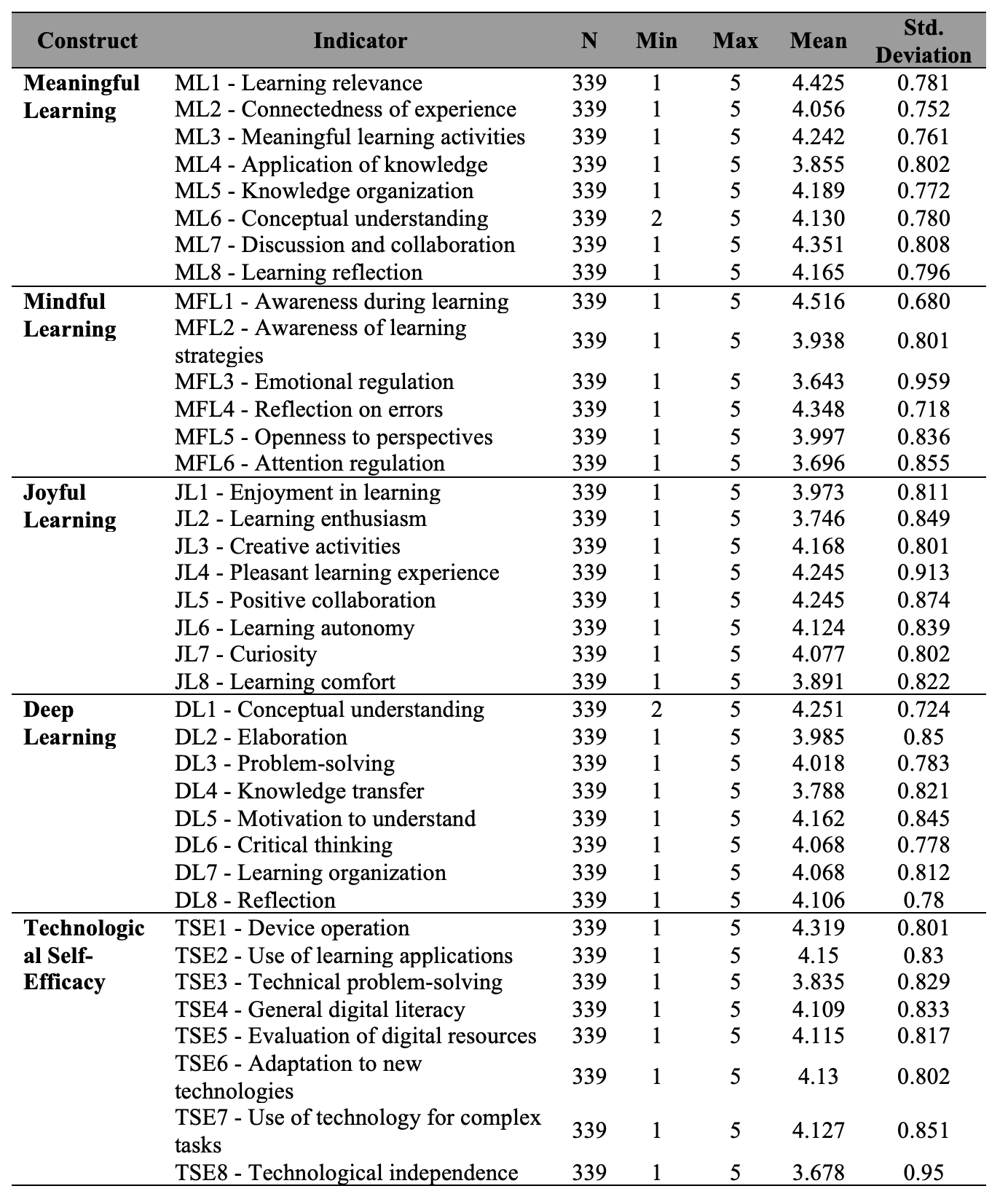
This study investigates the effects of meaningful learning, mindful learning, and joyful learning on deep learning, as well as the moderating role of technological self-efficacy in vocational accounting education. Despite increasing attention to deep learning, prior studies have largely examined these pedagogical approaches separately, resulting in limited understanding of their integrated effects, particularly in vocational contexts. A quantitative research design was employed using a survey method involving 339 vocational high school students in the Accounting and Financial Services program. Data were collected through a structured questionnaire consisting of 38 measurement items and analyzed using Partial Least Squares Structural Equation Modeling (PLS-SEM). The findings reveal that meaningful learning (β = 0.260, p < 0.001), mindful learning (β = 0.261, p < 0.001), and joyful learning (β = 0.233, p < 0.001) each have a positive and significant effect on deep learning. In addition, technological self-efficacy significantly moderates these relationships, indicating that the effects of the three learning approaches on deep learning are stronger among students with higher levels of technological confidence. The model demonstrates strong explanatory power (R² = 0.754), indicating that deep learning is shaped by the integrated influence of cognitive, metacognitive, affective, and technological dimensions. This study contributes to the literature by proposing an integrative framework that combines meaningful, mindful, and joyful learning with technological self-efficacy as a boundary condition. Practically, the findings provide insights for designing technology-enhanced, student-centered instructional strategies to foster deep learning in vocational education.
Downloads
References
Asmawan, M. C., & Arianto, B. (2022). Pembelajaran Daring pada Masa Covid 19: Studi Kasus pada Sekolah Menengah Kejuruan. Jurnal Pendidikan Ilmu Sosial, 32(1). https://doi.org/10.23917/jpis.v32i1.17197
Azzahra, S., & Fauzan, S. (2023). Computational Thinking of Accounting Students in Terms of Critical Thinking and Problem-Solving Skills. Jurnal Pendidikan Ilmu Sosial, 33(1). https://doi.org/10.23917/jpis.v33i1.22689
Bakosh, L. S., Snow, R. M., Tobias, J. M., Houlihan, J. L., & Barbosa-Leiker, C. (2016). Maximizing Mindful Learning: Mindful Awareness Intervention Improves Elementary School Students’ Quarterly Grades. Mindfulness, 7(1), 59–67. https://doi.org/10.1007/s12671-015-0387-6
Bhakti, C. P., Alfarizqi, M., Ghiffari, N., & Salsabila, K. (2018). Joyful Learning: Alternative Learning Models to Improving Student Happiness. Varidika Pendidikan, 30(2), 30–35. https://doi.org/10.23917/varidika.v30i2.7572
Bryce, T. G. K., & Blown, E. J. (2024). Ausubel’s meaningful learning re-visited. Current Psychology, 43(5), 4579–4598. https://doi.org/10.1007/s12144-023-04440-4
Chirenje, L. I., & Williams, J. B. (2024). Learning design for impact: a transformative education model for sustainability. Society and Business Review, 20(3), 623–646. https://doi.org/https://doi.org/10.1108/SBR-12-2024-0414
Choli, I., Mujib, A., Saputra, E., Rahmawan, F., & Oktapiani, M. (2024). 21st Century Learning and Smartphone Preference as a Learning Media. Jurnal Iqra’: Kajian Ilmu Pendidikan, 9(2). http://journal.iaimnumetrolampung.ac.id/index.php/ji/
Cochran, L. M., & Parker Peters, M. (2023). Mindful preparation: An exploration of the effects of mindfulness and SEL training on pre-service teacher efficacy and empathy. Teaching and Teacher Education, 123. https://doi.org/10.1016/j.tate.2022.103986
Dewi Kunthi, Y., & Az-Zahra, K. (2025). Development of the Behaviorism Learning Model in Fiqh Subjects in the Digital Era. Jurnal Iqra’: Kajian Ilmu Pendidikan, 10(3). https://journal.iaimnumetrolampung.ac.id/index.php/ji/index
Diputera, M. A., Zulpan, & Eza, G. N. (2024). Memahami Konsep Pendekatan Deep Learning dalam Pembelajaran Anak Usia Dini Yang Meaningful, Mindful dan Joyful: Kajian Melalui Filsafat Pendidikan. Jurnal Bunga Rampai Usia Emas, 10(2). https://doi.org/10.24114/jbrue.v10i2.65978
Doleck, T., Lemay, D. J., Basnet, R. B., & Bazelais, P. (2020). Predictive analytics in education: a comparison of deep learning frameworks. Education and Information Technologies, 25(3), 1951–1963. https://doi.org/10.1007/s10639-019-10068-4
Downes, T., Di Cesare, D. M., Gallagher, T. L., & Rowsell, J. (2020). Parents’ beliefs about and associations to their elementary children’s home technology usage. Education and Information Technologies, 25(5), 4557–4574. https://doi.org/10.1007/s10639-020-10188-2
Efferin, S., & Soeherman, B. (2024). Mindfulness for sustainable development: a case of accounting education in Indonesia. Accounting Education. https://doi.org/10.1080/09639284.2024.2303730
Febriyanti, C., Suharyati, H., & Sunaryo, W. (2025). Strategies to Increase Teacher Innovativeness through Strengthening Learning Organisation, Creativity, Self-Efficacy and Job Satisfaction. Jurnal Iqra’: Kajian Ilmu Pendidikan, 10(1). https://journal.iaimnumetrolampung.ac.id/index.php/ji/index
Feriyanto, F., & Anjariyah, D. (2024). Deep Learning Approach Through Meaningful, Mindful, and Joyful Learning: A Library Research. Electronic Journal of Education, Social Economics and Technology, 5(2), 208–212. https://doi.org/10.33122/ejeset.v5i2.321
Fiandra, Y. A., Jalinus, N., Ridwan, R., & Abdullah, R. (2022). The Effect of Prior Knowledge and ASSURE Model on Simulation and Digital Communication Learning Outcomes in Vocational High School. Jurnal VARIDIKA, 1(1), 53–62. https://doi.org/10.23917/varidika.v1i1.18283
Gan, B., Menkhoff, T., & Smith, R. (2015). Enhancing students’ learning process through interactive digital media: New opportunities for collaborative learning. Computers in Human Behavior, 51, 652–663. https://doi.org/10.1016/j.chb.2014.12.048
Gu, Y., Sun, B., He, J., & Huang, W. (2024). Sustainability Education as a Predictor of Student Well-Being Through Mindfulness and Social Support: A Mediated Moderation Model. Sustainability (Switzerland), 16(23). https://doi.org/10.3390/su162310508
Hirzulloh, M. F., & Annadhif, T. A. (2024). Islamic Education in the Era of Industrial Revolution 4.0 and the Utilization of Digital Technology in the Teaching and Learning Process. Jurnal Iqra’ : Kajian Ilmu Pendidikan, 9(2), 409–437. https://journal.iaimnumetrolampung.ac.id/index.php/ji/
Jangid, M., & Kumar, R. (2025). Deep learning approaches to address cold start and long tail challenges in recommendation systems: a systematic review. Multimedia Tools and Applications, 84(5), 2293–2325. https://doi.org/10.1007/s11042-024-20262-3
Kim, B., & Park, M. J. (2018). Effect of personal factors to use ICTs on e-learning adoption: comparison between learner and instructor in developing countries. Information Technology for Development, 24(4), 706–732. https://doi.org/10.1080/02681102.2017.1312244
Klusmann, B., Sanderman, R., & Schroevers, M. J. (2023). Delivering mindfulness in the classroom via a technology-enabled approach: Feasibility and the potential impact on teachers’ psychological well-being, self-efficacy, and mindfulness. Teaching and Teacher Education, 122. https://doi.org/10.1016/j.tate.2022.103950
Kostiainen, E., Ukskoski, T., Ruohotie-Lyhty, M., Kauppinen, M., Kainulainen, J., & Mäkinen, T. (2018). Meaningful learning in teacher education. Teaching and Teacher Education, 71, 66–77. https://doi.org/10.1016/j.tate.2017.12.009
Levin, O. (2024). Simulation as a pedagogical model for deep learning in teacher education. Teaching and Teacher Education, 143. https://doi.org/10.1016/j.tate.2024.104571
Masry, A. H., & Haim. (2022). Teachers’ technological competence and success in online teaching during the COVID-19 crisis: the moderating role of resistance to change. International Journal of Educational Management, 36(1), 1–13. https://doi.org/10.1108/IJEM-03-2021-0086
Masry, A. H., & Makaldy, R. (2025). Technological self-efficacy and sense of coherence: Key drivers in teachers’ AI acceptance and adoption. Computers and Education: Artificial Intelligence, 8, 100377. https://doi.org/https://doi.org/10.1016/j.caeai.2025.100377
Narimo, S., Anggraini, S., Efita Sari, D., & Mustapha, R. (2022). Analysis of Effectiveness of Economics Subject Tutoring After School. Jurnal Pendidikan Ilmu Sosial, 32(1). https://journals.ums.ac.id/index.php/jpis/article/view/18844/7710
Polman, J., Hornstra, L., & Volman, M. (2021). The meaning of meaningful learning in mathematics in upper-primary education. Learning Environments Research, 24(3), 469–486. https://doi.org/10.1007/s10984-020-09337-8
Purwandari, E., & Khoirunnisa. (2023). Student Engagement Models: Parental Support, Academic Self-Efficacy, and the Teacher-Student Relationship. Jurnal Iqra’: Kajian Ilmu Pendidikan, 8(2), 481–494. http://journal.iaimnumetrolampung.ac.id/index.php/ji/
Rahman Hakim, A., Widayati, A., Ary Wibawa, E., & Septiana, Y. (2023). The Effectiveness of Digital Literature-Based Learning Video on Improving Student’s Digital Literature Skill. Jurnal Pendidikan Ilmu Sosial, 33(1). https://doi.org/10.23917/jpis.v33i1.21782
Santi, S., Andriyaningsih, A., Seneru, W., Burmansah, B., Luwiha, L., Pratama, A. S., & Suryanadi, J. (2024). Mindful Learning: Mindfulness Practice Matters for Students on the Quality of Learning in the Classroom. International Journal of Science and Applied Science: Conference Series, 8(2), 53. https://doi.org/10.20961/ijsascs.v8i2.95098
Shi, Y. R., Sin, K. F. K., & Wang, Y. Q. (2025). Teacher professional development of digital pedagogy for inclusive education in post-pandemic era: Effects on teacher competence, self-efficacy, and work well-being. Teaching and Teacher Education, 168. https://doi.org/10.1016/j.tate.2025.105230
Sundaram, S., & Ramesh, R. (2022). Effectiveness of joyful game-based blended learning method in learning chemistry during COVID-19. International Journal of Evaluation and Research in Education, 11(4), 2140–2146. https://doi.org/10.11591/ijere.v11i4.22427
Sutama, S., & Fajriani, I. N. (2022). Media Pembelajaran E-Learning Berbasis WEB di Tingkat Sekolah Menengah Kejuruan. Jurnal VARIDIKA, 33(2), 129–140. https://doi.org/10.23917/varidika.v33i2.15330
Syah, M. F. J., Janudin, S. E., Mansor, M., Fuadi, D., Suranto, S., Romadhoni, D. N., & Hafidah, A. S. N. (2023). Pre-Service Teacher Professional Identity Formation: Narrative study on Indonesian Accounting Teacher Candidate. Jurnal VARIDIKA, 35(2), 80–93. https://doi.org/10.23917/varidika.v1i2.23190
Tondeur, J., Aesaert, K., Prestridge, S., & Consuegra, E. (2018). Computers & Education A multilevel analysis of what matters in the training of pre-service teacher’s ICT competencies. Education, Computer Science. https://doi.org/https://doi.org/10.1016/J.COMPEDU.2018.03.002
Trinovita, D., Nurchurifiani, E., Hastomo, T., Andewi, W., & Hasbi, M. (2025). Exploring the Influence of Generative AI on Self-Regulated Learning: A Mixed-Methods Study in the EFL Context. Jurnal Iqra’: Kajian Ilmu Pendidikan, 10(2). https://journal.iaimnumetrolampung.ac.id/index.php/ji/index
Weng, Xiaojing, Ng, Oi-Lam, Cui, Zhihao, & Leung, Suzannie. (2022). Creativity Development with Problem-Based Digital Making and Block-Based Programming for Science, Technology, Engineering, Arts, and Mathematics Learning in Middle School Contexts. Journal of Educational Computing Research, 61(2), 304–328. https://doi.org/10.1177/07356331221115661
Yeh, Y., Jui-Yen, C., & and Ting, Y.-S. (2023). Engaging Elementary School Children in Mindful Learning Through Story-Based Creativity Games Facilitates Their Growth Mindset. International Journal of Human–Computer Interaction, 39(3), 519–528. https://doi.org/10.1080/10447318.2022.2041901
Downloads
Submitted
Accepted
Published
Versions
- 07/27/2026 (2)
- 07/27/2026 (1)
Issue
Section
License
Copyright (c) 2026 Dhany Efita Sari, Sukma Wijayanti, Suranto Suranto, Rochman Hadi Mustofa, Noor Lela Ahmad, Nadia Fauzi Asila, Nisaul Karomah, Raden Ahmed Abdillah

This work is licensed under a Creative Commons Attribution 4.0 International License.