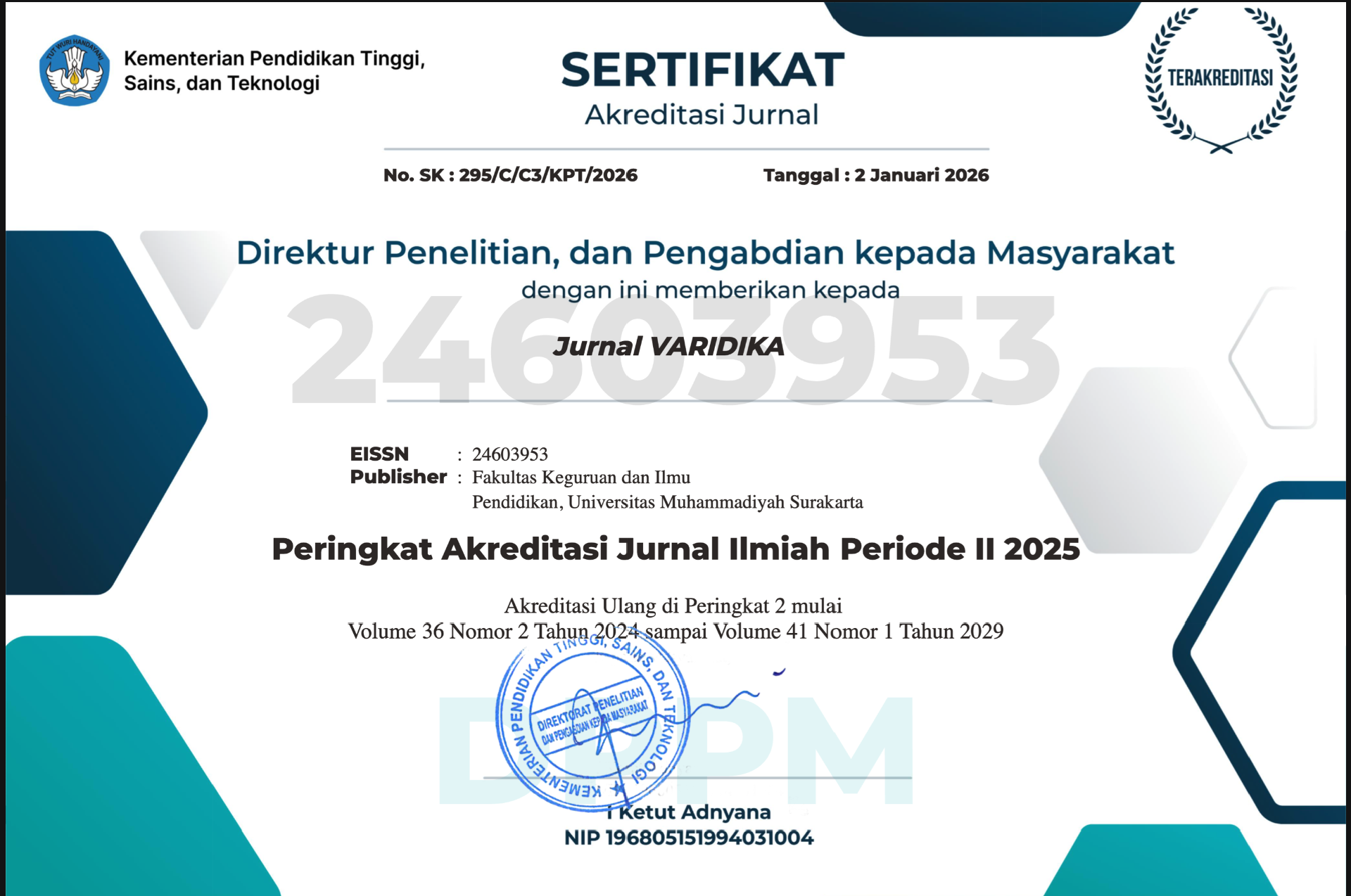
Twenty Years of Multicultural Education Scholarship: Insights from the Journal for Multicultural Education and the Multicultural Education Technology Journal
DOI:
https://doi.org/10.23917/varidika.v38i3.16131Keywords:
Educational Research Trends, Global Education, Literature Review, Multicultural EducationAbstract
Despite the rapid growth of multicultural education research worldwide, systematic insights into how this field has evolved across major scholarly outlets over time remain limited. This study presents a literature review of twenty years of multicultural education scholarship published in two leading journals, the Multicultural Education Technology Journal and the Journal for Multicultural Education. Drawing on systematic content and narrative analysis of 521 Scopus-indexed articles, the review explores publication trends, author affiliations, thematic development, citation patterns, and keyword co-occurrence across two editorial phases. The findings reveal a clear shift from a technology-oriented focus (2007–2013) toward a broader and more interdisciplinary multicultural education agenda (2014–2025). Malaysia and the United States emerge as the most prolific contributors, while dominant research themes include inclusive education, teacher preparation, linguistic diversity, and culturally responsive pedagogy. Citation patterns suggest growing scholarly influence, including among early-career publications, alongside increasing international and interdisciplinary collaboration. Although the analysis is limited to Scopus-indexed sources, the findings provide valuable insights for scholars, editors, and policymakers seeking to strengthen equity-oriented educational research. Overall, this review contributes institutional knowledge on the evolution, internationalization, and educational impact of multicultural education research over the past two decades.
Downloads
References
Ahamer, G. (2012). Human geography trains diverse perspectives on global development. Multicultural Education and Technology Journal, 6(4), 312–333. https://doi.org/10.1108/17504971211279554
Ahamer, G. (2013a). Multiple cultures of doing geography facilitate Global Studies. Multicultural Education and Technology Journal, 7(2), 228–250. https://doi.org/10.1108/17504971311328099
Ahamer, G. (2013b). Quality assurance through multiple cultures in Global Studies. Multicultural Education and Technology Journal, 7(2), 110–122. https://doi.org/10.1108/metj.2013.32207baa.001
Aoyama, I., Saxon, T. F., & Fearon, D. D. (2011). Internalizing problems among cyberbullying victims and moderator effects of friendship quality. Multicultural Education & Technology Journal, 5(2), 92-105. https://doi.org/10.1108/17504971111142637
Bader, L., & Köttstorfer, M. (2013). E-learning from a student's view with focus on Global Studies. Multicultural Education and Technology Journal, 7(2), 176–191. https://doi.org/10.1108/17504971311328062
Banks, J. A. (2016). Cultural diversity and education: Foundations, curriculum, and teaching. Routledge.
Cherng, H. Y. S., & Davis, L. A. (2019). Multicultural matters: An investigation of key assumptions of multicultural education reform in teacher education. Journal of Teacher Education, 70(3), 219-236. https://doi.org/10.1177/0022487117742884
Crumb, L., Chambers, C., Azano, A., Hands, A., Cuthrell, K., & Avent, M. (2023). Rural cultural wealth: Dismantling deficit ideologies of rurality. Journal for Multicultural Education, 17(2), 125-138. https://doi.org/10.1108/JME-06-2022-0076
Duraković, E., Feigl, B. M., Fischer, B. M., & Ahamer, G. (2012). Dialogic Global Studies for multicultural technology assessment. Multicultural Education and Technology Journal, 6(4), 261–286. https://doi.org/10.1108/17504971211279527
Economides, A. A. (2008). Culture‐aware collaborative learning. Multicultural Education & Technology Journal, 2(4), 243-267. https://doi.org/10.1108/17504970810911052
Edwards, E. C. (2025). Applying a racial lens to measures of school safety to examine Black youth perceptions and outcomes. Journal for Multicultural Education, 19(4), 479–512. https://doi.org/10.1108/JME-11-2023-0123
Fox, W., & Gay, G. (1995). Integrating multicultural and curriculum principles in teacher education. Peabody Journal of Education, 70(3), 64-82. https://doi.org/10.1080/01619569509538835
Gay, G. (2018). Culturally responsive teaching: Theory, research, and practice. Teachers College Press.
Hsu, H. Y. (2009). Preparing teachers to teach literacy in responsive ways that capitalize on students' cultural and linguistic backgrounds through weblog technology. Multicultural Education and Technology Journal, 3(3), 168-181. https://doi.org/10.1108/17504970910984853
Hunduma, C. M., & Mekuria, Y. S. (2024). Multicultural education and global citizenship: Literature review. Multidisciplinary Reviews, 7(10), 2024223-2024223. https://10.31893/multirev.2024223
Johnson, E. J. (2015). Debunking the “language gap”. Journal for Multicultural Education, 9(1), 42-50. https://doi.org/10.1108/JME-12-2014-0044
King, E. T., & Scott, L. M. (2014). English as gatekeeper: Linguistic capital and American schools. Journal for Multicultural Education, 8(4), 226-236. https://doi.org/10.1108/JME-06-2014-0026
Ladson-Billings, G. (2014). Culturally sustaining pedagogies: Teaching and learning for justice in a changing world. Teachers College Press.
Leistyna, P. (2002). Defining and designing multiculturalism: One school system’s efforts. SUNY Press.
McGee, E. O., White, D. T., Jenkins, A. T., Houston, S., Bentley, L. C., Smith, W. J., & Robinson, W. H. (2016). Black engineering students’ motivation for PhD attainment: Passion plus purpose. Journal for Multicultural Education, 10(2), 167-193. https://doi.org/10.1108/JME-01-2016-0007
Obiakor, F. E. (2023). Reducing hate through multicultural education and transformation. IAP.
Payadnya, I. P. A. A., Atmaja, I. M. D., Noviyanti, P. L., Wibawa, K. A., & Jayantika, I. G. A. N. T. (2025). Exploring “Wa Pat Nem Tus Dasa”: The potential of a Balinese traditional mod 2 counting system in culturally based mathematics learning. Journal for Multicultural Education, 19(4), 448–459. https://doi.org/10.1108/JME-02-2025-0050
Pollock, M., Musillo Aschoff, C., Ko-Wong, L., & Homan, E. (2025). Yearning to learn: Youth voices from restriction states, 2023. Journal for Multicultural Education, 19(4), 341–363. https://doi.org/10.1108/JME-03-2024-0032
Porcaro, D. (2011). Applying constructivism in instructivist learning cultures. Multicultural Education & Technology Journal, 5(1), 39-54. https://doi.org/10.1108/17504971111121919
Robinson, R. P., & Jones, S. P. (2024). Left behind but not left alone: testimonies of Black preservice experiences with white cooperating teachers. Journal for Multicultural Education, 18(3), 289-301. https://doi.org/10.1108/JME-11-2022-0147
Sleeter, C. (2018). Multicultural education past, present, and future: Struggles for dialog and power-sharing. International Journal of Multicultural Education, 20(1), 5-20. https://doi.org/10.18251/ijme.v20i1.1663
Tamuri, A., Othman, M. Y. H., Dakir, J. M., Munawar, A., & Stapa, Z. (2013). Religious education and ethical attitude of Muslim adolescents in Malaysia. Multicultural Education and Technology Journal, 7(4), 257–274. https://doi.org/10.1108/METJ-03-2013-0008
Thakurta, A., Msurshima, N. M., & Blake, A. R. (2025). Inquiring into belonging: A practitioner study of South Asian international students' experiences in U.S. higher education. Journal for Multicultural Education, 19(4), 513–526. https://doi.org/10.1108/JME-07-2024-0084
Torres, C. A., & Tarozzi, M. (2020). Multiculturalism in the world system: towards a social justice model of inter/multicultural education. Globalisation, societies and education, 18(1), 7-18. https://doi.org/10.1080/14767724.2019.1690729
Watfa, A. A., & Jedouri, B. (2025). Using adaptive learning systems to enhance educational innovation: Perspectives of multicultural faculty members at Kuwait University. Journal for Multicultural Education, 19(4), 540–554. https://doi.org/10.1108/JME-02-2025-0043
Downloads
Submitted
Accepted
Published
Versions
- 04/18/2026 (2)
- 03/21/2026 (1)
Issue
Section
License
Copyright (c) 2026 Rully Charitas Indra Prahmana, Naufal Ishartono, Shahibul Ahyan

This work is licensed under a Creative Commons Attribution 4.0 International License.