Self-Regulated Learning for Vocational Students’ Inductive Thinking in Solving Contextual Geometric Sequence Problems
DOI:
https://doi.org/10.23917/varidika.v38i2.15096Keywords:
Geometric Sequences, Inductive Reasoning, Problem Solving, Self-Regulated LearningAbstract
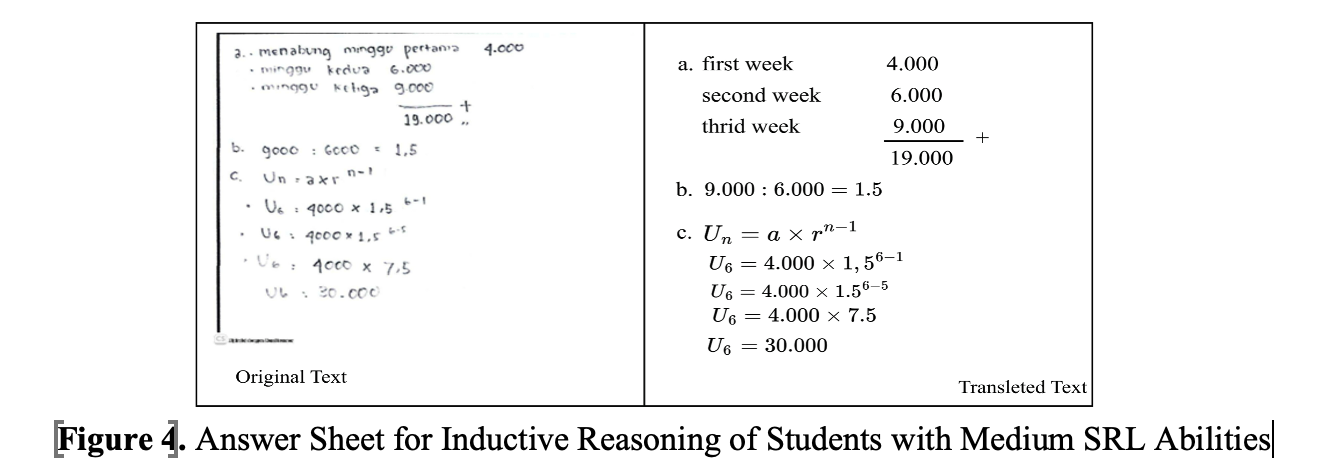
Contextual problems play an important role in learning in vocational high schools because they connect mathematical concepts with real-life situations relevant to students. However, studies that specifically examine vocational high school students’ inductive thinking skills in solving contextual mathematical problems, particularly in geometric sequences, viewed from the level of Self-Regulated Learning (SRL), are still limited. This study aims to analyze the inductive thinking abilities of vocational high school students in solving contextual geometric sequence problems based on their SRL levels. A qualitative approach with descriptive analysis was employed. The research subjects consisted of 33 eleventh-grade students from the Accounting and Institutional Finance class at SMK Negeri 1 Boyolali. The results showed that 3 students were categorized as having high SRL, 24 students had moderate SRL, and 6 students had low SRL. Analysis of students’ responses revealed that students with high SRL were able to meet all indicators of inductive reasoning, namely observing regularities, identifying patterns, and formulating generalizations. Students with moderate SRL were able to observe regularities and identify patterns but experienced difficulties in formulating generalizations. Meanwhile, students with low SRL were only able to observe regularities. These findings indicate that SRL levels influence students’ inductive thinking abilities. This research revealing students’ characteristics and difficulties at each inductive reasoning indicator based on SRL levels within the context of geometric sequences in vocational high schools, as well as providing practical implications for teachers in designing more effective contextual mathematics learning.
Downloads
References
Adeoye, M. A., & Jimoh, H. A. (2023). Problem-Solving Skills Among 21st-Century Learners Toward Creativity and Innovation Ideas. Thinking Skills and Creativity Journal, 6(1), 52–58. https://doi.org/10.23887/tscj.v6i1.62708
Alyani, F., & Ramadhina, A. L. (2022). The Relation between Self-Regulated Learning and Mathematical Problem-Solving During Covid-19. Journal of Education Research and Evaluation, 6(4), 645–652. https://doi.org/10.23887/jere.v6i4.47593
Amiruddin, A., Qorib, M., Naimi, N., & Deliati, D. (2022). The Role of Inductive Learning Models on The Students Self-Regulated Learning in Math Journaling. Cypriot Journal of Educational Sciences, 17(7), 2428–2446. https://doi.org/10.18844/cjes.v17i7.7680
Angraini, L. M., Larsari, V. N., Muhammad, I., & Kania, N. (2023). Generalization and Analogical Reasoning of Junior High School Viewed from Bruner’s Learning Theory. Infinity Journal, 12(2), 291–306. https://doi.org/10.22460/infinity.v12i2.p291-306
Anugraheni, I. (2019). Pengaruh Pembelajaran Problem Solving Model Polya Terhadap Kemampuan Memecahkan Masalah Matematika Mahasiswa. Jurnal Pendidikan, 4(1), 1–6. https://doi.org/10.26740/jp.v4n1.p1--6
Astiati, S. D., & Ilham, I. (2025). Analisis Kemampuan Berpikir Induktif Matematis Siswa pada Mata Pelajaran Barisan Aritmatika. Jurnal Pendidikan Dan Pembelajaran Indonesia (JPPI), 5(1), 319–328. https://doi.org/10.53299/jppi.v5i1.995
Astuti, P., Sari, N. K., & Wirawan Fajar. (2023). Kemampuan Pemecahan Masalah Kontekstual Siswa SMA Kelas XI Pada Materi Barisan dan Deret. ANTHOR : Education and Learning Journal, 2(3), 396–401. https://doi.org/10.31004/anthor.v2i3.152
Astuty, E. S. W., Waluya. St. Budi, & Sugianto. (2019). Mathematical Reasoning Ability Based on Self Regulated Learning by Using the Learning of Reciprocal Teaching with RME Approach. Unnes Journal of Mathematics Education Research, 8(1), 49–56. http://journal.unnes.ac.id/sju/index.php/ujmer
BSKAP. (2025). Capaian Pembelajaran Mata Pelajaran Matematika Jenjang SMA/SMK fase E (Keputusan Kepala BSKAP No. 046/H/KR/2025).
Cahyani, N. D., & Sritresna, T. (2023). Kemampuan Penalaran Matematis Siswa dalam Menyelesaikan Soal Cerita. Jurnal Inovasi Pembelajaran Matematika: PowerMathEdu, 2(1), 103–112. https://doi.org/10.31980/pme.v2i1.1404
Creswell. J.W., & Guetterman, T. C. (2018). Educational Research Planning, Conducting, and Evaluating Quantitative and Qualitative Research (6th ed.). Pearson.
Evidiasari, S., & Irawati, S. (2019). Penalaran Induktif Siswa SMA Dalam Menyelesaikan Masalah Transfromasi Geometri. Jurnal Kajian Pembelajaran Matematika, 3(2), 78–85. http://journal2.um.ac.id/index.php/jkpm
Fathan, Y. A. (2025). Analisis Kemampuan Pemahaman Konsep Matematika Siswa SMK RPI Jakarta pada Materi Matriks. Algoritma : Jurnal Matematika, Ilmu Pengetahuan Alam, Kebumian Dan Angkasa, 3(1), 190–195. https://doi.org/10.62383/algoritma.v3i1.381
Hasibuan, D. S., Parta, I. N., & Qohar, A. (2023). Profil Penalaran Induktif Siswa SMP dalam Memecahkan Masalah Numerasi pada Materi Pola Bilangan. AKSIOMA: Jurnal Program Studi Pendidikan Matematika, 12(3), 3387. https://doi.org/10.24127/ajpm.v12i3.7279
Ilmi, N. J., Mursidik, E. M., & Kurniawati, R. P. (2022). Self Regulated Learning pada Gaya Belajar Kinestetik Kelas V Sekolah Dasar. Prosiding Konferensi Ilmiah Dasar, 3, 276–281. http://prosiding.unipma.ac.id/index.php/KID
Ismali, R. N., Yerizon, & Fauzan, A. (2023). Exploring Self-Regulated Learning and Their Impact on Students’ Mathematical Communication Skills on the Topic of Number Patterns With the Blended Learning System Rafki Nasuha Ismail Universitas Negeri Padang Yerizon Universitas Negeri Padang. Journal of Higher Education Theory and Practice, 23(16), 207. https://doi.org/https://doi.org/10.33423/jhetp.v23i16.6477
Izzah, K. H., & Azizah, M. (2019). Analisis Kemampuan Penalaran Siswa dalam Pemecahan Masalah Matematika Siswa Kelas IV. Indonesian Journal Of Educational Research and Review, 2(2). https://doi.org/http://doi,org/10.23887/ijerr.v2i2.17629
Jusra, H., & Rahmawati, A. D. (2022). Analysis of Students Mathematical Reasoning Abilities in Terms of Self-Regulated Learning. In Jurnal Inspirasi Pendidikan (Vol. 12, Number 2).
Kementrian Pendidikan dan Kebudayaan Republik Indonesia. (2017). Matematika untuk SMA/MA/SMK/MK Kelas XI (2017 Revisi). Kementrian Pendidikan dan Kebudayaan Republik (Kemendikbud RI).
Kholid, M. N., & Naufan, F. (2025). Next-Level Learning: Classifying Self-Regulated Learning in Mathematical Problem-Solving. Educational Process: International Journal, 17. https://doi.org/10.22521/edupij.2025.17.390
Kristiyanti, M. (2023). Metode Penelitian (D. Abimanto, Ed.). CV. Pustaka STIMART AMNI Semarang.
Landa, J., Berciano, A., & Marbán, J. M. (2024). Self-Regulation Profiles of Pre-Service Mathematics Teachers for Primary Education in Mathematical Problem-Solving Contexts. Education Sciences, 14(9). https://doi.org/10.3390/educsci14091018
Leana, K. L., & Luthfi, A. K. (2017). Systematic Literature Review: Pengaruh Self-Regulated Learning Terhadap Kemampuan Pemecahan Masalah Matematika Siswa Berdasarkan Jenjang Pendidikan. Jurnal Penelitian Dan Penalaran, 11(2), 21–30. https://doi.org/https://dou.org/10.26618/jp.v11i2.15919
Magfiroh, M., Prabawanto, S., & Rosjanuardi, R. (2024). Learning Obstacle of Students in Geometrical Sequence and Series. KnE Social Sciences. https://doi.org/10.18502/kss.v9i13.15960
Maulida, A. S., Wahyudin, W., Turmudi, T., & Nurlaelah, E. (2024). Differences in The Influence of Self-Regulated Learning Levels on Enhancing Students’ Mathematical Reasoning Abilities. DWIJA CENDEKIA: Jurnal Riset Pedagogik, 8(2), 221. https://doi.org/10.20961/jdc.v8i2.89291
Medyasari, T. L., Zaenuri, & Dewi, N. R. (2020). Kemampuan Pemecahan Masalah Matematis Siswa SMA Negeri 5 Semarang. PRISMA, Prosiding Seminar Nasional Matematika, 3, 464–470. https://journal.unnes.ac.id/sju/index.php/prisma/
Miles, M. B., huberman, M., & Saldana, J. (2014). Qualitative Data Analysis A Methods Sourcebook. SAGE Publications, Inc.
Mulyasari, Y. (2018). Inductive Approach Implementation to Improve the Mathematichal Reasoning, Problem-Solving, and Self-Concept of Junior High School Student in Karawang District. PRISMA, 7(2), 186–196. https://jurnal.unsur.ac.id/prisma
Nugrahani, R. P., Nurcahyo, A., & Kholid, M. N. (2024). Analisis Kemampuan Berpikir Reflektif Matematis Siswa pada Materi Statistika Ditinjau dari Self-Regulated Learning. Lebesgue: Jurnal Ilmiah Pendidikan Matematika, Matematika Dan Statistika, 5(1), 232–242. https://doi.org/10.46306/lb.v5i1
Nurcahyani, M. J., & Sumardi, S. (2022). Meningkatkan Kemampuan Pemecahan Masalah Peserta Didik Melalui Pembelajaran Berbantuan LKPD Berbasis Discovery Learning. AKSIOMA: Jurnal Program Studi Pendidikan Matematika, 11(4), 3624. https://doi.org/10.24127/ajpm.v11i4.5765
Nursoffina, M., & Efendi, N. (2021). Analysis of The Relationship Between Mathematical Reasoning and Problem Solving of Elementary Students Mathematics Material. Academia Open, 6. https://doi.org/10.21070/acopen.6.2022.1813
OECD. (2019). Development Co-operation Report 2019 (Development Co-Operation Report). OECD Publishing. https://doi.org/10.1787/9a58c83f-en
OECD. (2023). PISA 2022 Results (Volume I): The State of Learning and Equity in Education. (PISA). OECD Publishing. https://doi.org/10.1787/53f23881-en
Panadero, E. (2017). A review of Self-Regulated Learning: Six Models and Four Directions for Research. In Frontiers in Psychology (Vol. 8, Number APR). Frontiers Media S.A. https://doi.org/10.3389/fpsyg.2017.00422
Polya, G. (2004). How to Solve it A New Aspect of Mathematical Method. Princeton University Press.
Prameswari, A. D., & Abadi, A. P. (2025). Analisis Kemampuan Pemecahan Masalah Siswa Kelas X SMA pada Materi Barisan Aritmetika. Jurnal Cendekia : Jurnal Pendidikan Matematika, 9(3), 486–497. https://doi.org/10.31004/cendekia.v9i1.3954
Putri, R. D. R. P., Ratnasari, T., Trimadani, D., Halimatussakdiah, Husna, E. N., & Yulianti, W. (2022). Pentingnya Keterampilan Abad 21 dalam Pembelajaran Matematika. Science and Education Journal (SICEDU), 1(2), 449–457. http://doi.org/10.31004/sicedu.v1i2.64
Rahmatika, D., & Waluya, S. B. (2023). Students’ Mathematical Reasoning Ability Viewed from Self-Regulated Learning in The Missouri Mathematics Project Learning with Open-Ended Approach. Unnes Journal of Mathematics Education, 12(1), 84–92. https://doi.org/10.15294/ujme.v12i1.66188
Rizqiani, A. S., Sridana, N., Junaidi, J., & Kurniati, N. (2023). Analisis Kemampuan Pemecahan Masalah Matematis dalam Menyelesaikan Soal Cerita Ditinjau dari Kemampuan Berpikir Kritis Siswa. Jurnal Ilmiah Profesi Pendidikan, 8(1), 232–239. https://doi.org/10.29303/jipp.v8i1.1138
Siswanto, E., & Meiliasari. (2024). Kemampuan Pemecahan Masalah pada Pembelajaran Matematika: Systematic Literature Review. Jurnal Riset Pembelajaran Matematika Sekolah, 8(1), 45–59. https://doi.org/http://doi.org/10.21009/jrpms.081.06
Sosa Moguel, L. E., Aparicio Landa, E., & Cabañas-Sánchez, G. (2019). Characterization of Inductive Reasoning in Middle School Mathematics Teachers in a Generalization Task. International Electronic Journal of Mathematics Education, 14(3). https://doi.org/10.29333/iejme/5769
Sugiyono. (2019). Metode Penelitian Kuantitatif Kualitatif dan R&D. Alfabeta.
Tasoin, F. A. L., & Adibah, F. (2024). Analisis Kemampuan Matematika Siswa dalam Menyelesaikan Soal Cerita pada Materi pada Materi Barisan dan Deret geometri. Journal of Education and Research, 3(1), 77–88. https://doi.org/https://doi.org/10.56707/jedar.v3i1.189
Tukaryanto, Hendikawati, P., & Nugroho, S. (2018). Peningkatan Kemampuan Penalaran Matematik dan Percaya Diri Siswa Kelas X Melalui Model Discovery Learning. Prosiding Seminar Nasional Matematika, 656–662. https://journal.unnes.ac.id/sju/index.php/prisma/
Van Vo, D., & Csapó, B. (2020). Development of Inductive Reasoning in Students Across School Grade Levels. Thinking Skills and Creativity, 37. https://doi.org/10.1016/j.tsc.2020.100699
Wardani, R. K., & Amidi. (2025). Kemampuan Penalaran Matematis Ditinjau dari Minat Belajar Siswa dengan Model Problem Based Learning Berbantuan Mathigon. JurnalLIlmiah Literasi Indonesia, 1(1), 183–193. https://doi.org/10.63822/s0amny98
Wibowo, T., Susianti, E., Nugraheni, P., & Purwoko, R. Y. (2024). Students’ Onto-Semiotic Approach in Solving Mathematics Problems. Jurnal Riset Pendidikan Matematika, 11(1), 1–14. https://doi.org/10.21831/jrpm.v11i1.51973
Wijayanti, R. (2022). Pembelajaran Matematika dengan Kontekstual Untuk Meningkatkan Kemampuan Penalaran Induktif pada Siswa kelas VIII SMP Negeri 11 Kota Cirebon. Jurnal Pendidikan Intelektium, 3(2), 382–388. https://doi.org/https://doi.org/10/37010/int.v3i2.1081
Yuwono, T., & Murniasih, T. R. (2024). Students’ Mathematical Connection Ability in Solving Problems. AKSIOMA: Jurnal Program Studi Pendidikan Matematika, 13(1), 124. https://doi.org/10.24127/ajpm.v13i1.3500
Zamnah, L. N. (2019). Analisis Self-Regulated Learning yang Memperoleh Pembelajaran Menggunakan Pendekatan Problem-Centered Learning dengan Hands-on Activity. ANARGYA:Jurnal Ilmiah Pendidikan Matematika, 2(1), 56–63. https://doi.org/https://dx.doi.org/1024176/anargya.v2i1.3495
Submitted
Accepted
Published
Versions
- 02/19/2026 (3)
- 02/16/2026 (2)
- 02/15/2026 (1)
Issue
Section
License
Copyright (c) 2026 Ragista Maya Sari, Adi Nurcahyo, Annisa Swastika

This work is licensed under a Creative Commons Attribution 4.0 International License.