Students’ Perceptions of Role-Playing Games in Mathematics Learning: A Descriptive Study
DOI:
https://doi.org/10.23917/varidika.v38i2.13600Keywords:
students perception, mathematical learning, role-playing games, mathematical thinking, arithmetic sequence and seriesAbstract
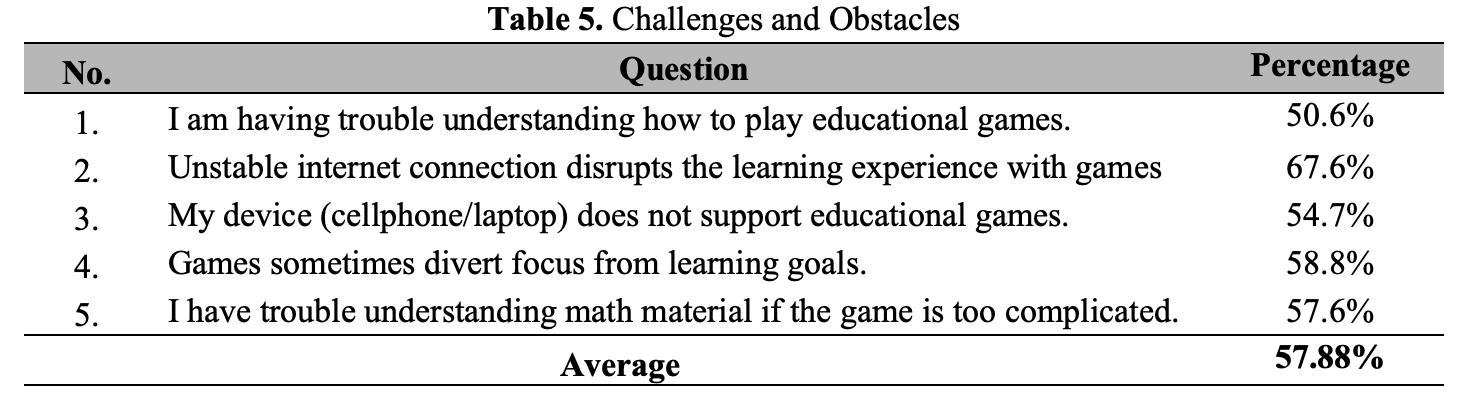
This study aims to describe students’ perceptions of the use of a role-playing game (RPG), Arithmetic Adventure: The Mystery of Polaria Village, in mathematics learning on arithmetic sequences and series. A quantitative descriptive research design was employed, involving 34 tenth-grade students at SMA Negeri 10 Palembang selected through purposive sampling based on their participation in RPG-based learning activities. Data were collected using a closed-ended Likert-scale questionnaire covering four aspects: motivation and engagement, perceived learning effectiveness, social interaction and collaboration, and challenges encountered during learning. Content validity was established through expert judgment, while instrument reliability was confirmed using Cronbach’s Alpha coefficients ranging from 0.77 to 0.91, indicating acceptable to excellent internal consistency. Descriptive analysis showed that students perceived the RPG positively in terms of motivation, engagement, and learning effectiveness, while challenges related to technical constraints and game complexity were reported at a moderate level. The integration of narrative-based gameplay with mathematical thinking stages—specializing, generalizing, conjecturing, and convincing—was perceived as supporting students’ reasoning and problem-solving processes. These findings suggest that RPG-based learning can serve as a meaningful and engaging instructional medium in mathematics, although its implementation requires careful design considerations and adequate technical support.
Downloads
References
Abd-Alrazaq, A., Alajlani, M., Alhuwail, D., Schneider, J., Akhu-Zaheya, L., Ahmed, A., & Househ, M. (2022). The Effectiveness of Serious Games in Alleviating Anxiety: Systematic Review and Meta-analysis. JMIR Serious Games, 10(1), 1–22. https://doi.org/10.2196/29137
Adipat, S., Laksana, K., Busayanon, K., Ausawasowan, A., & Adipat, B. (2021). Engaging Students in the Learning Process with Game-Based Learning: The Fundamental Concepts. International Journal of Technology in Education, 4(3), 542–552. https://doi.org/10.46328/ijte.169
Ahmad, S., Khan, F., & Whangbo, T. K. (2022). Performance evaluation of topological infrastructure in Internet-of-things-enabled serious games. Computers, Materials and Continua, 71(2), 2653–2666. https://doi.org/10.32604/cmc.2022.022821
Aminah, N., Sukestiyarno, Y. L., Cahyono, A. N., & Maat, S. M. (2023). Student Activities in Solving Mathematics Problems with A Computational Thinking using Scratch. International Journal of Evaluation and Research in Education, 12(2), 613–621. https://doi.org/10.11591/ijere.v12i2.23308
Anagnostopoulou, E. (2023). Using RPG-Based Learning Environment to Increase Engagement and Motivation for Learning Higher Mathematics. European Conference on Games Based Learning, 756–815.
Chan, S. W., Looi, C. K., Ho, W. K., Huang, W., Seow, P., & Wu, L. (2021). Learning number patterns through computational thinking activities: A Rasch model analysis. Heliyon, 7(9). https://doi.org/10.1016/j.heliyon.2021.e07922
Cheung, S. Y., & Ng, K. Y. (2021). Application of the Educational Game to Enhance Student Learning. Frontiers in Education, 6. https://doi.org/10.3389/feduc.2021.623793
Choi-Lundberg, D. L., Butler-Henderson, K., Harman, K., & Crawford, J. (2023). A systematic review of digital innovations in technology-enhanced learning designs in higher education. Australasian Journal of Educational Technology, 39(3), 133–163.
Christopoulos, A., Mystakidis, S., Kurczaba, J., Laakso, M. J., & Stylios, C. (2024). Is Immersion in 3D Virtual Games Associated with Mathematical Ability Improvement in Game-Based Learning? International Journal of Science and Mathematics Education, 22(7), 1479–1499. https://doi.org/10.1007/s10763-023-10440-4
Chrysafiadi, K., Kamitsios, M., & Virvou, M. (2023). Fuzzy-based dynamic difficulty adjustment of an educational 3D-game. Multimedia Tools and Applications, 82(18), 27525–27549. https://doi.org/10.1007/s11042-023-14515-w
Cirneanu, A. L., & Moldoveanu, C. E. (2024). Use of Digital Technology in Integrated Mathematics Education. Applied System Innovation, 7(4). https://doi.org/10.3390/asi7040066
Curelaru, M., Curelaru, V., & Cristea, M. (2022). Students’ Perceptions of Online Learning during COVID-19 Pandemic: A Qualitative Approach. Sustainability (Switzerland), 14(13). https://doi.org/10.3390/su14138138
Dwi Ferdiani, R., Manuharawati, & Khabibah, S. (2022). Activist learners’ creative thinking processes in posing and solving geometry problem. European Journal of Educational Research, 11(1), 117–126. https://doi.org/10.12973/eu-jer.11.1.117
Gakime, R. G., Waititu, M. M., & Mwangi, F. G. (2025). Teachers’ Perceptions of Digital Game Utilisation in Teaching and Learning Physics Concepts in Secondary Schools of Murang’a County, Kenya. EdinBurg Peer Reviewed Journals and Books Publishers Journal of Education, 5(2), 27–43.
Gui, Y., Cai, Z., Yang, Y., Kong, L., Fan, X., & Tai, R. H. (2023). Effectiveness of Digital Educational Game and Game Design in STEM Learning: A Meta-Analytic Review. International Journal of STEM Education, 10(36), 1–25. https://doi.org/10.1186/s40594-023-00424-9
Hellín, C. J., Calles-Esteban, F., Valledor, A., Gómez, J., Otón-Tortosa, S., & Tayebi, A. (2023). Enhancing Student Motivation and Engagement through a Gamified Learning Environment. Sustainability (Switzerland), 15(19). https://doi.org/10.3390/su151914119
Hidayat, W., Rohaeti, E. E., Ginanjar, A., & Putri, R. I. I. (2022). An ePub learning module and students’ mathematical reasoning ability: A development study. Journal on Mathematics Education, 13(1), 103–118. https://doi.org/10.22342/jme.v13i1.pp103-118
Huseinović, L. (2023). The Effects of Gamification On Student Motivation And Achievement In Learning English As A Foreign Language In Higher Education. MAP Education and Humanities, 4(1), 10–36. https://doi.org/10.53880/2744-2373.2023.4.10
Huynh, E., Nyhout, A., Ganea, P., & Chevalier, F. (2020). Designing Narrative-Focused Role-Playing Games for Visualization Literacy in Young Children. IEEE Transactions on Visualization and Computer Graphics, 27, 924–934. http://arxiv.org/abs/2008.13749
Ishak, S. A., Hasran, U. A., & Din, R. (2023). Media Education through Digital Games: A Review on Design and Factors Influencing Learning Performance. Education Science, (102), 1. https://doi.org/10.3390/educsci
Ishartono, N., Nurcahyo, A., Waluyo, M., Prayitno, H. J., & Hanifah, M. (2022). Integrating GeoGebra into the flipped learning approach to improve students’ self-regulated learning during the covid-19 pandemic. Journal on Mathematics Education, 13(1), 69–86. https://doi.org/10.22342/jme.v13i1.pp69-86
Izah, S. C., Sylva, L., & Hait, M. (2024). Cronbach’s Alpha: A Cornerstone in Ensuring Reliability and Validity in Environmental Health Assessment. ES Energy and Environment, 23(1057). https://doi.org/10.30919/esee1057
Kablan, Z., & Günen, A. (2021). The Relationship between Students’ Reflective Thinking Skills and Levels of Solving Routine and Non-routine Science Problems. Science Education International, 32(1), 55–62. https://doi.org/10.33828/sei.v32.i1.6
Li, L., Hew, K. F., & Du, J. (2024). Gamification enhances student intrinsic motivation, perceptions of autonomy and relatedness, but minimal impact on competency: a meta-analysis and systematic review. Educational Technology Research and Development, 72(2), 765–796. https://doi.org/10.1007/s11423-023-10337-7
Masruroh, F., Dinarti, S., & Qomarijah, O. N. (2025). The Effect of Role Playing Game Learning Media on Mathematics Learning Outcomes of Grade VIII Students at SMP Islam Cendekia Harapan Jombang. Electronic Journal of Education, Social Economics and Technology, 6(2), 1007. https://doi.org/10.33122/ejeset.v6i2.1007
Pasqualotto, A., Parong, J., Green, C. S., & Bavelier, D. (2023). Video Game Design for Learning to Learn. International Journal of Human-Computer Interaction, 39(11), 2211–2228. https://doi.org/10.1080/10447318.2022.2110684
Patiño, A., Ramírez-Montoya, M. S., & Ibarra-Vazquez, G. (2023). Trends and research outcomes of technology-based interventions for complex thinking development in higher education: A review of scientific publications. In Contemporary Educational Technology (Vol. 15, Number 4). Bastas. https://doi.org/10.30935/cedtech/13416
Purwaningsih, E., & Sarwanto, W. (2024). The Potential of the Gamification Model in Improving Students’ Creativity and Critical Thinking Skills. Social, Humanities, and Educational Studies SHEs: Conference Series, 8(1), 41–50. https://jurnal.uns.ac.id/shes
Rozi, F., & Firdausiah, F. (2021). Implementation of Role-Playing Games in Overcoming Introverted Children. Al-Ishlah, 13(2), 1394–1402. https://doi.org/10.35445/alishlah.v13i2.629
Saha, M., Islam, S., Akhi, A. A., & Saha, G. (2024). Factors affecting success and failure in higher education mathematics: Students’ and teachers’ perspectives. Heliyon, 10(7). https://doi.org/10.1016/j.heliyon.2024.e29173
Setiana, D. S., Purwoko, R. Y., & Sugiman. (2021). The Application of Mathematics Learning Model to Stimulate Mathematical Critical Thinking Skills of Senior High School Students. European Journal of Educational Research, 10(1), 509–523. https://doi.org/10.12973/EU-JER.10.1.509
Shah, Y. P. (2024). An Analysis of Sequence and Series. Historical Journal, 15(1), 40–44. https://doi.org/10.3126/hj.v15i1.63974
Shongwe, B. (2024). The effect of STEM problem-based learning on students’ mathematical problem-solving beliefs. Eurasia Journal of Mathematics, Science and Technology Education, 20(8). https://doi.org/10.29333/ejmste/14879
Sinaga, N. A., Ningtyas, F. A., Mahmuzah, R., Zahara, Y., & Fatwa, I. (2023). The Effect of Deductive-Inductive Learning Approach on Creative Thinking Ability and Learning Motivation. PARADIKMA, 16(2), 7–14.
Sugiyono. (2013). Metode Penelitian Kuantitatif, Kualitatif, dan R&D. Penerbit Alfabeta.
Sukasno, S., Zulkardi, Z., Putri, R. I. I., & Somakim, S. (2024). The Design of Student Worksheets on Integer Material Using the Context of Musi Rawas Tourism. Jurnal Math Educator Nusantara: Wahana Publikasi Karya Tulis Ilmiah Di Bidang Pendidikan Matematika, 10(2), 210–220. https://doi.org/10.29407/jmen.v10i2.21640
Susanti, E., Wulandari, T., Hapizah, Indaryanti, Isrok’atun, & Simarmata, R. H. (2025). Digital-Worksheets Based Creative Problem Solving to Support Students Mathematical Thinking for Audio-Visual Students. Mathematics Education Journal, 19(1), 23–46. https://doi.org/10.22342/jpm.v19i1.pp23-46
Untari, A. D. (2022). Game Based Learning: Alternative 21 st Century Innovative Learning Models in Improving Student Learning Activeness. EDUEKSOS: The Journal of Social and Economic Education, 11(2), 228. https://doi.org/10.24235/edueksos
Wang, Q., & Abdullah, A. H. (2024). Enhancing Students’ Critical Thinking Through Mathematics in Higher Education: A Systemic Review. In SAGE Open (Vol. 14, Number 3). SAGE Publications Inc. https://doi.org/10.1177/21582440241275651
Xiong, X. (2025). Influence of teaching styles of higher education teachers on students‘ engagement in learning: The mediating role of learning motivation. Education for Chemical Engineers, 51, 87–102. https://doi.org/10.1016/j.ece.2025.02.005
Zhang, J., Xu, J., & Li, M. (2025). The impact of educational live action role-playing games on social–emotional competence: a mixed-method study with Chinese college students. Frontiers in Psychology, 16. https://doi.org/10.3389/fpsyg.2025.1538761
Zhang, Z., Bekker, T., Markopoulos, P., & Skovbjerg, H. M. (2024). Supporting and understanding students’ collaborative reflection-in-action during design-based learning. International Journal of Technology and Design Education, 34(1), 307–343. https://doi.org/10.1007/s10798-023-09814-0
Zhao, D., Muntean, C. H., Chis, A. E., Rozinaj, G., & Muntean, G. M. (2022). Game-Based Learning: Enhancing Student Experience, Knowledge Gain, and Usability in Higher Education Programming Courses. IEEE Transactions on Education, 65(4), 502–513. https://doi.org/10.1109/TE.2021.3136914
Zourmpakis, A. I., Kalogiannakis, M., & Papadakis, S. (2023). Adaptive Gamification in Science Education: An Analysis of the Impact of implementation and Adapted game Elements on Students’ Motivation. Computers, 12(7). https://doi.org/10.3390/computers12070143
Submitted
Accepted
Published
Versions
- 02/19/2026 (3)
- 02/19/2026 (2)
- 02/15/2026 (1)
Issue
Section
License
Copyright (c) 2026 Naqiyyah Nurrosyadah, Ely Susanti, Somakim

This work is licensed under a Creative Commons Attribution 4.0 International License.