Bibliometric Analysis of Living Qur'an Research: A Dimensions Database Exploration (2005-2025) Using R for Statistical Computing and Bibliometrix Software
DOI:
https://doi.org/10.23917/suhuf.v37i2.12568Keywords:
Qur'anic studies, Living Al-Qur’an, Bibliometric analysis, Publication trends, Academic productivityAbstract
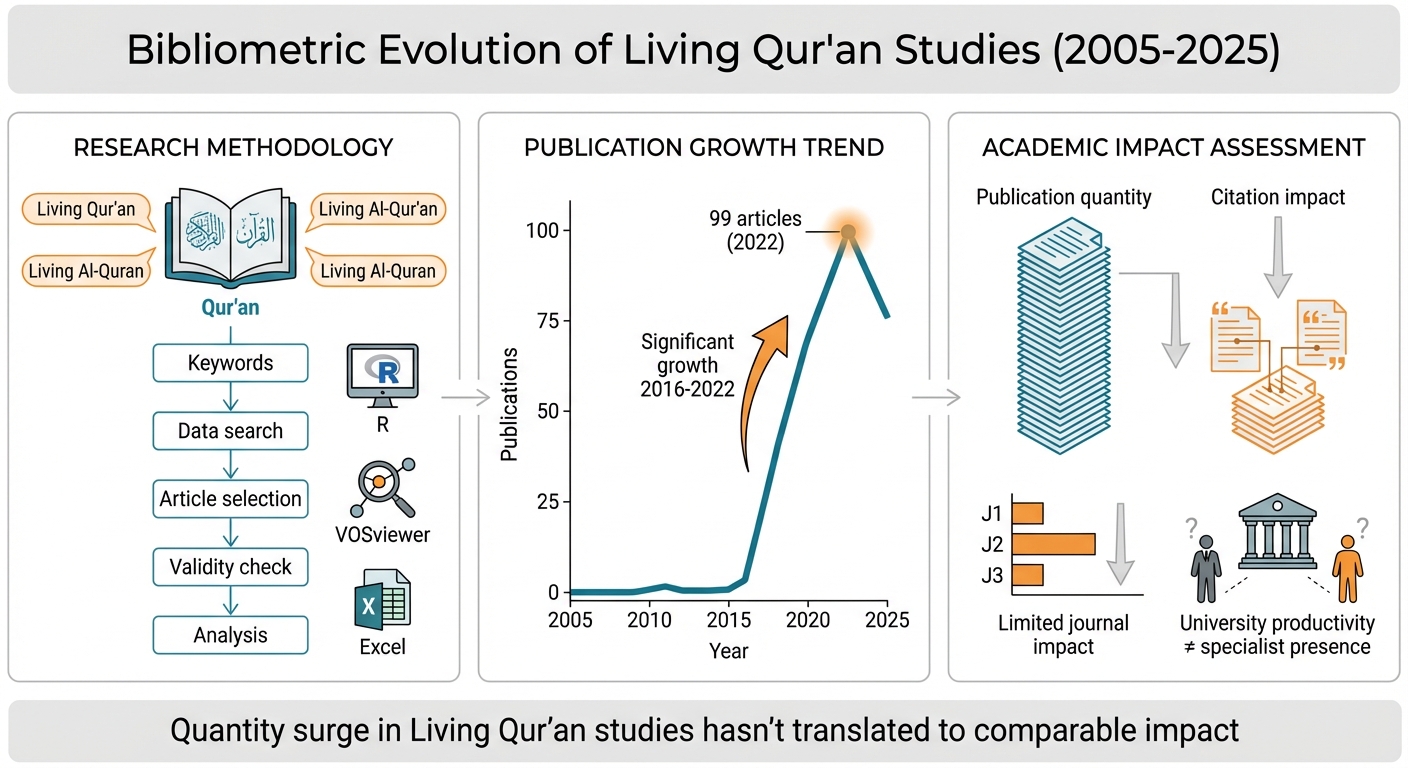
This research analyses the development of living Qur'an studies between 2005 and 2025 using the keywords “Living Qur’an”, “Living Al-Qur’an”, "Living Al-Quran", and “Living Al-Quran,” with two keywords containing no apostrophe. Data scraping and analysis rely on a bibliometric approach by analyzing utilizing tools such as R, VOSviewer, and Microsoft Excel to see the development of living Qur'an studies from the category of publications per year, average article citations, most publication sources, local impact of publication sources, most productive authors, most affiliated sources, and most cited documents globally in the database. The steps taken to categorize the data are as follows: determining keywords, searching for data, selecting articles, checking the validity of the data, and finally, analysis. The results showed that, since the emergence of the Living Qur'an from 2005 to 2025, the trend increased significantly from 2016 to 2022, peaking in 2022 with 99 articles. However, despite the increase in quantity, the academic impact of these articles is limited, as reflected in the journal's h-index. This finding also suggests that a university’s collective interest and productivity in the Living Qur'an discourse is not related to the presence of the discourse specialists in the given university.
Downloads
References
[1] D. Rusmana, Metode penelitian Al-Qur’an dan tafsir. Bandung: Pustaka Setia, 2015.
[2] A. Al-Ubbadi, “Tradisi Pembacaan Surat Al-Fath Dalam Pembuka Pembacaan Maulid Simthu Dhurâr Di Pondok Pesantren Salafiyyah Darul Mukhtar Gembor Periuk Tangerang (Studi Living Qur‟ An) [The Tradition of Reciting Surah Al-Fath as the Opening of the Maulid Simthu Dhurâr Re,” Institut PTIQ Jakarta, 2024. [Online]. Available: https://repository.ptiq.ac.id/id/eprint/1539/
[3] A. U. Hasbillah, Ilmu Living Quran-Hadis: Ontologi, Epistemologi, dan Aksiologi. Yayasan Wakaf Darus-Sunnah, 2019.
[4] I. A. A. M. bin I. M. Al-Bukhari, Shahih Bukhari, Kitab Tibb, Bab al Raqa bi Al-Qur’an wal Muawwidatain. Beirut: Dar al-Kutub Ilmiyyah, 1971.
[5] D. Junaedi, “Living Qur’an: Sebuah Pendekatan Baru dalam Kajian Al-Qur’an (Studi Kasus di Pondok Pesantren As-Siroj Al-Hasan Desa Kalimukti Kec. Pabedilan Kab. Cirebon) [Living Qur’an: A New Approach in Qur’anic Studies (A Case Study at Pondok Pesantren As-Siroj Al-Ha,” J. QUR’AN HADITH Stud., vol. 4, no. 2, pp. 169–190, (Indonesia), Dec. 2015, doi: https://doi.org/10.15408/quhas.v4i2.2392.
[6] F. Yeni, N. Pinto, and G. Gonsales, “Living Hadith Studies: A VOSviewer Perspective,” Mashdar J. Stud. Al-Qur’an dan Hadis, vol. 6, no. 2, pp. 173–186, 2024, doi: https://doi.org/10.15548/mashdar.v6i2.9514.
[7] A. El Ashfahany, M. Q. Multazam, S. Ahmed, M. R. Ab Rahman, and M. S. Apriantoro, “Relationship of Zakat and Waqf to Poverty and Inequality: Bibliometrics Analysis,” Suhuf, vol. 37, no. 1, pp. 171–187, May 2025, doi: https://www.doi.org/10.23917/suhuf.v37i1.9938.
[8] D. Petersen, “Dimensions: A Research Tool for Librarians,” J. Electron. Resour. Med. Libr., vol. 19, no. 3, pp. 94–100, Jul. 2022, doi: https://doi.org/10.1080/15424065.2022.2113348.
[9] J. M. Merigó and J.-B. Yang, “A bibliometric analysis of operations research and management science,” Omega (United Kingdom), vol. 73, pp. 37–48, 2017, doi: https://doi.org/10.1016/j.omega.2016.12.004.
[10] N. Donthu, S. Kumar, D. Mukherjee, N. Pandey, and W. M. Lim, “How to conduct a bibliometric analysis: An overview and guidelines,” J. Bus. Res., vol. 133, pp. 285–296, 2021, doi: https://doi.org/10.1016/j.jbusres.2021.04.070.
[11] I. Passas, “Bibliometric Analysis: The Main Steps,” Encyclopedia, vol. 4, no. 2, pp. 1014–1025, Jun. 2024, doi: https://doi.org/10.3390/encyclopedia4020065.
[12] L. Ansorge, “Citation coverage by Dimensions and Scopus of articles published in European Science Editing,” Eur. Sci. Ed., vol. 49, 2023, doi: https://doi.org/10.3897/ese.2023.e102691.
[13] V. K. Singh, P. Singh, M. Karmakar, J. Leta, and P. Mayr, “The journal coverage of Web of Science, Scopus and Dimensions: A comparative analysis,” Scientometrics, vol. 126, no. 6, pp. 5113–5142, 2021, doi: https://doi.org/10.1007/s11192-021-03948-5.
[14] A. Ma’ruf, A. N. Yandhi, and F. H. N. Athief, “Bibliometric and visual analysis of research on ethical finance,” Multidiscip. Rev., vol. 7, no. 5, p. 2024099, Feb. 2024, doi: https://doi.org/10.31893/multirev.2024099.
[15] H. Hamdi et al., “Research Trends on the Integration of Science and Character Education: A Bibliometric Analysis Review,” Suhuf Int. J. Islam. Stud., vol. 37, no. 1, pp. 24–36, May 2025, doi: https://doi.org/10.23917/suhuf.v37i1.10022.
[16] A. J. Lotka, “The frequency distribution of scientific productivity,” J. Washingt. Acad. Sci., vol. 16, no. 12, pp. 317–323, Nov. 1926, doi: https://www.jstor.org/stable/24529203.
[17] E. T. Taufik, “Living Qur’an: Bid’ah dan Kecelakaan Sejarah dalam Studi Al-Qur’an [Living Qur’an: Innovation (Bid’ah) and a Historical Mishap in Qur’anic Studies].” Accessed: Nov. 20, 2025. [Online]. Available: https://lsqh.uin-suka.ac.id/id/kolom/detail/650/living-quran-bidah-dan-kecelakaan-sejarah-dalam-studi-al-q
[18] E. T. Taufik, “Dilema Living Qur’an: Teori, Fenomena, atau Wacana? [The Dilemma of the Living Qur’an: Theory, Phenomenon, or Discourse?],” in AL-QUR’AN, HADIS, DAN SOSIAL-BUDAYA: Apresiasi atas Gagasan Prof. Dr. Saifuddin Zuhri Qudsy, S.Th.I., MA, 2023, pp. 1–49, (Indonesia). [Online]. Available: https://www.researchgate.net/publication/375371234_Dilema_Living_Qur’an_Teori_Fenomena_atau_Wacana
[19] N. U. Al Amin, E. T. Taufik, S. Mufidatunrofiah, and I. Ahmad Rifai, “Kejawen, Multiculturalism, and Principles of the Qur’an: Transformation and Resupposition of QS. al-Kafirun (109): 6 in Urip Sejati Community of Yogyakarta,” ESENSIA J. Ilmu-Ilmu Ushuluddin, vol. 21, no. 1, pp. 71–90, Apr. 2020, doi: https://doi.org/10.14421/esensia.v21i1.2195.
[20] S. T. I. Safruroh, “Agama Dan Perilaku Kesehatan Masyarakat: Studi Kasus Praktik Pengobatan Dengan Al-Qur’an Di Klinik Zarra Medika Singaparna, Tasikmalaya, Jawa Barat [Religion and Community Health Behavior: A Case Study of Qur’anic Healing Practices at Zarra Medika Clinic,” SUNAN KALIJAGA YOGYAKARTA, 2021. [Online]. Available: https://digilib.uin-suka.ac.id/id/eprint/46991/
[21] S. Z. Qudsy, I. Abdullah, H. Jubba, Z. H. Prasojo, and E. Tanadi Taufik, “The making of living ḥadīth: a new direction of ḥadīth studies in Indonesia,” Cult. Relig., vol. 23, no. 4, pp. 353–372, Oct. 2023, doi: https://doi.org/10.1080/14755610.2024.2336461.
[22] M. Mansur, Living Qur’an dalam Lintasan sejarah studi Al-Qur’an. Yogyakarta: Teras, 2007.
[23] A. Rafiq, “The Reception of the Qur’an in Indonesia: A Case Study of the Place of the Qur’an in a Non-Arabic Speaking Community,” ProQuest LLC, 2014.
[24] S. Z. Qudsy and S. K. Dewi, Living Hadis: Praktik, Resepsi, Teks, dan Transmisi. Yogyakarta: QMedia & Ilmu Hadis Press, 2018.
[25] L. I. N. Fina and A. Rafiq, “The Reception of the Qur’an in Popular Sufi sm in Indonesia tadabbur among the Ma ‘iyah Community,” in Communities Of The QUr’an : Dialogue, Debate, and Diversity in The Twenty-First Century, London: Oneworld Publication, 2019, pp. 57–78. [Online]. Available: http://digilib.uin-suka.ac.id/id/eprint/57524
[26] W. Darmalaksana, N. Alawiah, E. H. Thoyib, S. Sadi’ah, and E. Ismail, “Analisis Perkembangan Penelitian Living Al-Qur’an dan Hadis [Analysis of the Development of Living Qur’an and Hadith Research],” J. Perspekt., vol. 3, no. 2, pp. 134, (Indonesia), Dec. 2019, doi: https://doi.org/10.15575/jp.v3i2.49.
[27] S. Nurani, L. Maulana, and E. Purwati, “Living Qur’an as New Market Trends of Islamic Education in Indonesia,” Hayula Indones. J. Multidiscip. Islam. Stud., vol. 6, no. 1, pp. 1–18, Jan. 2022, doi: https://doi.org/10.21009/hayula.006.01.01.
Downloads
Submitted
Accepted
Published
How to Cite
Issue
Section
License
Copyright (c) 2025 Asyiq Billah Ali, Maulida Fitri Fi Ardillah, Fejrian Yazdajird Iwanebel, Egi Tanadi Taufik

This work is licensed under a Creative Commons Attribution 4.0 International License.