Religion and Politics; Reconfiguring the Ontology of Political Beings in Taha Abdurrahman’s Thought
DOI:
https://doi.org/10.23917/suhuf.v37i2.12196Keywords:
Taha Abdurrahman, Islamic political ontology, amanah, mītsāq, iʾtimāniyyahAbstract
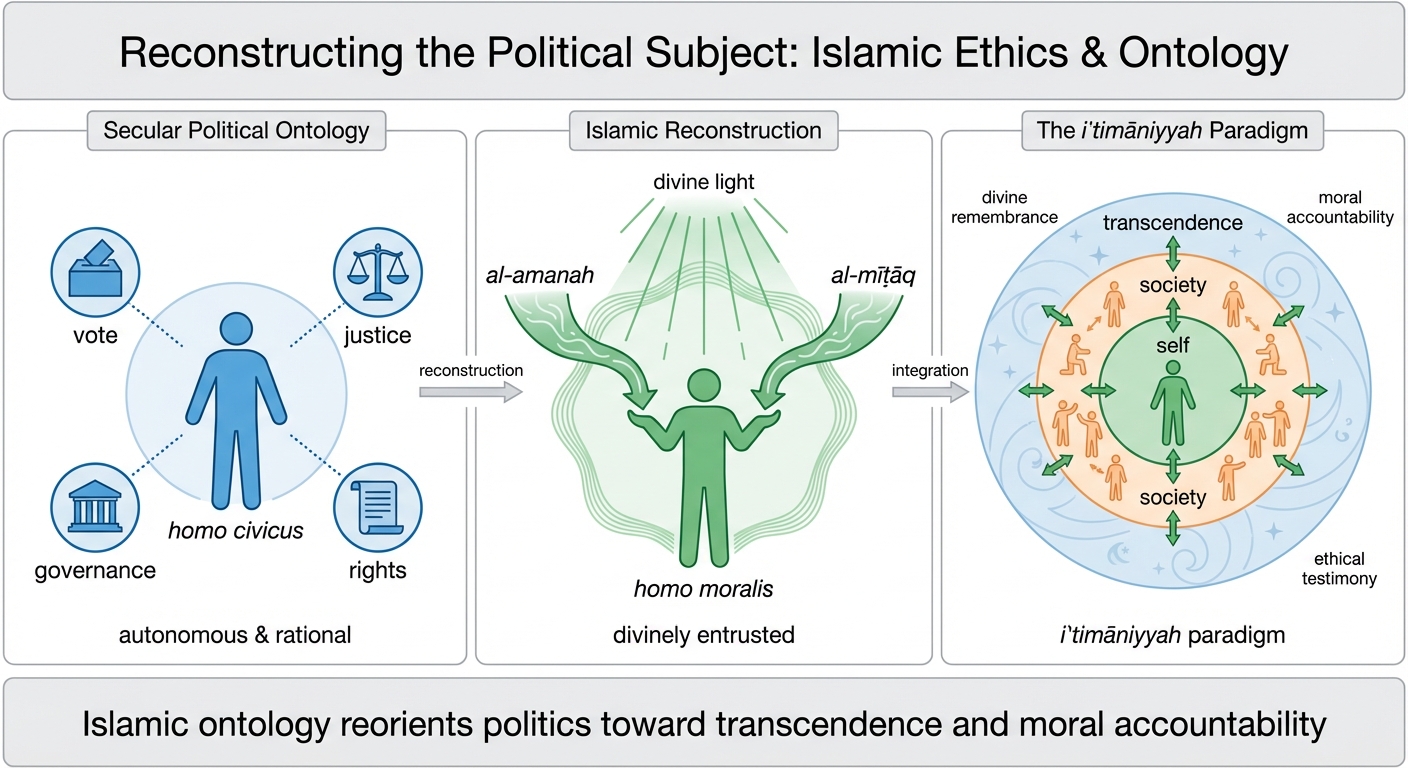
This article explores Taha Abdurrahman's reconstruction of the political subject's ontology as a critical response to the secular foundations of modern political thought. In contemporary discourse, the political human is often conceptualized as a rational and autonomous agent (homo civicus), detached from any transcendent or moral obligation. Taha challenges this model by reintroducing two foundational Islamic concepts: al-amanah (divine trust) and al-mīṯāq (primordial covenant). He redefines the political subject as homo moralis, a moral-spiritual being tasked with ethical responsibility toward God and society. Through his iʾtimāniyyah paradigm, Taha offers a political ontology grounded not in power competition, but in moral accountability, ethical testimony, and self-purification (tazkiyah). This article situates Taha's ideas within broader currents in contemporary Islamic philosophy, comparing them to Seyyed Hossein Nasr's perennialism, Mohammed Arkoun's deconstruction, and Abdolkarim Soroush's epistemic pluralism. It argues that Taha's integration of moral theology, linguistic ethics, and spiritual epistemology presents a robust alternative to secular political rationality. Ultimately, Taha's thought lays the groundwork for a renewed Islamic political ontology where governance and citizenship are oriented toward transcendence, moral excellence, and divine remembrance.
Downloads
References
[1] C. Taylor, A secular age. Harvard University Press, 2007. doi: https://doi.org/10.4159/9780674044289.
[2] D. Martin, J. Casanova, and P. Beyer, “Public Religions in the Modern World,” Br. J. Sociol., vol. 47, no. 1, p. 189, Mar. 1996, doi: https://doi.org/10.2307/591125.
[3] U. Kansong, I. R. Sunarwinadi, and P. Triputra, “Religious Populism in Mainstream Media between Indonesia and India,” J. Messenger, vol. 14, no. 1, pp. 1–16, Dec. 2023, doi: https://doi.org/10.26623/themessenger.v14i1.4193.
[4] M. Rizky HK, “Membaca Pemikiran Taha Abdurrahman Tentang Etika Politik Islam [Reading Taha Abdurrahman’s Thoughts on Islamic Political Ethics],” Politea J. Polit. Islam, vol. 3, no. 2, pp. 273–286, (Indonesia), Aug. 2020, doi: https://doi.org/10.20414/politea.v3i2.2339.
[5] T. Abdurrahman, Rūḥ al-Ḥadāthah : al-Madkhal Ilaa Ta’sisi al-Hadatsah al-Islamiyyah. Beirut: al-Markaz al-ṯaqāfī al-ʿArabī, 2006.
[6] T. Abdurrahman, Rūḥ al-dīn: Min ḍīq al-ʿalmāniyya ilā saʿat al-iʾtimāniyya, 2nd ed. Casablanca: al-Markaz al-Thaqāfī al-ʿArabī, 2012.
[7] T. Abdurrahman, Uṣūl al-dīn al-iʾtimārī,” in Dīn al-ḥayāʾ: Min al-fiqh al-iʾtimārī ilā l-fiqh al-intimāʾī. Beirut: al-Muʾassasa al-ʿArabiyya li-l-Fikr wa-l-Ibdā, 2017.
[8] S. H. Nasr, Knowledge and the Sacred: Revisioning Academic Accountability. Suny Press, 1989. [Online]. Available: https://books.google.co.id/books?hl=en&lr=&id=IChnJl0Mu4sC&oi=fnd&pg=PP9&dq=S.+H.+Nasr,+Knowledge+and+The+Sacred.++New+York:+State+University+of+New+York+Press,+1989.&ots=Bkx-Y7-ICn&sig=c4BKQchKKYCHAvw42IbYx_Fm8vI&redir_esc=y#v=onepage&q=S. H. Nasr%2C Knowledge and The Sacred. New York%3A State University of New York Press%2C 1989.&f=false
[9] M. Arkoun, Islam: to Reform or to Subvert?, vol. 7. Saqi, 2012. [Online]. Available: https://books.google.co.id/books?hl=en&lr=&id=iD4hBQAAQBAJ&oi=fnd&pg=PT4&dq=M.+Arkoun,+Islam:+To+Reform+or+to+Subvert%3F++London:+Saqi+Books,+2012.&ots=CEmH-oLpkC&sig=dzEswAiTZM-ug53LLUzfnq2QtcM&redir_esc=y#v=onepage&q=M. Arkoun%2C Islam%3A To Reform or to Subvert%3F London%3A Saqi Books%2C 2012.&f=false
[10] A. Soroush, Reason, freedom, and democracy in Islam: Essential writings of Abdolkarim Soroush. Oxford University Press, 2000. [Online]. Available: https://books.google.co.id/books?hl=en&lr=&id=kDL5BgAAQBAJ&oi=fnd&pg=PR7&dq=A.+Soroush,+Reason,+Freedom,+and+Democracy+in+Islam.++Oxford:+Oxford+University+Press,+2000.&ots=4qh7-1k4K-&sig=JPJAcaVMz9OAhAAx59_zH6-e_d4&redir_esc=y#v=onepage&q=A. Soroush%2C Reason%2C Freedom%2C and Democracy in Islam. Oxford%3A Oxford University Press%2C 2000.&f=false
[11] F. Ghaffari, K. Faizin, A. Afif, S. S. Karimullah, and M. R. Fathony, “The Relationship Between Religion and Politics of Muhammad Iqbal: A Philosopical and its Relevance,” Suhuf, vol. 37, no. 1, pp. 123–130, May 2025, doi: https://www.doi.org/10.23917/suhuf.v37i1.10286.
[12] C. Reeve, ARISTOTLE : Politics. United States of America: Hackett Publishing Company, Inc., 1998.
[13] A. MacIntyre, “After Virtue: A Study in Moral Theory, Third Edition,” Jul. 19, 2017. doi: https://doi.org/10.7274/24725406.v1.
[14] N. Hashemi, Islam, Secularism, and Liberal Democracy. Oxford University Press, 2009. doi: https://doi.org/10.1093/acprof:oso/9780195321241.001.0001.
[15] S. H. Nasr, The heart of Islam: Enduring values for humanity. Zondervan, 2009. [Online]. Available: https://books.google.co.id/books?hl=en&lr=&id=oAbB52U0icgC&oi=fnd&pg=PR11&dq=S.+H.+Nasr,+The+Heart+of+Islam :+Enduring+Values+for+Humanity.++New+York:+HarperOne,+2004.&ots=VtgWxBca8i&sig=0GMoYLmZ8QpGsFDZn6ycVme-_Rk&redir_esc=y#v=onepage&q&f=false
[16] M. Arkoun, “Rethinking Islam: Common Question, Uncommon Answers Boulder,” 1994, Westview Press.
[17] A. Soroush, Expansion of prophetic experience. Leiden, The Netherlands: Brill, 2009. doi: https://doi.org/10.1163/ej.9789004171053.i-355.
[18] M. Hashas, “The Political Theology of Taha Abderrahmane: Religion, Secularism, and Trusteeship,” in Islamic Political Theology, Lexington Books, 2021, pp. 113–133. [Online]. Available: https://art.torvergata.it/handle/2108/390073
[19] F. Suleiman, “The Philosophy of Taha Abderrahman: A Critical Study,” Die Welt des Islam., vol. 61, no. 1, pp. 39–71, Mar. 2020, doi: https://doi.org/10.1163/15700607-00600A10.
[20] T. Abdurrahman, Suʾāl al-ʿamal: Baḥth ʿan uṣūl al-ʿamaliyya fī l-fikr wa-l-ʿilm. Beirut: al-Markaz al-Thaqāfī al-ʿArabī, 2012.
[21] T. Abdurrahman, al-Ḥaqq al-ʿarabī fī l-ikhtilāf al-falsafī. Casablanca: al-Markaz al-Thaqāfī al-ʿArabī, 2014.
[22] W. Hallaq, Reforming modernity: ethics and the new human in the philosophy of Abdurrahman Taha. Columbia University Press, 2019. doi: https://doi.org/10.7312/hall19388-004.
[23] T. Abdurrahman, Sual al-Akhlakك Musahamah fi al-Naqd al-Akhlaqi lil-Hadathah al-Gharbiyyah. Casablanca: al-Markaz al-Thaqāfī al-ʿArabī, 2000.
[24] Ṭāha ʿAbdurraḥmān, Buʾs al-Dahrāniyyah: Al-Naqd al-Iʿtimānī li Faṣl al-Akhlāq ʿan al-Dīn. Casablanca: al-Shabaka al-ʿArabiyya li-l-Abḥāth wa-l-Nashr, 2014.
[25] M. Hashas and M. Al-Khatib, Islamic Ethics and the Trusteeship Paradigm: Taha Abderrahmane’s Philosophy in Comparative Perspectives. BRILL, 2021. doi: https://doi.org/10.1163/9789004438354.
[26] T. Abdurrahman, Dīn al-ḥayāʾ: Min al-fiqh al-iʾtimārī ilā l-fiqh al-intimāʾī. Beirut: al-Muʾassasa al-ʿArabiyya li-l-Fikr wa-l-Ibdā, 2017.
Downloads
Submitted
Accepted
Published
How to Cite
Issue
Section
License
Copyright (c) 2025 Muhammad Rizky HK

This work is licensed under a Creative Commons Attribution 4.0 International License.