Dynamics of Islamic Legal Thought: Comparison of the Concept of Maqashid Al-sharī’ah in Madhhab Zaidiyah and Ja'fariyah
DOI:
https://doi.org/10.23917/suhuf.v37i2.11814Keywords:
Maqāṣid al-syarī'ah, Zaidiyah madhhab, Ja'fariyah madhhab, comparative Islamic law, contemporary fiqhAbstract
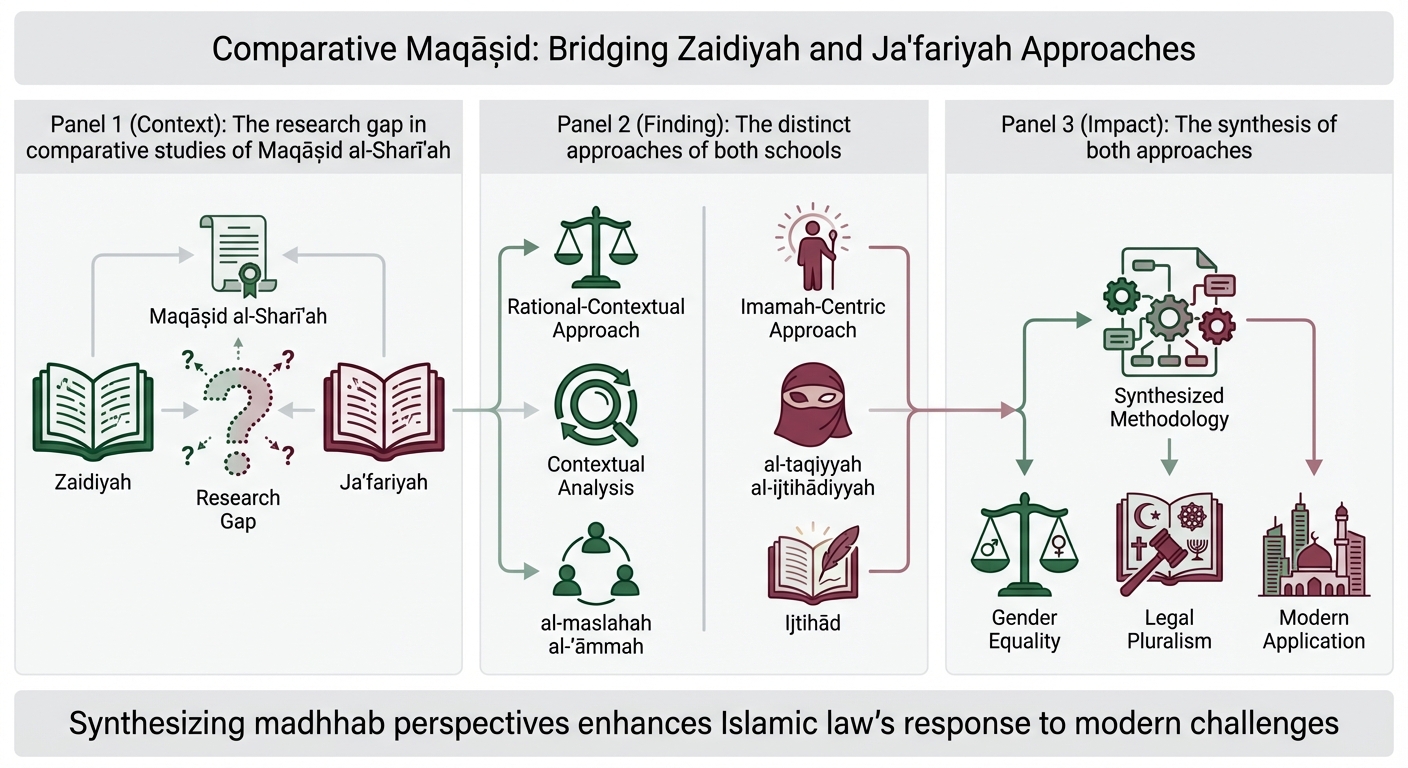
The research paper analyzed the concept of Maqāṣid al-Sharī’ah in Zaidiyah and Ja’fariyah madhhabs comparison, examining its relevance in both fractured times and the modern world. The background for this research was the lack of a systematic study on the comparative epistemological and methodological characteristics of the two madhhabs of thought, which made it more than attractive to develop law-responsive approaches for 21st-century tendencies in Islamic law. The paper's objectives were to identify commonalities and differences between Zaidiyah and Ja'fariyah perspectives on Maqāṣid and to test how these differences contribute to the solution of contemporary issues, including sex- and law-gender equality, and law pluralism. The research employed a comparative qualitative design overall, with a textual-contextual analysis approach, conducting deep and critical analysis of classical material, as well as a thematic one, to track patterns of Maqāṣid interpretation. The results include the fact that Zaidiyah adopted a systemic rational-contextual approach to Maqāṣid based on al-maslahah al-‘āmmah and Ja'fariyah – an imamah-centric approach via al-taqiyyah al-ijtihādiyyah. The study also concludes that the synthesis of these approaches is effective in providing a methodology for Islamic law.
Downloads
References
[1] M. S. Moktar, W. M. Y. Wan Chik, A. W. Md. Ali, M. H. Ghani, and N. F. Zulkafli, “The Maqasid Syariah in State Jurisprudence,” Int. J. Acad. Res. Bus. Soc. Sci., vol. 14, no. 12, Dec. 2024, doi: https://doi.org/10.6007/IJARBSS/v14-i12/24303.
[2] A. Binti Ramli, “Al-‘Alāqah baina Ushūl al-Fiqh wa Maqāshidi al-Sharīah wa al-Da’wah ilā Ta’sīsi ‘Ilmi al-Maqāshid,” Mazahib, vol. 15, no. 2, pp. 273–285, Jan. 2017, doi: https://doi.org/10.21093/mj.v15i2.634.
[3] S. Sumarta, B. Burhanudin, and T. Budiyanto, “Maqasid Al-Syariah Mendorong Keadilan Dan Keseimbangan Dalam Hukum Islam [Maqasid Al-Syariah Promotes Justice and Balance in Islamic Law],” Khulasah Islam. Stud. J., vol. 6, no. 1, pp. 16–31, (Indonesia), Jun. 2024, doi: https://doi.org/10.55656/kisj.v6i1.120.
[4] A. H. B. Yusuf, “A Study of Conceptual Foundations of Maqāsid al-Sharī’ah (objectives of Islamic Law) as expounded by classical Muslim Jurists,” Islam. Q., vol. 64, no. 4, pp. 527–546, 2020, [Online]. Available: https://www.scopus.com/inward/record.uri?eid=2-s2.0-85126957293&partnerID=40&md5=48934ed61f651e2044e338ca594269de
[5] F. A. Zulfa, M. Achmad, D. Soylu, and Fadhil, “Mapping Contemporary Islamic Legal Thought In Indonesia: A Dialog Between Fiqh And The Culture Of The Archipelago,” al-Mawarid J. Syariah dan Huk., vol. 7, no. 1, pp. 177–202, Mar. 2025, doi: https://doi.org/10.20885/mawarid.vol7.iss1.art10.
[6] A. P. Omolu, “Syi’ah Zaidiyah: Konsep Imamah Dan Ajaran-Ajaran Lainnya [Shi’ah Zaidiyah: The Concept of Imamah and Other Teachings],” Hunafa J. Stud. Islam., vol. 9, no. 2, pp. 207–218, (Indonesia), 2012, doi: https://doi.org/ 10.24239/JSI.V9I2.52.
[7] Nāṣir ibn ʿAbd Allāh al-Qaffāri, Uṣūl Madh-hab al-Shīʿah al-Imāmiyyah al-Ithnā ʿAshariyyah (A Comprehensive Study of the Shīʿah creed). MAHAJJAH. [Online]. Available: https://ebnhussein.com/wp-content/uploads/2020/12/usul-madhab-alshia-by-al-qaffari.pdf
[8] A. F. March, “Islamic Legal Theory, Secularism and Religious Pluralism: Is Modern Religious Freedom Sufficient for the Shari’a ‘Purpose [Maqsid]’ of ‘Preserving Religion [Hifz Al-Din]?,’” SSRN Electron. J., 2009, doi: https://doi.org/10.2139/ssrn.1452895.
[9] Dasmadi, S. Hadi, Y. Junchu, N. Wahyuningtyas, and R. S. Wedadjati, “Maqasid al-Shariah and Organizational Performance:A Systematic Literature Review Dasmadia,” Glob. Rev. Islam. Econ. Bus., vol. 12, no. 2, pp. 106–119, 2024, doi: https://doi.org/10.14421/grieb.2024.122-03.
[10] Y. Helmy, “From Islamic Modernism to Theorizing Authoritarianism: Bin Bayyah and the Politicization of the Maqāṣid Discourse,” Am. J. Islam Soc., vol. 38, no. 3–4, pp. 36–70, 2021, doi: https://doi.org/10.35632/ajis.v38i3-4.2934.
[11] J. Auda, Maqasid al-Shariah as philosophy of Islamic law: a systems approach. London: International Institute of Islamic Thought (IIIT), 2008. [Online]. Available: https://iiit.org/wp-content/uploads/Maqasid-Al-Shariah-as-a-Philosophy-of-Islamic-Law-Combined.pdf
[12] R. Gleave, Scripturalist Islam: The History and Doctrines of the Akhbari Shi’i School (Islamic Philosophy, Theology, and Science), vol. 72. Brill, 2007. [Online]. Available: https://books.google.co.id/books/about/Scripturalist_Islam.html?id=Fl8nsyyNV_0C&redir_esc=y
[13] M. H. Kamali, M. Eriouiche, and M. Mohadi, “In Focus Maqāsid Al-Sharīʿah And Ijtihād As Instruments Of Civilisational Renewal,” J. Contemp. Maqasid Stud., vol. 3, no. 1, pp. 145–174, Jan. 2024, doi: https://doi.org/10.52100/jcms.v3i1.134.
[14] H. Modarressi, Tradition and survival: a bibliographical survey of early Shi’ite literature. Oxford: Oneworld, 2003. [Online]. Available: https://cir.nii.ac.jp/crid/1970867909886056221
[15] A. Duderija and H. Rane, Islam and Muslims in the West. Springer, 2019. [Online]. Available: https://link.springer.com/book/10.1007/978-3-319-92510-3
[16] B. Haykel, Revival and Reform in Islam: the legacy of Muhammad al-Shawkani. Cambridge University Press, 2003. [Online]. Available: https://books.google.com/books?hl=en&lr=&id=RfYKUkNbf2EC&oi=fnd&pg=PP10&dq=B.+Haykel,+Revival+and+Reform+in+Islam:+The+Legacy+of+Muhammad+Al-Shawkani.+Cambridge+University+Press,+2003.+Accessed:+Jul.+10,+2025.+%5BOnline%5D.+Available:+http://books.google.it/books%3Fid%3DRfYKUkNbf2EC&ots=Lt0p1GBDZ-&sig=3UMUd9ad7izNHXsRwsxPs8BGepo
[17] A. W. Murti, P. Purwanto, A. K. Diharto, D. Ramdhani, and M. B. Alauddin, “What Matters More: Religious Values or Academic Excellence?A Conjoint Analysis of Parental Priorities in Islamic Education,” Suhuf, vol. 37, no. 1, pp. 188–199, May 2025, doi: https://www.doi.org/10.23917/suhuf.v37i1.10576.
[18] M. W. Shohib, M. Z. Azani, N. L. Inayati, D. Dartim, and A. Nubail, “Islamic Perspective on Organizational Citizenship Behavior Among Academic Staff in Indonesian State Islamic Higher Education: Is It Effective?,” Suhuf, vol. 36, no. 2, Nov. 2024, doi: https://www.doi.org/10.23917/suhuf.v36i2.4702.
[19] A. Quraishi, “Principles of Islamic Jurisprudence By Mohammad Hashim Kamali,” J. Law Relig., vol. 15, pp. 385–387, 2001, [Online]. Available: https://www.cambridge.org/core/journals/journal-of-law-and-religion/article/abs/principles-of-islamic-jurisprudence-by-mohammad-hashim-kamali-cambridge-cambridge-islamic-texts-society1991-pp-xxi-417-price-not-available-isbn-0946621233-paper-isbn-0946621241/D3C97692977C5D9D0BA5BA649DA9EDD2
[20] A. A. Sachedina, The just ruler in Shi’ite Islam: the comprehensive authority of the jurist in Imamite jurisprudence. Oxford University Press, 1998. [Online]. Available: https://books.google.co.id/books?hl=en&lr=&id=AH9k4VIznQwC&oi=fnd&pg=PR11&dq=A.+.+Sachedina,+The+Just+Ruler+in+Shi’ite+Islam :+The+Comprehensive+Authority+of+the+Jurist+in+Imamite+Jurisprudence.+Oxford+University+Press,+1998.&ots=RhzWwBIMye&sig=_BJMQn9VIc4QUxS4Cz9WevhMS0Y&redir_esc=y#v=onepage&q=A. . Sachedina%2C The Just Ruler in Shi’ite Islam %3A The Comprehensive Authority of the Jurist in Imamite Jurisprudence. Oxford University Press%2C 1998.&f=false
[21] S. M. Tabataba’i, Shi’ite Islam. New York: State University of New York Press, 1975. [Online]. Available: https://ia904604.us.archive.org/27/items/shiite-islam/Shiite-Islam.pdf
[22] N. Haider, Shi’i Islam: an introduction. Cambridge University Press, 2014. [Online]. Available: https://books.google.co.id/books?hl=en&lr=&id=1ywDBAAAQBAJ&oi=fnd&pg=PR9&dq=N.+Haider,+Shi’i+Islam:+An+Introduction.+Cambridge+University+Press,+2014.+doi:+10.1017/CBO9781139381710.&ots=OzYT-HSbsY&sig=Dm6hYjlkokeLbwElGdZlP-vbkdI&redir_esc=y#v=onepage&q&f=false
[23] N. Calder and J. Mojaddedi, Interpretation and jurisprudence in medieval Islam. Routledge, 2022. [Online]. Available: https://books.google.co.id/books?hl=en&lr=&id=zCxcEAAAQBAJ&oi=fnd&pg=PA1968&dq=Norman.+Calder,+J.+A.+.+Mojaddedi,+and+Andrew.+Rippin,+Interpretation+and+Jurisprudence+in+Medieval+Islam,+1st+ed.+Routledge,+2019.&ots=HzRizIFd3e&sig=7OgFpa_W37fyTQ_hHMoVmY3N_bE&redir_esc=y#v=onepage&q&f=false
[24] M. Sālim Al-Khiḍr, Contradiction Between The Shīʿī Jaʿfarī School And Historical Fact (Jadal al-Madhhab wa al-Tārīkh). Maḥajjah Research Institute, 2023. [Online]. Available: https://mahajjah.com/wp-content/uploads/2023/09/Jadal-al-Madhhab-14-12-2023.pdf
[25] Z. Mubarrak, I. A. Bakar, and M. Hamdani, “The Urgency of the Islamic Law and Contemporary Societal Challenges: The Flexibility of al-Maslahah in Determining the Hierarchy of Maqāṣid al-Sharīʿah,” El-Usrah, vol. 8, no. 1, pp. 344–365, 2025, doi: https://doi.org/10.22373/pxydd884.
[26] A. Saeed, Interpreting the Qur’an: towards a contemporary approach. Taylor & Francis, 2005. [Online]. Available: https://library.oapen.org/handle/20.500.12657/102482
[27] A. Duderija, “Islamic law reform and maqīṣid al-sharī‘a in the thought of Mohammad Hashim Kamali,” in Maqasid Al-Shari’a and Contemporary Reformist Muslim Thought: An Examination, 2014, pp. 13–37. doi: https://doi.org/10.1057/9781137319418_2.
Downloads
Submitted
Accepted
Published
How to Cite
Issue
Section
License
Copyright (c) 2025 Ahmad Khori

This work is licensed under a Creative Commons Attribution 4.0 International License.