Synergy of the Ministry of Religious Affairs, Nahdlatul Ulama, and Muhammadiyah in Driving Religious Moderation to Achieve Indonesia's SDGs Targets
DOI:
https://doi.org/10.23917/profetika.v25i02.8536Keywords:
religious moderation, sdgs, nahdlatul ulama, muhammadiyah, cross-sectoral collaborationAbstract
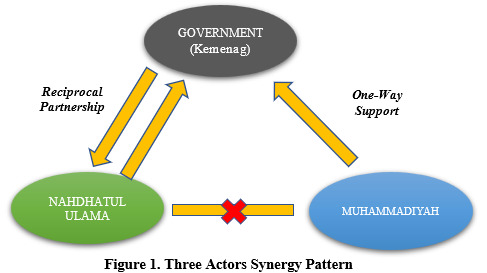
Objective: This study examines the synergy between the Ministry of Religious Affairs, Nahdlatul Ulama (NU), and Muhammadiyah in promoting religious moderation to contribute to Indonesia’s achievement of the Sustainable Development Goals (SDGs). The primary objective is to explore how these three key actors collaborate in fostering moderation and how their efforts align with SDG targets, particularly those focused on peace, justice, and strong institutions (Goal 16). Theoretical Framework: Theoretical frameworks of religious moderation and functionalism guide the study, emphasizing the importance of balanced religious practices in a pluralistic society. Literature Review: The literature review highlights the roles of NU and Muhammadiyah in religious moderation, noting their unique contributions: NU’s inclusive Islam Nusantara approach and Muhammadiyah’s emphasis on Wasathiyah Islam. These frameworks underscore the importance of tolerance, justice, and harmony in national life, aligning with Indonesia’s commitment to promoting peace and reducing social fragmentation. However, studies also point to challenges, such as ideological differences between the two organizations and their relationship with the government, which complicate cross-sector collaboration. Methods: A qualitative research methodology was employed, utilizing interviews, observations, and document studies to gather data from key informants within the Ministry of Religious Affairs, NU, and Muhammadiyah. Thematic and constant comparative analysis were applied to identify key patterns and themes, including the interplay between religious moderation, government policy, and SDG implementation. Results: The research findings reveal that while progress has been made in promoting religious moderation, the lack of effective collaboration between the government and religious organizations remains a significant barrier. NU’s close ideological ties with the government contrast with Muhammadiyah’s critical yet supportive stance, leading to fragmented efforts. This fragmentation hampers the full realization of shared goals, including the achievement of SDGs in Indonesia. Implications: The study’s implications suggest that strengthening cross-sectoral collaboration and aligning organizational efforts are essential for achieving religious harmony and advancing SDG targets. Novelty: The novelty of this research lies in its focus on the intersection of religious moderation and SDGs, offering insights into how religious actors can contribute to sustainable development.
References
S. Institute, ‘Setara Institute Catat 329 Pelanggaran Kbb Sepanjang 2023’, Setara Institute. Accessed: Jan. 18, 2025. [Online]. Available: https://setara-institute.org/setara-institute-catat-329-pelanggaran-kbb-sepanjang-2023/
A. Lidwina, ‘Intoleransi, Pelanggaran Kebebasan Beragama Terbanyak Dilakukan Aktor Non-Negara | Databoks’. Accessed: Nov. 02, 2023. [Online]. Available: https://databoks.katadata.co.id/datapublish/2021/04/09/intoleransi-pelanggaran-kebebasan-beragama-terbanyak-dilakukan-aktor-non-negara
Majid, ‘BNPT: 33 Juta Penduduk Indonesia Terpapar Radikalisme, Butuh Undang-Undang Pencegahan’, KOMPAS.tv. Accessed: Nov. 02, 2023. [Online]. Available: https://www.kompas.tv/nasional/311315/bnpt-33-juta-penduduk-indonesia-terpapar-radikalisme-butuh-undang-undang-pencegahan
A. Arifinsyah, S. Andy, and A. Damanik, ‘The Urgency of Religious Moderation in Preventing Radicalism in Indonesia’, ESENSIA J. Ilmu-Ilmu Ushuluddin, vol. 21, no. 1, Art. no. 1, Apr. 2020, https://doi.org/10.14421/esensia.v21i1.2199.
M. Castells, ‘An introduction to the information age’, City, vol. 2, no. 7, pp. 6–16, 1997, https://doi.org/10.1080/13604819708900050.
M. Castells, The power of identity. John Wiley & Sons, 2011.
U. Husna and M. Thohir, ‘Religious moderation as a new approach to learning Islamic religious education in schools’, J. Pendidik. Islam, vol. 14, no. 1, Art. no. 1, 2020, https://doi.org/10.21580/nw.2020.14.1.5766.
F. F. Nisak, H. Munawaroh, and S. Abbas, ‘The Effect of “Kids Moderations” Interactive Multimedia on Religious Moderation Attitudes in Early Childhood’, Indonesia. J. Early Child. Educ. Res., vol. 1, no. 1, Art. no. 1, Jun. 2022, https://doi.org/10.31958/ijecer.v1i1.5811.
F. M. Manshur and H. Husni, ‘Promoting religious moderation through literary-based learning: a quasi-experimental study’, Int. J. Adv. Sci. Technol., vol. 29, no. 6, pp. 5849–55, 2020.
A. A. Ardiansyah and M. Erihadiana, ‘Strengthening Religious Moderation as A Hidden Curriculum in Islamic Religious Universities in Indonesia’, Nazhruna J. Pendidik. Islam, vol. 5, no. 1, Art. no. 1, Feb. 2022, https://doi.org/10.31538/nzh.v5i1.1965.
Z. Zakariyah, U. Fauziyah, and M. M. N. Kholis, ‘Strengthening the Value of Religious Moderation in Islamic Boarding Schools’, Tafkir Interdiscip. J. Islam. Educ., vol. 3, no. 1, Art. no. 1, Jan. 2022, https://doi.org/10.31538/tijie.v3i1.104.
B. Afwadzi and M. Miski, ‘Religious moderation in Indonesian higher educations: literature review’, Ulul Albab J. Studi Islam, vol. 22, no. 2, Art. no. 2, Dec. 2021, https://doi.org/10.18860/ua.v22i2.13446.
Y. Kawangung, ‘Religious moderation discourse in plurality of social harmony in Indonesia’, Int. J. Soc. Sci. Humanit., vol. 3, no. 1, pp. 160–170, 2019, https://doi.org/10.29332/ijssh.v3n1.277.
I. Subchi, Z. Zulkifli, R. Latifa, and S. Sa’diyah, ‘Religious Moderation in Indonesian Muslims’, Religions, vol. 13, no. 5, Art. no. 5, May 2022, https://doi.org/10.3390/rel13050451.
H. Pajarianto, I. Pribad, and P. Sari, ‘Tolerance between religions through the role of local wisdom and religious moderation’, HTS Teol. Stud. Theol. Stud., vol. 78, no. 4, Art. no. 4, 2022, Accessed: Oct. 31, 2023. https://doi.org/10.4102/hts.v78i4.7043
A. Kasdi, U. Farida, and C. Mahfud, ‘Islamic Studies and Local Wisdom at PTKIN in Central Java: Opportunities, Challenges, and Prospects of Pioneering Religious Moderation in Indonesia’, Hikmatuna, vol. 6, no. 1, pp. 51–62, 2020, https://doi.org/10.28918/hikmatuna.v6i1.2618.
E. Mahrus, Z. H. Prasojo, and B. Busro, ‘Messages of Religious Moderation Education in Sambas Islamic Manuscripts’, Madania J. Kaji. Keislam., vol. 24, no. 1, Art. no. 1, Jun. 2020, https://doi.org/10.29300/madania.v24i1.3283.
M. Daheri, ‘Religious Moderation, Inclusive, and Global Citizenship as New Directions for Islamic Religious Education in Madrasah’, Nazhruna J. Pendidik. Islam, vol. 5, no. 1, Art. no. 1, Feb. 2022, https://doi.org/10.31538/nzh.v5i1.1853.
‘Tradisi Pemikiran Moderasi Beragama Nahdlatul Ulama | Fuadi | Al-Fikra : Jurnal Ilmiah Keislaman’. Accessed: Jan. 16, 2025. [Online]. Available: https://ejournal.uin-suska.ac.id/index.php/al-fikra/article/view/16692
K. Anwar, ‘Ahl as Sunnah waal Jama’ah in Indonesia: A Study on Al-Banjari’s and Islam Nusantara Sunnism’, NALAR J. Perad. Dan Pemikir. Islam, vol. 6, no. 1, pp. 28–37, 2022, https://doi.org/10.23971/njppi.v6i1.4364.
P. Ariadi, ‘Tasawuf Melayu Nusantara: Perspektif Muhammadiyah Dan Nahdlatul Ulama’, -Tabligh, vol. 1, no. 1, Art. no. 1, Jun. 2016.
K. H. M. F. S. Makmun, 2024.
N. K. Ridwan and A. Rozaki, ‘Gerakan Kultural Islam Nusantara’, 2015.
A. Baso, ‘Islam Nusantara: ijtihad jenius & ijma’ulama Indonesia’, No Title, 2015.
Kyai Sa’dullah, 2024.
A. Suaidi, ‘Ancaman Nyata dari Dalam: Metamorfosis Identitas Muhammadiyah dan Dilema Demokrasi’, J. Islam Indones., vol. 1, no. 1, pp. 18–41, 2007.
A. Azra, Indonesia, Islam, and democracy: Dynamics in a global context. Equinox Publishing, 2006.
A. Syahid, Islam nusantara: Relasi agama-budaya dan tendensi kuasa ulama. Rajawali Pers, 2019.
M. I. Rahmat, Islam pribumi: mendialogkan agama, membaca realitas. Erlangga, 2003.
N. Nasikhin, R. Raaharjo, and N. Nasikhin, ‘Moderasi Beragama Nahdlatul Ulama dan Muhammadiyah dalam Konsep Islam Nusantara dan Islam Berkemajuan’, Islam. Rev. J. Ris. Dan Kaji. Keislam., vol. 11, no. 1, Art. no. 1, Apr. 2022, https://doi.org/10.35878/islamicreview.v11i1.371.
A. Wahid, Islamku, Islam Anda, Islam Kita: Agama Masyarakat Negara Demokrasi. Jakarta, 2006.
N. S. Mujahid, ‘Prinsip-Prinsip Nahdlatul Ulama dan Urgensinya dalam Tantangan Internasional’, Al-Fiqh, vol. 1, no. 1, Art. no. 1, Mar. 2023, https://doi.org/10.59996/al-fiqh.v1i1.92.
M. Bahruddin, ‘Peran Ulama Nahdlatul Ulama Dalam Menyiarkan Paham Keagamaan Moderat Di Provinsi Lampung’, Anal. J. Studi Keislam., vol. 17, no. 1, pp. 43–64, Jul. 2017, https://doi.org/10.24042/ajsk.v17i1.1770.
I. Kharismatunisa’ and M. Darwis, ‘Nahdlatul Ulama dan Perannya dalam Menyebarkan Nilai-Nilai Pendidikan Aswaja An-Nahdliyah pada Masyarakat Plural’, Tarbiyatuna J. Pendidik. Islam, vol. 14, no. 2, Art. no. 2, Aug. 2021, https://doi.org/10.36835/tarbiyatuna.v14i2.1094.
K. M. Hamzah, Pengantar studi aswaja an-nahdliyah. LKIS Pelangi Aksara, 2017.
A. S. Maarif, Islam dalam bingkai keindonesiaan dan kemanusiaan: sebuah refleksi sejarah. PT Mizan Publika, 2009.
H. Andy, 2024.
G. El-Guyanie, Resolusi jihad paling syar’i: biarkan kebenaran yang hampir setengah abad dikaburkan catatan sejarah itu terbongkar! Yogyakarta: LKiS, 2010.
C. Anam, ‘Pertumbuhan dan perkembangan NU’, Surabaya Duta Aksara Mulia, 2010.
I. Ibrahim, ‘Islam Wasathiyah, Begini Pengertian dan Penjelasannya!’, Muhammadiyah. Accessed: Nov. 05, 2023. [Online]. Available: https://muhammadiyah.or.id/islam-wasathiyah-begini-pengertian-dan-penjelasannya/
F. A. Sandiah, ‘Darul Ahdi wa al-Syahadah, Negara Pancasila Perspektif Islam Berkemajuan’, Muhammadiyah. Accessed: Jan. 16, 2025. [Online]. Available: https://muhammadiyah.or.id/2023/08/darul-ahdi-wa-al-syahadah-negara-pancasila-perspektif-islam-berkemajuan/
A. Mu’ti, ‘Sekretaris Umum PP Muhammadiyah’, Sep. 2024.
Dede, ‘Trainer TOT Moderasi Beragama’, 2024.
Z. A. Bagir and J. Sormin, Politik Moderasi dan Kebebasan Beragama-Suatu Tinjauan Kritis. Elex Media Komputindo, 2022.
Submitted
Accepted
Published
Issue
Section
License
Copyright (c) 2024 Sekar Ayu Aryani, Erham Budi Wiranto, Ahmad Asroni, Waston, Siti Fauziyah, Muhamad Yusup

This work is licensed under a Creative Commons Attribution 4.0 International License.