Islam and Tolerance Education for the Sustainable Development Goals (SDGs)
DOI:
https://doi.org/10.23917/profetika.v25i02.8510Keywords:
islamic education, tolerance, multiculturalism, sustainable development goals (sdgs), inclusivityAbstract
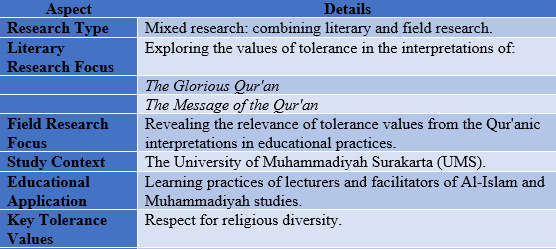
Objective: This study aims to explore the integration of Islamic teachings on tolerance and multicultural education within the framework of the Sustainable Development Goals (SDGs). The focus is on analyzing the values of democracy, tolerance, and multiculturalism derived from the Qur'an and Islamic education, emphasizing their relevance in promoting global peace and inclusivity. The study is motivated by fundamental Islamic principles, including prohibitions against denouncing other religions, respect for human dignity regardless of belief, interfaith communication, freedom of religion, the prohibition of forced adherence to any religion, maintaining positive assumptions (husnudzan) about others, and acknowledgment of diverse religious practices. Theoretical framework: The theoretical framework is grounded in the intersection of Islamic ethics and the SDGs, particularly Goal 4 (Quality Education), Goal 16 (Peace, Justice, and Strong Institutions), and Goal 17 (Partnerships for the Goals). Literature Review: The literature review highlights previous studies on tolerance in Islamic teachings and their implementation in educational settings, showcasing how Islamic education aligns with global goals. Methods: This research adopts a qualitative field study approach, collecting data through in-depth observations and interviews with educators and students at the University of Muhammadiyah Surakarta. Results: The findings reveal that democratic and tolerant multicultural values in Islamic education are implemented through three learning models: (1) Baitul Arqam for Muslim students during semesters 1-2, (2) Classical Learning for non-Muslim students in semesters 1-2, and (3) Integrated Classical Learning for both Muslim and non-Muslim students in semesters 3-4. The study demonstrates that these models effectively foster a culture of inclusivity and tolerance among students from diverse backgrounds. Implications: The findings have significant implications for developing educational frameworks that contribute to SDG targets by promoting peaceful coexistence and mutual respect. Novelty: The novelty of this research lies in linking Islamic educational practices with the SDGs, offering a unique perspective on the role of religious education in achieving global sustainability.
References
K. N. Kurniawan, “Tolerance education in the hidden curriculum: A case study on Indonesian public school,” Masy. J. Sosiol., vol. 23, no. 1, pp. 1–30, 2018. https://doi.org/10.7454/mjs.v23i1.7841.
L. Muhtifah, Z. Hudi Prasojo, S. Sappe, and E. Elmansyah, “The theology of Islamic moderation education in Singkawang, Indonesia: The city of tolerance,” HTS Teol. Stud. / Theol. Stud., vol. 77, no. 4, pp. 1–10, Oct. 2021. https://doi.org/10.4102/hts.v77i4.6552.
S. A. Sahfutra, “Gagasan Pluralisme Agama Gus Dur Untuk Kesetaraan Dan Kerukunan,” Reli. J. Stud. Agama-Agama, vol. 10, no. 1, p. 89, 2014. https://doi.org/10.14421/rejusta.2014.1001-06.
R. Ardi, D. H. Tobing, G. N. Agustina, A. F. Iswahyudi, and D. Budiarti, “Religious schema and tolerance towards alienated groups in Indonesia,” Heliyon, vol. 7, no. 7, p. e07603, 2021. https://doi.org/10.1016/j.heliyon.2021.e07603.
I. Sukardi, “Character Education Based on Religious Values: an Islamic Perspective,” Ta’dib, vol. 21, no. 1, p. 41, 2016. https://doi.org/10.19109/td.v21i1.744.
B. Anderson, “Mythology and the Tolerance of the Javanese,” Newyork: Cornell, 1996. [Online]. Available: https://ehrafworldcultures.yale.edu/cultures/oe05/documents/030.
D. M. C. Beck and I. Irawan, “Islam, Pancasila and Value Systems of Indonesian National Education,” J. Pendidik. Islam, vol. 1, no. 1, p. 1, 2016. https://doi.org/10.15575/jpi.v1i1.610.
D. A. Rizal and A. Kharis, “Kerukunan Dan Toleransi Antar Umat Beragama Dalam Mewujudkankesejahteraan Sosial,” Komunitas J. Pengemb. Easy. Islam, vol. 13, no. 1, pp. 34–52, 2022. [Online]. Available: https://journal.uinmataram.ac.id/index.php/komunitas/article/view/4701.
M. M. F. Akbar, “Religious Tolerance: Does Indonesian Law Guarantee It?” Indones. J. Int. Clin. Leg. Educ., vol. 7, no. 2, pp. 1–18, 2021. https://doi.org/10.15294/ijicle.v3i1.43170.
B. Stiftung, “A Modern Concept of Tolerance Basis for democratic interaction in Pluralistic Societies Discussion Paper,” pp. 1–13, 2004, [Online]. Available: https://www.bertelsmann-stiftung.de/fileadmin/files/Projekte/84_Salzburger_Trilog/Salzburger_Trilog_2004-Discussion_Paper.pdf
A. Safithri, Kawakib, and H. A. Shiddiqi, “Implementasi Nilai-Nilai Moderasi dan Toleransi Antar Umat Beragama dalam Menciptakan Kerukunan Masyarakat di Kota Pontianak Kalimantan Barat,” Al Fuadiy, vol. 4, no. 1, pp. 13–26, 2022. https://doi.org/10.55606/af.v4i1.7.
R. Hermawati, C. Paskarina, and N. Runiawati, “Toleransi Antar Umat Beragama di Kota Bandung,” Umbara, vol. 1, no. 2, 2017. https://doi.org/10.24198/umbara.v1i2.10341.
H. Daulay, “Kebijakan Kerukunan Multikultur dalam Merajut Toleransi Umat Beragama (Studi Atas Pemolisian Kasus Azan Di Tanjung Balai Sumatera Utara),” J. Manaj. Dakwah, vol. 1, no. 2, p. 19, 2019. [Online]. Available: https://garuda.kemdikbud.go.id/documents/detail/1983993.
E. Kristi, “Nilai Toleransi dalam Al-Qur’an dan Relevansinya dengan Pendidikan Indonesia,” pp. 1–80, 2023, [Online]. Available: https://repository.uin-suska.ac.id/72406/2/TESIS ELIZABETH KRISTI.pdf.
A. M. Ghazali, “Toleransi Beragama Dan Kerukunan Dalam Perspektif Islam,” Relig. J. Agama dan Lintas Budaya, vol. 1, no. 1, pp. 25–40, 2016, [Online]. Available: https://journal.uinsgd.ac.id/index.php/Religious/article/download/1360/pdf_3.
Y. Hakim, “Pendidikan Toleransi Beragama Dalam Al-Qur’an,” 2019, [Online]. Available: https://repository.uinjkt.ac.id/dspace/handle/123456789/46546.
M. T. Huda, E. R. Amelia, and H. Utami, “Ayat-Ayat Toleransi Dalam Al-Quran Perspektif Tafsir Al-Misbah Dan Tafsir Al-Azhar,” Tribakti J. Pemikir. Keislam., vol. 30, no. 2, pp. 260–281, 2019. https://doi.org/10.33367/tribakti.v30i2.657.
Rabiatul Adawiyah Binti rahman, “Toleransi Antar Umat Beragama Menurut Al-Quran,” pp. 1–12, 2019, [Online]. Available: https://repository.ar-raniry.ac.id/id/eprint/6958/.
C. Surahman, B. Sunarya, and T. Yuniartin, “Konsep toleransi dalam Alquran (Studi atas ¬Q.S. Al-Kāfirūn dan implikasinya terhadap pembelajaran PAI di sekolah),” Humanika, vol. 22, no. 2, pp. 147–162, 2022. https://doi.org/10.21831/hum.v22i2.53517.
M. Anam, M. R. Fanani, and Afrizal El Adzim Syahputra, “Prinsip Toleransi Beragama Perspektif QS. Al-An’ām [6]:108 dan Relevansinya dalam Konteks Keindonesiaan,” Qof, vol. 7, no. 1, pp. 67–80, 2023. https://doi.org/10.30762/qof.v7i1.794.
I. Nursidik and E. Komarudin, “Methodology of the Book of the Holy Qur’an and The Massage of Qur’an: A Comparative Study of the Book of Tafsir by A. Yusuf Ali and Muhammad Asad,” Mashadiruna J. Ilmu Al-Qur’an dan Tfasir, vol. 2, no. 1, pp. 11–18, 2023. [Online]. Available: https://journal.uinsgd.ac.id/index.php/mashadiruna/article/view/20129.
A. Y. Ali, “The Meaning of The Noble Qur’an” Commentary, p. 467, 2006, [Online]. Available: https://www.holybooks.com/wp-content/uploads/2010/05/english-quran-with-commentariesyusuf-ali.pdf
H. Haerul, I. Iqra, B. M. A. Muhammad Hamad Al-Nil, and R. Mahmoud ELSakhawy, “The Role of the Teacher in Instilling Tauhid-Based Education in Students in the Perspective of the Qur’an,” Solo Univers. J. Islam. Educ. Multicult., vol. 1, no. 01, pp. 50–57, May 2023. https://doi.org/10.61455/sujiem.v1i01.35.
M. Huda and M. Kartanegara, “Islamic spiritual character values of al-Zarnūjī’s Taʻlīm al-Mutaʻallim,” Mediterr. J. Soc. Sci., vol. 6, no. 4S2, pp. 229–265, 2015. https://doi.org/10.5901/mjss.2015.v6n4s2p229.
U. Azizah and T. Juwariyah, “Abdullah Yusuf Ali’s Methodology of Interpretation (Linguistic Tafsir The Holy Of Qur’an),” 2022. https://doi.org/10.4108/eai.20-10-2021.2316349.
S. H. Latief and N. Hamid, “Chapter Iv Critique on Abdullah Yusuf Ali’S Methods of Qur’Anic,” pp. 129–173.
F. Ushuluddin and I. Surakarta, Kajian Dialog Antar Agama. [Online]. Available: https://fud.uinsaid.ac.id/akasia/index.php?p=show_detail&id=6600&keywords=.
C. Qur et al., “Continue Abdullah yusuf ali quran commentary pdf.” [Online]. Available: https://archive.org/details/quran-english-translation-and-commentary-by-yusuf-ali/page/2013/mode/1up.
L. Safitri, “The Message of The Quran Karya Muhammad Asad,” MAGHZA J. Ilmu Al-Qur’an dan Tafsir, vol. 4, no. 2, pp. 177–192, 2019. https://doi.org/10.24090/maghza.v4i2.3349.
N. A. Rochmawati, “Cross-Reference terhadap Bibel dalam The Holy Qur’an: Text, Translation and Commmentary Karya Abdullah Yusuf Ali,” Nun J. Stud. Alquran dan Tafsir di Nusant., vol. 7, no. 2, pp. 329–348, 2021. https://doi.org/10.32495/nun.v7i2.303.
Meinura, E. D. Konsep Pendidikan Islam dalam Perspektif Ahmad Tafsir. JURNAL JENDELA PENDIDIKAN, 2(03), 413–422. (2022). https://doi.org/10.57008/jjp.v2i03.259.
Z. Agus, “Pendidikan Islam Dalam Perspektif Al-Ghazali,” Raudhah Proud to be Prof. J. Tarb. Islam., vol. 3, no. 2, pp. 21–38, 2018. https://doi.org/10.48094/raudhah.v3i2.28.
Yuhaswita Yuhaswita, “Akal Dan Wahyu Dalam Pemikiran M. Quraish Shihab,” J. Ilm. Syi’ar, vol. 17, pp. 95–106, 2017. [Online]. Available: https://ejournal.iainbengkulu.ac.id/index.php/syiar/article/view/909.
T. M. Omara and K. A. Harby, “Measurement and analysis of the religious and spiritual factors of quality of life of residents of Islamic cities,” Interdisciplinaria, vol. 40, no. 1, pp. 399–412, 2023. https://doi.org/10.16888/interd.2023.40.1.24.
A. Hepp and V. Krönert, “Media Cultures and Religious Change: ‘Mediatization’ as ‘Branding Religion,’” vol. 49, no. 0, 2008, pp. 1–10. [Online]. Available: https://citeseerx.ist.psu.edu/document?repid=rep1&type=pdf&doi=ccb0293d12a845ce6c638a121d5592e96c282a04.pdf
A. N. Amir, “Muhammad Asad dan Epistemologi Tafsirnya: Ide Kontekstual dan Sosio-Historis,” Muqoddima J. Pemikir. dan Ris. Sosiol., vol. 2, no. 2, pp. 99–114, 2021. https://doi.org/10.47776//MJPRS.002.02.01.
H. L. Hakim, “Hak Kebebasan Ekspresi Beragama Dalam Dinamika Hukum Dan Politik Di Indonesia,” J. Huk. dan Perundang-undangan, vol. 1, no. 1, 2021. https://doi.org/10.21274/legacy.2021.1.1.96-111.
T. Rambe, “Implementasi Pemikiran A. Mukti Ali terhadap Problem Hubungan Antar Umat Beragama di Indonesia,” J. Anal. Islam., vol. 6, no. 2, pp. 104–116, 2017. [Online]. Available: https://jurnal.uinsu.ac.id/index.php/analytica/article/view/1275.
A. J. Afandi, “Best Practice Pembelajaran Toleransi (Implementasi Kajian Tematik Hadith Al-Adyan Bagi Kerukunan Umat Beragama),” NUANSA J. Penelit. Ilmu Sos. dan Keagamaan Islam, vol. 16, no. 1, p. 65, 2019. https://doi.org/10.19105/nuansa.v16i1.2365.
D. Mardina, “Toleransi Beragama dalam Tafsir Klasik Perspektif Qira’at dan Semiologi,” Disertasi, pp. 1–362, 2022. [Online]. Available: http://repository.iiq.ac.id//handle/123456789/2499.
M. K. Muna, “Nilai Toleransi Beragama dalam Surah al- Hujurat ayat 11-13 dan Relevansinya terhadap Tujuan Pendidikan Islam. (Kajian Analisis Interpretatif kitab Tafsir Al-Munir Karya Wahbah al-Zuhaili),” Tesis, pp. 1–101, 2016. [Online]. Available: http://digilib.uin-suka.ac.id/id/eprint/23531.
N. Ari Khairurrijal Fahmi, “Nilai Pendidikan Akhlak Dalam Syair Imam Al-Syafi’i (Kajian Struktural Genetik),” Arab. J. Pendidik. Bhs. Arab dan Kebahasaaraban, vol. 2, no. 3, pp. 12–13, 2014. https://doi.org/10.1007/BF03187648.
M. F. Ashaari et al., “An Assessment of Teaching and Learning Methodology in Islamic Studies,” Procedia - Soc. Behav. Sci., vol. 59, pp. 618–626, 2012. https://doi.org/10.1016/j.sbspro.2012.09.322.
A. Muthalib, “Islamic Education Research Problem,” J. Educ. Learn., vol. 6, no. 2, p. 81, 2012. https://doi.org/10.11591/edulearn.v6i2.150.
A. A. R. Supriyanto, Amrin, “Islamic Education Paradigm (A Case Study at Islamic Boarding School of Al-Muayyad Surakarta),” Akad. J. Pemikir. Islam, vol. 27, no. 1, pp. 31–46, 2022. https://doi.org/10.32332/akademika.v27i1.4562.
M. Miskiah, Y. Suryono, and A. Sudrajat, “Integration of information and communication technology into Islamic religious education teacher training,” Cakrawala Pendidik., vol. 38, no. 1, pp. 130–140, 2019. https://doi.org/10.21831/cp.v38i1.23439.
S. Indo, “The Relationship Between Religion And Science Critical Studies on Ian G. Barbour’s Theory,” Jicsa, vol. Volume 04, no. Number 02 December, 2015. [Online]. Available: https://journal.uin-alauddin.ac.id/index.php/jicsa/article/download/1084/1046.
D. A. Kim-Cragg, “We Take Hold of the White Man’s Worship with One Hand, but with the Other Hand We Hold Fast Our Fathers’ Worship”: The Beginning of Indigenous Methodist Christianity and Its Expression in the Christian Guardian, Upper Canada circa 1829,” Religions, vol. 14, no. 2, 2023. https://doi.org/10.3390/rel14020139.
M. Sholeh, I. Affandi, K. Komalasari, and E. Wiyanarti, “Building Social Intelligence Based on Islamic Boarding School Values,” in International Conference on Rural Studies in Asia (ICoRSIA 2018) Building, 2019, vol. 313, no. ICoRSIA 2018, pp. 41–47. https://doi.org/10.2991/icorsia-18.2019.11.
C. Tan, “Educative Tradition and Islamic School in,” J. Arab. Islam. Stud., vol. 14, no. May 2010, pp. 47–62, 2014. https://doi.org/10.5617/jais.4638.
N. F. Azzahra, “Effects of the Pesantren Law on Indonesia’s Education System – A Projection,” Center for Indonesia Policy Studies, no. 9, pp. 1–32, 2020. https://doi.org/10.35497/296490.
W. Asrowi, “Effectiveness of Social Science Learning Based on Noble Values of Ki Hajar Dewantara’s Teaching to Strengthen the Students’ Character How to Cite,” IJAL Int. J. Act. Learn., vol. 2, no. 1, pp. 1–14, 2017, [Online]. Available: https://www.semanticscholar.org/paper/Effectiveness-of-Social-Science-Learning-Based-on-Warsito-Asrowi/fadb6df7c3bcff86975b8927eaea5c75b828e87f.
Submitted
Accepted
Published
Issue
Section
License
Copyright (c) 2024 Abdullah Mahmud, Zamroni, Hamim Ilyas

This work is licensed under a Creative Commons Attribution 4.0 International License.