Pesantren Enterprises: How Religious Institutions Drive Business Ecosystem Growth and Contribute to SDGs
DOI:
https://doi.org/10.23917/profetika.v26i03.17479Keywords:
pesantren, business ecosystem, islamic economics, sdgs, community empowermentAbstract
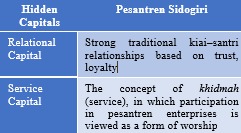
Objective: This study aims to analyze the economic transformation of Islamic boarding schools through case studies of Sidogiri Islamic Boarding School and Idrisiyyah Islamic Boarding School, as well as identify the success factors of integrating religious values and modern business management. Theoretical framework: This research uses the concepts of Islamic economics, community empowerment, and social entrepreneurship that emphasize the integration of spiritual values with professional business management. Literature review: The literature shows that pesantren not only function as religious educational institutions, but also develop into centers for community-based economic empowerment and social entrepreneurship. Method: The study used an instrumental comparative case study approach by comparing the economic transformation of the Sidogiri Islamic Boarding School and the Idrisiyyah Islamic Boarding School. Results: The results of the study show that the two Islamic boarding schools have succeeded in developing various community-based business units. This success is supported by the kyai-santri relationship, the concept of solemnity, spiritual values, and community loyalty. Implications: Pesantren have great potential as agents of economic empowerment and sustainable development that support the achievement of the SDGs, especially poverty alleviation and inclusive economic growth. Novelty: The novelty of this research lies in the analysis of the integration of religious traditions and modern business management in the economic development of pesantren and its contribution to the SDGs in Indonesia.
References
[1] H. D. Molasy, S. E. Z. Ernada, L. D. Eriyanti, R. Y. E. Sova, and M. R. Hanif, “The role of pesantren in developing Indonesian women-led small businesses’ Halal industry,” in AIP Conference Proceedings, K. D., P. R.M., A. R., and A. R., Eds., American Institute of Physics, 2024. https://doi.org/10.1063/5.0241840.
[2] O. P. Y. Meishanti, E. Susantini, R. P. Puspitawati, K. Sari, and R. T. H. Putri, “Building Sustainable Entrepreneurship With a Science-Based Green Entrepreneurship Learning Model and Sustainable Development Goals in Islamic Boarding Schools,” J. Pendidik. IPA Indones., vol. 14, no. 4, pp. 797–812, 2025, https://doi.org/10.15294/jpii.v14i4.34369.
[3] Suliswiyadi, M. Kurnia, A. Miswanto, and I. Nugroho, “Entrepreneurship education model of pesantren based on theopreneurship,” Opcion, vol. 34, no. 86, pp. 2229–2240, 2018, [Online]. Available: https://www.scopus.com/pages/publications/85064053873?origin=resultslist
[4] A. Rachman and B. Sangare, “Impact of Implementation of Halal Tourism in West Nusa Tenggara Province: Maqāṣid Al-Sharīa Perspective,” Justicia Islam, vol. 20, no. 1, pp. 17–36, 2023, https://doi.org/10.21154/justicia.v20i1.5173.
[5] A. Ariatin, W. Dhewanto, O. Y. Sudrajad, S. Rustiadi, and M. Wasesa, “Business Survival Strategy during COVID-19 Pandemic: A Case Study of Kopontren,” Grey J., vol. 19, no. 1, pp. 57–73, 2023, https://www.scopus.com/pages/publications/85150724179?origin=resultslist
[6] A. I. Sulaiman and D. Ahmadi, “Empowerment communication in an Islamic boarding school as a medium of harmonization,” J. Komun. Malaysian J. Commun., vol. 36, no. 4, pp. 323–338, 2020, https://doi.org/10.17576/JKMJC-2020-3604-20.
[7] Hirsanuddin, Rodliyah, and Minollah, “Hybrid contract design in sharia banking product development,” J. Leg. Ethical Regul. Issues, vol. 24, no. Special Issue 1, pp. 1–13, 2021, https://www.scopus.com/pages/publications/85112790597?origin=resultslist
[8] Daniar, S. Iswati, and A. F. Zarkasyi, “Social enterprise in the context of educational institution: Lessons from Gontor, Indonesia,” Opcion, vol. 35, no. SpecialIssue19, pp. 2244–2258, 2019, https://www.scopus.com/pages/publications/85069179681?origin=resultslist
[9] S. J. Barter, “Ulama, the state, & war: Community Islamic leaders in the Aceh conflict,” Contemp. Islam, vol. 5, no. 1, pp. 19–36, 2011, https://doi.org/10.1007/s11562-010-0141-8.
[10] M. Wardi, I. Ismail, Z. Zainollah, and I. S. Wekke, “Entrepreneurship and financing in Islamic educational institution of Darul Ulum Banyuanyar Pamekasan,” Acad. Entrepreneur. J., vol. 25, no. Special Issue 2, pp. 1–14, 2019, [Online]. Available: https://www.scopus.com/pages/publications/85081218873?origin=resultslist
[11] W. Widodo, S. Chalim, Y. Susanto, N. H. S. Masrukhin, F. Usman, and M. H. Rofiq, “Digital Work Training in Islamic Boarding Schools: A Strategic Model for Enhancing Santri Employability and Reducing Youth Unemployment in Urban Indonesia,” Munaddhomah, vol. 7, no. 2, pp. 248–259, 2026, https://doi.org/10.31538/munaddhomah.v7i2.2646.
[12] A. Wibowo et al., “Does Islamic values matter for Indonesian students’ entrepreneurial intention? The mediating role of entrepreneurial inspiration and attitude,” J. Islam. Account. Bus. Res., vol. 13, no. 2, pp. 242–263, 2022, https://doi.org/10.1108/JIABR-03-2021-0090.
[13] A. Ariatin, W. Dhewanto, and O. Yudha, “Entrepreneurial Muslim leadership in Islamic cooperative business unit,” J. Islam. Account. Bus. Res., vol. 15, no. 3, pp. 499–518, 2024, https://doi.org/10.1108/JIABR-04-2022-0100.
[14] D. Gandasari, D. Dwidienawati, D. Tjahjana, and M. Sugiarto, “Group Activities and Communication Patterns on Empowerment of the Santri Tani Millennial Group (Kstm) in Indonesia: a Case in Sukabumi and Purwakarta, West Java,” Acad. Entrepreneur. J., vol. 27, no. Special Issue 2, pp. 01–11, 2021, [Online]. Available: https://www.scopus.com/pages/publications/85112270571?origin=resultslist
[15] I. Zaki, I. Mawardi, T. Widiastuti, A. Hendratmi, and D. F. Anova, “Business network strategy in Islamic micro finance institution of Islamic boarding school,” Humanit. Soc. Sci. Rev., vol. 7, no. 4, pp. 276–279, 2019, https://doi.org/10.18510/hssr.2019.7435.
[16] R. Auliyah, M. Nasih, and D. Agustia, “Determinants of business success at Sunan Drajat Islamic Boarding School, East Java, Indonesia,” Cogent Bus. Manag., vol. 12, no. 1, 2025, https://doi.org/10.1080/23311975.2025.2492828.
[17] B. Pratistha et al., “Business ecosystem architecture in the business units of Islamic boarding schools,” Int. J. Serv. Econ. Manag., vol. 16, no. 3, pp. 217–231, 2025, https://doi.org/10.1504/IJSEM.2025.146240.
[18] I. Mustofa, W. Hefni, I. A. Maliki, and U. Chamdan, “Fiqh of Civilization at Traditional Islamic Boarding School: Contextualizing of Islamic Jurisprudence through Classical Texts of Mu’amalat,” Juris J. Ilm. Syariah, vol. 23, no. 2, pp. 351–365, 2024, https://doi.org/10.31958/juris.v23i2.12245.
[19] A. Fatah, A. Karim, and M. Masruri, “Quranic Edupreneur: Counter to Unemployment in Contemporary Indonesia,” AlBayan, vol. 21, no. 3, pp. 385–406, 2023, https://doi.org/10.1163/22321969-20230140.
[20] R. Lukens-Bull, “Lost in a sea of subjectivity: The subject position of the researcher in the anthropology of Islam,” Contemp. Islam, vol. 1, no. 2, pp. 173–192, 2007, https://doi.org/10.1007/s11562-007-0014-y.
[21] A. Prayogi, “Pendekatan Kualitatif dalam Ilmu Sejarah: Sebuah Telaah Konseptual,” Hist. Madania J. Ilmu Sej., vol. 5, no. 2, pp. 240–254, 2021, https://doi.org/10.15575/hm.v5i2.15050.
[22] A. Sholikhah, “Statistik Deskriptif Dalam Penelitian Kualitatif,” KOMUNIKA J. Dakwah dan Komun., vol. 10, no. 2, pp. 342–362, 2016, https://doi.org/10.24090/komunika.v10i2.953.
[23] M. Mulyadi, “Penelitian Kuantitatif Dan Kualitatif Serta Pemikiran Dasar Menggabungkannya,” J. Stud. Komun. dan Media, vol. 15, no. 1, p. 128, 2013, https://doi.org/10.31445/jskm.2011.150106.
[24] W. Andayani, E. G. Sukoharsono, M. N. Mukmin, and A. H. B. Abdul Aziz, “Assessing the financial sustainability of micro waqf banks: insights from Indonesia,” Cogent Soc. Sci., vol. 11, no. 1, 2025, https://doi.org/10.1080/23311886.2025.2488117.
[25] A. Abroza and I. Mas’ud, “Bibliometric Analysis: The Evolution of Entrepreneurship among Islamic Boarding School Students from an Islamic Economic Law Perspective,” Al-Muamalat J. Ekon. Syariah, vol. 11, no. 1, pp. 33–47, 2024, https://doi.org/10.15575/am.v11i1.33744.
[26] S. A. Chaniago, M. Izza, B. S. Wijaya, and F. F. P. Rozi, “Implementation of Halal Supply Chain in the Cooperative of Islamic Boarding School: Maqashid Syariah Perspective,” J. Huk. Islam, vol. 22, no. 1, pp. 57–88, 2024, https://doi.org/10.28918/jhi_v22i1_3.
[27] I. Zaki, T. Widiastuti, A. T. R. C. Yudha, I. Wijayanti, and D. A. Mi’raj, “Implementation of Islamic entrepreneurial culture in Islamic boarding schools,” Int. J. Innov. Creat. Chang, vol. 11, no. 11, pp. 452–469, 2020, [Online]. Available: https://www.scopus.com/pages/publications/85083043515?origin=resultslist
[28] M. M. Mas’udi, L. Latifah, A. Wahab, S. F. Puara, A. S. Nugraha, and H. Rafsanjani, “Typology of pesantren in agribusiness development and its implications for economic sustainability: A case study in East Java, Indonesia,” Multidiscip. Sci. J., vol. 8, no. 6, pp. 1–9, 2025, https://doi.org/10.31893/multiscience.2026337.
[29] Munifah, S. Huda, U. D. Hamida, Subandi, M. Syazali, and R. Umam, “The use of management strategies to attract the public’s interest in pesantren: A new model for pesantren dynamics study,” Int. J. Innov. Creat. Chang, vol. 8, no. 8, pp. 363–383, 2019, [Online]. Available: https://www.scopus.com/pages/publications/85076528878?origin=resultslist
[30] R. Rofiaty, “The relational model of entrepreneurship and knowledge management toward innovation, strategy implementation, and improving Islamic boarding school performance,” J. Model. Manag., vol. 14, no. 3, pp. 662–685, 2019, https://doi.org/10.1108/JM2-05-2018-0068.
[31] Fadhlurrahman et al., “Empowering santri through entrepreneurial education: A path to sustainable development in Islamic boarding schools,” Multidiscip. Sci. J., vol. 8, no. 6, 2025, https://doi.org/10.31893/multiscience.2026366.
[32] I. Zaki, M. B. F., Zusak, M. N. H. Ryandono, and L. N. Rosyidi, “Designing Strategy of Pesantren Unit Business Virtual Market in Indonesia,” Qual. - Access to Success, vol. 26, no. 207, pp. 297–302, 2025, https://doi.org/10.47750/QAS/26.207.31.
[33] H. Muhammad, “Islamic Corporate Social Responsibility: An Exploratory Study in Islamic Microfinance Institutions,” J. Asian Financ. Econ. Bus., vol. 7, no. 12, pp. 773–782, 2020, https://doi.org/10.13106/JAFEB.2020.VOL7.NO12.773.
[34] T. Harjawati, Sumiati, S. Aisjah, and K. Ratnawati, “Integrated business strategies in Islamic boarding School-based businesses: a qualitative phenomenological study on human resource management, cooperation, marketing, production, and finance,” Cogent Bus. Manag., vol. 13, no. 1, 2026, https://doi.org/10.1080/23311975.2025.2607801.
[35] M. K. F. Raya, “Digital Islam: new space for authority and religious commodification among Islamic preachers in contemporary Indonesia,” Contemp. Islam, vol. 19, no. 1, pp. 161–194, 2025, https://doi.org/10.1007/s11562-024-00570-z.
[36] I. Zaki, M. B. F., Zusak, D. A., Mi’raj, and F. F. Hasib, “Islamic community-based business cooperation and sustainable development goals: a case of pesantren community in Indonesia,” Int. J. Ethics Syst., vol. 38, no. 4, pp. 621–632, 2022, https://doi.org/10.1108/IJOES-12-2021-0218.
[37] A. I. Sulaiman, Masrukin, and B. Suswanto, “The Implementation of Community Empowerment Model As a Harmonization in the Village Traumatized By Terrorism Case,” J. Ilm. Peuradeun, vol. 7, no. 1, pp. 59–80, 2019, https://doi.org/10.26811/peuradeun.v7i1.257.
[38] A. Saniotis, “Muslims and ecology: Fostering Islamic environmental ethics,” Contemp. Islam, vol. 6, no. 2, pp. 155–171, 2012, https://doi.org/10.1007/s11562-011-0173-8.
[39] R. Sulistyowati, F. I. Maula, A. M. Mahendra, and F. A’rasy, “Ecosystems and entrepreneurial intention among students: the mediating role of Islamic values,” Perspekt. Nauk. i Obraz., vol. 69, no. 3, pp. 113–129, 2024, https://doi.org/10.32744/pse.2024.3.7.
[40] M. Yusuf, Alwis, M. Rasidin, D. Witro, and A. Nurjaman, “The role of Islamic boarding schools in student empowerment: Study of Anak Jalanan At-Tamur Islamic boarding school in Bandung Regency,” Kasetsart J. Soc. Sci., vol. 45, no. 3, pp. 779–790, 2024, https://doi.org/10.34044/j.kjss.2024.45.3.09.
[41] D. Mariyono, “Multicultural values: meeting point of two forces in developing Islamic education,” Qual. Educ. All, vol. 1, no. 1, pp. 46–69, 2024, https://doi.org/10.1108/QEA-02-2024-0018.
[42] Supani, A. Yaqin, M. Sukron, Muchimah, and H. Ahmad, “From Classical Shafi’i Jurisprudence to Diverse Madhhab Perspectives: Shifting Literatures and Practices of Sharia Economic Law in Islamic Pesantren,” Juris J. Ilm. Syariah, vol. 24, no. 1, pp. 63–72, 2025, https://doi.org/10.31958/juris.v24i1.13419.
[43] R. A. S. Siregar, M. A. Rababah, R. Ritonga, T. M. Harahap, and E. Siregar, “Islamic Boarding School Cooperatives as an Instrument for Empowering the Community’s Economy: Analysis of Islamic Economic Law,” Nurani, vol. 25, no. 1, pp. 323–343, 2025, https://doi.org/10.19109/nurani.v25i1.27698.
[44] A. Zaenurrosyid, H. Sholihah, and undefined Nurhidayatuloh, “The Islamic philanthropy model based on maslah”.
[45] I. Qizam, I. Berakon, and H. Ali, “The role of halal value chain, Sharia financial inclusion, and digital economy in socio-economic transformation: a study of Islamic boarding schools in Indonesia,” J. Islam. Mark, vol. 16, no. 3, pp. 810–840, 2025, https://doi.org/10.1108/JIMA-03-2024-0108.
[46] S. Al-Hakim, M. Sar’an, A. Fathonih, and A. A. Hidayat, “Contextualising Sharīʿah Economic Law: The Role of Pesantren in Indonesia’s Socio-Legal Landscape,” J. Ilm. Mizani, vol. 12, no. 2, pp. 479–496, 2025, https://doi.org/10.29300/mzn.v12i2.7926.
[47] A. El Ashfahany, M. R. Jihad, N. N. Kurniawati, S. Hidayat, and T. A. Mustofa, “Balanced scorecard approach to measuring the performance of a non-profit organization: Case study on a Waqf-based Pesantren in Indonesia,” Probl. Perspect. Manag., vol. 22, no. 2, pp. 600–614, 2024, https://doi.org/10.21511/ppm.22(2).2024.47.
[48] R. Winarsih, A. R. Masrifah, and K. Umam, “The Integration of Islamic Commercial and Social Economy Through Productive Waqf To Promote Pesantren Welfare,” J. Islam. Monet. Econ. Financ., vol. 5, no. 2, pp. 321–340, 2019, https://doi.org/10.21098/jimf.v5i2.1065.
Downloads
Submitted
Accepted
Published
Issue
Section
License
Copyright (c) 2025 Lukman Fauroni, Helmi Haris

This work is licensed under a Creative Commons Attribution 4.0 International License.