Prophetic Intelligence in Islamic Education for Corruption Prevention: A Study from Solo Raya within the SDGs Framework
DOI:
https://doi.org/10.23917/profetika.v26i03.17106Keywords:
prophetic intelligence, islamic education, anti-corruption, values, sdgsAbstract
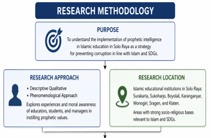
Objective: This study aims to analyze the implementation of prophetic intelligence in Islamic education as a strategy for building anti-corruption character in the Greater Solo area, by highlighting its contribution to the achievement of Islam and the SDGs. Theoretical framework: The theoretical framework of this research is based on the concept of prophetic intelligence that combines rationality, spirituality, and morality as the basis of ethical awareness. Literature review: Literature review confirms that prophetic Islamic education plays an important role in instilling ethical and spiritual values as a measure to prevent corruption. Several studies have shown that the integration of prophetic values in the Islamic education curriculum can form a culture of honesty, social responsibility, and institutional transparency. Methods: This study uses a qualitative approach with phenomenological methods to explore the meaning of teachers' experiences in implementing prophetic values in Islamic educational institutions in Solo Raya. Data was obtained through in-depth interviews, participatory observations, and documentation studies, then analyzed with Miles and Huberman's interactive model that included data reduction, presentation, and verification. Results: The results of the study show that the implementation of prophetic intelligence is effective in strengthening integrity, honesty, and accountability in the educational environment. Teachers act as an ethical bridge between spirituality and modern governance, internalizing prophetic values through example, moral habituation, and ethical reflection. Prophetic Islamic education has been proven to be able to suppress corrupt behavior and foster a culture of social responsibility. Implications: The integration of prophetic values in Islamic education has a direct impact on the establishment of educational institutions that are transparent, ethical, and just, as well as serving as a moral model for the wider community. Novelty: This study examines applying prophetic intelligence in Islamic education as an anti-corruption character strategy by integrating prophetic values into curricula, linking it to SDG 4 and SDG 16 an area still underexplored.
References
[1] M. Isnaini and I. Iskandar, “Akal Dan Kecerdasan Dalam Perspektif Al-Qur’an Dan Hadits,” MUSHAF J. J. Ilmu Al Quran dan Hadis, vol. 1, no. 1, pp. 103–118, 2021, https://doi.org/10.54443/mushaf.v1i1.13.
[2] S. Rohman, “Pengembangan Lembar Kerja Peserta Didik Berbasis STEAM (Science, Technology, Engineering, Arts, and Mathematics) pada Konsep Sistem Gerak Makhluk Hidup di SMP/MTs.” Jakarta: FITK UIN Syarif Hidayatullah Jakarta, 2023.
[3] M. Muthoharoh, “Internalisasi nilai-nilai Pendidikan Karakter melalui Pembelajaran Pendidikan Agama Islam di Sekolah,” Tabyin J. Pendidik. Islam, vol. 3, no. 02, pp. 24–31, 2021, https://doi.org/10.52166/tabyin.v3i02.145.
[4] T. Muhtar, T. Supriyadi, A. S. Lengkana, and S. Hanifah, “Religious characters-based physical education learning in elementary school,” Int. J. Learn. Teach. Educ. Res., vol. 18, no. 12, pp. 211–239, 2019, https://doi.org/10.26803/ijlter.18.12.13.
[5] M. A. K. Hasan and K. Arifah Ma’sum, “The Relevance Between Values of Akhlak Education in Adnan and Syahid’s Tafsir with Education Law in Indonesia,” J. Stud. Al-Qur’an, vol. 20, no. 1, pp. 35–51, 2024, https://doi.org/10.21009/jsq.20.1.04.
[6] Sahri, I. Fuadi, A. Tanzeh, and Kojin, “Implementation of Prophetic Education in Building Religious and Social Culture at Al Fattah Islamic High School,” re-JIEM (Research J. Islam. Educ. Manag., vol. 6, no. 1, pp. 18–28, 2023, https://doi.org/10.19105/re-jiem.v6i1.8683.
[7] T. Quran, T. T. Spread, and Y. Ali intend to provide a welcome space of encounters and reflections upon the commonalities and shared goals of the great.
[8] M. Abuzar, S. Uddin, and A. Khondoker, “Ethical Curriculum Development : Insights From Islamic Epistemology Towards Sustainable Development Goals ( SDGs ),” Profetika J. Stud. Islam, vol. 25, no. 2, pp. 273–286, 2024, https://doi.org/10.23917/profetika.v25i02.7306.
[9] R. Kumolohadi, F. Mangunsong, and J. Suleeman, “Development and Validation of Ethical Awareness Scale among University Students,” J. Pengukuran Psikol. Dan Pendidik. Indones., vol. 10, no. 1, pp. 20–31, 2021, https://doi.org/10.15408/jp3i.v10i1.17216.
[10] A. Fildzah and A. D. Makrufi, “At-Taqaddum Islamic Mentoring : Implementation and Impact of Mentoring Activities at Muhammadiyah 1 Junior High School, Yogyakarta,” At-Taqaddum, pp. 17–30, 2021.
[11] S. Yumnah, “Kecerdasan Profetik Dalam Membentuk Kepribadian Muslim,” vol. 4, no. 1, pp. 92–103, 2019.
[12] Nursita Rahmadhanti, Diny Nadira, Misbahul Munawarrah, Ahmad Raihan Nasution, and Kasful Anwar, “Pendidikan Anti Korupsi Dalam Islam,” J. Student Res., vol. 1, no. 5, pp. 319–324, 2023, https://doi.org/10.55606/jsr.v1i5.1739.
[13] S. Suwito, I. Novianti, S. Suparjo, C. A. Widaputri, and M. ’Azmi Nuha, “Hybrid Sufism for enhancing quality of life: Ethnographic perspective in Indonesia,” HTS Teol. Stud. / Theol. Stud., vol. 78, no. 4, pp. 1–8, 2022, https://doi.org/10.4102/HTS.V78I4.7198.
[14] M. Mahmudulhassan, M. Abuzar, S. U. A. Khondoker, and J. Khanom, “The Dignity of Labor in Islam: Ethical Principles and Contemporary Relevance,” Suhuf, vol. 37, no. 1, pp. 47–57, 2025, https://doi.org/10.23917/suhuf.v37i1.10193.
[15] A. Muttaqin, “From occultism to hybrid Sufism: The transformation of an Islamic-hybrid spiritual group in contemporary Indonesia,” Indones. J. Islam Muslim Soc., vol. 4, no. 1, pp. 81–104, 2014, https://doi.org/10.18326/ijims.v4i1.81-104.
[16] I. S. Wekke, M. Ashrori, and B. Hamuddin, “Institutional Transformation of Madrasa of Muslim Minority in Thailand,” J. Pendidik. Islam, vol. 4, no. 1, p. 15, 2018, https://doi.org/10.15575/jpi.v4i1.1961.
[17] Muthoifin, I. Afiyah, and Nuha, “Behavioral responses of cows and goats during slaughtering for Eid Al-Adha: A field study in Surakarta,” J. Anim. Behav. Biometeorol., vol. 12, no. 4, 2024, https://doi.org/10.31893/jabb.2024034.
[18] A. Hajar, “Transforming Islamic Education for Environmental and Social,” Sinergi Int. J. Islam. Stud., vol. 2, no. 2, pp. 82–95, 2024, https://doi.org/10.61194/ijis.v2i2.601.
[19] Uswatun Hasanah, “Exploring Religious Education and Character Development in Pesantren: A Phenomenological Study | Journal of Educational Innovation and Research,” J. Educ. Innov. Res. , vol. 1, no. 4, pp. 119–127, 2025.
[20] I. M. Afiyah, “The Existence of Library Literacy in Indonesia in the Millennial Era : Strategies for Improving the Quality of Education to Support the Sustainable Development Goals (SDGs),” Solo Int. Colab. Publ. Soc. Sci. Humanit., vol. 3, no. 1, pp. 41–52, 2025, https://doi.org/10.61455/sicopus.v3i01.229.
[21] H. Amin, “Value-based frameworks and peace education in faith-neutral, faith-based and faith-inspired schools in Islamabad: A comparative analysis,” J. Peace Educ., vol. 21, no. 1, pp. 54–81, 2024, https://doi.org/10.1080/17400201.2023.2289655.
[22] Muthoifin et al., “Islamic Banking: a Comprehensive Review of the Definition, Strategy, Legal Framework, and Practice of Contracts in the Modern Financial System,” J. Lifestyle SDG’S Rev., vol. 5, no. 1, 2025, https://doi.org/10.47172/2965-730X.SDGsReview.v5.n01.pe03067.
[23] N. K. Denzin and Y. S. Lincoln, The Sage handbook of qualitative research. Sage, 2011.
[24] S. Ismet, I. Laili, and D. Rahmawati, “The Role of Islamic Education in Promoting Moral and Ethical Values Among Modern Youth,” J. Acad. Sci., vol. 2, no. 3, pp. 823–832, 2025.
[25] A. Nirwana et al., “The Role of Traditional Salt Production in Achieving Halal Standards of the Ulama Consultative Council: Implications for Sustainable Development Goals,” J. Lifestyle SDG Rev., vol. 4, no. 2, pp. 1–47, 2024, https://doi.org/10.47172/2965-730X.SDGsReview.v4.n02.pe01721.
[26] M. Muhtar, A. Sholeh, and M. Mahmudulhassan, “The Reasons Of Lifelong Education For The Sustainable Development Goals (SDGs): The Islamic Epistemology Perspective,” vol. 5, pp. 1–23, 2025, https://doi.org/10.47172/2965-730X.SDGsReview.v5.n02.pe02988.
[27] M. B. Miles, “Qualitative data analysis: An expanded sourcebook,” Thousand Oaks, 1994.
[28] N. Lalani and G. Ali, “Methodological and ethical challenges while conducting qualitative research on spirituality and end of life in a Muslim context: a guide to novice researchers,” Int. J. Palliat. Nurs., vol. 26, no. 7, pp. 362–370, 2020, https://doi.org/10.12968/ijpn.2020.26.7.362.
[29] Y. S. Lincoln and E. G. Guba, Naturalistic inquiry. Sage, 1985, https://doi.org/10.1016/0147-1767(85)90062-8.
[30] T. N. Basit, “Ethics, reflexivity and access in educational research: issues in intergenerational investigation,” Res. Pap. Educ., vol. 28, no. 4, pp. 506–517, 2013, https://doi.org/10.1080/02671522.2012.689318.
[31] A. Mahmud, Zamroni, and H. Ilyas, “Islam and Tolerance Education for the Sustainable Development Goals (SDGs),” Profetika J. Stud. Islam, vol. 25, no. 02, pp. 387–404, 2025, https://doi.org/10.23917/profetika.v25i02.8510.
[32] M. Sri Mega Indah Umi Zulfiani and I. Rosyadi, “Corporate Social Responsibility (CSR) Practices Of Shariaconsumer Cooperatives For Sustainable Development Goals (SDGs) Ethical Perspective,” J. Lifestyle SDGs Rev., vol. 4, pp. 1–20, 2024, https://doi.org/10.47172/2965-730X.SDGsReview.v4.n00.pe01752.
[33] R. M. Branch and İ. Varank, Instructional design: The ADDIE approach, vol. 722. Springer, 2009, https://doi.org/10.1007/978-0-387-09506-6.
[34] F. Riyadi, A. Remanda, A. Kasdi, and A. Marsal, “Constitutional Ijtihad and the Reform of Islamic Family Law : A Comparative Analysis of Indonesia and Egypt in Advancing SDG 16,” vol. 26, no. 2, pp. 353–370, 2025, https://doi.org/10.23917/profetika.v26i02.11106.
[35] M. Ali et al., “Tracking Education Transformation Towards Sustainable Development Goals: a Bibliometric Review on the Influence of Socioeconomic Factors in the Education Ecosystem,” J. Lifestyle SDG’S Rev., vol. 5, no. 1, 2025, https://doi.org/10.47172/2965-730X.SDGsReview.v5.n01.pe03295.
[36] M. M. A. Sholeh, A. Nirwana, and M. Mahmudulhassan, “The Reasons of Lifelong Education for the Sustainable Development Goals (SDGs): The Islamic Epistemology Perspective,” J. Lifestyle SDGs Rev., vol. 5, no. 2, pp. e02988–e02988, 2025, https://doi.org/10.47172/2965-730X.SDGsReview.v5.n02.pe02988.
[37] Muthoifin et al., “Women, Islamic Education, and Socioeconomics for the Sustainable Development Goals (SDGs): a Bibliometric Study of Understanding From 1880 To 2024,” J. Lifestyle SDG’S Rev., vol. 5, no. 2, 2025, https://doi.org/10.47172/2965-730X.SDGsReview.v5.n02.pe01737.
[38] N. Y. Muthoifin, I. R. Isman, and M. Ishmah Afiyah, “Fostering The Ummah’s Economy Through The Stockinvestment System : The Views Of The Mui For Sustainable Development Goals ( SDGS ),” J. Lifestyle SDGs Rev., vol. 4, pp. 1–19, 2024, https://doi.org/10.47172/2965-730X.SDGsReview.v4.n00.pe01685.
[39] Muthoifin et al., “Bibliometric Analysis of the Socialization of Islamic Inheritance Law in the Scopus Database and Its Contribution to Sustainable Development Goals (SDGs),” J. Lifestyle SDG’S Rev., vol. 5, no. 2, 2025, https://doi.org/10.47172/2965-730X.SDGsReview.v5.n02.pe03057.
[40] N. L. Inayati, T. A. Mustofa, A. F. Rohmani, F. N. Anggraini, and Muthoifin, “Development of Religious Education in Junior High Schools for Sustainable Development Goals (SDGs): a Study in Surakarta,” J. Lifestyle SDG’S Rev., vol. 5, no. 2, 2025, https://doi.org/10.47172/2965-730X.SDGsReview.v5.n02.pe04411.
[41] S. Amatullah and S. Dixit, “Situatedness of school choice among Muslim students: An intersectional approach,” Contemp. Educ. Dialogue, vol. 20, no. 2, pp. 206–235, 2023, https://doi.org/10.1177/09731849231187706.
[42] N. Hamid, Sutama, S. Hidayat, Waston, A. Nirwana, and Muthoifin, “Creative Leadership: an Implementing Study of Transformative Leadership Models in High School for Sustainable Development Goals,” J. Lifestyle SDG’S Rev., vol. 5, no. 1, 2024, https://doi.org/10.47172/2965-730X.SDGsReview.v5.n01.pe01686.
[43] Suwarsono, B. Setiadji, M. Asy’arie, Waston, A. Nirwana, and Muthoifin, “The Future of the Civilization of the Ummah Is Reviewed From the Sociology of Education for the Sustainable Development Goals (SDGs),” J. Lifestyle SDG’S Rev., vol. 4, no. 1, 2024, https://doi.org/10.47172/2965-730X.SDGsReview.v4.n00.pe01688.
Downloads
Submitted
Accepted
Published
Issue
Section
License
Copyright (c) 2025 Muh. Fatahillah Suparman, Sujito, Moh. Abdul Kholiq Hasan, Al-Ameen M. Ibnohajad, Eman Suherman

This work is licensed under a Creative Commons Attribution 4.0 International License.