Overcoming Arabic Learning Barriers in MI Muhammadiyah Tambaksari Blora: SDGs-Oriented Approaches
DOI:
https://doi.org/10.23917/profetika.v26i03.16173Keywords:
arabic language learning, problems, alternative solutions, sdgs, islamic educationAbstract
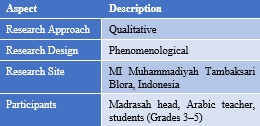
Objective: This study aims to identify barriers in Arabic language learning at MI Muhammadiyah Tambaksari, Blora and to propose practical solutions to improve learning effectiveness in a rural madrasah context. Theoretical framework: The study is grounded in SDG 4 (Quality Education) within the United Nations Sustainable Development Goals, emphasising inclusive, equitable, and sustainable primary education as an analytical lens. Literature review: Previous studies report challenges in Arabic learning related to media, motivation, methods, and teacher competence, but rarely connect these issues to sustainability and global education frameworks. Methods: This research uses a qualitative descriptive case study approach, with data collected through observations, interviews, and document analysis, and analysed using descriptive qualitative techniques. Results: The findings reveal several key barriers to Arabic language learning at MI Muhammadiyah Tambaksari Blora, including limited learning media, low student motivation, insufficient lesson hours, mismatched teacher educational backgrounds, and the lack of a supportive Arabic language environment. These factors are interrelated and collectively reduce the effectiveness of Arabic language instruction, particularly in developing balanced language skills. Implications: The study recommends SDGs-oriented strategies such as interactive media development, varied teaching methods, teacher competency improvement, time optimisation, and supportive language environments to enhance learning quality. Novelty: This study is novel in applying SDG 4 to link local Arabic learning problems with sustainable and inclusive education, offering a context-sensitive model for rural Islamic primary schools.
References
[1] R. Rahmaini, “Arabic Language Learning Strategy: A Study of Learning in Madrasah Based on Boarding Boards,” AL-ISHLAH J. Pendidik., vol. 15, no. 2, pp. 1625–1634, 2023, https://doi.org/10.35445/alishlah.v15i2.2506.
[2] A. Agustini, “Urgensi Pemahaman Bahasa Arab dalam Mempelajari Agama Islam di Indonesia,” RIGHT J. Agama dan Hak Azazi Mns., vol. 10, no. 2, p. 195, 2023, https://doi.org/10.14421/inright.v10i2.2922.
[3] L. N. Khasanah and Y. A. Tantowi, “Problematika Pembelajaran Bahasa Arab pada Mahasiswa Lulusan Umum di Prodi Pendidikan Bahasa Arab Universitas Pendidikan Indonesia,” Tadris Al-’Arabiyyah J. Pendidik. Bhs. Arab dan Kebahasaaraban, vol. 2, no. 1, pp. 113–123, 2023, https://doi.org/10.15575/ta.v2i1.23072.
[4] A. Muzammil, “Pembelajaran Bahasa Arab Melalui Media Radio dan Televisi,” TADRIS AL-ARABIYAT J. Kaji. Ilmu Pendidik. Bhs. Arab, vol. 3, no. 1, pp. 124–137, 2023, https://doi.org/10.30739/arabiyat.v3i1.1916.
[5] S. Haq, “Pembelajaran Bahasa Arab di Era Digital: Problematika dan Solusi dalam Pengembangan Media,” MUKADIMAH J. Pendidikan, Sejarah, dan Ilmu-ilmu Sos., vol. 7, no. 1, pp. 211–222, 2023, https://doi.org/10.30743/mkd.v7i1.6937.
[6] A. K. Nashoih, K. Fadhli, A. Taqiyuddin, A. Khorib, I. N. Sholikhah, and C. Putriningtyas, “Penguatan Kompetensi Guru Melalui Pelatihan Dan Pendampingan Pembuatan Media Pembelajaran Kartu BiZi Bagi Guru Bahasa Arab Di Jombang,” Jumat Pendidik. J. Pengabdi. Masy., vol. 3, no. 1, pp. 18–25, 2022, https://doi.org/10.32764/abdimaspen.v3i1.2285.
[7] F. Fekih-Romdhane et al., “Cross-country validation of the Arabic version of the WHO-5 Well-Being Index in non-clinical young adults from six Arab countries,” Cambridge Prism. Glob. Ment. Heal., vol. 12, 2025, https://doi.org/10.1017/gmh.2025.10051.
[8] M. Alharrasi, S. A. Al-Dossary, D. K. Yesodharan, H. E. El-Gazar, K. Al-Abri, and A. M. Ali, “A psychometric analysis of the Arabic version of the PHQ-9 for depression screening in cardiovascular disease patients,” Acta Psychol. (Amst), vol. 260, 2025, https://doi.org/10.1016/j.actpsy.2025.105574.
[9] G. S. M. Al-Bluwi, E. Masuadi, A. Marquis, R. H. Al-Rifai, I. Elbarazi, and L. A. Ahmed, “Translation and content validity of the Arabic Communication and Symbolic Behaviour Scales Developmental Profile (CSBS DP) Infant–Toddler Checklist,” BMJ Open, vol. 15, no. 12, 2025, https://doi.org/10.1136/bmjopen-2025-105032.
[10] H. Ghazzawi et al., “The Arabic version of the fat phobia scale short form: reliability and structural validity,” Eating and Weight Disorders, vol. 30, no. 1. Springer Science and Business Media Deutschland GmbH, 2025. https://doi.org/10.1007/s40519-025-01727-2.
[11] F. Fekih-Romdhane et al., “Validation of the Arabic version of the Gratitude Questionnaire (GQ-4) in a sample of non-clinical adults,” BMC Psychol., vol. 13, no. 1, 2025, https://doi.org/10.1186/s40359-025-02441-5.
[12] S. Gerges et al., “Psychometric properties of the Arabic versions of the perceived social competence scale and the prosociality scale,” Health Qual. Life Outcomes, vol. 23, no. 1, 2025, https://doi.org/10.1186/s12955-025-02341-7.
[13] I. Muthoifin; Nuha; Afiyah, “The Existence of Islamic Law in Indonesia in the Millennial Era in Supporting the Sustainable Development Goals ( SDGs ): Maqashid Sharia Perspective,” Demak Univers. J. Islam Sharia, vol. 3, no. 1, pp. 27–40, 2025, https://doi.org/10.61455/deujis.v3i01.226.
[14] B. E. Alshareef, O. A. Alfuqaha, I. B. Maali, and K. Amer, “Validation and assessment of the Arabic Psychological First Aid Scale among physicians, nurses, and counsellors in Jordan,” BMC Psychol., vol. 13, no. 1, 2025, https://doi.org/10.1186/s40359-025-02428-2.
[15] W. H. Abd El-hakeem, S. I. Sayed, and F. W. Shahin, “Arabic version of Pediatric Sleep Questionnaire (PSQ),” Egypt. J. Otolaryngol., vol. 41, no. 1, 2025, https://doi.org/10.1186/s43163-025-00762-1.
[16] A. Albilali et al., “Psychometric Validation of the Arabic Version of the WPAI: Migraine Questionnaire in Patients with Migraine,” Neurol. Int., vol. 17, no. 12, 2025, https://doi.org/10.3390/neurolint17120202.
[17] S. A. Sanad, A. M. Mokhtar, M. O. Alharbi, H. B. Alem, A. F. Bukhari, and F. Zawawi, “Qualitative Assessment of Quality and Readability of Patient-Directed Arabic Online Resources for Cochlear Implants in Children,” Int. Arch. Otorhinolaryngol., vol. 29, no. 2, 2025, https://doi.org/10.1055/s-0045-1804516.
[18] A. Khalaf, R. Mathew, and P. Ny, “Breastfeeding transition in Oman: A generation shift or a product of social development? A qualitative study on three generations of Omani mothers,” PLoS One, vol. 20, no. 4 April, 2025, https://doi.org/10.1371/journal.pone.0319789.
[19] H. Bitar and S. Alismail, “Toward an Understanding of the Lack of Transmission of Facts About Human Papillomavirus: Qualitative Case Study,” JMIR Cancer, vol. 11, 2025, https://doi.org/10.2196/64183.
[20] A. Altun et al., “Lost in translation?“: A qualitative exploration of digital perinatal mental health resource use among migrant women,” Int. J. Equity Health, vol. 24, no. 1, 2025, https://doi.org/10.1186/s12939-025-02715-9.
[21] W. Husain et al., “The translation and validation of the Arabic language version of the biphasic sleep scale among young adults,” Sleep Epidemiol., vol. 5, 2025, https://doi.org/10.1016/j.sleepe.2025.100118.
[22] H. Jahrami, W. Husain, H. Ghazzawi, Z. Saif, A. Ammar, and K. Trabelsi, “The translation and validation of the procrastination and precrastination traits scale in the modern Arabic Language,” Sci. Rep., vol. 15, no. 1, 2025, https://doi.org/10.1038/s41598-025-20963-1.
[23] M. M. Saleh, E. T. F. Farag, M. H. Boshnaq, and A. A. M. Hassan, “Implications of cluster substitution in Egyptian Arabic children: 30–48 months,” Egypt. J. Otolaryngol., vol. 41, no. 1, 2025, https://doi.org/10.1186/s43163-025-00922-3.
[24] M. Sri Mega Indah Umi Zulfiani and I. Rosyadi, “Corporate Social Responsibility (CSR) Practices Of Shariaconsumer Cooperatives For Sustainable Development Goals (SDGs) Ethical Perspective,” J. Lifestyle SDGs Rev., vol. 4, pp. 1–20, 2024, https://doi.org/10.47172/2965-730X.SDGsReview.v4.n00.pe01752.
[25] S. Elzayat, M. M. Hussein, A. Ebeed, S. Khaled, and M. E. El-Deeb, “The Carcinologic Handicap Index: translation and cross-cultural adaptation to the Arabic language,” Egypt. J. Otolaryngol., vol. 41, no. 1, 2025, https://doi.org/10.1186/s43163-025-00865-9.
[26] S. Berglundh, K. Abunnaja, S. Herzig van Wees, E. C. Larsson, and H. Kilander, “Arabic speaking women’s experience of postpartum contraceptive counselling in Sweden,” Reprod. Heal. , vol. 22, no. 1, 2025, https://doi.org/10.1186/s12978-025-02074-2.
[27] K. Al-abri, H. A. L. Sumri, M. Al-Azri, D. K. Yesodharan, and R. Al Kindi, “Validation of the Arabic version of the edinburgh postnatal depression scale for screening antenatal depression in Oman,” BMC Pregnancy Childbirth, vol. 25, no. 1, 2025, https://doi.org/10.1186/s12884-025-07793-9.
[28] E. H. Nada, D. H. Galhom, A. A. E. Elsayed, and N. H. Gad, “Validity and reliability of the Arabic version of vestibular rehabilitation benefit questionnaire,” Egypt. J. Otolaryngol., vol. 41, no. 1, 2025, https://doi.org/10.1186/s43163-025-00836-0.
[29] I. M. A. Jomaa, R. R. Moustafa, W. B. Wahba, E. Hamid, N. El Nahas, and T. Roushdy, “Developing a culturally adapted Cairene Egyptian Arabic–Western Aphasia Battery—Revised (CEA-WAB-R),” Egypt. J. Neurol. Psychiatry Neurosurg., vol. 61, no. 1, 2025, https://doi.org/10.1186/s41983-025-00994-1.
[30] M. Hussein et al., “Reliability and validity of the Arabic version of cluster headache impact questionnaire in both active episodic and chronic cluster headache,” J. Headache Pain, vol. 26, no. 1, 2025, https://doi.org/10.1186/s10194-025-01991-8.
[31] R. K. Dakwar and G. Tarabeh, “The Relationship between Parenting Styles, Child’s Gender, and Gender-Shift Use in Arabic Child-Directed Speech,” J. Child Lang., vol. 52, no. 6, pp. 1413–1436, 2025, https://doi.org/10.1017/S030500092400031X.
[32] O. Eilayyan, T. A. Altaim, A. Salameh, and F. M. Al Zoubi, “Cross-cultural adaptation and psychometric validation of the STarT back tool for Jordanian Arabic-speaking adults with low back pain,” PLoS One, vol. 20, no. 11 November, 2025, https://doi.org/10.1371/journal.pone.0336398.
[33] T. Aljuhani et al., “The Feasibility of the Arabic Version of Ages and Stages Questionnaire 3 to Identify Preterm Infants at Risk of Developmental Delays in Saudi Arabia,” Pediatr. Rep., vol. 17, no. 5, 2025, https://doi.org/10.3390/pediatric17050105.
[34] A. S. Abutair, M. M. Rahman, and A. Bin Said, “Development and validation of the Arabic version of the social-ecological model questionnaire for patients undergoing maintenance hemodialysis,” PLoS One, vol. 20, no. 10 October, 2025, https://doi.org/10.1371/journal.pone.0333740.
[35] S. AlBallaa, N. AlTwairesh, A. AlSalman, and S. Alfarhood, “GATmath and GATLc: Comprehensive benchmarks for evaluating Arabic large language models,” PLoS One, vol. 20, no. 9 September, 2025, https://doi.org/10.1371/journal.pone.0329129.
[36] G. M. Al-Otaibi, H. M. Alotaibi, and S. S. Alsalmi, “Communication Errors in Human–Chatbot Interactions: A Case Study of ChatGPT Arabic Mental Health Support Inquiries,” Behav. Sci. (Basel), vol. 15, no. 8, 2025, https://doi.org/10.3390/bs15081119.
[37] A. Hamdy, A. Youssef, and C. Ryan, “Arab2Vec: An Arabic word embedding model for use in Twitter NLP applications,” PLoS One, vol. 20, no. 8 August, 2025, https://doi.org/10.1371/journal.pone.0328369.
[38] F. Fekih-Romdhane et al., “Validation of the abridged version of the autism-spectrum quotient (AQ-28) in the Arabic-speaking adult general population,” J. Public Health Res., vol. 14, no. 3, 2025, https://doi.org/10.1177/22799036251377610.
[39] M. Madi, H. Hamzeh, S. Abujaber, and I. Altubasi, “Translation, cross-cultural adaptation and psychometric properties of the Arabic version of the Fremantle Knee Awareness Questionnaire in people with knee osteoarthritis,” PLoS One, vol. 20, no. 7 July, 2025, https://doi.org/10.1371/journal.pone.0328228.
[40] M. M. A. Sholeh, Waston, A. Nirwana, and M. Mahmudulhassan, “The Reasons of Lifelong Education for the Sustainable Development Goals (SDGs): The Islamic Epistemology Perspective,” J. Lifestyle SDGs Rev., vol. 5, no. 2, p. e02988, Nov. 2024, https://doi.org/10.47172/2965-730X.SDGsReview.v5.n02.pe02988.
[41] M. Baroudi, E. C. Larsson, and H. Kilander, “Navigating complex decisions in a new setting; perspectives of Arabic-speaking migrant men in Sweden on family planning decision making,” PLoS One, vol. 20, no. 6 June, 2025, https://doi.org/10.1371/journal.pone.0325935.
Downloads
Submitted
Accepted
Published
Issue
Section
License
Copyright (c) 2026 Widodo, Armin Nurhartanto, Alberto Emmanuel Conti Morales

This work is licensed under a Creative Commons Attribution 4.0 International License.