Integration of Religious and Character Education in the Independent Curriculum: Efforts to Support the SDGs in Ogan Ilir Regency
DOI:
https://doi.org/10.23917/profetika.v26i02.14853Keywords:
religious education, character education, independent curriculum, sdgs, ogan ilir regencyAbstract
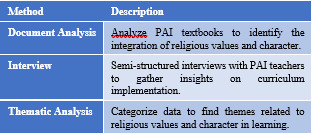
Objective: This study aims to explore how the integration of religious values and character education in Islamic Religious Education (PAI) in the Independent Curriculum supports the achievement of the Sustainable Development Goals (SDGs), especially in supporting quality education (SDG 4). Theoretical framework: This study uses the theory of integration of scientific patterns, such as interdisciplinary, multidisciplinary, transdisciplinary, and value integration, to understand how religious values and character are integrated in PAI. Literature review: Character education and religious values have an important role in shaping students' morals and intellect. This study examines the integration of the two in the Islamic education curriculum, which aims not only to teach religious knowledge but also to shape the character of students. Methods: This study used a qualitative design with case studies using the analysis of PAI textbook documents and interviews with PAI teachers in high school and vocational schools. The data was analyzed using thematic analysis techniques. Results: The findings of the study show that the integration of religious values and character education in PAI has been carried out systematically in the curriculum. Values such as honesty, responsibility, empathy, and critical thinking are included in learning objectives, materials, methods, media, and evaluation. The Merdeka Curriculum emphasizes a holistic education that promotes students' academic development and character. Implications: This study shows the importance of integrating religious values and character in PAI to support the achievement of SDG 4. Teachers have an important role in instilling these values in students. Novelty: This research provides new insights into the integration of religious values and character in the Independent Curriculum, as well as its contribution to achieving sustainable development goals.
References
[1] M. Pionera, A. Syarif, and S. R. Agustina, “Implementasi Kurikulum Merdeka Belajar Pada Mata Pelajaran Pai Kelas Vii Smpn Satu Atap-2 Tewang Sangalang Garing,” J. Hadratul Madaniyah, vol. 10, no. 2, pp. 20–25, 2023, https://doi.org/10.33084/jhm.v10i2.6538.
[2] G. Maksum et al., “Religious values as foundations of education: Insights from teachers’ perspectives,” Res. J. Adv. Humanit., vol. 6, no. 3, 2025, https://doi.org/10.58256/tb06n075.
[3] I. Hanafie and K. Khojir, “Kurikulum dalam Perspektif Imam al-Ghazali dan Relevansinya dengan Capaian Pembelajaran Mata Pelajaran PAI pada Kurikulum Merdeka,” DAYAH J. Islam. Educ., vol. 6, no. 1, p. 60, 2023, https://doi.org/10.22373/jie.v6i1.15947.
[4] A. M. Isaac, “Changing the Relation of Science and Religion through Integrated Islamic Curricula: A Theoretical Position on Faith-Based Science Education,” Austral Comun., vol. 14, no. 2, 2025, https://doi.org/10.26422//aucom.2025.1402.isa.
[5] Muthoifin et al., “Bibliometric Analysis of the Socialization of Islamic Inheritance Law in the Scopus Database and Its Contribution to Sustainable Development Goals (SDGs),” J. Lifestyle SDG’S Rev., vol. 5, no. 2, 2025, https://doi.org/10.47172/2965-730X.SDGsReview.v5.n02.pe03057.
[6] M. B. Aziz, Fitriani, R. Nurhasanah, A. A. Abidin, F. Dwiyama, and M. Toha, “Cultural Heritage as a Driver of Educational Choices: Evaluating the Role of Bugis Values in the Selection of Islamic Private Schools in Indonesia,” Nazhruna J. Pendidik. Islam, vol. 7, no. 3, pp. 726–741, 2024, https://doi.org/10.31538/nzh.v7i3.110.
[7] M. A. H. Putra, E. Malihah, E. Wiyanarti, and W. Darmawan, “Religious Values in Hijaz Yamani Poetry: Integration of Spiritual Responsibility in Character Education,” Karsa, vol. 33, no. 1, pp. 33–65, 2025, https://doi.org/10.19105/karsa.v33i1.18745.
[8] Muthoifin et al., “Women, Islamic Education, and Socioeconomics for the Sustainable Development Goals (SDGs): a Bibliometric Study of Understanding From 1880 To 2024,” J. Lifestyle SDG’S Rev., vol. 5, no. 2, 2025, https://doi.org/10.47172/2965-730X.SDGsReview.v5.n02.pe01737.
[9] M. A. Rokhimawan, M. G. Aulia, I. Rifai, and S. L. Azahro, “The Correlation between Understanding the Independent Learning – Kampus Merdeka (MBKM) Curriculum with the Fulfillment of PAI Student Learning Rights,” J. Pendidik. Agama Islam, vol. 20, no. 2, pp. 279–292, 2023, https://doi.org/10.14421/jpai.v20i2.8049.
[10] S. U. A. Khondoker, Waston, A. N. An, Mahmudulhassan, and Muthoifin, “The Role of Faith-Based Education in Bangladesh’s Multicultural System and Its Impact on the Sustainable Development Goals (SDGs),” J. Lifestyle SDG’S Rev., vol. 5, no. 2, 2025, https://doi.org/10.47172/2965-730X.SDGsReview.v5.n02.pe03472.
[11] A. Wedi, D. Mardiana, and Umiarso, “Digital Transformation Model of Islamic Religious Education in the AI Era: A Case Study of Madrasah Aliyah in East Java, Indonesia,” Int. J. Learn. Teach. Educ. Res., vol. 24, no. 8, pp. 842–863, 2025, https://doi.org/10.26803/ijlter.24.8.37.
[12] Muthoifin et al., “An Interfaith Perspective on Multicultural Education for Sustainable Development Goals (SDGs),” J. Lifestyle SDG’S Rev., vol. 4, no. 3, p. e01720, Sep. 2024, https://doi.org/10.47172/2965-730X.SDGsReview.v4.n03.pe01720.
[13] S. S. Posangi, A. Lundeto, S. Labaso, H. Anwar, and M. Damopolii, “Enhancing Islamic Education Quality Through Educational Supervision and ICT,” J. Ilm. Peuradeun, vol. 13, no. 2, pp. 1209–1234, 2025, https://doi.org/10.26811/peuradeun.v13i2.1955.
[14] M. Sri Mega Indah Umi Zulfiani and I. Rosyadi, “Corporate Social Responsibility (CSR) Practices Of Shariaconsumer Cooperatives For Sustainable Development Goals (SDGs) Ethical Perspective,” J. Lifestyle SDGs Rev., vol. 4, pp. 1–20, 2024, https://doi.org/10.47172/2965-730X.SDGsReview.v4.n00.pe01752.
[15] A. Fakhruddin, S. Anwar, and M. R. Fajar Islamy, “Enhancing academic self-concept and historical literacy in Islamic studies through collaborative learning: a study on prospective Islamic Education teachers in Indonesia,” Cogent Educ., vol. 12, no. 1, 2025, https://doi.org/10.1080/2331186X.2025.2491871.
[16] A. N. Suwarsono, Bambang Setiadji, Musa Asy’arie, Waston, Muthoifin, “The Future Of The Civilization Of The Ummah Is Reviewed From The Sociology Of Education For The Sustainable Development Goals (SDGS’ S ),” J. Lifestyle SDGs Rev., vol. 4, pp. 1–19, 2024, https://doi.org/10.47172/2965-730X.SDGsReview.v4.n00.pe01688.
[17] M. I. Sholeh et al., “The Role of Teachers in Increasing Students’ Learning Motivation in Islamic Religious Education,” J. Pendidik. Agama Islam, vol. 21, no. 2, pp. 421–441, 2024, https://doi.org/10.14421/jpai.v21i2.8846.
[18] Muthoifin et al., “Sharia Economic Empowerment of Low-Income Communities and Subsidy Recipients in Boyolali for Sustainable Development Goals,” J. Lifestyle SDG Rev., vol. 5, no. 1, 2025, https://doi.org/10.47172/2965-730X.SDGsReview.v5.n01.pe02983.
[19] A. A. Mekarisce, “Teknik Pemeriksaan Keabsahan Data pada Penelitian Kualitatif di Bidang Kesehatan Masyarakat,” JJurnal Ilm. Kesehat. Masy. Media Komun. Komunitas Kesehat. Masy., vol. 12, no. 3, pp. 145–151, 2020, https://doi.org/10.52022/jikm.v12i3.102.
[20] A. Sholikhah, “Statistik Deskriptif Dalam Penelitian Kualitatif,” KOMUNIKA J. Dakwah dan Komun., vol. 10, no. 2, pp. 342–362, 2016, https://doi.org/10.24090/komunika.v10i2.953.
[21] D. Susanto, Risnita, and M. S. Jailani, “Teknik Pemeriksaan Keabsahan Data Dalam Penelitian Ilmiah,” J. QOSIM J. Pendidikan, Sos. Hum., vol. 1, no. 1, pp. 53–61, 2023, https://doi.org/10.61104/jq.v1i1.60.
[22] S. Rizal, S. Nahar, and M. Al Farabi, “Islamic Values: Integration in Learning Mathematics and Science at Man 2 Level 2022/2023 Academic Year,” Munaddhomah, vol. 4, no. 3, pp. 732–745, 2023, https://doi.org/10.31538/munaddhomah.v4i3.653.
[23] Sukiman, U. Baroroh, A. S. Nugraheni, and A. Sama-Alee, “Innovation of the Internship Program and Its Implications for the Soft Skill Development of Prospective Islamic Religious Education Teachers at Sunan Kalijaga State Islamic University, Yogyakarta,” J. Pendidik. Agama Islam, vol. 21, no. 1, pp. 165–185, 2024, https://doi.org/10.14421/jpai.v21i1.7583.
[24] C. Hastasari, B. Setiawan, and S. Aw, “Students’ communication patterns of Islamic boarding schools: the case of Students in Muallimin Muhammadiyah Yogyakarta,” Heliyon, vol. 8, no. 1, p. 8824, 2022. https://doi.org/10.1016/j.heliyon.2022.e08824.
[25] Hamdi, S. U. Rizal, N. Hikmah, M. Syabrina, Sulistyowati, and Mualimin, “Developing Digital-Based Islamic Religious Education Teaching Modules on the Subject Matter of Duha Prayer in Elementary Schools,” J. Pendidik. Agama Islam, vol. 21, no. 1, pp. 131–146, 2024, https://doi.org/10.14421/jpai.v21i1.7520.
[26] M. A. Rosyidin and I. Arifin, “Integration of Islamic and Indonesian Education in the Perspective of KH. Salahuddin Wahid,” J. Pendidik. Agama Islam, vol. 18, no. 2, pp. 227–256, 2021, https://doi.org/10.14421/jpai.2021.182-02.
[27] Hariani and Kamil, “Implementasi Kurikulum Merdeka Belajar Pada Mata Pelajaran PAI Di Kelas XI SMA Tarbiyah Islamiyah Hamparan Perak,” J. Soc. Sci. Res., vol. 4, no. 1, pp. 11086–11097, 2024, https://doi.org/10.31004/innovative.v4i1.9046.
[28] S. S. Susanti et al., “Innovative Digital Media in Islamic Religious Education Learning,” J. Pendidik. Agama Islam, vol. 21, no. 1, pp. 40–59, 2024, https://doi.org/10.14421/jpai.v21i1.7553.
[29] M. Shaleh, Tobroni, Mundir, and Umiarso, “Development of a Holistic-Integrative Islamic Religious Education Curriculum in an Integrated Islamic School,” Eurasian J. Educ. Res., vol. 2024, no. 113, pp. 227–241, 2024, https://doi.org/10.14689/ejer.2024.113.13.
[30] M. Zainuddin, Mardianto, and H. Matsum, “Development of Game-Based Learning Media on Islamic Religious Education Materials,” Nazhruna J. Pendidik. Islam, vol. 6, no. 1, pp. 13–24, 2023, https://doi.org/10.31538/nzh.v6i1.2824.
[31] M. T. Yani, M. Hazin, and Y. Hanafi, “Educational Experience Insertion Model of Religious Moderation and National Defence As Efforts To Prevent Radicalism and Communism Via Islamic Religious Education Instructions,” Artseduca, vol. 2023, no. 36, pp. 111–124, 2023, https://doi.org/10.6035/artseduca.3610.
[32] A. Khanif, “Islamic Religious Education Learning Strategy for Alpha Generation,” Ascarya J. Islam. Sci. Cult. Soc. Stud., vol. 3, no. 1, pp. 36–45, 2023, https://doi.org/10.53754/iscs.v3i1.461.
[33] A. Alimni, A. Amin, and D. A. Kurniawan, “The role of Islamic education teachers in fostering students’ emotional intelligence,” Int. J. Eval. Res. Educ., vol. 11, no. 4, pp. 1881–1892, 2022, https://doi.org/10.11591/ijere.v11i4.22116.
[34] M. A. Abdullah, “Islamic Religious Education Based on Religious Intersubjectivity: Philosophical Perspectives and Phenomenology of Religion,” J. Pendidik. Agama Islam, vol. 19, no. 1, pp. 141–163, 2022, https://doi.org/10.14421/jpai.2022.191-11.
[35] Masturin, “Development of Islamic Religious Education Materials Based on Religious Moderation in Forming Student Character,” Munaddhomah, vol. 3, no. 4, pp. 346–355, 2022, https://doi.org/10.31538/munaddhomah.v3i4.310.
[36] F. Ismail, M. Astuti, D. Nasrudin, I. Wigati, and Zuhdiyah, “Assessment Model of Islamic Religious Education in the Psychomotor Domain during the COVID-19 Pandemic in Indonesia,” Eurasian J. Educ. Res., vol. 2022, no. 101, pp. 190–203, 2022, https://doi.org/10.14689/ejer.2022.101.011.
[37] N. Burhanuddin and D. Ilmi, “Typologies of Religious Moderation in Indonesian Higher Education Institutions,” J. Indones. Islam, vol. 16, no. 2, pp. 455–479, 2022, https://doi.org/10.15642/JIIS.2022.16.2.455-479.
[38] M. Rahmat and M. W. B. H. M. Yahya, “The Impact of Inclusive Islamic Education Teaching Materials Model on Religious Tolerance of Indonesian Students,” Int. J. Instr., vol. 15, no. 1, pp. 347–364, 2022, https://doi.org/10.29333/iji.2022.15120a.
[39] A. M. Putri and A. P. Astutik, “TikTok as a Generation-Z Islamic Religious Learning Media During the Covid-19 Pandemic,” J. Pendidik. Agama Islam, vol. 18, no. 2, pp. 273–294, 2021, https://doi.org/10.14421/jpai.2021.182-04.
[40] Nuhayati and A. Hamid, “Radicalism Prevention Through Islamic Religious Education Learning At Elementary School,” J. Pendidik. Islam, vol. 6, no. 1, pp. 109–126, 2020, https://doi.org/10.15575/jpi.v6i1.8352.
[41] H. L. Siregar, Syihabuddin, K. A. Hakam, and K. Komalasari, “Application of project-based learning (PJBL) in Islamic religious education courses (an alternative solution to the problem of learning PAI at PTU),” J. Crit. Rev., vol. 7, no. 1, pp. 21–28, 2020, https://doi.org/10.22159/jcr.07.01.05.
Downloads
Submitted
Accepted
Published
Issue
Section
License
Copyright (c) 2025 Endang Switri, M. Sirozi, Annisa Astrid, Muhammad Ndow

This work is licensed under a Creative Commons Attribution 4.0 International License.