Green Sukuk the Perspective of Sharia Economic Law: A Development Financing Instrument for Achieving the SDGs
DOI:
https://doi.org/10.23917/profetika.v26i03.12781Keywords:
green sukuk, maqashid al-syariah, financing instruments, sharia economic law, sdgsAbstract
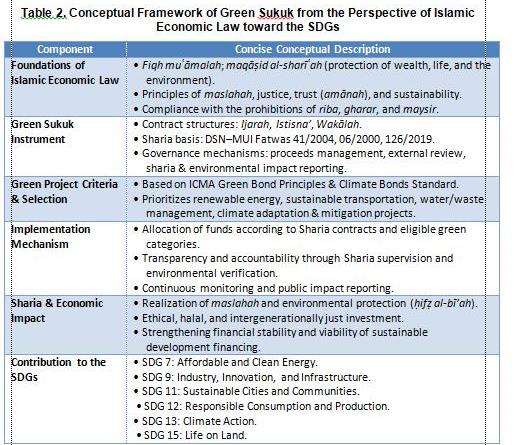
Objective: This study aims to analyze the role of Green Sukuk as a sustainable development financing instrument from the perspective of Islamic economic law, while also examining its contribution to achieving the Sustainable Development Goals (SDGs). Theoretical framework: This study is grounded in the principles of Islamic jurisprudence (fiqh muamalah), maqashid al-shari'ah, and sustainable finance theory, which emphasize justice, sustainability, and social responsibility. Literature review: the literature review highlights the concept and evolution of green sukuk, the theoretical framework of sharia: maqashid, maslahah, and risk-sharing, standards and governance: sharia-ESG. Methods: The research method used is qualitative with a juridical normative approach, through the analysis of regulatory documents, fatwas, and reports on the issuance of Green Sukuk. The results: The results show that Green Sukuk not only fulfills sharia principles but is also effective in supporting environmentally friendly projects, such as renewable energy, water management, and green transportation. Implications: These findings imply that Green Sukuk can be a strategic instrument for both the government and the private sector in integrating sharia values with the global sustainable development agenda. Novelty: The novelty of this research lies in the integrative approach that connects sharia economic law with green financial instruments, while also positioning Green Sukuk as an innovative financing model that is in line with maqashid al-syariah and SDGs.
References
[1] M. I. Balative, E. Hariyanto, A. Sholikhah, and R. G. Prayoga, “A Closer Look at Indonesia’s Experience in Developing Green Sukuk,” in Islamic Finance and Sustainability, London: Routledge, 2025, p. 24.
[2] L. Abubakar and T. Handayani, “Green Sukuk: Sustainable Financing Instruments for Infrastructure Development in Indonesia,” in Proceedings of the 1st Borobudur International Symposium on Humanities, Economics and Social Sciences (BIS-HESS 2019), Atlantis Press, 2020, pp. 983–987. doi: https://doi.org/10.2991/assehr.k.200529.206.
[3] E. Solehudin et al., “Transformation of Shariah Economic Justice: Ethical and Utility Perspectives in the framework of Maqashid Shariah,” Al-Risalah Forum Kaji. Huk. dan Sos. Kemasyarakatan, vol. 24, no. 1, pp. 101–115, 2024, doi: https://doi.org/10.30631/alrisalah.v24i1.1467.
[4] M. Rahman, C. R. Isa, T.-T. Tu, M. Sarker, and M. A. K. Masud, “A bibliometric analysis of socially responsible investment sukuk literature,” Asian J. Sustain. Soc. Responsib., vol. 5, no. 1, p. 7, 2020, doi: https://doi.org/10.1186/s41180-020-00035-2.
[5] S. Shahimi and S. A. Zahari, “Principles of Sustainability in Islamic Finance,” in Islamic Finance and Sustainability, London: Routledge, 2025, p. 30.
[6] A. J. Mahama and I. N. Yakubu, “Islamic Banks’ Investment in Green Sukuk and Sustainable Development in the UAE,” in Strategic Approaches to Banking Business and Sustainable Development Goals, I. N. Yakubu, Ed., Cham: Springer Nature Switzerland, 2025, pp. 87–100. doi: https://doi.org/10.1007/978-3-031-80744-2_5.
[7] A. Delle Foglie and J. S. Keshminder, “Challenges and opportunities of SRI sukuk toward financial system sustainability: a bibliometric and systematic literature review,” Int. J. Emerg. Mark., vol. 19, no. 10, pp. 3202–3225, Dec. 2022, doi: https://doi.org/10.1108/IJOEM-04-2022-0601.
[8] M. P. Musari, R. Khairunnisa, N. M. Mahsyar, and N. Killinc-Ata, “Towards a Sustainable Future Evaluating Green Sukuk in Indonesia and the UAE,” in Islamic Finance and Sustainability, London: Routledge, 2025, p. 21.
[9] E. Housby, Islamic and Ethical Finance in the United Kingdom. Edinburgh: Edinburgh University Press., 2013.
[10] N. Alam, M. Duygun, and R. T. Ariss, “Green Sukuk: An Innovation in Islamic Capital Markets,” in Energy and Finance: Sustainability in the Energy Industry, A. Dorsman, Ö. Arslan-Ayaydin, and M. B. Karan, Eds., Cham: Springer International Publishing, 2016, pp. 167–185. doi: https://doi.org/10.1007/978-3-319-32268-1_10.
[11] S. N. Baity and T. R. Poetri, “Ensuring the credibility and sharia compliance of sovereign green sukuk to achieve net zero emissions in Indonesia,” SERAMBI J. Ekon. Manaj. dan Bisnis Islam, vol. 7, no. 3, pp. 315–334, Aug. 2025, doi: https://doi.org/10.36407/serambi.v7i3.1683.
[12] M. Rahman, C. R. Isa, G. Dewandaru, M. H. Hanifa, N. T. Chowdhury, and M. Sarker, “Socially responsible investment sukuk (Islamic bond) development in Malaysia,” Qual. Res. Financ. Mark., vol. 12, no. 4, pp. 599–619, 2020, doi: https://doi.org/10.1108/QRFM-09-2019-0117.
[13] F. Faizi, A. S. Kusuma, and P. Widodo, “Islamic green finance: mapping the climate funding landscape in Indonesia,” Int. J. Ethics Syst., vol. 40, no. 4, pp. 711–733, 2024, doi: https://doi.org/10.1108/IJOES-08-2023-0189.
[14] Monzer Khaf, Notes on Islamic Economics. Al Manhal, 2014.
[15] M. S. Abdullah and J. S. Keshminder, “What drives green sukuk? A leader’s perspective,” J. Sustain. Financ. Invest., vol. 12, no. 3, pp. 985–1005, 2022, doi: https://doi.org/10.1080/20430795.2020.1821339.
[16] M. M. Alam, C. S. Akbar, S. M. Shahriar, and M. M. Elahi, “The Islamic Shariah principles for investment in stock market,” Qual. Res. Financ. Mark., vol. 9, no. 2, pp. 132–146, 2017, doi: https://doi.org/10.1108/QRFM-09-2016-0029.
[17] Muhammad Zuardi, Ahmad Kholil, Amrin, and Ishma Amelia, “Transformation of the Concept of Maslahah in Sustainable Islamic Finance: a Hermeneutic Analysis of al-Ghazali’s Thoughts and ash-Syatibi,” Profetika J. Stud. Islam, vol. 26, no. 01, pp. 211–228, 2025, doi: https://doi.org/10.23917/profetika.v26i01.9616.
[18] D. Mubarak, N. Othman, M. A. S. Nadzri, K. Universiti, and I. Antarabangsa, “Maqasid-Shariah And Well-Being: A Systematic,” in Proceedings of the 1st International Conference on Islamic Economics, 2022, pp. 170–201.
[19] R. H. S. Lestari, A. K. Damayanti, and M. A. Masuwd, “Optimising Societal Welfare:: The Strategic Role of Maqashid Shariah and Maslahah in Contemporary Islamic Economics and Business,” Al-Insyiroh J. Stud. Keislam., vol. 11, no. 1, pp. 20–40, Mar. 2025, doi: https://doi.org/10.35309/alinsyiroh.v11i1.363.
[20] Ahmad Kholil, Muhammad Zuardi, Amrin, and Juryatina, “Optimizing Islamic Financial Instruments in Indonesia to Support SDGs: Maqashid Syariah Perspective,” Profetika J. Stud. Islam, vol. 26, no. 01, pp. 191–210, 2025, doi: https://doi.org/10.23917/profetika.v26i01.9217.
[21] S. N. Mohd Zameri, S. F. Syed Alwi, Mohammad Firdaus Mohammad Hattac;, and Aula Ahmad Hafidh Saiful Fikri, “MASLAHAH AND ITS APPLICATION IN ISLAMIC FINANCE,” Int. J. Islam. Bus., vol. 9, no. 1, pp. 82–94, Jun. 2024, doi: https://doi.org/10.32890/ijib2024.9.1.5.
[22] M. H. Dolgun and A. Mirakhor, An Alternative Approach to Liquidity Risk Management of Islamic Banks. Boston: Walter de Gruyter GmbH & Co KG, 2021.
[23] I. Anas, A. R. Z. Alfarouq, and A. Nasution, “The Role of DSN-MUI Fatwa No.153/DSN-MUI/VI/2022 in Realizing Consumer Protection in The Islamic Banking Sector,” Ekon. SYARIAH J. Econ. Stud., vol. 8, no. 2, pp. 206–218, 2024, doi: https://doi.org/10.30983/es.v8i2.8697.
[24] A. N. F. Naridha and R. Setyowati, “Optimizing the Performance of The Sharia Supervisory Council in Sharia Financial Institutions,” J. Priv. Commer. LAW, vol. 4, no. 2, pp. 66–89, 2020.
[25] R. A. Setiawan, The Future of Islamic Banking and Finance in Indonesia Performance, Risk and Regulation. London: Routledge, 2023. doi: https://doi.org/10.4324/9781003393986.
[26] H. Mohamed, “Sukuk and Sustainability Exploring Green Financial Instruments and the Transition to Low-Carbon Economies,” in Islamic Finance and Sustainability, London: Routledge, 2025, p. 22.
[27] L. H. Tan, B. C. Chew, and S. R. Hamid, “Qualitative Research in Financial Markets Article information :,” Qual. Res. Financ. Mark., vol. 9, no. 4, pp. 359–381, 2017, [Online]. Available: https://doi.org/10.1108/ QRFM-01-2017-0002
[28] P. Connolly, Approaches to the study of Religion. London: The Continuum International Publishing Group, 2006.
[29] J. W. Cresswell, Educational research: Planning, conducting, and evaluating quantitative and qualitative research, 4th ed. Boston.: Pearson, 2012.
[30] M. B. Miles, A. M. Huberman, and J. Saldana, Qualitative data analysis: A methods sourcebook. Sage Publications, Inc, 2014.
[31] K. Ahmad and A. Hassan, “Distributive Justice: The Islamic Perspective,” Intellect. Discourse, vol. 8, no. 2, pp. 159–172, May 2013, doi: https://doi.org/10.31436/id.v8i2.490.
[32] A. H. Ghozali, Ihya Ulumuddin, 2nd ed. 2005.
[33] A. Munawir, M. Azwar, S. Khaliza, and M. Yasir, “Islamic Economic Thought Abu Yusuf , Al-Ghazali , Asy- Syatibi ( Comparative Study of Relations , Comparison and Relevance with Modern Islamic Economics ),” Riwayat Educ. J. Hist. Humanit., vol. 6, no. 2, pp. 270–282, 2023, doi: https://doi.org/10.24815/jr.v6i2.29968.
[34] M. Redclift, “Sustainable development (1987–2005): an oxymoron comes of age,” Sustain. Dev., vol. 13, no. 4, pp. 212–227, 2025, doi: https://doi.org/10.1002/sd.281.
[35] D. Mebratu, “Sustainability and sustainable development: Historical and conceptual review,” Environ. Impact Assess. Rev., vol. 18, no. 6, pp. 493–520, 1998, doi: https://doi.org/10.1016/S0195-9255(98)00019-5.
[36] F. H. M. Liu and K. P. Y. Lai, “Ecologies of green finance: Green sukuk and development of green Islamic finance in Malaysia,” Environ. Plan. A Econ. Sp., vol. 53, no. 8, pp. 1896–1914, 2021, doi: https://doi.org/10.1177/0308518X211038349.
[37] R. Dixon, G. A. Mousa, and A. Woodhead, “The Role of Environmental Initiatives in Encouraging Companies to Engage in Environmental Reporting,” Eur. Manag. J., vol. 23, no. 6, pp. 702–716, 2005, doi: https://doi.org/10.1016/j.emj.2005.10.014.
[38] J. S. Keshminder, M. S. Abdullah, and M. Mardi, “Green sukuk – Malaysia surviving the bumpy road: performance, challenges and reconciled issuance framework,” Qual. Res. Financ. Mark., vol. 14, no. 1, pp. 76–94, 2021, doi: https://doi.org/10.1108/QRFM-04-2021-0049.
[39] N. A. Abasimel, “Islamic Banking and Economics: Concepts and Instruments, Features, Advantages, Differences from Conventional Banks, and Contributions to Economic Growth,” J. Knowl. Econ., vol. 14, no. 2, pp. 1923–1950, 2023, doi: https://doi.org/10.1007/s13132-022-00940-z.
[40] Q. Ali, S. Rusgianto, S. Parveen, H. Yaacob, and R. M. Zin, “An empirical study of the effects of green Sukuk spur on economic growth, social development, and financial performance in Indonesia,” Environ. Dev. Sustain., vol. 26, no. 8, pp. 21097–21123, 2024, doi: https://doi.org/10.1007/s10668-023-03520-6.
[41] Muzaiyanah, “The Concept of Green Economy as SDGS in the Perspective of Islamic Business Ethics,” in International Conference on Islamic Studies (ICIS), 2022, pp. 180–190.
[42] O. I. Tawfik, H. E. Elmaasrawy, and K. Hussainey, “The impact of Sharia compliance on attracting investments: empirical evidence from GCC,” Int. J. Islam. Middle East. Financ. Manag., vol. 18, no. 1, pp. 23–48, 2024, doi: https://doi.org/10.1108/IMEFM-02-2024-0060.
[43] T. I. Tanin, A. U. F. Ahmad, and A. Muneeza, “Shariah-compliant equities and Shariah screening: need for convergence of ethical screening of stocks with Shariah screening,” Int. J. Emerg. Mark., vol. 18, no. 2, pp. 296–315, 2021, doi: https://doi.org/10.1108/IJOEM-09-2020-1041.
[44] I. Qodir, “Environmental Fiqh In Perspective Theory Of Legal Function,” Sarwah, pp. 87–104, 2020.
[45] Departemen Agama RI, AL-JUMANATUL ‘ALI Al-Qur’an dan Terjemahannya. Bandung: CV. Penerbit J-ART, 2014.
[46] M. N. Siddiqi, “Islamic Banking and Finance: Theory and Practice,” Islam. Econ. Stud., vol. 13, no. 2, 2006.
[47] M. N. Siddiqi, “Methodology of Islamic economics,” Handbook on Islam and Economic Life. pp. 71–89, 2014. doi: https://doi.org/10.4337/9781783479825.00009.
[48] M. N. Siddiqi, Banking without Interest. Leicester: Islamic Foundation (originally published in Urdu), 1983.
[49] Alwy Ahmed Mohamed and Abdulrohim E-sor, “Zakat as a Legal Obligation in Sharia within the Context of Contemporary Taxation Systems,” Demak Univers. J. Islam Sharia, vol. 3, no. 02, pp. 229–244, May 2025, doi: https://doi.org/10.61455/deujis.v3i02.345.
[50] M. A. M. M. Shah, S. Mahzan, S. F. N. Sadikan, M. H. Shahudin, and N. A. Johari, “The Relevancy of Hisbah (Accountability) in The Modern Era: A Brief Analysis,” J. Islam dan Masy. Kontemporari, vol. 22, no. 2, pp. 30–35, 2021, doi: https://doi.org/10.37231/jimk.2021.22.2.574.
[51] D. S. A. Suroso, B. Setiawan, P. Pradono, Z. S. Iskandar, and M. A. Hastari, “Revisiting the role of international climate finance (ICF) towards achieving the nationally determined contribution (NDC) target: A case study of the Indonesian energy sector,” Environ. Sci. Policy, vol. 131, pp. 188–195, 2022, doi: https://doi.org/10.1016/j.envsci.2022.01.022.
[52] K. Handayani, P. Anugrah, F. Goembira, I. Overland, B. Suryadi, and A. Swandaru, “Moving beyond the NDCs: ASEAN pathways to a net-zero emissions power sector in 2050,” Appl. Energy, vol. 311, p. 118580, 2022, doi: https://doi.org/10.1016/j.apenergy.2022.118580.
[53] I. S. Hastuti, “Assessing Indonesia’s Enhanced Nationally Determined Contributions (NDC) to The Paris Agreement: Identifying The Obstacles Indonesia has in Addressing Climate Change,” in Proceedings of the International Conference on Business, Economics, Social Sciences, and Humanities - Humanities and Social Sciences Track (ICOBEST-HSS 2024), Atlantis Press, 2024, pp. 154–167. doi: https://doi.org/10.2991/978-2-38476-269-9_14.
[54] S. Al-Suwailem, Risk in a turbulent world: Insights from Islamic finance. Islamic finance: The new regulatory challenge,. John Wiley & Sons Singapore Pte, 2013. doi: https://doi.org/10.1002/9781118628973.
[55] N. M. . Birdsall et al., “The East Asian miracle : economic growth and public policy (Vol. 1 of 2) : Main report (English). A World Bank policy research report New York,” New York, 1993.
[56] J. E. Stiglitz, People, Power, and Profits: Progressive Capitalism for an Age of Discontent. Penguin UK, 2019.
[57] N. Stern, “The Economics of Climate Change,” Am. Econ. Rev., vol. 98, no. 2, pp. 1–37, 2008, doi: https://doi.org/10.1257/aer.98.2.1.
[58] N. Stern, “Public economics as if time matters: Climate change and the dynamics of policy,” J. Public Econ., vol. 162, pp. 4–17, 2018, doi: https://doi.org/10.1016/j.jpubeco.2018.03.006.
[59] Yusuf Qardhawi, Halal dan Haram Dalam Islam, terj. Mu„ammal Hamidy. Surabaya: Bone Pustaka, 2007.
[60] A. H. Abd Razak, “Multiple Sharia’ board directorship: a Maslahah (public interest) perspective,” J. Islam. Mark., vol. 11, no. 3, pp. 745–764, Jul. 2019, doi: 10.1108/JIMA-10-2018-0185.
[61] Erdiwansyah, R. Mamat, M. S. M. Sani, and K. Sudhakar, “Renewable energy in Southeast Asia: Policies and recommendations,” Sci. Total Environ., vol. 670, pp. 1095–1102, 2019, doi: https://doi.org/10.1016/j.scitotenv.2019.03.273.
[62] R. Sheikh, “Developing ethical investment criteria based on Maqasid Shariah,” Qual. Res. Financ. Mark., Sep. 2025, doi: https://doi.org/10.1108/QRFM-04-2025-0103.
[63] S. S. Ahmed, “The Evolving Role of Sustainable Development in Shaping Political Progress: A Contemporary Islamic Perspective on Human Rights and Civil Institution,” MILRev Metro Islam. Law Rev., vol. 4, no. 1, pp. 1–30, 2025.
[64] Z. Iqbal and A. Mirakhor, “Ethical Dimensions of Islamic Economics and Finance,” Ethical Dimens. Islam. Financ. Theory Pract., pp. 103–134, 2017.
[65] K. Kaharuddin, A. Amrin, M. R. Nurdin, S. Sugiyarto, S. Su’ud, and S. Supriyanto, “The Role of Islamic Financial Literacy and Local Wisdom in Decisions to Use Sharia Banking Products: A Systematic Literature Review,” Mimb. Agama Budaya, vol. 41, no. 1, pp. 61–79, 2024, doi: https://doi.org/10.15408/mimbar.v41i1.38602.
[66] N. Razali, A. H. A. Aziz, and R. Hassan, “Governments’ initiatives towards Islamic green finance,” in Islamic Green Finance, London: Routledge, 2024, p. 9.
[67] M. K. Lewis, “Accentuating the positive: governance of Islamic investment funds,” J. Islam. Account. Bus. Res., vol. 1, no. 1, pp. 42–59, Apr. 2010, doi: https://doi.org/10.1108/17590811011033406.
[68] A. B. Setyowati, “Governing sustainable finance: insights from Indonesia,” Clim. Policy, vol. 23, no. 1, pp. 108–121, 2023, doi: https://doi.org/10.1080/14693062.2020.1858741.
[69] M. A. Elgari, “Credit Risk in Islamic Banking and Finance,” Islam. Econ. Stud., vol. 10, no. 2, pp. 1–25, 2003.
Downloads
Submitted
Accepted
Published
Issue
Section
License
Copyright (c) 2026 Hubbul Wathan, Anriza Witi Nasution, Sulfi Amri Bin Sulaiman

This work is licensed under a Creative Commons Attribution 4.0 International License.