
Nearpod-assisted PBL enactment within the TPACK framework: Transforming mathematics learning to enhance problem solving skills and digital literacy
Article Sidebar
- PBL-TPACK , Nearpod , Mathematical problem-solving , Digital literacy , Initial mathematics ability
Abstract
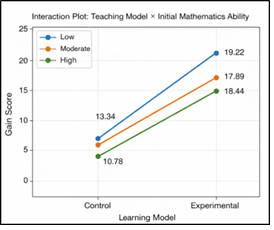
Technology integration in mathematics learning requires a theoretically grounded design rather than simple digital adoption. Within the Technological Pedagogical and Content Knowledge (TPACK) framework, Problem-Based Learning (PBL) represents pedagogical knowledge, and Nearpod represents technological knowledge. This study does not propose a new model; instead, it operationalizes TPACK through a structured instructional enactment that aligns statistical content, PBL inquiry phases, and Nearpod affordances. A quasi-experimental pretest–posttest control group design was employed with twelfth-grade students. Baseline equivalence between the experimental and control groups was confirmed using an independent-samples t-test. Enhancement in mathematical problem-solving was analyzed using gain scores, independent-samples t-tests, and two-way ANOVA. Results revealed a significant difference in scores gained between groups. A significant main effect of the instructional approach and an interaction effect with initial ability were found. Digital literacy also differed significantly between groups. These findings demonstrate that TPACK becomes instructionally meaningful when statistical content is transformed through structured inquiry and technology-mediated representation, although students’ initial mathematics ability moderates’ effectiveness.
Full text article
References
Arends, R. I. (2012). Learning to teach (9th ed.). McGraw-Hill.
Belland, B. R., Walker, A. E., & Kim, N. J. (2017). A Bayesian network meta-analysis to synthesize the influence of contexts of scaffolding use on cognitive outcomes in STEM education. Review of Educational Research, 87(6), 1042–1081. https://doi.org/10.3102/0034654317723009
Badan Pengembangan Sumber Daya Manusia dan Penelitian Komunikasi dan Informatika. (2024). Indeks masyarakat digital Indonesia 2024. Kementerian Komunikasi dan Informatika Republik Indonesia.
Bond, M., Buntins, K., Bedenlier, S., Zawacki-Richter, O., & Kerres, M. (2020). Mapping research in student engagement and educational technology in higher education: A systematic evidence map. International Journal of Educational Technology in Higher Education, 17(1), 1–30. https://doi.org/10.1186/s41239-019-0176-8
Carretero, S., Vuorikari, R., & Punie, Y. (2017). DigComp 2.1: The digital competence framework for citizens with eight proficiency levels and examples of use. Publications Office of the European Union. https://doi.org/10.2760/38842
Chiu, T. K. F. (2021). Digital support for student engagement in blended learning based on self-determination theory. Computers in Human Behavior, 124, 106909. https://doi.org/10.1016/j.chb.2021.106909
Creswell, J. W. (2017). Research design: Qualitative, quantitative, and mixed methods approaches (4th ed.). SAGE Publications.
Crompton, H., Burke, D., Jordan, K., & Wilson, S. W. G. (2021). Learning with technology during emergencies: A systematic review of K–12 education. British Journal of Educational Technology, 52(4), 1554–1575. https://doi.org/10.1111/bjet.13114
Davar, N. F., Dewan, M. A. A., & Zhang, X. (2025). AI chatbots in education: Challenges and opportunities. Information, 16(3), Article 235. https://doi.org/10.3390/info16030235
Drijvers, P., Doorman, M., Boon, P., Reed, H., & Gravemeijer, K. (2010). The teacher and the tool: Instrumental orchestrations in the technology-rich mathematics classroom. Educational Studies in Mathematics, 75(2), 213–234. https://doi.org/10.1007/s10649-010-9254-5
Ellianawati, E., Sipayung, E. S. P. S., Subali, B., Linuwih, S., & Simbulas, L. J. (2025). Effectiveness of Nearpod-based interactive learning media in enhancing students’ scientific literacy and numeracy in renewable energy topic. Jurnal Pendidikan MIPA, 26(1), 367–380. https://doi.org/10.23960/jpmipa.v26i1.pp367-380
Eshet, Y. (2004). Digital literacy: A conceptual framework for survival skills in the digital era. Journal of Educational Multimedia and Hypermedia, 13(1), 93–106. https://www.learntechlib.org/primary/p/4793/
Garfield, J. B., & Ben-Zvi, D. (2008). Developing students’ statistical reasoning: Connecting research and teaching practice. Springer. https://doi.org/10.1007/978-1-4020-8383-9
Gilster, P. (1997). Digital literacy. Wiley Computer Pub.
Hiebert, J., & Grouws, D. A. (2007). The effects of classroom mathematics teaching on students’ learning. In F. K. Lester Jr. (Ed.), Second handbook of research on mathematics teaching and learning (pp. 371–404). Information Age Publishing.
Hmelo-Silver, C. E. (2004). Problem-based learning: What and how do students learn? Educational Psychology Review, 16(3), 235–266. https://doi.org/10.1023/B:EDPR.0000034022.16470.f3
Hoesny, M. U., Setyosari, P., Praherdhiono, H., & Suryati, N. (2024). Integrating digital technology into project-based learning: Its impact on speaking performance. MEXTESOL Journal, 48(3), 1–12. https://doi.org/10.61871/mj.v48n3-4
Howard, S. K., Tondeur, J., Siddiq, F., & Scherer, R. (2021). Ready, set, go! Profiling teachers’ readiness for online teaching in secondary education. Technology, Pedagogy and Education, 30(1), 141–158. https://doi.org/10.1080/1475939X.2020.1839543
Hwang, G. J., & Chien, S. Y. (2022). Definition, roles, and potential research issues of the metaverse in education: An artificial intelligence perspective. Computers and Education: Artificial Intelligence, 3, 100082. https://doi.org/10.1016/j.caeai.2022.100082
Jenkins, H. (2007). Confronting the challenges of participatory culture: Media education for the 21st century. MIT Press.
Kaliisa, R., Palmer, E., & Miller, J. (2019). Mobile learning in higher education: A comparative analysis of developed and developing country contexts. British Journal of Educational Technology, 50(2), 546–561. https://doi.org/10.1111/bjet.12583
Kilpatrick, J., Swafford, J., & Findell, B. (Eds.). (2001). Adding it up: Helping children learn mathematics. National Academy Press. https://doi.org/10.17226/9822
Kirschner, P. A., Sweller, J., & Clark, R. E. (2006). Why minimal guidance during instruction does not work: An analysis of the failure of constructivist, discovery, problem-based, experiential, and inquiry-based teaching. Educational Psychologist, 41(2), 75–86. https://doi.org/10.1207/s15326985ep4102_1
Krupp, L., Steinert, S., Kiefer-Emmanouilidis, M., Avila, K. E., Lukowicz, P., Kuhn, J., Küchemann, S., & Karolus, J. (2024). Unreflected acceptance: Investigating the negative consequences of ChatGPT-assisted problem solving in physics education. Frontiers in Artificial Intelligence and Applications, 386, 199–212. https://doi.org/10.3233/FAIA240195
Labadze, L., Grigolia, M., & Machaidze, L. (2023). Role of AI chatbots in education: Systematic literature review. International Journal of Educational Technology in Higher Education, 20(1), 1–17. https://doi.org/10.1186/s41239-023-00426-1
Lazonder, A. W., & Harmsen, R. (2016). Meta-analysis of inquiry-based learning: Effects of guidance. Review of Educational Research, 86(3), 681–718. https://doi.org/10.3102/0034654315627366
Martin, A. (2008). Digital literacy and the “digital society.” In C. Lankshear & M. Knobel (Eds.), Digital literacies: Concepts, policies, and practices (pp. 151–176). Peter Lang.
Mirza, Q. U. A., & Rebello, N. S. (2025). Help or hype? Students’ engagement and perception of using AI to solve physics problems. Physics Education Research Conference Proceedings, 294–299. https://doi.org/10.1119/perc.2025.pr.Mirza
Mishra, P., & Koehler, M. J. (2006). Technological pedagogical content knowledge: A framework for teacher knowledge. Teachers College Record, 108(6), 1017–1054. https://doi.org/10.1111/j.1467-9620.2006.00684.x
National Council of Teachers of Mathematics. (2000). Executive summary: Principles and standards for school mathematics. NCTM. https://www.nctm.org/Standards-and-Positions/Principles-and-Standards/
Ng, W. (2012). Can we teach digital natives digital literacy? Computers & Education, 59(3), 1065–1078. https://doi.org/10.1016/j.compedu.2012.04.016
OECD. (2023). PISA 2022 results: Factsheets Indonesia. OECD Publishing. https://www.oecd.org/en/publications/pisa-results-2022-volume-iii-factsheets_041a90f1-en/indonesia_a7090b49-en.html
Polya, G. (2014). How to solve it: A new aspect of mathematical method (2nd ed.). Princeton University Press.
Redecker, C. (2017). European framework for the digital competence of educators: DigCompEdu. Publications Office of the European Union. https://doi.org/10.2760/159770
Ribble, M. (2011). Digital citizenship in schools: Nine elements all students should know (2nd ed.). International Society for Technology in Education.
Schoenfeld, A. H. (2016). Learning to think mathematically: Problem solving, metacognition, and sense making in mathematics. Journal of Education, 196(2), 1–38. https://doi.org/10.1177/002205741619600202
Scherer, R., Siddiq, F., & Tondeur, J. (2019). The technology acceptance model (TAM): A meta-analytic structural equation modeling approach to explaining teachers’ adoption of digital technology in education. Computers & Education, 128, 13–35. https://doi.org/10.1016/j.compedu.2018.09.009
Stylianides, G. J., & Stylianides, A. J. (2014). Impacting positively on students’ mathematical problem-solving beliefs: An instructional intervention of short duration. The Journal of Mathematical Behavior, 33, 8–29. https://doi.org/10.1016/j.jmathb.2013.09.001
Tanjung, S., Baharuddin, Ampera, D., Farihah, & Jahidin, I. (2022). Problem-based learning (PBL) model with technological, pedagogical, and content knowledge (TPACK) approach. International Journal of Education in Mathematics, Science and Technology, 10(3), 735–751. https://doi.org/10.46328/ijemst.2510
van Laar, E., van Deursen, A. J. A. M., van Dijk, J. A. G. M., & de Haan, J. (2017). The relation between 21st-century skills and digital skills: A systematic literature review. Computers in Human Behavior, 72, 577–588. https://doi.org/10.1016/j.chb.2017.03.010
Voogt, J., Fisser, P., Pareja Roblin, N., Tondeur, J., & van Braak, J. (2013). Technological pedagogical content knowledge: A review of the literature. Journal of Computer Assisted Learning, 29(2), 109–121. https://doi.org/10.1111/j.1365-2729.2012.00487.x
Ying, C. L., Osman, S., Kurniati, D., Masykuri, E. S., Kumar, J. A., & Hanri, C. (2020). Difficulties that students face when learning algebraic problem-solving. Universal Journal of Educational Research, 8(11), 5405–5413. https://doi.org/10.13189/ujer.2020.081143
Zhai, X. (2022). ChatGPT for next generation science learning. Computers and Education: Artificial Intelligence, 3, 100072. https://doi.org/10.1016/j.caeai.2022.100072
Authors
Copyright (c) 2026 Hafsah Adha Diana, Nadya Syifa Utami, Fatimah Fatmawati

This work is licensed under a Creative Commons Attribution-NonCommercial 4.0 International License.