Development of a Workplace Well-being Scale in the Context of Islamic Boarding Schools (Pesantren)
DOI:
https://doi.org/10.23917/indigenous.v10i1.7191Keywords:
Workplace well-being, Pesantren, Development of measuring instrumentsAbstract
This research explores workplace well-being in the context of Islamic boarding schools in Indonesia, with a focus on aspects of justice, sincerity, obedience and calling. Workplace well-being in Islamic boarding schools includes a healthy work environment, social support, work-life balance, recognition of contributions, career development, and access to physical and mental health resources. Pesantren as an integral Islamic educational institution in Indonesian Muslim society has a unique approach to workplace well-being, which involves the values of simplicity, sincerity, independence, Islamic brotherhood and independence. This research uses a mixed method which combines qualitative grounded theory and quantitative descriptive approaches. Data was collected through interviews, observation and Likert scales. Development of an Islamic boarding school workplace well-being measuring tool through the steps of developing a theoretical framework, preparing a blueprint, writing items, expert assessment, reading tests, psychological scale tests, differential power and reliability analysis, and preparing the final scale. This measuring instrument was tested using Exploratory Factor Analysis (EFA) and Confirmatory Factor Analysis (CFA), showing four factors that were able to explain 90% of the variance in workplace well-being in Islamic boarding schools. CFA results indicate high validity and reliability of this instrument. Workplace well-being in Islamic boarding schools is formed from justice, sincerity, obedience and calling, which emphasizes internal spirit over external needs, approaching workplace spirituality from a positive psychology perspective. This research concludes that workplace well-being in Islamic boarding schools can be achieved through a harmonious balance between justice, obedience, sincerity and calling in carrying out Islamic boarding school duties.
References
Abidin, S. T., & Faizah, S. I. (2021). Kesejahteraan Ustadz dari Prespektif Maqashid Syariah. Jurnal Ekonomi Syariah Teori Dan Terapan. https://doi.org/10.20473/vol8iss20212pp141-146 DOI: https://doi.org/10.20473/vol8iss20212pp141-146
Aiken, L. R. (1984). Three Coefficients for Analyzing the Reliability and Validity of Ratings. Educational and Psychological Measurement. DOI: https://doi.org/10.1177/0013164485451012
Aryanti, R. D., Sari, E. Y. D., & Widiana, H. S. (2020). A Literature Review of Workplace Well-Being. https://doi.org/10.2991/assehr.k.201017.134 DOI: https://doi.org/10.2991/assehr.k.201017.134
Balakrishnan, K., Harji, M. B., & Angusamy, A. (2021). Intercultural communication competence: well-being and performance of multicultural teams. Journal of Intercultural Communication. https://doi.org/10.36923/jicc.v21i2.16 DOI: https://doi.org/10.36923/jicc.v21i2.16
Besnoy, K. D., Dantzler, J., Besnoy, L. R., & Byrne, C. (2016). Using exploratory and confirmatory factor analysis to measure construct validity of the Traits, Aptitudes, and Behaviors Scale (TABS). Journal for the Education of the Gifted. https://doi.org/10.1177/0162353215624160 DOI: https://doi.org/10.1177/0162353215624160
Brown, T. A. (2008). Confirmatory Factor Analysis for Applied Research: Second Edition. In Guilford Press.
Costello, A. B., & Osborne, J. W. (2005). Best Practices in Exploratory Factor Analysis: Four Recommendations for Getting The Most from Your Analysis. Practical Assessment, Research and Evaluation, 10(7).
Creswell, J. W., & Creswell, J. D. (2018). Research Design: Qualitative, Quantitative, and Mixed Methods Approaches (Fifth). SAGE Publications Inc.
Edosomwan, H. S., Oguegbe, T. M., & Joe-Akunne, C. O. (2023). Workplace Well-Being in Manufacturing Organizations in Nigeria: Do Employee Green Behavior, Core Self-Evaluations and Empowering Leadership Matter? International Journal of Occupational Safety and Health. https://doi.org/10.3126/ijosh.v13i1.42236 DOI: https://doi.org/10.3126/ijosh.v13i1.42236
Hairunnisa, H. (2020). Pengaruh Etika Kerja Islam dan Budaya Organisasi Terhadap Kepuasan Kerja. Psikoborneo: Jurnal Ilmiah Psikologi. https://doi.org/10.30872/psikoborneo.v8i1.4868 DOI: https://doi.org/10.30872/psikoborneo.v8i1.4868
Johnston, M., Dixon, D., Hart, J., Glidewell, L., Schröder, C., & Pollard, B. (2014). Discriminant content validity: A quantitative methodology for assessing content of theory-based measures, with illustrative applications. British Journal of Health Psychology. https://doi.org/10.1111/bjhp.12095 DOI: https://doi.org/10.1111/bjhp.12095
Kartawijaya, F., Sabil, S., Lestiningsih, A. S., & Widodo, D. P. (2021). Pengaruh Lingkungan Kerja Dan Reward Terhadap Kinerja Karyawan. Jurnal Ekobistek. https://doi.org/10.35134/ekobistek.v8i1.25 DOI: https://doi.org/10.35134/ekobistek.v8i1.25
Kim, U. (2000). Indigenous, cultural, and cross-cultural psychology: A theoretical, conceptual, and epistemological analysis. Asian Journal of Social Psychology. https://doi.org/10.1111/1467-839X.00068 DOI: https://doi.org/10.1111/1467-839X.00068
Kinowska, H., & Sienkiewicz, Ł. J. (2020). Influence of algorithmic management practices on workplace well-being – evidence from European organisations. Information Technology and People. https://doi.org/10.1108/ITP-02-2022-0079 DOI: https://doi.org/10.1108/ITP-02-2022-0079
Kun, A., & Gadanecz, P. (2022). Workplace happiness, well-being and their relationship with psychological capital: A study of Hungarian Teachers. Current Psychology. https://doi.org/10.1007/s12144-019-00550-0 DOI: https://doi.org/10.1007/s12144-019-00550-0
Mahipalan, M., & Sheena, S. (2019). Workplace Spirituality and Subjective Happiness Among High School Teachers: Gratitude As A Moderator. Explore. https://doi.org/10.1016/j.explore.2018.07.002 DOI: https://doi.org/10.1016/j.explore.2018.07.002
Murti, D. C., & Hertinjung, W. S. (2017). Peran Daya Juang dengan Prestasi Tahfidzul Qur’an. Jurnal Indigenous, 2(1), 60–66. https://doi.org/10.23917/indigenous.v2i1.4983
Nasution, N. A. (2020). Lembaga Pendidikan Islam Pesantren. Al-Muaddib: Jurnal Ilmu-Ilmu Sosial Dan Keislaman .
Nejad, H. G., Nejad, F. G., & Farahani, T. (2021). Adaptability and Workplace Subjective Well-Being: The Effects of Meaning and Purpose on Young Workers in The Workpalce. Canadian Journal of Career Development. https://doi.org/10.53379/cjcd.2021.70 DOI: https://doi.org/10.53379/cjcd.2021.70
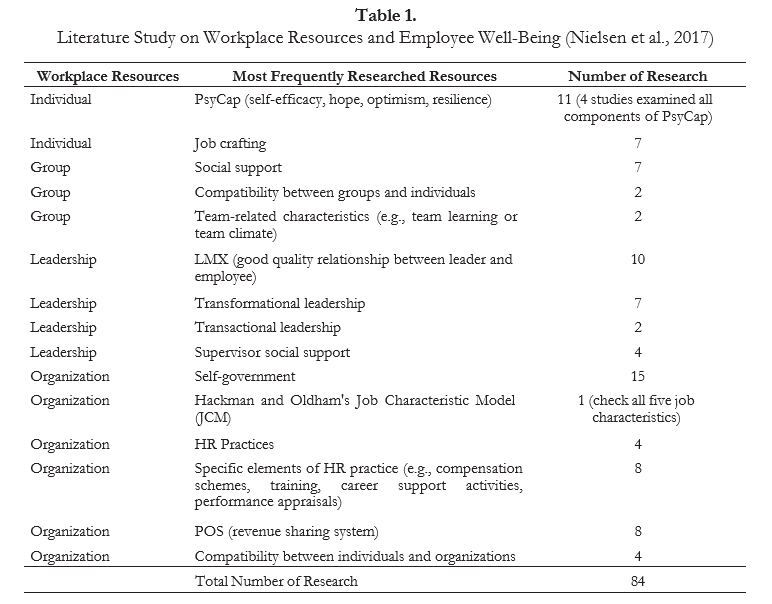
Nielsen, K., Nielsen, M. B., Ogbonnaya, C., Känsälä, M., Saari, E., & Isaksson, K. (2017). Workplace resources to improve both employee well-being and performance: A systematic review and meta-analysis. In Work and Stress. https://doi.org/10.1080/02678373.2017.1304463 DOI: https://doi.org/10.1080/02678373.2017.1304463
Norris, M., & Lecavalier, L. (2010). Evaluating the use of exploratory factor analysis in developmental disability psychological research. Journal of Autism and Developmental Disorders. https://doi.org/10.1007/s10803-009-0816-2 DOI: https://doi.org/10.1007/s10803-009-0816-2
Nowakowski-Sims, E., & Kumar, J. (2020). Soul work in social work. Journal of Religion and Spirituality in Social Work. https://doi.org/10.1080/15426432.2019.1706694 DOI: https://doi.org/10.1080/15426432.2019.1706694
Pangestu, M. A. D., & Muhammad, A. (2022). Analisis Faktor The Brief Jail Mental Health Screen Versi Bahasa Indonesia Dengan Metode Confirmatory Factor Analysis (CFA). Ganaya: Jurnal Ilmu Sosial Dan Humaniora, 5, 424–437. https://jayapanguspress.penerbit.org/index.php/ganaya424
Purwastuti, L. A. (2018). Membangun Karakter Toleran- Militan melalui Pendidikan Inspiratif. HUMANIKA. https://doi.org/10.21831/hum.v11i1.20996 DOI: https://doi.org/10.21831/hum.v11i1.20996
Rani, H. A., Radzi, A. R., Alias, A. R., Almutairi, S., & Rahman, R. A. (2022). Factors Affecting Workplace Well-Being: Building Construction Projects. Buildings. https://doi.org/10.3390/buildings12070910 DOI: https://doi.org/10.3390/buildings12070910
Sampson, M. G. (2019). Statistical Analysis in JASP: A Guide for Students (2nd ed.). SAGE Publications.
Suhartini, A. dkk. (2020). Keihlasan dan Arti Pentingnya Dalam Mengelola Pendidikan. AJIQS.
Supardi, A. M., Salehah, M., & Komalasari, S. (2023). The Role of Workplace Well-Being on Employee Work Satisfaction (Vol. 1). Atlantis Press SARL. https://doi.org/10.2991/978-2-38476-032-9_33 DOI: https://doi.org/10.2991/978-2-38476-032-9_33
Syifa, W. S. M., Solahudin, D., & Rahman, A. (2020). Manajemen Strategik Pondok Pesantren dalam Mencetak Kader Da’i Multi Bahasa. Tadbir: Jurnal Manajemen Dakwah. https://doi.org/10.15575/tadbir.v5i4.957 DOI: https://doi.org/10.15575/tadbir.v5i4.957
Umar, J., & Nisa, Y. F. (2020). Uji Validitas Konstruk dengan CFA dan Pelaporannya. Jurnal Pengukuran Psikologi Dan Pendidikan Indonesia. https://doi.org/10.15408/jp3i.v9i2.16964 DOI: https://doi.org/10.15408/jp3i.v9i2.16964
Wijayanto, A. Y., & Fauziah, N. (2020). Kerja Di Genggamanku Keluarga Di Hatiku Interpretative Phenomenological Analysis Tentang Work-Family Balance Pada Ibu Bekerja. Jurnal EMPATI. https://doi.org/10.14710/empati.2018.20149 DOI: https://doi.org/10.14710/empati.2018.20149
Wilcox, A., & Koontz, A. (2022). Workplace well-being: Shifting from an individual to an organizational framework. In Sociology Compass. https://doi.org/10.1111/soc4.13035 DOI: https://doi.org/10.1111/soc4.13035
Workplace, F. (2021). Future Workplace 2021 HR Sentiment Survey: Five Strategic Priorities for The Hybrid Workplace. Lyra. https://futureworkplacenetwork.com/wp-content/uploads/2022/01/2021-HR-Sentiment-Survey-eBook.pdf
Yusup, F. (2018). Uji Validitas dan Reliabilitas Instrumen Penelitian Kuantitatif. Jurnal Tarbiyah : Jurnal Ilmiah Kependidikan. https://doi.org/10.18592/tarbiyah.v7i1.2100 DOI: https://doi.org/10.18592/tarbiyah.v7i1.2100
Zamralita, Z., & Wilis, A. P. L. (2023). Workplace Well-Being untuk Meningkatkan Work Engagement Karyawan. Jurnal Muara Ilmu Ekonomi Dan Bisnis. https://doi.org/10.24912/jmieb.v7i2.26050 DOI: https://doi.org/10.24912/jmieb.v7i2.26050
Zarkasyi, H. F. (2020). Imam Zarkasyi’s modernization of pesantren in Indonesia: (A case study of darussalam gontor). Qudus International Journal of Islamic Studies. https://doi.org/10.21043/QIJIS.V8I1.5760 DOI: https://doi.org/10.21043/qijis.v8i1.5760
Submitted
Published
How to Cite
Issue
Section
License
Copyright (c) 2025 Aryani Pamukti, Fathul Lubabin Nuqul, Retno Mangestuti, Mohammad Mahpur, Elok Halimatus Sa’diyah

This work is licensed under a Creative Commons Attribution 4.0 International License.