The Role of Culture, Leader Motivating Language, and Procedural Justice Climate on Organizational Identification
DOI:
https://doi.org/10.23917/indigenous.v9i2.4793Keywords:
Leader-motivating language, Organizational culture, Organizational identification, Procedural justice climateAbstract
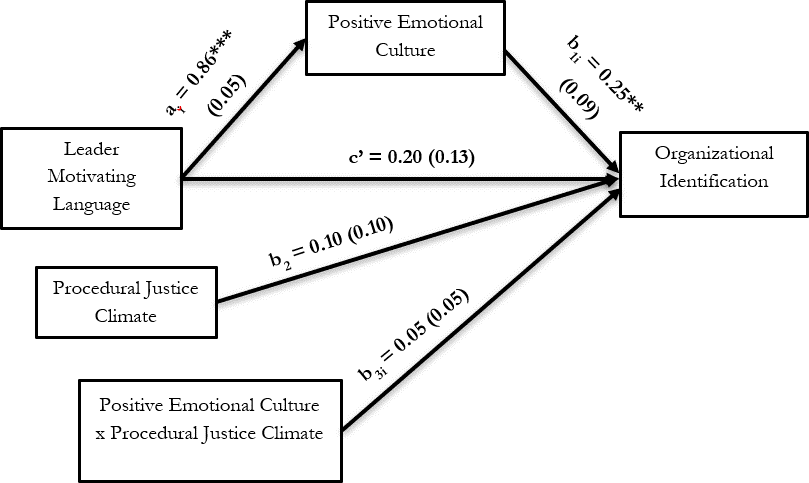
Emotional culture is a crucial aspect that can enhance organizational outcomes. However, research on affective aspects in the workplace is still underexplored and requires further investigation. This study aims to examine the moderating role of procedural justice climate in the relationship between leader motivating language and organizational identification, mediated by positive emotional culture. The study involved 158 employees with a minimum of one year of work experience and has a superior in their workplace. Measurement tools included the leader motivating language scale (α = 0.95), organizational identification scale (α = 0.74), positive emotional culture scale (α = 0.94), and procedural justice climate scale (α = 0.88), adapted into the Indonesian language. Data was analyzed with PROCESS model 4 and 14 by Hayes. The results indicate that 1) positive emotional culture partially mediates the relationship between leader motivating language and organizational identification; 2) procedural justice climate does not moderate the relationship between leader motivating language and organizational identification mediated by positive emotional culture. This study lays the groundwork for further research, suggesting that organizations should focus on organizatinal culture, therefore it increases employee’s organizational identification.
References
Ashforth, B. E., & Mael, F. (1989). Social identity theory and the organization. The Academy of Management Review, 14(1), 20–39. https://doi.org/10.2307/258189 DOI: https://doi.org/10.2307/258189
Barsade, S. G., & O’Neill, O. A. (2014). What’s love got to do with it? A longitudinal study of the culture of companionate love and employee and client outcomes in a long-term care setting. Administrative Science Quarterly, 59(4), 551–598. https://doi.org/10.1177/0001839214538636 DOI: https://doi.org/10.1177/0001839214538636
Barsade, S. G., & O’Neill, O. A. (2016). Manage your emotional culture. Harvard Business Review, 1–19. https://hbr.org/2016/01/manage-your-emotional-culture
Colquitt, J. A. (2004). Does the justice of the one interact with the justice of the many? Reactions to procedural justice in teams. Journal of Applied Psychology, 89(4), 633–646. https://doi.org/10.1037/0021-9010.89.4.633 DOI: https://doi.org/10.1037/0021-9010.89.4.633
Denison, D. R. (1996). What is the difference between organizational culture and organizational climate? A native’s point of view on a decade of paradigm wars. Academy of Management Review, 21(3), 619–654. https://doi.org/10.5465/AMR.1996.9702100310 DOI: https://doi.org/10.2307/258997
Dozier, D. M., Grunig, L. A., & Grunig, J. E. (1995). Manager’s guide to excellence in public relations and communication management. Lawrence Erlbaum Associates, Inc. https://www.routledge.com/Managers-Guide-to-Excellence-in-Public-Relations-and-Communication-Management/Dozier-Grunig-Grunig/p/book/9780805818109?srsltid=AfmBOoptwZn0ifXGLSRLiNOUyjHkNThc-6Z27h4LnL4TopD21s6NIpi9
Ellemers, N., & Haslam, S. A. (2012). Social identity theory. In Handbook of Theories of Social Psychology (pp. 379–398). SAGE Publications Ltd. https://doi.org/10.4135/9781446249222.n45 DOI: https://doi.org/10.4135/9781446249222.n45
Gebauer, J. E., Paulhus, D. L., & Neberich, W. (2013). Big two personality and religiosity across cultures: Communals as religious conformists and agentics as religious contrarians. Social Psychological and Personality Science, 4(1), 21–30. https://doi.org/10.1177/1948550612442553 DOI: https://doi.org/10.1177/1948550612442553
Grunig, J. E., & Dozier, D. M. (2002). Excellent public relations and effective organizations: A study of communication management in three countries (1st ed.). Routledge. https://doi.org/10.4324/9781410606617 DOI: https://doi.org/10.4324/9781410606617
Gutierrez-Wirsching, S., Mayfield, J., Mayfield, M., & Wang, W. (2015). Motivating language as a mediator between servant leadership and employee outcomes. Management Research Review, 38(12), 1234–1250. https://doi.org/10.1108/MRR-01-2014-0009 DOI: https://doi.org/10.1108/MRR-01-2014-0009
Hartmann, S., Weiss, M., Hoegl, M., & Carmeli, A. (2021). How does an emotional culture of joy cultivate team resilience? A sociocognitive perspective. Journal of Organizational Behavior, 42(3), 313–331. https://doi.org/10.1002/job.2496 DOI: https://doi.org/10.1002/job.2496
Hsiung, H. H. (2012). Authentic leadership and employee voice behavior: A multi-level psychological process. Journal of Business Ethics, 107(3), 349–361. https://doi.org/10.1007/s10551-011-1043-2 DOI: https://doi.org/10.1007/s10551-011-1043-2
Islam, G. (2014). Social identity theory. In Encyclopedia of Critical Psychology (pp. 1781–1783). Springer New York. https://doi.org/10.1007/978-1-4614-5583-7_289 DOI: https://doi.org/10.1007/978-1-4614-5583-7_289
Lee, E. S., Park, T. Y., & Koo, B. J. (2015). Identifying organizational identification as a basis for attitudes and behaviors: A meta-analytic review. Psychological Bulletin, 141(5), 1049–1080. https://doi.org/10.1037/bul0000012 DOI: https://doi.org/10.1037/bul0000012
Lee, Y. (2022). Dynamics of millennial employees’ communicative behaviors in the workplace: The role of inclusive leadership and symmetrical organizational communication. Personnel Review, 51(6), 1629–1650. https://doi.org/10.1108/PR-09-2020-0676 DOI: https://doi.org/10.1108/PR-09-2020-0676
Lin, X., & Leung, K. (2014). What signals does procedural justice climate convey? The roles of group status, and organizational benevolence and integrity. Journal of Organizational Behavior, 35(4), 464–488. https://doi.org/10.1002/job.1899 DOI: https://doi.org/10.1002/job.1899
Mayfield, J., & Mayfield, M. (2018). Motivating language theory. Springer International Publishing. https://doi.org/10.1007/978-3-319-66930-4 DOI: https://doi.org/10.1007/978-3-319-66930-4
Mayfield, M., Mayfield, J., & Walker, R. (2021). Leader communication and follower identity: How leader motivating language shapes organizational identification through cultural knowledge and fit. International Journal of Business Communication, 58(2), 221–253. https://doi.org/10.1177/2329488420979285 DOI: https://doi.org/10.1177/2329488420979285
Men, L. R., & Robinson, K. L. (2018). It’s about how employees feel! Examining the impact of emotional culture on employee–organization relationships. Corporate Communications: An International Journal, 23(4), 470–491. https://psycnet.apa.org/doi/10.1108/CCIJ-05-2018-0065 DOI: https://doi.org/10.1108/CCIJ-05-2018-0065
Men, L. R., & Yue, C. A. (2019). Creating a positive emotional culture: Effect of internal communication and impact on employee supportive behaviors. Public Relations Review, 45(3), 1–12. https://doi.org/10.1016/j.pubrev.2019.03.001 DOI: https://doi.org/10.1016/j.pubrev.2019.03.001
Men, R. L., & Bowen, S. A. (2017). Excellence in internal communication management. Business Expert Press. https://www.businessexpertpress.com/books/excellence-in-internal-communication-management/
Michel, A., Stegmaier, R., & Sonntag, K. (2010). I scratch your back - you scratch mine. Do procedural justice and organizational identification matter for employees’ cooperation during change? Journal of Change Management, 10(1), 41–59. https://doi.org/10.1080/14697010903549432 DOI: https://doi.org/10.1080/14697010903549432
Myers, K. K., Davis, C. W., Schreuder, E. R., & Seibold, D. R. (2016). Organizational identification: A mixed methods study exploring students’ relationship with their university. Communication Quarterly, 64(2), 210–231. https://doi.org/10.1080/01463373.2015.1103285 DOI: https://doi.org/10.1080/01463373.2015.1103285
Podsakoff, P. M., MacKenzie, S. B., & Podsakoff, N. P. (2012). Sources of method bias in social science research and recommendations on how to control it. Annual Review of Psychology, 63(1), 539–569. https://doi.org/10.1146/annurev-psych-120710-100452 DOI: https://doi.org/10.1146/annurev-psych-120710-100452
Robbins, S. P., & Judge, T. A. (2013). Organizational Behavior (15th ed.). Pearson.
Schein, E. H., & Schein, P. (2017). Organizational culture and leadership (5th ed.). John Wiley & Sons, Inc. https://lib-pasca.unpak.ac.id/index.php?p=fstream-pdf&fid=2910&bid=14980
Smidts, A., Pruyn, A. T. H., & Van Riel, C. B. M. (2001). The impact of employee communication and perceived external prestige on organizational identification perceived external prestige erasmus research institute of management. Academy of Management Journal, 44(5), 1051–1062. https://doi.org/10.5465/3069448 DOI: https://doi.org/10.2307/3069448
Sriramesh, K., Grunig, J. E., & Dozier, D. M. (1996). Observation and measurement of two dimensions of organizational culture and their relationship to public relations. Journal of Public Relations Research, 8(4), 229–261. https://doi.org/10.1207/s1532754xjprr0804_0 DOI: https://doi.org/10.1207/s1532754xjprr0804_02
Sun, R., Li, J. Y. Q., Lee, Y., & Tao, W. (2023). The role of symmetrical internal communication in improving employee experiences and organizational identification during covid-19 pandemic-induced organizational change. International Journal of Business Communication, 60(4), 1398–1426. https://doi.org/10.1177/23294884211050628 DOI: https://doi.org/10.1177/23294884211050628
Tajfel, H. (1978). Differentiation between social groups: Studies in the social psychology of intergroup relations. Academic Press.
Van Knippenberg, D., & Van Schie, E. C. M. (2000). Foci and correlates of organizational identification. Journal of Occupational and Organizational Psychology, 73(2), 137–147. https://doi.org/10.1348/096317900166949 DOI: https://doi.org/10.1348/096317900166949
Vijayalakshmi, V., & Bhattacharyya, S. (2012). Emotional contagion and its relevance to individual behavior and organizational processes: A position paper. Journal of Business and Psychology, 27(3), 363–374. https://doi.org/10.1007/s10869-011-9243-4 DOI: https://doi.org/10.1007/s10869-011-9243-4
Warrick, D. D. (2017). What leaders need to know about organizational culture. Business Horizons, 60(3), 395–404. https://doi.org/10.1016/j.bushor.2017.01.011 DOI: https://doi.org/10.1016/j.bushor.2017.01.011
Whitman, D. S., Caleo, S., Carpenter, N. C., Horner, M. T., & Bernerth, J. B. (2012). Fairness at the collective level: A meta-analytic examination of the consequences and boundary conditions of organizational justice climate. Journal of Applied Psychology, 97(4), 776–791. https://doi.org/10.1037/a0028021 DOI: https://doi.org/10.1037/a0028021
Yue, C. A., Men, L. R., & Ferguson, M. A. (2021). Examining the effects of internal communication and emotional culture on employees’ organizational identification. International Journal of Business Communication, 58(2), 169–195. https://doi.org/10.1177/2329488420914066 DOI: https://doi.org/10.1177/2329488420914066
Submitted
Accepted
Published
How to Cite
Issue
Section
License
Copyright (c) 2024 Fathiyah Faiha Faisal, Alice Salendu

This work is licensed under a Creative Commons Attribution 4.0 International License.