Islamic Religiosity and Future Anxiety on Disabled Children’s Parents: Parental Acceptance as a Mediating Variable
DOI:
https://doi.org/10.23917/indigenous.v9i2.4648Keywords:
Future anxiety, Islamic religiosity, Parental acceptance, Disabled children’s parentsAbstract
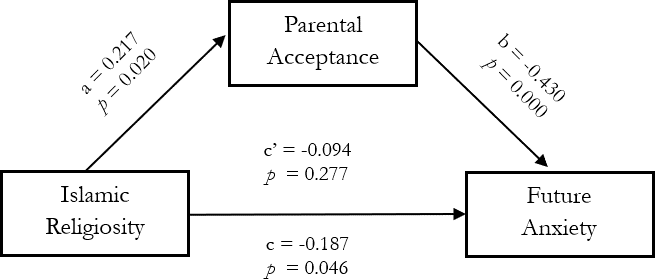
The birth of a child with special needs introduces a myriad of challenges, triggering complex psychological dynamics in parents that significantly influence their anxieties about the child's future. This research aims to delve into this intricate phenomenon by examining the role of parental acceptance as a mediator in the impact of Islamic religiosity on future anxiety among parents of children with special needs. The study involved 115 parents (46 fathers and 69 mothers) of children with special needs at SLBN Tasikmalaya, selected through purposive sampling. Data collection was executed through the administration of research questionnaires. The analytical framework employed path analysis, an integrated method amalgamating regression analysis and mediation analysis, facilitated by the use of SPSS application version 25. The calculated results revealed that Islamic religiosity exerts an indirect effect, assuaging future anxiety through the mediating influence of parental acceptance. These findings underscore the significant role of parental acceptance in mediating the impact of Islamic religiosity and its potential to contribute to the reduction of future anxiety. Consequently, the study advocates for the implementation of targeted programs aimed at promoting Islamic religiosity and fostering parental acceptance, providing a strategic avenue to mitigate the enduring impacts of future anxiety within this demographic.
References
Abdel-Khalek, A. M., Nuño, L., Gómez-Benito, J., & Lester, D. (2019). The relationship between religiosity and anxiety: A Meta-analysis. Journal of Religion and Health, 58(5), 1847–1856. https://doi.org/10.1007/s10943-019-00881-z DOI: https://doi.org/10.1007/s10943-019-00881-z
Aflakseir, A. (2012). Religiosity, personal meaning, and psychological well-being: A study among Muslim students in England. Pakistan Journal of Social and Clinical Psychology, 10(1), 27–31. https://gcu.edu.pk/pages/gcupress/pjscp/volumes/pjscp2012april-5.pdf
Alhafiza, R. G., Hanum, S., & Funun, F. (2022). Tawakkul in the Qur’an as coping mechanism for IIUM student mastery in coping with the covid-19 challenges. Mashdar: Jurnal Studi Al-Qur’an Dan Hadis, 4(2), 205–218. https://doi.org/10.15548/mashdar.v4i2.4824 DOI: https://doi.org/10.15548/mashdar.v4i2.4824
Amir, Y. (2021). Pengembangan skala religiusitas untuk subyek Muslim. Indonesian Journal for The Psychology of Religion, 1(1), 47–60. https://doi.org/10.24854/ijpr403 DOI: https://doi.org/10.24854/ijpr403
Ariesta, A. (2016). Kecemasan orang tua terhadap karier anak berkebutuhan khusus. E-Journal Bimbingan Dan Konseling, 4(5), 50–61. https://journal.student.uny.ac.id/ojs/index.php/fipbk/article/view/1154
Baron, R. M., & Kenny, D. A. (1986). The moderator–mediator variable distinction in social psychological research: Conceptual, strategic, and statistical considerations. Journal of Personality and Social Psychology, 51(6), 1173–1182. https://doi.org/10.1037/0022-3514.51.6.1173 DOI: https://doi.org/10.1037//0022-3514.51.6.1173
Beighton, C., & Wills, J. (2017). Are parents identifying positive aspects to parenting their child with an intellectual disability or are they just coping? A qualitative exploration. Journal of Intellectual Disabilities, 21(4), 325–345. https://doi.org/10.1177/1744629516656073 DOI: https://doi.org/10.1177/1744629516656073
Bernard, M. E., Vernon, A., Terjesen, M., & Kurasaki, R. (2013). Self-acceptance in the education and counseling of young people. In The strength of self-acceptance: Theory, practice and research (pp. 1–288). Springer Science + Business Media. https://doi.org/10.1007/978-1-4614-6806-6 DOI: https://doi.org/10.1007/978-1-4614-6806-6_10
Caicedo, C. (2014). Families with special needs children: Family health, functioning, and care burden. Journal of the American Psychiatric Nurses Association, 20(6), 398–407. https://doi.org/10.1177/1078390314561326 DOI: https://doi.org/10.1177/1078390314561326
Cantwell, J., Muldoon, O. T., & Gallagher, S. (2014). Social support and mastery influence the association between stress and poor physical health in parents caring for children with developmental disabilities. Research in Developmental Disabilities, 35(9), 2215–2223. https://doi.org/10.1016/j.ridd.2014.05.012 DOI: https://doi.org/10.1016/j.ridd.2014.05.012
Case, S. (2000). Refocusing on the parent: What are the social issues of concern for parents of disabled children? Disability & Society, 15(2), 271–292. https://doi.org/10.1080/09687590025676 DOI: https://doi.org/10.1080/09687590025676
Chan, K, K. S., Lam, C. B., Law, N. C. W., & Cheung, R. Y. M. (2018). From child autistic symptoms to parental affective symptoms: A family process model. Research in Developmental Disabilities, 75(2), 22–31. https://doi.org/10.1016/j.ridd.2018.02.005 DOI: https://doi.org/10.1016/j.ridd.2018.02.005
Cousino, M. K., & Hazen, R. A. (2013). Parenting stress among caregivers of children with chronic illness: A systematic review. Journal of Pediatric Psychology, 38(8), 809–828. https://doi.org/10.1093/jpepsy/jst049 DOI: https://doi.org/10.1093/jpepsy/jst049
Dabrowska, A., & Pisula, E. (2010). Parenting stress and coping styles in mothers and fathers of pre-school children with autism and down syndrome. Journal of Intellectual Disability Research, 54(3), 266–280. https://doi.org/10.1111/j.1365-2788.2010.01258.x DOI: https://doi.org/10.1111/j.1365-2788.2010.01258.x
Emerson, E., Hatton, C., Llewellyn, G., Blacker, J., & Graham, H. (2006). Socio-economic position, household composition, health status and indicators of the well-being of mothers of children with and without intellectual disabilities. Journal of Intellectual Disability Research, 50(12), 862–873. https://doi.org/10.1111/j.1365-2788.2006.00900.x DOI: https://doi.org/10.1111/j.1365-2788.2006.00900.x
Epli, H., Batık, M. V., Çabuker, N. D., & Çelik, S. B. (2021). The relationship between perceived parental rejection and dating anxiety: The mediating role of interpersonal cognitive distortions. International Journal of Progressive Education, 17(3), 70–85. https://doi.org/10.29329/ijpe.2021.346.5 DOI: https://doi.org/10.29329/ijpe.2021.346.5
Fradelos, E. C., Alikari, V., Vus, V., Papathanasiou, I. V., Tsaras, K., Tzavella, F., & Lekka, D. (2020). Assessment of the relation between religiosity, anxiety, depression and psychological resilience in nursing staff. Health Psychology Research, 8(1), 30–34. https://doi.org/10.4081/hpr.2020.8234 DOI: https://doi.org/10.4081/hpr.2020.8234
Frazier, C., Mintz, L. B., & Mobley, M. (2005). A multidimensional look at religious involvement and psychological well-being among urban elderly African Americans. Journal of Counseling Psychology, 52(4), 583–590. https://doi.org/10.1037/0022-0167.52.4.583 DOI: https://doi.org/10.1037/0022-0167.52.4.583
Gallagher, S., Phillips, A. . C., Lee, H., & Carroll, D. (2015). The association between spirituality and depression in parents caring for children with developmental disabilities: Social support and/or last resort. Journal of Religion and Health, 54(1), 358–370. https://doi.org/10.1007/s10943-014-9839-x DOI: https://doi.org/10.1007/s10943-014-9839-x
Ginsburg, G. S., Siqueland, L., Masia-Warner, C., & Hedtke, K. A. (2004). Anxiety disorders in children: Family matters. Cognitive and Behavioral Practice, 11(1), 28–43. https://doi.org/10.1016/S1077-7229(04)80005-1 DOI: https://doi.org/10.1016/S1077-7229(04)80005-1
Girli, A. (2018). Being a parent of a child with autism from diagnosis to the university years. Journal of Education and Training Studies, 6(5), 55–64. https://doi.org/10.11114/jets.v6i5.3146 DOI: https://doi.org/10.11114/jets.v6i5.3146
Gray, K. M., Piccinin, A. M., Hofer, S. M., Mackinnon, A., Bontempo, D. E., Einfeld, S. L., Parmenter, T., & Tonge, B. J. (2011). The longitudinal relationship between behavior and emotional disturbance in young people with intellectual disability and maternal mental health. Research in Developmental Disabilities, 32(3), 1194–1204. https://doi.org/10.1016/j.ridd.2010.12.044 DOI: https://doi.org/10.1016/j.ridd.2010.12.044
Haryanto, H. C. (2017). Apa manfaat dari agama? (Studi pada masyarakat beragama Islam di Jakarta). Insight: Jurnal Ilmiah Psikologi, 18(1), 19–31. https://doi.org/10.26486/psikologi.v18i1.346 DOI: https://doi.org/10.26486/psikologi.v18i1.346
Hatzmann, J., Heymans, H. S. A., Ferrer-i-Carbonell, A., van Praag, B. M. S., & Grootenhuis, M. A. (2008). Hidden consequences of success in pediatrics: Parental health-related quality of life-results from the care project. Pediatrics, 122(5), 1030–1038. https://doi.org/10.1542/peds.2008-0582 DOI: https://doi.org/10.1542/peds.2008-0582
Heiman, T. (2002). Parents of children with disabilities: Resilience, coping, and future expectations. Journal of Developmental and Physical Disabilities, 14(2), 159–171. https://doi.org/10.1023/A:1015219514621 DOI: https://doi.org/10.1023/A:1015219514621
Insani, M. F., Rusmana, A., & Hakim, Z. (2021). Kecemasan orangtua terhadap masa depan anak penyandang disabilitas intelektual di SLB C Bina Asih Cianjur. Jurnal Ilmiah Rehabilitasi Sosial (Rehsos), 3(1), 40–57. https://doi.org/10.31595/rehsos.v3i1.377 DOI: https://doi.org/10.31595/rehsos.v3i1.377
Jaworski, R. (2002). Psychologiczna analiza religijności w perspektywie komunikacji interpersonalnej. Studia Psychologica, 3(3), 143–166. https://bazhum.muzhp.pl/media//files/Studia_Psychologica/Studia_Psychologica-r2002-t-n3/Studia_Psychologica-r2002-t-n3-s143-166/Studia_Psychologica-r2002-t-n3-s143-166.pdf
Jiu, C. K., Pitri, P., Pratama, K., Usman, U., & Kardiatun, T. (2020). Maternal barriers in raising children with special needs in rural areas: A qualitative study. IJDS Indonesian Journal of Disability Studies, 7(2), 156–163. https://doi.org/10.21776/ub.ijds.2020.007.02.04 DOI: https://doi.org/10.21776/ub.ijds.2020.007.02.04
Kamila, A. (2022). Psikoterapi dzikir dalam menangani kecemasan. Happiness, Journal of Psychology and Islamic Science, 4(1), 40–49. https://doi.org/10.30762/happiness.v4i1.363 DOI: https://doi.org/10.30762/happiness.v4i1.363
Khamis, I. E. M., Ramchahi, A. A., & Yusoff, M. Y. Z. M. (2023). Permissibility of the literal translation of the glorious qur’an: A new perspective. QURANICA - International Journal of Quranic Research, 15(2), 25–57. https://ejournal.um.edu.my/index.php/quranica/article/view/49030/16572
Lardieri, L. A., Blacher, J., & Swanson, H. L. (2000). Sibling relationships and parent stress in families of children with and without learning disabilities. Learning Disability Quarterly, 23(2), 105–116. https://doi.org/10.2307/1511140 DOI: https://doi.org/10.2307/1511140
Lee, J. (2013). Maternal stress, well-being, and impaired sleep in mothers of children with developmental disabilities: A literature review. Research in Developmental Disabilities, 34(11), 4255–4273. https://doi.org/10.1016/j.ridd.2013.09.008 DOI: https://doi.org/10.1016/j.ridd.2013.09.008
Leondari, A., & Gialamas, V. (2009). Religiosity and psychological well-being. International Journal of Psychology, 44(4), 241–248. https://doi.org/10.1080/00207590701700529 DOI: https://doi.org/10.1080/00207590701700529
Lestari, R., & Pratisti, W. D. (2019). Gratitude and optimism in parents of children with autism spectrum disorders (ASD). South East Asia Journal of Contemporary Business, Economics and Law, 20(6), 10–16. https://seajbel.com/wp-content/uploads/2019/12/KLICELS14_07.pdf DOI: https://doi.org/10.17148/IARJSET.2019.61204
Liu, Q., Shono, M., & Kitamura, T. (2009). Psychological well-being, depression, and anxiety in Japanese university students. Depression and Anxiety, 26(8), 99–105. https://doi.org/10.1002/da.20455 DOI: https://doi.org/10.1002/da.20455
Maham, R., & Bhatti, O. K. (2019). Impact of taqwa (islamic piety) on employee happiness: A study of Pakistan’s banking sector. Cogent Business & Management, 6(1), 1–22. https://doi.org/10.1080/23311975.2019.1678554 DOI: https://doi.org/10.1080/23311975.2019.1678554
Manik, M. T., Rini, W. N. E., Lanita, U., Sari, R. E., & Sari, P. (2023). The relationship of knowledge, parental support and self-acceptance with the level of anxiety of young women in facing puberty at Junior High School 7 Jambi City in 2022. KESANS : International Journal of Health and Science, 2(9), 720–729. https://doi.org/10.54543/kesans.v2i9.187 DOI: https://doi.org/10.54543/kesans.v2i9.187
McCann, D., Bull, R., & Winzenberg, T. (2012). The daily patterns of time use for parents of children with complex needs: A systematic review. Journal of Child Health Care, 16(1), 26–52. https://doi.org/10.1177/1367493511420186 DOI: https://doi.org/10.1177/1367493511420186
McLean, S., & Halstead, E. J. (2021). Resilience and stigma in mothers of children with emotional and behavioural difficulties. Research in Developmental Disabilities, 108(12), 1–9. https://doi.org/10.1016/j.ridd.2020.103818 DOI: https://doi.org/10.1016/j.ridd.2020.103818
McLeod, B. D., Wood, J. J., & Weisz, J. R. (2007). Examining the association between parenting and childhood anxiety: A meta-analysis. Clinical Psychology Review, 27(2), 155–172. https://doi.org/10.1016/j.cpr.2006.09.002 DOI: https://doi.org/10.1016/j.cpr.2006.09.002
Mugno, D., Ruta, L., D’Arrigo, V. G., & Mazzone, L. (2007). Impairment of quality of life in parents of children and adolescents with pervasive developmental disorder. Health and Quality of Life Outcomes, 5(1), 22–30. https://doi.org/10.1186/1477-7525-5-22 DOI: https://doi.org/10.1186/1477-7525-5-22
Mukti, D. I., & Dewi, D. S. E. (2013). Relationship between religiosity with self acceptance. Psychoidea, 11(2), 35–40. http://jurnalnasional.ump.ac.id/index.php/PSYCHOIDEA/article/view/512
Navalkar, P. G. (2010). Fathering a child with a disability in India: A perspective from Mumbai. Childhood Education, 86(6), 389–393. https://doi.org/10.1080/00094056.2010.10523175 DOI: https://doi.org/10.1080/00094056.2010.10523175
Nugraha, A. D. (2020). Memahami kecemasan: Perspektif psikologi Islam. IJIP : Indonesian Journal of Islamic Psychology, 2(1), 1–22. https://doi.org/10.18326/ijip.v2i1.1-22 DOI: https://doi.org/10.18326/ijip.v2i1.1-22
Padden, C., & James, J. E. (2017). Stress among parents of children with and without autism spectrum disorder: A comparison involving physiological indicators and parent self-reports. Journal of Developmental and Physical Disabilities, 29(4), 567–586. https://doi.org/10.1007/s10882-017-9547-z DOI: https://doi.org/10.1007/s10882-017-9547-z
Perwataningrum, C. Y., Prabandari, Y. S., & Sulistyarini, R. I. (2016). Pengaruh terapi relaksasi zikir terhadap penurunan tingkat kecemasan pada penderita dispepsia. Jurnal Intervensi Psikologi (JIP), 8(2), 147–164. https://doi.org/10.20885/intervensipsikologi.vol8.iss2.art1 DOI: https://doi.org/10.20885/intervensipsikologi.vol8.iss2.art1
Qolbi, F. H. (2020). Masa emerging adulthood pada mahasiswa : Kecemasan akan masa depan. Psikoislamika : Jurnal Psikologi Dan Psikologi Islam, 17(1), 44–54. https://doi.org/10.18860/psi.v17i1.8821 DOI: https://doi.org/10.18860/psi.v17i1.8821
Rahmawati, S. (2018). Pengaruh religiusitas terhadap penerimaan diri orangtua anak autis di sekolah luar biasa xyz. Jurnal Al-Azhar Indonesia Seri Humaniora, 4(1), 17–24. https://doi.org/10.36722/sh.v4i1.248 DOI: https://doi.org/10.36722/sh.v4i1.248
Raina, G., & Goyal, P. (2018). Impact of Parental Acceptance-Rejection on Anxiety among Metropolitan Adolescents. Indian Journal of Mental Health, 5(3), 301. https://doi.org/10.30877/ijmh.5.3.2018.301-306 DOI: https://doi.org/10.30877/IJMH.5.3.2018.301-306
Rohner, R. P., & Ali, S. (2020). Parental acceptance-rejection questionnaire (PARQ). In V. Zeigler-Hill & T. K. Shackelford (Eds.), Encyclopedia of personality and individual differences. Springer International Publishing. https://doi.org/10.1007/978-3-319-28099-8 DOI: https://doi.org/10.1007/978-3-319-24612-3_56
Santoso, D. S., & Rizkiana, A. (2019). Positive thinking on future anxiety on hearing impaired college students. Proceedings of the 4th ASEAN Conference on Psychology, Counselling, and Humanities (ACPCH 2018), 194–196. https://doi.org/10.2991/acpch-18.2019.48 DOI: https://doi.org/10.2991/acpch-18.2019.48
Sari, N. P. R. D., & Dewi, D. K. (2013). Perbedaan tingkat kecemasan masa depan karir anak ditinjau dari self concept dan persepsi dukungan sosial pada ibu anak tunarungu di SMALB-B Karya Mulia Surabaya. Character: Jurnal Penelitian Psikologi, 2(1), 1–7. https://ejournal.unesa.ac.id/index.php/character/article/view/4593
Sayyidah, A. F., Mardhotillah, R. N., Sabila, N. A., & Rejeki, S. (2022). Peran religiusitas Islam dalam meningkatkan kesejahteraan psikologis. Al-Qalb : Jurnal Psikologi Islam, 13(2), 103–115. https://doi.org/10.15548/alqalb.v13i2.4274 DOI: https://doi.org/10.15548/alqalb.v13i2.4274
Scandrett, K. G., & Mitchell, S. L. (2009). Religiousness, religious coping, and psychological well-being in nursing home residents. Journal of the American Medical Directors Association, 10(8), 581–586. https://doi.org/10.1016/j.jamda.2009.06.001 DOI: https://doi.org/10.1016/j.jamda.2009.06.001
Setiawati, D. N. A. E., Baitina, A., Hormasyah, R. D., & Latipun. (2019). Religiosity and anxiety relationship in mediation by self- acceptance in patients with chronic disease. The International Journal of Indian Psychology, 7(1), 836–846. https://doi.org /%2010.25215/0701.094
Seymour, M., Giallo, R., & Wood, C. E. (2017). The psychological and physical health of fathers of children with autism spectrum disorder compared to fathers of children with long-term disabilities and fathers of children without disabilities. Research in Developmental Disabilities, 69(10), 8–17. https://doi.org/10.1016/j.ridd.2017.07.018 DOI: https://doi.org/10.1016/j.ridd.2017.07.018
Shreve-Neiger, A. K., & Edelstein, B. A. (2004). Religion and anxiety: A critical review of the literature. Clinical Psychology Review, 24(4), 379–397. https://doi.org/10.1016/j.cpr.2004.02.003 DOI: https://doi.org/10.1016/j.cpr.2004.02.003
Syahdiah, U., Fadhliah, M., Nurhidayah, Sakni, A. S., & Lutfiah, W. (2022). Efektivitas terapi zikir dalam mengurangi kecemasan pada remaja menjelang ujian. Jurnal Penelitian Ilmu Ushuluddin, 2(2), 370–380. https://doi.org/10.15575/jpiu.v2i2.15578
Syams, A. U. N. A., Hamid, H., & Akmal, N. (2023). Kontribusi penerimaan diri terhadap kecemasan menghadapi masa depan pada mahasiswa Universitas Negeri Makassar. Jurnal Psikologi Talenta Mahasiswa, 2(3), 18–25. https://ojs.unm.ac.id/jtm/article/view/35244/20526
Vasile, C. (2013). An evaluation of self-acceptance in adults. Procedia - Social and Behavioral Sciences, 78(5), 605–609. https://doi.org/10.1016/j.sbspro.2013.04.360 DOI: https://doi.org/10.1016/j.sbspro.2013.04.360
Wardani, D. S. (2009). Strategi coping orang tua menghadapi anak autis. Indigenous: Jurnal Ilmiah Psikologi, 11(1), 26–35. https://doi.org/10.23917/indigenous.v11i1.1628
Weaver, A. J., & Flannelly, K. J. (2004). The role of religion/spirituality for cancer patients and their caregivers. Southern Medical Journal, 97(12), 1210–1214. https://doi.org/10.1097/01.SMJ.0000146492.27650.1C DOI: https://doi.org/10.1097/01.SMJ.0000146492.27650.1C
Widiastuti, M., & Yuniarti, K. W. (2017). Penerimaan diri sebagai mediator hubungan antara religiusitas dengan kecemasan pada penyandang diabetes mellitus tipe 2. Psikologika: Jurnal Pemikiran Dan Penelitian Psikologi, 22(1), 1–13. https://doi.org/10.20885/psikologika.vol22.iss1.art1 DOI: https://doi.org/10.20885/psikologika.vol22.iss1.art1
Widyastuti, T., Hakim, M. A., & Lilik, S. (2019). Terapi zikir sebagai intervensi untuk menurunkan kecemasan pada lansia. Gadjah Mada Journal of Professional Psychology (GamaJPP), 5(2), 147–157. https://doi.org/10.22146/gamajpp.13543 DOI: https://doi.org/10.22146/gamajpp.13543
Wijanarko, A., & Ediati, A. (2016). Penerimaan diri pada orangtua yang memiliki anak skizofrenia.. Jurnal Empati, 5(3), 424–429. https://doi.org/10.14710/empati.2016.15362
Winarsih, T., & Rohmadan, Z. V. (2021). The anxiety of children’s future in parents who have children with autism spectrum disorder. Proceedings of the International Conference on Health and Medical Sciences (AHMS 2020), 216–218. https://doi.org/10.2991/ahsr.k.210127.048 DOI: https://doi.org/10.2991/ahsr.k.210127.048
Wood, J. J., McLeod, B. D., Sigman, M., Hwang, W., & Chu, B. C. (2003). Parenting and childhood anxiety: theory, empirical findings, and future directions. Journal of Child Psychology and Psychiatry, 44(1), 134–151. https://doi.org/10.1111/1469-7610.00106 DOI: https://doi.org/10.1111/1469-7610.00106
Wulandari, T., Masyitoh, Queentari, R., Suhaimah, Bahri, S., & Nahuda. (2022). The effect of prayer on mental health conditions in children and adolescent. Muhammadiyah International Public Health and Medicine Proceeding, 333–338. https://e-journal.fkmumj.ac.id/index.php/miphmp/issue/view/5 DOI: https://doi.org/10.61811/miphmp.v1i2.215
Yaffe, Y. (2018). Establishing specific links between parenting styles and the s-anxieties in children: Separation, social, and school. Journal of Family Issues, 39(5), 1419–1437. https://doi.org/10.1177/0192513X17710286 DOI: https://doi.org/10.1177/0192513X17710286
Yusfina, Y. (2016). Pengaruh penerimaan diri dan kecerdasan emosi dengan kecemasan pada pegawai yang akan menghadapi masa pensiun. Psikoborneo: Jurnal Ilmiah Psikologi, 4(2), 233–239. https://doi.org/10.30872/psikoborneo.v4i2.4006 DOI: https://doi.org/10.30872/psikoborneo.v4i2.4006
Zaini, A. (2015). Shalat sebagai terapi bagi pengidap gangguan kecemasan dalam perspektif psikoterapi Islam. Konseling Religi: Jurnal Bimbingan Konseling Islam, 6(2), 319–334. http://jurnal.uinsu.ac.id/index.php/alijaz/article/view/5421
Zaleski, Z. (1996). Future anxiety: Concept, measurement, and preliminary research. Personality and Individual Differences, 21(2), 165–174. https://doi.org/10.1016/0191-8869(96)00070-0 DOI: https://doi.org/10.1016/0191-8869(96)00070-0
Zulfian, Z., & Saputra, H. (2021). Mengenal konsep tawakal Ibnu ‘Athaillah Al-Sakandari. Jurnal Pemikiran Islam, 1(1), 74–88. https://doi.org/10.22373/jpi.v1i1.10357 DOI: https://doi.org/10.22373/jpi.v1i1.10357
Submitted
Accepted
Published
How to Cite
Issue
Section
License
Copyright (c) 2024 Gumelar Ferdiansyah Pratama, Herdian, Nur'aeni, Suwarti

This work is licensed under a Creative Commons Attribution 4.0 International License.