Adolescents’ Sexuality: The Role of Parent and Microsystem Education of Sexuality
DOI:
https://doi.org/10.23917/indigenous.v9i2.4350Keywords:
Religiosity, Sexuality Education, References of Social Media, Peer AttachmentAbstract
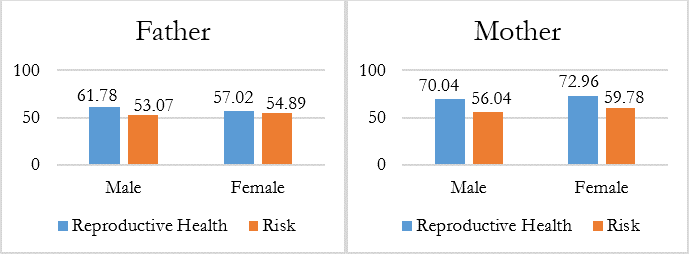
Adolescence is a phase in which a person experiences significant change and maturity in their sexuality. Adolescents seek various sources of knowledge through media access and peers and try to follow their peers' attitudes, values, and behaviour. Religious beliefs and parental interactions are other contributing elements. This research aims to determine the influence of religiosity, sexuality education, references from social media, and peer attachment on sexuality. This research was conducted in Tangerang Regency and involved 180 respondents, consisting of high school, vocational, and madrasah aliyah students in grades 10 and 11, with the criteria of being Muslim, living with both parents and actively using social media. The sampling technique used a stratified non-proportional random sampling method, which was carried out using an interview method using a questionnaire. Adolescents in this study had high religiosity. Sexuality education carried out by fathers is categorized as low, while sexuality education carried out by mothers is categorized as moderate. Adolescents' social media references and peer attachment are categorized as moderate. The results of the Structural Equation Modeling analysis found that religiosity, sexuality education, references from social media, and peer attachment had a significant positive effect on sexuality. These findings imply the importance of interventions that target good and correct values related to sexuality, both in the smallest domain, namely the family, through instilling religious values, sexuality education, and parental control over references in media consumed by adolescents and their peers, as well as more broadly, namely government policy.
References
Alfita, L., Ulfa, T. C., & Ghalda, I. (2021). The relationship between religiosity and sexual behavior in adolescents in Merdeka Square, Langsa City. International Journal of Islamic Educational Psychology, 2(2), 166–176. https://doi.org/10.18196/ijiep.v2i2.13090 DOI: https://doi.org/10.18196/ijiep.v2i2.13090
Arisjulyanto, D., Ismail, D., Fuad, A., & Putri, C. R. (2023). The impact of social media on sexual behaviour of adolescents in West Lombok district. AIP Conference Proceedings, 2621(1), 40008. https://doi.org/10.1063/5.0143175 DOI: https://doi.org/10.1063/5.0143175
Armsden, G. C., & Greenberg, M. T. (1987). The inventory of parent and peer attachment: Individual differences and their relationship to psychological well-being in adolescence. Journal of Youth and Adolescence, 16(5), 427–454. https://doi.org/10.1007/BF02202939 DOI: https://doi.org/10.1007/BF02202939
Azinar, M. (2013). Perilaku seksual pranikah berisiko terhadap kehamilan tidak diinginkan. Jurnal Kesehatan Masyarakat, 8(2), 153–160. https://doi.org/10.15294/kemas.v8i2.2639
Baams,L.,Dubas,J.S.,&vanAken,M.A.G.(2017).Comprehensivesexualityeducationasalongitudinal predictor of LGBTQ name-calling and perceived willingness to intervene in school. Journal of Youth and Adolescence, 46(5), 931–942. https://doi.org/10.1007/s10964-017-0638-z DOI: https://doi.org/10.1007/s10964-017-0638-z
Bingenheimer, J. B., Asante, E., & Ahiadeke, C. (2015). Peer influences on sexual activity among adolescents in Ghana. Studies in Family Planning, 46(1), 1–19. https://doi.org/10.1111/ j.1728-4465.2015.00012.x DOI: https://doi.org/10.1111/j.1728-4465.2015.00012.x
Bronfenbrenner, U. (1979). The ecology of human development: Experiments by nature and design. DOI: https://doi.org/10.4159/9780674028845
Harvard University Press.
Burgess, V., Dziegielewski, S. F., & Green, C. E. (2005). Improving comfort about sex communication between parents and their adolescents: Practice-based research within a teen sexuality group. Brief Treatment and Crisis Intervention, 5(4), 379–390. https://doi. org/10.1093/brief-treatment/mhi023 DOI: https://doi.org/10.1093/brief-treatment/mhi023
Byers, E. S., Sears, H. A., & Foster, L. R. (2013). Factors associated with middle school students’ perceptions of the quality of school-based sexual health education. Sex Education: Sexuality, Society and Learning, 13(2), 214–227. https://doi.org/10.1080/14681811.2012.727083 DOI: https://doi.org/10.1080/14681811.2012.727083
Chibuye, S., & Kumatongo, B. (2022). The role of comprehensive sexuality education on child sexual abuse and teenage pregnancy among secondary school learners. International Journal of Educational Innovation and Research, 1(2), 135–143. https://doi.org/10.31949/ijeir. v1i2.2477 DOI: https://doi.org/10.31949/ijeir.v1i2.2477
Darmasih, R. (2018). Faktor yang mempengaruhi perilaku seks pranikah pada remaja sma di Surakarta [Skripsi, Universitas Muhammadiyah Surakarta]. Universitas Muhammadiyah Surakarta. Retrieved from https://eprints.ums.ac.id/5959/1/J410050007.PDF
Dias, H., Amendoeira, J., Silva, M., & Cruz, O. (2019). O7 The influence of peers on the experience of sexuality in adolescence: A scoping review. European Journal of Public Health, 29(Supplement_2), ckz098.003. https://doi.org/10.1093/eurpub/ckz098.003 DOI: https://doi.org/10.1093/eurpub/ckz098.003
Dittus, P. J., & Jaccard, J. (2000). Adolescents’ perceptions of maternal disapproval of sex: Relationship to sexual outcomes. Journal of Adolescent Health, 26(4), 268–278. https://doi. org/10.1016/S1054-139X(99)00096-8 DOI: https://doi.org/10.1016/S1054-139X(99)00096-8
Fevriasanty, F. I., Suyanto, B., Soedirham, O., Sugihartati, R., & Ahsan, A. (2021). Effects of social media exposure on adolescent sexual attitudes and behavior: A systematic review. International Journal of Public Health Science, 10(2), 272–280. https://doi.org/10.11591/ ijphs.v10i2.20818 DOI: https://doi.org/10.11591/ijphs.v10i2.20818
Goldfarb, E. S., & Lieberman, L. D. (2021). Three decades of research: the case for comprehensive sex education. Journal of Adolescent Health, 68(1), 13–27. https://doi.org/10.1016/j. jadohealth.2020.07.036 DOI: https://doi.org/10.1016/j.jadohealth.2020.07.036
Haglund, K. A., & Fehring, R. J. (2010). The association of religiosity, sexual education, and parental factors with risky sexual behaviors among adolescents and young adults. Journal of Religion and Health, 49(4), 460–472. https://doi.org/10.1007/s10943-009-9267-5 DOI: https://doi.org/10.1007/s10943-009-9267-5
Hong, L., He, X., Xue, L., Guo, L., & Liu, W. (2022). Comprehensive sexuality education improves primary students’ explicit and implicit attitudes toward homosexuality. International Journal of Sexual Health, 34(3), 503–520. https://doi.org/10.1080/19317611.2022.2067282 DOI: https://doi.org/10.1080/19317611.2022.2067282
Hurlock, E. B. (1981). Developmental psychology: life span approach (5th Ed.). Tata Mc. Graw Hill. Husein, M. (2018). Islam dan seksualitas. Retrieved from http://www.huseinmuhammad.net/islam-dan-seksualitas/
Lansford, J. (2021, June 15). The importance of fathers for child development. Psychology Today. Retrieved from: https://www.psychologytoday.com/intl/blog/parenting-and- culture/202106/the-importance-fathers-child-development
Laporte, H., Rousseau, A., & Eggermont, S. (2020). Effects of media on sexual behaviors In The International Encyclopedia of Media Psychology (pp. 1–12). https://doi.org/https://doi. org/10.1002/9781119011071.iemp0110 DOI: https://doi.org/10.1002/9781119011071.iemp0110
Lavanya, T., Priyanka, K., & Koshy, R. (2011). A study on parents’ attitudes towards sex and sex education. Indian Journal of Community Psychology, 7(1), 88–98. Retrieved from http:// ovidsp.ovid.com/ovidweb.cgi?T=JS&PAGE=reference&D=psyc8&NEWS=N&AN= 2011-09823-012
Lefkowitz, E. S., Gillen, M. M., Shearer, C. L., & Boone, T. L. (2004). Religiosity, sexual behaviors, and sexual attitudes during emerging adulthood. Journal of Sex Research, 41(2), 150–159. https://doi.org/10.1080/00224490409552223 DOI: https://doi.org/10.1080/00224490409552223
Mahajan, P., & Sharma, N. (2005). Parents attitude towards imparting sex education to their adolescent girls. The Anthropologist, 7, 197–199. Retrieved from https://api.semanticscholar. org/CorpusID:70615488 DOI: https://doi.org/10.1080/09720073.2005.11890907
Mahmudah, M., Yaunin, Y., & Lestari, Y. (2016). Faktor-Faktor yang berhubungan dengan perilaku seksual remaja di kota Padang. Jurnal Kesehatan Andalas, 5(2), 448–455. https:// doi.org/10.25077/jka.v5i2.538 DOI: https://doi.org/10.25077/jka.v5i2.538
Mariani, N. N., & Arsy, D. F. (2017). Faktor-faktor yang mempengaruhi perilaku seksual remaja di SMPN 15 kota Cirebon tahun 2017. Care : Jurnal Ilmiah Ilmu Kesehatan, 5(3), 443. https://doi.org/10.33366/cr.v5i3.711 DOI: https://doi.org/10.33366/cr.v5i3.711
Mbarushimana, V., Goldstein, S., & Conco, D. N. (2023). “Not just the consequences, but also the pleasurable sex”: a review of the content of comprehensive sexuality education for early adolescents in Rwanda. BMC Public Health, 23(1), 1–14. https://doi.org/10.1186/s12889- 022-14966-0 DOI: https://doi.org/10.1186/s12889-022-14966-0
McMillan, C., Felmlee, D., & Osgood, D. (2018). Peer influence, friend selection, and gender: how network processes shape adolescent smoking, drinking, and delinquency. Social Networks, 55, 86–96. https://doi.org/10.1016/j.socnet.2018.05.008 DOI: https://doi.org/10.1016/j.socnet.2018.05.008
Miller, B. C., Norton, M. C., Fan, X., & Christopherson, C. R. (1998). Pubertal development, parental communication, and sexual values in relation to adolescent sexual behaviors. The Journal of Early Adolescence, 18(1), 27–52. https://doi.org/10.1177/0272431698018001002 DOI: https://doi.org/10.1177/0272431698018001002
Murphy-Erby, Y., Stauss, K., Boyas, J., & Bivens, V. (2011). Voices of Latino parents and teens: Tailored strategies for parent–child communication related to sex. Journal of Children and Poverty, 17(1), 125–138. https://doi.org/10.1080/10796126.2011.531250 DOI: https://doi.org/10.1080/10796126.2011.531250
National Commission for Child Protection. (2016). Komnas PA sebut 97% remaja indonesia pernah akses pornografi. Media Indonesia. Retrieved from https://mediaindonesia. com/humaniora/71598/komnas-pa-sebut-97-remaja-indonesia-pernah-akses- pornografi#google_vignette
National Population and Family Planning Board (BKKBN), Statistics Indonesia (BPS), Ministry of Health (Kemenkes), & ICF. (2018). Indonesia demographic and health survey 2017: Adolescent reproductive health. BKKBN, BPS, Kemenkes, ICF. Retrieved from https://dhsprogram.com/pubs/pdf/FR343/FR343.pdf
Negy, C., Velezmoro, R., Reig-Ferrer, A., Smith-Castro, V., & Livia, J. (2016). Parental influence on their adult children’s sexual values: a multi-national comparison between the United States, Spain, Costa Rica, and Peru. Archives of Sexual Behavior, 45(2), 477–489. https:// doi.org/10.1007/s10508-015-0570-9 DOI: https://doi.org/10.1007/s10508-015-0570-9
Odimegwu, C. (2005). Influence of religion on adolescent sexual attitudes and behaviour among Nigerian university students: affiliation or commitment?. African Journal of Reproductive Health, 9(2), 125–140. https://doi.org/10.2307/3583469 DOI: https://doi.org/10.2307/3583469
Okigbo, C. C., Kabiru, C. W., Mumah, J. N., Mojola, S. A., & Beguy, D. (2015). Influence of parental factors on adolescents’ transition to first sexual intercourse in Nairobi, Kenya: A longitudinal study. Reproductive Health, 12(1), 1–12. https://doi.org/10.1186/s12978-015-0069-9 DOI: https://doi.org/10.1186/s12978-015-0069-9
Peci, B. (2017). Peer influence and adolescent sexual behavior trajectories: links to sexual initation. European Journal of Multidisciplinary Studies, 4(3), 96. https://doi.org/10.26417/ejms.v4i3. p96-105 DOI: https://doi.org/10.26417/ejms.v4i3.p96-105
Pikunas, L. (1976). Human development and emergent science. McGraw Hill
Polacek, G., Rojas, V., Levitt, S., & Mika, V. (2006). Media and sex. American Journal of Sexuality Education, 1(4), 51–69. https://doi.org/10.1300/J455v01n04_05 DOI: https://doi.org/10.1300/J455v01n04_05
Potard, C., Courtois, R., & Rusch, E. (2008). The influence of peers on risky sexual behaviour during adolescence. The European Journal of Contraception & Reproductive Health Care, 13(3), 264–270. https://doi.org/10.1080/13625180802273530 DOI: https://doi.org/10.1080/13625180802273530
Pratiwi, H., Ismail, M., & Haida, R. N. (2023). Sexuality education for early childhood: themes, methods, and perceptions of raudhatul athfal (RA) educators. Jurnal Pendidikan Dan Kebudayaan, 8(1), 35–55. https://doi.org/10.24832/jpnk.v8i1.3786 DOI: https://doi.org/10.24832/jpnk.v8i1.3786
Quinn, D. A., & Lewin, A. (2019). Family religiosity, parental monitoring, and emerging adults’ sexual behavior. Religions, 10(2), 0–16. https://doi.org/10.3390/rel10020114 DOI: https://doi.org/10.3390/rel10020114
Raffaelli, M., & Green, S. (2003). Parent-adolescent communication about sex: Retrospective reports by Latino college students. Journal of Marriage and Family, 65(2), 474–481. https:// doi.org/10.1111/j.1741-3737.2003.00474.x DOI: https://doi.org/10.1111/j.1741-3737.2003.00474.x
Salsabila, D. F., Rofifah, R., Natanael, Y., & Ramdani, Z. (2019). Uji validitas konstruk indonesian- psychological measurement of islamic religiousness (I-PMIR). Jurnal Psikologi Islam Dan Budaya, 2(2), 1–10. https://doi.org/10.15575/jpib.v2i2.5494 DOI: https://doi.org/10.15575/jpib.v2i2.5494
Scott, S., & Jackson, S. (2010). Theorising Sexuality. Professor Sue Scott.
Sekar Arumi, M., & Faradilla, N. (2023). Adolescent religiosity and pre-marital sexual behavior: The mediating role of pre-marital sexual attitude. INSPIRA: Indonesian Journal of Psychological Research, 4(1), 54–61. https://doi.org/10.32505/inspira.v4i1.5877 DOI: https://doi.org/10.32505/inspira.v4i1.5877
Shashi Kumar, R., Das, R. C., Prabhu, H. R. A., Bhat, P. S., Prakash, J., Seema, P., & Basannar, D.
R. (2013). Interaction of media, sexual activity and academic achievement in adolescents. Medical Journal Armed Forces India, 69(2), 138–143. https://doi.org/https://doi. org/10.1016/j.mjafi.2012.08.031 DOI: https://doi.org/10.1016/j.mjafi.2012.08.031
Sijtsma, H., Lee, N. C., Braams, B. R., Hollarek, M., Walsh, R. J., van Buuren, M., &
Krabbendam, L. (2023). The development of adolescent trust behavior. Journal of Experimental Child Psychology, 231, 105653. https://doi.org/10.1016/j.jecp.2023.105653 DOI: https://doi.org/10.1016/j.jecp.2023.105653
Sousa, M. A., Oliveira, P. A., Lima, M. D. O., & Freitas, M. I. F. (2020). Influence of social media for sexuality of adolescents. European Journal of Public Health, 30(Supplement_5), ckaa166.050. https://doi.org/10.1093/eurpub/ckaa166.050 DOI: https://doi.org/10.1093/eurpub/ckaa166.050
Sunarti, E. (2005). Pengaruh tekanan ekonomi keluarga, dukungan sosial, kualitas perkawinan, pengasuhan, dan kecerdasan emosi anak terhadap prestasi belajar anak. Media Gizi dan Keluarga, 29(1), 34-40. Retrieved from: http://repository.ipb.ac.id/handle/123456789/52156
Sunarti, E. (2021). Jangan sampai menyesal: lindungi keluarga dan generasi penerus bangsa dari gerakan kebebasan orientasi dan perilaku seksual menyimpang. IPB Press.
Svedin, C. G., Åkerman, I., & Priebe, G. (2011). Frequent users of pornography. A population based epidemiological study of Swedish male adolescents. Journal of Adolescence, 34(4), 779–788. https://doi.org/https://doi.org/10.1016/j.adolescence.2010.04.010 DOI: https://doi.org/10.1016/j.adolescence.2010.04.010
Theresia, F., Tjhay, F., Surilena, S., & Widjaja, N. T. (2020). Faktor-faktor yang mempengaruhi perilaku seksual siswa SMP Di Jakarta Barat. Jurnal Kesehatan Reproduksi, 11(2), 101–113. https://doi.org/10.22435/kespro.v11i2.3142.101-113 DOI: https://doi.org/10.22435/kespro.v11i2.3142.101-113
Ulfah, M. (2019). Faktor-faktor yang mempengaruhi perilaku seksual pranikah pada remaja SMP dan SMA di wilayah eks-kota administratip Cilacap. Medisains, 16(3), 137. https://doi. org/10.30595/medisains.v16i3.3733 DOI: https://doi.org/10.30595/medisains.v16i3.3733
Van Ouytsel, J., Ponnet, K.,& Walrave, M.(2014). Theassociationsbetweenadolescents’ consumption of pornography and music videos and their sexting behavior. Cyberpsychology, Behavior, and Social Networking, 17(12), 772–778. https://doi.org/10.1089/cyber.2014.0365 DOI: https://doi.org/10.1089/cyber.2014.0365
Vandenbosch, L., & Eggermont, S. (2014). The role of television in adolescents’ sexual attitudes: Exploring the explanatory value of the three-step self-objectification process. Poetics, 45, 19–35. https://doi.org/https://doi.org/10.1016/j.poetic.2014.06.002 DOI: https://doi.org/10.1016/j.poetic.2014.06.002
Wang, Z., & Uk, A. (2009). Parent-adolescent communication and sexual risk-taking behaviours of adolescents. [Master's thesis, University of Stellenbosch]. CORE. Retrieved from: https:// core.ac.uk/download/pdf/37320879.pdf.
Weeks, J. (2002). Sexuality and its discontents: Meanings, myths, and modern sexualities. Routledge https://doi.org/10.4324/9780203407462 DOI: https://doi.org/10.4324/9780203407462
Zaleski, E. H., & Schiaffino, K. M. (2000). Religiosity and sexual risk-taking behavior during the transition to college. Journal of Adolescence, 23(2), 223–227. https://doi.org/10.1006/ jado.2000.0309 DOI: https://doi.org/10.1006/jado.2000.0309
Submitted
Accepted
Published
How to Cite
Issue
Section
License
Copyright (c) 2024 Ayu Arba Zaman, Euis Sunarti, Diah Krisnatuti

This work is licensed under a Creative Commons Attribution 4.0 International License.