The Construction of the Lust Measurement Instrument According to Al-Ghazali
DOI:
https://doi.org/10.23917/indigenous.v10i1.12384Keywords:
Measuring construct of lust, measuring instruments of lust, personality, self-controlAbstract
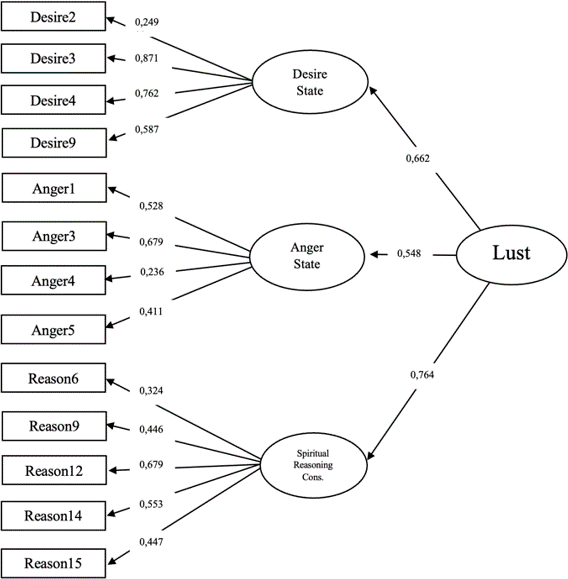
This study aims to create an instrument for measuring lust and validate the construct of lust measurement according to Al-Ghazali. In broad line, this research was carried out in two stages, namely (1) construction of a measuring instrument for nafs, and (2) field trials and evaluation of psychometric properties. The first stage produces 42 items that have been justified by 14 Subject Matter Experts (SME). In the second stage, by using confirmatory factor analysis (CFA) evaluation and through comparison of unidimensional and multidimensional models as well as through concurrent validity with a self-control scale based on data from 319 participants, a valid multidimensional model of lust measurement instrument was obtained and formed the dimensions of syahwat state, anger state, and spiritual reasoning. There are 13 valid items with a Likert model response 1-5 (Strongly Disagree - Strongly Agree). The results of the reliability estimation indicate that the lust measurement instrument has good consistency. Based on the results of additional analysis, namely the correlation with the Big Five personality traits, it also shows that personality traits have a relationship with individual lust.
References
Abu-Raiya, H., & Pargament, K. I. (2011). Empirically based psychology of Islam: Summary and critique of the literature. Mental Health, Religion & Culture, 14(2), 93–115. https://doi.org/10.1080/13674670903426482 DOI: https://doi.org/10.1080/13674670903426482
Adz-Dzakiey, H. B. (2007). Prophetic Psychology: Psikologi Kenabian: Menghidupkan Potensi dan Kepribadian Kenabian Dalam Diri (H. R. Ramadhana). Al-Manar. https://lib.ui.ac.id/detail.jsp?id=127269
Anggoro, W. J., & Widhiarso, W. (2010). Konstruksi dan identifikasi properti psikometris instrumen pengukuran kebahagiaan berbasis pendekatan indigenous psychology: studi multitrait-multimethod. Jurnal Psikologi, 37(2), 176–188. https://doi.org/10.22146/jpsi.7728
Arifin, H. H., & Milla, M. N. (2020). Adaptasi dan properti psikometrik skala kontrol diri ringkas versi Indonesia. Jurnal Psikologi Sosial, 18(2), 179–195. https://doi.org/10.7454/jps.2020.18 DOI: https://doi.org/10.7454/jps.2020.18
Azwar, S. (2018). Penyusunan Skala Psikologi (2nd ed.). Pustaka Pelajar.
Azwar, S. (2019). Reliabilitas dan Validitas (4th ed.). Pustaka Pelajar.
Badri, M. B. (1991). The Dilema of Muslim Psychologists. Pustaka Firdaus.
Chizanah, L., & Hadjam, M. N. R. (2013). Penyusunan instrumen pengukuran ikhlas. Psikologika : Jurnal Pemikiran Dan Penelitian Psikologi, 18(1), 39–49. https://doi.org/10.20885/psikologika.vol18.iss1.art5 DOI: https://doi.org/10.20885/psikologika.vol18.iss1.art5
Church, A. T. (2016). Personality traits across cultures. Current Opinion in Psychology, 8, 22–30. https://doi.org/10.1016/j.copsyc.2015.09.014 DOI: https://doi.org/10.1016/j.copsyc.2015.09.014
de Raad, B., & Mlačić, B. (2015). Big Five Factor Model, Theory and Structure. In International Encyclopedia of the Social & Behavioral Sciences (pp. 559–566). Elsevier. https://doi.org/10.1016/B978-0-08-097086-8.25066-6 DOI: https://doi.org/10.1016/B978-0-08-097086-8.25066-6
de Ridder, D. T. D., de Boer, B. J., Lugtig, P., Bakker, A. B., & van Hooft, E. A. J. (2011). Not doing bad things is not equivalent to doing the right thing: Distinguishing between inhibitory and initiatory self-control. Personality and Individual Differences, 50(7), 1006–1011. https://doi.org/10.1016/j.paid.2011.01.015 DOI: https://doi.org/10.1016/j.paid.2011.01.015
Etikawati, A. I., Siregar, J. R., Jatnika, R., & Widjaja, H. (2019). Pengembangan instrumen pengasuhan berbasis nilai budaya jawa. Jurnal Ilmu Keluarga Dan Konsumen, 12(3), 208–222. https://doi.org/10.24156/jikk.2019.12.3.208 DOI: https://doi.org/10.24156/jikk.2019.12.3.208
Fachrunisa, R. A., & Chizanah, L. (2020). Al-ghazali’s psychological construct of nafsu. International Journal of Islamic Psychology, 3(1), 10–21. https://journal.iamphome.org/index.php/IJIP/article/view/9
Fahmi, M. (2016). Nalar kritis terhadap konsep nafsu Al-Ghazali. At-Turas: Jurnal Studi Keislaman, 3(2), 175–187 https://doi.org/10.33650/at-turas.v3i2.188
Farmawati, C., & Hidayati, N. (2019). Penyusunan dan pengembangan alat ukur islamic personality scale (IPS). Jurnal Psikologi Islam Dan Budaya, 2(1), 19–30. https://doi.org/10.15575/jpib.v2i1.4318 DOI: https://doi.org/10.15575/jpib.v2i1.4318
Feist, J., & Feist, G. J. (2008). Theories of Personality (7th ed.). McGraw-Hill Higher Education.
Furr, R. M. (2021). Psychometrics: An Introduction (4th ed.). SAGE Publications.
Haque, A. (2004). Psychology from islamic perspective: contributions of early muslim scholars and challenges to contemporary muslim psychologists. Journal of Religion and Health, 43(4), 357–377. https://doi.org/10.1007/s10943-004-4302-z DOI: https://doi.org/10.1007/s10943-004-4302-z
Haryono, S. (2016). Metode SEM Untuk Penelitian Manajemen dengan AMOS, LISREL dan PLS. PT. Intermedia Personalia Utama.
Hu, L., & Bentler, P. M. (1999). Cutoff criteria for fit indexes in covariance structure analysis: Conventional criteria versus new alternatives. Structural Equation Modeling: A Multidisciplinary Journal, 6(1), 1–55. https://doi.org/10.1080/10705519909540118 DOI: https://doi.org/10.1080/10705519909540118
Husin, H. (2018). Id, ego dan superego dalam pendidikan islam. Al Qalam: Jurnal Ilmiah Keagamaan Dan Kemasyarakatan, 11(23), 47–64. https://doi.org/10.35931/aq.v0i0.3 DOI: https://doi.org/10.35931/aq.v0i0.3
Ishaq, U. M. (2020). IBN Al-Haytham: Pendidikan Akhlak. Ellunar.
Jackson, D. L., Gillaspy, J. A., & Purc-Stephenson, R. (2009). Reporting practices in confirmatory factor analysis: An overview and some recommendations. Psychological Methods, 14(1), 6–23. https://doi.org/10.1037/a0014694 DOI: https://doi.org/10.1037/a0014694
KBBI. (2019). Arti Kata Data - Kamus Besar Bahasa Indonesia. KBBI Online. https://kbbi.web.id/data
Khairunisa, R., Mayollie, M. R., Br.Siagian, C., Rahman, D. F., Mayasari, F., & Wismanto, W. (2024). Manusia dalam islam: antara akal, ruh dan nafsu. Karakter: Jurnal Riset Ilmu Pendidikan Islam, 2(1), 41–52. https://doi.org/10.61132/karakter.v2i1.363 DOI: https://doi.org/10.61132/karakter.v2i1.363
Koeske, G. F. (1994). Some recommendations for improving measurement validation in social work research. Journal of Social Service Research, 18(3–4), 43–72. https://doi.org/10.1300/J079v18n03_02 DOI: https://doi.org/10.1300/J079v18n03_02
Maham, R., & Bhatti, O. K. (2020). Dataset on the scale validation of Islamic piety. Data in Brief, 33, 106360. https://doi.org/10.1016/j.dib.2020.106360 DOI: https://doi.org/10.1016/j.dib.2020.106360
Mao, T., Pan, W., Zhu, Y., Yang, J., Dong, Q., & Zhou, G. (2018). Self-control mediates the relationship between personality trait and impulsivity. Personality and Individual Differences, 129, 70–75. https://doi.org/10.1016/j.paid.2018.03.013 DOI: https://doi.org/10.1016/j.paid.2018.03.013
McCrae, R. R., & John, O. P. (1992). An introduction to the five-factor model and its applications. Journal of Personality, 60(2), 175–215. https://doi.org/10.1111/j.1467-6494.1992.tb00970.x DOI: https://doi.org/10.1111/j.1467-6494.1992.tb00970.x
Murase, T., Roebuck, A., & Takahashi, K. (2019). Development and validation of a situational judgement test of Japanese leadership knowledge. Asia Pacific Business Review, 25(2), 227–250. https://doi.org/10.1080/13602381.2018.1548543 DOI: https://doi.org/10.1080/13602381.2018.1548543
Ramdhani, N. (2012). Adaptasi bahasa dan budaya dari skala kepribadian big five. Jurnal Psikologi UGM, 39(2), 189–207. https://doi.org/10.22146/jpsi.6986
Rehman, D. F. N. (2018). Self-control in islam and its psychological aspect. Journal of Religious Studies (UOCHJRS), 2(1), 16–36. https://doi.org/10.33195/uochjrs-v2iIII952018 DOI: https://doi.org/10.33195/uochjrs-v2iIII952018
Riyono, B. (2014). Human Motivation Model Sebuah Koreksi terhadap Teori “Need Hierarchy” Maslow. In S. Wimbarti & L. Chizanah (Eds.), Perkembangan Psikologi Masa Kini Kajian Berbagai Bidang (pp. 62–77). Yogyakarta: Beta Offset.
Riyono, B. (2020). A study of the internal structure of the anchor personality inventory [Kajian struktur internal dari anchor personality inventory]. ANIMA Indonesian Psychological Journal, 35(2). https://doi.org/10.24123/aipj.v35i2.2907 DOI: https://doi.org/10.24123/aipj.v35i2.2907
Roccas, S., Sagiv, L., Schwartz, S. H., & Knafo, A. (2002). The big five personality factors and personal values. Personality and Social Psychology Bulletin, 28(6), 789–801. https://doi.org/10.1177/0146167202289008 DOI: https://doi.org/10.1177/0146167202289008
Rusdi, A. (2016). Syukur dalam psikologi dan konstruksi alat ukurnya. Jurnal Ilmiah Penelitian Psikologi: Kajian Empiris & Non-Empiris, 2(2), 37–54. https://doi.org/10.22236/jippuhamka.v2i2.9210
Rusdi, A. (2017). Rida dalam psikologi islam dan konstruksi alat ukurnya. Jurnal Psikologi Islam, 4(1), 95–117. https://jpi.api-himpsi.org/index.php/jpi/article/view/41
Rusdi, A. (2018). Pengembangan skala hasad (HS-8) dalam psikologi Islam. Jurnal Psikologi Islam, 5(2), 117–130. DOI: https://doi.org/10.22373/jiif.v6i2.3043
Santoso, S., Safitri, A., Niko, P. F., Razkia, D., & Fitriyana, N. (2020). Harmonisasi al-ruh, al-nafs, dan al-hawa dalam psikologi islam. Jurnal Islamika, 3(1), 170–181. https://doi.org/10.37859/jsi.v3i1.1899 DOI: https://doi.org/10.37859/jsi.v3i1.1899
Sari, E. P., & Nanum, S. (2018). Konstruksi alat ukur amanah dalam perspektif Alquran-Hadis. Jurnal Psikologi Islam. Jurnal Psikologi Islam, 5(1), 13–26. https://jpi.api-himpsi.org/index.php/jpi/article/view/55 DOI: https://doi.org/10.47399/jpi.v1i1.15
Saroglou, V. (2010). Religiousness as a cultural adaptation of basic traits: A five-factor model perspective. Personality and Social Psychology Review, 14(1), 108–125. https://doi.org/10.1177/1088868309352322 DOI: https://doi.org/10.1177/1088868309352322
Shek, D. T. L., & Yu, L. (2014). Confirmatory factor analysis using AMOS: a demonstration. International Journal on Disability and Human Development, 13(2), 191–204. https://doi.org/10.1515/ijdhd-2014-0305 DOI: https://doi.org/10.1515/ijdhd-2014-0305
Skinner, R. (2019). Traditions, paradigms and basic concepts in islamic psychology. Journal of Religion and Health, 58(4), 1087–1094. https://doi.org/10.1007/s10943-018-0595-1 DOI: https://doi.org/10.1007/s10943-018-0595-1
Suryadi, R. A. (2016). Pendidikan islam: telaah konseptual mengenai konsep jiwa manusia. Taklim: Jurnal Pendidikan Agama Islam, 14(1), 37–50. https://doi.org/10.17509/tk.v14i1.50291
Umar, J., & Nisa, Y. F. (2020). Uji validitas konstruk dengan CFA dan pelaporannya. Jurnal Pengukuran Psikologi Dan Pendidikan Indonesia (JP3I), 9(2), 1–11. https://doi.org/10.15408/jp3i.v9i2.16964 DOI: https://doi.org/10.15408/jp3i.v9i2.16964
Wahab, N. W. B., Abu Bakar, A. A. B. B., & Mohamad, A. M. M. bin. (2017). Analisis elemen-elemen nafsu dalam teori psikoanalisis sigmund freud dan kitab penawar bagi hati al-mandili. Jurnal Islam Dan Masyarakat Kontemporari, 14(1), 43–55. https://doi.org/10.37231/jimk.2017.14.1.196 DOI: https://doi.org/10.37231/jimk.2017.14.1.196
Widarjono, A. (2015). Analisis Multivariat Terapan : Dengan Program SPSS, AMOS, dan SMARTPLS (2nd ed.). Yogyakarta : UPP STIM YKPN.
Widhiarso, W. (2009a). Estimasi reliabilitas pengukuran dalam pendekatan model persamaan struktural. Buletin Psikologi, 17(1), 33–38. https://jurnal.ugm.ac.id/buletinpsikologi/article/view/11480
Widhiarso, W. (2009b). Koefisien reliabilitas pada pengukuran kepribadian yang bersifat multidimensi. Psikobuana: Jurnal Ilmiah Psikologi, 1(1), 39–48.
Yahya, N., S.H.S, O., Al-Shafi’I, M. M. O., Abdullah, M. S., Ali, M. S., & Zin, E. I. E. W. (2018). The concept of human will according to al-ghazali and abraham maslow: A comparative study. International Journal of Academic Research in Business and Social Sciences, 8(10), 91–99. https://doi.org/10.6007/IJARBSS/v8-i10/4715 DOI: https://doi.org/10.6007/IJARBSS/v8-i10/4715
Submitted
Published
How to Cite
Issue
Section
License
Copyright (c) 2025 Indigenous: Jurnal Ilmiah Psikologi

This work is licensed under a Creative Commons Attribution 4.0 International License.