Mindfulness for the Mental Health of Working Women: How Effective Is It and What Are the Challenges?
DOI:
https://doi.org/10.23917/indigenous.v10i1.11733Keywords:
mindfulness, effectiveness, mental health, working women, barriersAbstract
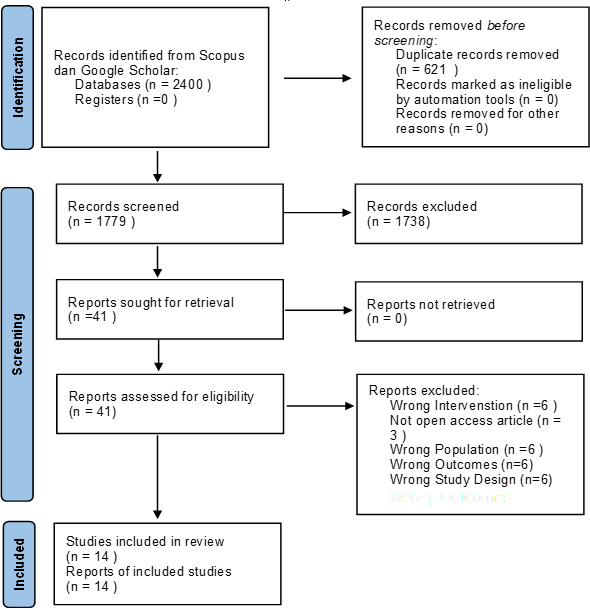
The mental health of working women is a critical issue within the context of increasing dual burdens of work and domestic responsibilities. Mindfulness interventions have been proposed as an effective approach to enhancing psychological well-being. The objectives was to examine the effectiveness of mindfulness interventions on the mental health of working women, identify implementation challenges, and formulate recommendations for future research. This study is a systematic literature review (SLR) of 14 quantitative and qualitative studies published in indexed journals. Quality assessment was conducted using the JADAD Score, JBI Checklist, and MMAT according to the study design. Out of 2,400 articles identified through Scopus and Google Scholar databases, 14 articles met the inclusion criteria and were analyzed in this review. These studies employed various methodological designs, including RCTs (n=6), quasi-experimental (n=5), and observational or cross-sectional studies (n=3). Based on the assessment of effectiveness, mindfulness interventions were classified as highly effective (n=6), moderately effective (n=5), and less effective (n=3), depending on intervention protocol, intensity of participation, and institutional support. Structured protocol-based mindfulness interventions with facilitators (MBSR, MBCT, MAC) demonstrated the highest effectiveness compared to self-guided or trait-based interventions. The majority of studies indicated that protocol-based mindfulness interventions such as MBSR and MBCT effectively reduced stress, burnout, and anxiety, and enhanced self-compassion and psychological well-being. Main barriers included time constraints, participant retention, and methodological limitations. Mindfulness interventions are a promising strategy to support the mental health of working women.
References
Adiratna, Y., Astono, S., Fertiaz, M., Subhan, Sugistria, C. A. O., Prayitno, H., Khair, R. I., Brando, A., & Putri, B. A. (2022). The Indonesian National Occupational Safety and Health Profile 2022. Kementerian Ketenagakerjaan Republik Indonesia.
Althammer, S. E., Reis, D., van der Beek, S., Beck, L., & Michel, A. (2021). A mindfulness intervention promoting work–life balance: How segmentation preference affects changes in detachment, well–being, and work–life balance. Journal of Occupational and Organizational Psychology, 94(2), 282–308. https://doi.org/10.1111/joop.12346
Basrowi, R. W., Wiguna, T., Samah, K., Djuwita F Moeloek, N., Soetrisno, M., Purwanto, S. A., Ekowati, M., Elisabeth, A., Rahadian, A., Ruru, B., & Pelangi, B. (2024). Exploring Mental Health Issues and Priorities in Indonesia Through Qualitative Expert Consensus. Clinical Practice & Epidemiology in Mental Health, 20(1). https://doi.org/10.2174/0117450179331951241022175443
Bowles, N. I., Davies, J. N., & Van Dam, N. T. (2022). Dose–response Relationship of Reported Lifetime Meditation Practice with Mental Health and Wellbeing: a Cross-sectional Study. Mindfulness, 13(10), 2529–2546. https://doi.org/10.1007/s12671-022-01977-6
BPS. (2023). Keadaan Angkatan Kerja Di Indonesia: Labor Force Situation in Indonesia August 2023 Volume 45, Nomor 2 (D. S. K. dan Ketenagakerjaan). Badan Pusat Statistik.
Badan Pusat Statistik. (2024). Keadaan Angkatan Kerja di Indonesia Agustus 2024. Badan Pusat Statistik. https://assets.dataindonesia.id/2025/06/20/1750410540296-93-21.-keadaan-angkatan-kerja-di-indonesia-agustus-2024.pdf
Chen, H., Liu, C., Cao, X., Hong, B., Huang, D.-H., Liu, C.-Y., & Chiou, W.-K. (2021). Effects of Loving-Kindness Meditation on Doctors’ Mindfulness, Empathy, and Communication Skills. International Journal of Environmental Research and Public Health, 18(8), 4033. https://doi.org/10.3390/ijerph18084033
D’Antoni, F., Feruglio, S., Matiz, A., Cantone, D., & Crescentini, C. (2022). Mindfulness meditation leads to increased dispositional mindfulness and interoceptive awareness linked to a reduced dissociative tendency. Journal of Trauma & Dissociation, 23(1), 8–23. https://doi.org/10.1080/15299732.2021.1934935
Ducar, D. M., Penberthy, J. K., Schorling, J. B., Leavell, V. A., & Calland, J. F. (2020). Mindfulness for healthcare providers fosters professional quality of life and mindful attention among emergency medical technicians. EXPLORE, 16(1), 61–68. https://doi.org/10.1016/j.explore.2019.07.015
Fabbro, A., Fabbro, F., Capurso, V., D’Antoni, F., & Crescentini, C. (2020). Effects of mindfulness training on school teachers’ self-reported personality traits as well as stress and burnout levels. Perceptual and Motor Skills, 127(3), 515–532. https://doi.org/10.1177/0031512520908708
Fida, R., Watson, D., Ghezzi, V., Barbaranelli, C., Ronchetti, M., & Di Tecco, C. (2023). Is gender an antecedent to workplace stressors? A systematic review and an empirical study using a person-centred approach. International Journal of Environmental Research and Public Health, 20(8), 5541. https://doi.org/10.3390/ijerph20085541
Gherardi-Donato, E. C. da S., Díaz-Serrano, K. V., Barbosa, M. R., Fernandes, M. N. de F., Gonçalves-Ferri, W. A., Camargo Júnior, E. B., & Reisdorfer, E. (2023). The impact of an online mindfulness-based practice program on the mental health of brazilian nurses during the covid-19 pandemic. International Journal of Environmental Research and Public Health, 20(4), 3666. https://doi.org/c
Gherardi-Donato, E. C. da S., Gimenez, L. B. H., Fernandes, M. N. de F., Lacchini, R., Camargo Júnior, E. B., Díaz-Serrano, K. V., Melchior, M., Pérez, R. G., Riquelme-Galindo, J., & Reisdorfer, E. (2023). Mindfulness practice reduces hair cortisol, anxiety and perceived stress in university workers: randomized clinical trial. Healthcare, 11(21), 2875. https://doi.org/10.3390/healthcare11212875
Godara, M., Hecht, M., & Singer, T. (2024). Training-related improvements in mental well-being through reduction in negative interpretation bias: A randomized trial of online socio-emotional dyadic and mindfulness interventions. Journal of Affective Disorders, 354, 662–672. https://doi.org/10.1016/j.jad.2024.03.037
Goldberg, S. B., Riordan, K. M., Sun, S., & Davidson, R. J. (2022). The empirical status of mindfulness-based interventions: a systematic review of 44 meta-analyses of randomized controlled trials. Perspectives on Psychological Science, 17(1), 108–130. https://doi.org/10.1177/1745691620968771
Greeson, J. M., McBride, E. E., Chin, G. R., Lee, H. H., & Colangelo, A. P. (2024). Trait mindfulness and mind-body health in students: The role of gender, race, and ethnicity. Journal of American College Health, 72(8), 2844–2855. https://doi.org/10.1080/07448481.2022.2135374
Harbour, E., Stöggl, T., Schwameder, H., & Finkenzeller, T. (2022). Breath tools: a synthesis of evidence-based breathing strategies to enhance human running. Frontiers in Physiology, 13. https://doi.org/10.3389/fphys.2022.813243
Higgins, J. P. T., Green, S., & Ben Van Den, A. (2020). Cochrane handbook for systematic reviews of interventions. International Coaching Psychology Review, 15(2), 123–125. https://doi.org/10.53841/bpsicpr.2020.15.2.123
International Lapor Organization. (2023). World Employment and Social Outlook. https://doi.org/10.54394/SNCP1637
Jankowski, T., & Holas, P. (2020). Effects of brief mindfulness meditation on attention switching. Mindfulness, 11(5), 1150–1158. https://doi.org/10.1007/s12671-020-01314-9
Kuyken, W., Ball, S., Crane, C., Ganguli, P., Jones, B., Montero-Marin, J., Nuthall, E., Raja, A., Taylor, L., Tudor, K., Viner, R. M., Allwood, M., Aukland, L., Dunning, D., Casey, T., Dalrymple, N., De Wilde, K., Farley, E.-R., Harper, J., … Williams, J. M. G. (2022). Effectiveness of universal school-based mindfulness training compared with normal school provision on teacher mental health and school climate: results of the MYRIAD cluster randomised controlled trial. Evidence Based Mental Health, 25(3), 125–134. https://doi.org/10.1136/ebmental-2022-300424
Kuyken, W., Warren, F. C., Taylor, R. S., Whalley, B., Crane, C., Bondolfi, G., Hayes, R., Huijbers, M., Ma, H., Schweizer, S., Segal, Z., Speckens, A., Teasdale, J. D., Van Heeringen, K., Williams, M., Byford, S., Byng, R., & Dalgleish, T. (2016). Efficacy of mindfulness-based cognitive therapy in prevention of depressive relapse. JAMA Psychiatry, 73(6), 565. https://doi.org/10.1001/jamapsychiatry.2016.0076
Lin, Y., Jiang, C., Pan, Y., & Xu, Z. (2024). The impact of mindfulness on nurses’ perceived professional benefits: the mediating roles of workplace spirituality and work-life balance. Frontiers in Psychology, 15. https://doi.org/10.3389/fpsyg.2024.1346326
Liu, X., Xiao, R., & Tang, W. (2022). The impact of school-based mindfulness intervention on bullying behaviors among teenagers: mediating effect of self-control. Journal of Interpersonal Violence, 37(21–22), NP20459–NP20481. https://doi.org/10.1177/08862605211052047
Lopez, G., Chaoul, A., Warneke, C. L., Christie, A. J., Powers-James, C., Liu, W., Narayanan, S., Delgado-Guay, M., Li, Y., Bruera, E., & Cohen, L. (2023). Self-administered meditation application intervention for cancer patients with psychosocial distress: a pilot study. Integrative Cancer Therapies, 22. https://doi.org/10.1177/15347354221148710
Mahmoudi, F., Zarnaghash, M., Shegefti, N. S., & Barzegar, M. (2024). The effect of educational intervention according to mindfulness on the psychological well-being of female heads of households. BMC Women’s Health, 24(1), 320. https://doi.org/10.1186/s12905-024-03125-9
Mäkinen, M., Jaakonsalo, E., Saarivainio, R., Koskiniemi, J., & Renholm, M. (2024). The effects of mindfulness training for emergency department and intermediate care unit nurses. Applied Nursing Research, 76, 151770. https://doi.org/10.1016/j.apnr.2024.151770
Marotta, M., Gorini, F., Parlanti, A., Berti, S., & Vassalle, C. (2022). Effect of mindfulness-based stress reduction on the well-being, burnout and stress of italian healthcare professionals during the COVID-19 pandemic. Journal of Clinical Medicine, 11(11), 3136. https://doi.org/10.3390/jcm11113136
Mohebi, M., Sadeghi-Bahmani, D., Zarei, S., Gharayagh Zandi, H., & Brand, S. (2021).Examining the effects of mindfulness–acceptance–commitment training on self-compassion and grit among elite female athletes. International Journal of Environmental Research and Public Health, 19(1), 134. https://doi.org/10.3390/ijerph19010134
Nübold, A., Van Quaquebeke, N., & Hülsheger, U. R. (2020). Be(com)ing real: a multi-source and an intervention study on mindfulness and authentic leadership. Journal of Business and Psychology, 35(4), 469–488. https://doi.org/10.1007/s10869-019-09633-y
Nurissama, E., & Basrowi, R. W. (2025). A literature review: potential ethical risk in mental health research at workplace setting. The Indonesian Journal of Community and Occupational Medicine, 4(3), 104–108. https://doi.org/10.53773/ijcom.v4i3.133.104-8
Ong, N. Y., Teo, F. J. J., Ee, J. Z. Y., Yau, C. E., Thumboo, J., Tan, H. K., & Ng, Q. X. (2024). Effectiveness of mindfulness-based interventions on the well-being of healthcare workers: a systematic review and meta-analysis. General Psychiatry, 37(3), e101115. https://doi.org/10.1136/gpsych-2023-101115
Paruzel-Czachura, M., & Kocur, D. (2023). Do meditation, mindfulness, and self-compassion impact utilitarian moral judgment? Mindfulness, 14(7), 1650–1661. https://doi.org/10.1007/s12671-023-02161-0
Pérez, V., Menéndez-Crispín, E. J., Sarabia-Cobo, C., de Lorena, P., Fernández-Rodríguez, A., & González-Vaca, J. (2022). Mindfulness-based intervention for the reduction of compassion fatigue and burnout in nurse caregivers of institutionalized older persons with dementia: a randomized controlled trial. International Journal of Environmental Research and Public Health, 19(18), 11441. https://doi.org/10.3390/ijerph191811441
Teixeira, D. S., Fortes, S., Kestenberg, C., Alves, K., Campos, M. R., Neto, A. O., Ortega, F., García-Campayo, J., & Demarzo, M. (2024). Improving patient-centered mental health promotion in primary care in vulnerable communities through mindfulness training in Rio de Janeiro, Brazil. Frontiers in Medicine, 11. https://doi.org/10.3389/fmed.2024.1356040
United Nations Economic and Social Commission for Asia and The Pacific. (2025). World Survey on The Role of Women in Development 2024; Harnessing Social Protection for Gender Equality, Resilience and Transformation. Research and Data Section, UN-Women.
UN Women. (2024). Progress on the Sustainable Development Goals: The gender snapshot 2024. UN Women. https://www.unwomen.org/sites/default/files/2024-09/progress-on-the-sustainable-development-goals-the-gender-snapshot-2024-en.pdf.
Vonderlin, R., Biermann, M., Bohus, M., & Lyssenko, L. (2020). Mindfulness-based programs in the workplace: a meta-analysis of randomized controlled trials. Mindfulness, 11(7), 1579–1598. https://doi.org/10.1007/s12671-020-01328-3
Walsh, M. M., Carleton, E., Ortynsky, M., Choi, E., Hancock, A. J., & Arnold, K. A. (2025). The role of daily mindfulness on work–home conflict: a daily study of women leaders. Equality, Diversity and Inclusion: An International Journal. https://doi.org/10.1108/EDI-02-2024-0075
Yang, Y., Su, F., Liu, H., & Li, X. (2023). The effect of mindfulness intervention on internet negative news perception and processing: An implicit and explicit approach. Frontiers in Psychology, 14. https://doi.org/10.3389/fpsyg.2023.1071078
Submitted
Published
How to Cite
Issue
Section
License
Copyright (c) 2025 RESTIANA HAPSARI

This work is licensed under a Creative Commons Attribution 4.0 International License.