Andhap Asor among Early Adult Women from Broken Homes: A Cultural Perspective on Emotional Regulation
DOI:
https://doi.org/10.23917/indigenous.v10i2.11279Keywords:
Andhap asor, broken home, cultural coping, early adulthood, emotional regulationAbstract
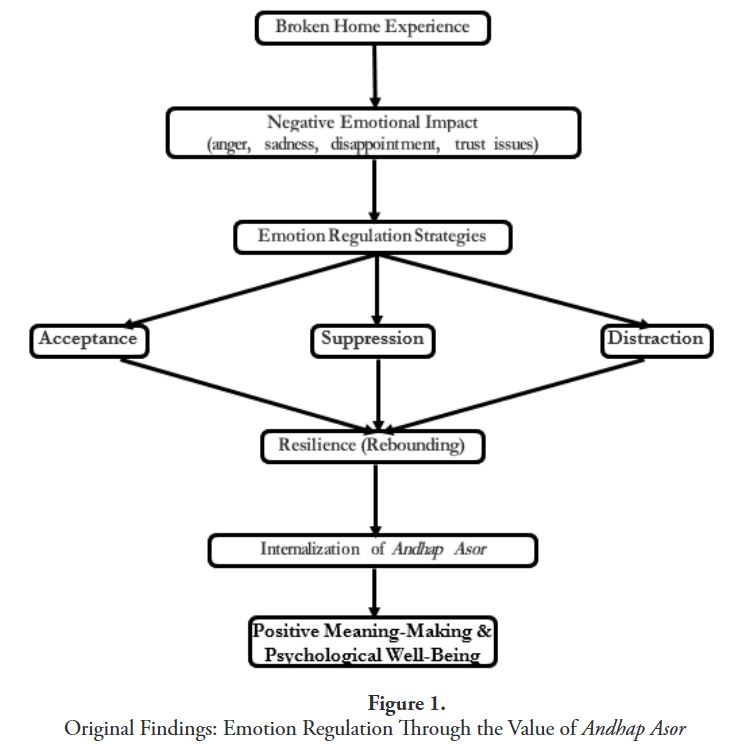
This study explores the role of Andhap Asor, a Javanese cultural value emphasizing humility and emotional restraint, as a coping mechanism for early adult women from broken home families. Using a qualitative approach with an intrinsic case study design, the research involved four Javanese women aged 20–30 who had experienced parental separation. Data were collected through semi-structured in-depth interviews, field notes, and non-participant observation, and analyzed using thematic analysis. Findings reveal four primary emotional regulation patterns: acceptance, suppression, distraction, and resilience. These strategies were deeply influenced by the internalization of Andhap Asor, which provided participants with a cultural framework to reinterpret emotional pain into personal growth. The value of Andhap Asor enabled participants to respond to emotional adversity with self-reflection, patience, and spiritual meaning—rather than with resentment or reactive behaviors. Thus, Andhap Asor serves as both an internal and social emotional regulation strategy, fostering psychological resilience and supporting interpersonal harmony. These findings highlight the significance of incorporating culturally grounded approaches in psychological interventions, particularly for individuals coping with the emotional impacts of family dysfunction.
References
Afifah, J. N., & Trimulyaningsih, N. (2025). The role of social support and self-efficacy on resilience of late adolescence with divorced parents. Psikologika, 30(1), 131–148. https:// doi.org/10.20885/psikologika.vol30.iss1.art8
Amato, P. R. (2000). The consequences of divorce for adults and children. Journal of Marriage and Family, 62(4), 1269–1287. https://doi/10.1111/j.1741-3737.2000.01269.x
Annisa, S. W., & Nur, H. (2025). Resiliensi remaja dari keluarga broken home: Kajian literatur tentang faktor, mekanisme, dan implikasi psikologis. PESHUM : Jurnal Pendidikan, Sosial dan Humaniora, 4(4), 5696–5716. https://doi.org/10.56799/peshum.v4i4.9253
Annisa, S. W., Salsabila, A. A., & Mahmud, A. M. (2024). Perkembangan Emosional Remaja Broken Home. PESHUM : Jurnal Pendidikan, Sosial dan Humaniora, 4(1), 709–726. https://doi.org/10.56799/peshum.v4i1.6768
Bunga, A. O., Evanytha, E., & Akhyar, M. (2024). Hubungan regulasi emosi dengan resiliensi pada emerging adulthood yang mengalami broken home. Peran Psikologi dalam pemberdayaan masyarakat untuk meningkatan kesejahteraan masyarakat Indonesia, 239-246
Creswell, J. W., & Poth, C. N. (2016). Qualitative inquiry and research design: Choosing among five approaches. Sage publications.
Cummings, E. M., & Davies, P. T. (2011). Marital conflict and children: An emotional security perspective. Guilford Press.
Duggal, S., Carlson, E. A., Sroufe, L. A., & Egeland, B. (2001). Depressive symptomatology in childhood and adolescence. Development and Psychopathology, 13(1), 143–164. https://doi. org/10.1017/S0954579401001109
Dumpratiwi, A. N., Cahyadi, M. M., & Ardani, A. N. (2023). Javanese society’s eyes: Understanding phenomenon of people with mental disorders in Java. Indigenous: Jurnal Ilmiah Psikologi, 8(2), 153–160. https://doi.org/10.23917/indigenous.v8i2.21010
Faizun, M., Rohmah, N. B., & Rejo, U. (2024). Narasi Religiositas, spiritualitas, dan proses kreatif Wawan Susetya sebagai pegiat sastra dan kebudayaan jawa. Jurnal Adat dan Budaya Indonesia, 6(2), 196–207. https://doi.org/10.23887/jabi.v6i2.75951
Tetha, M., & Fisabilillah, S. D. (2024). Psychological Well-Being pada Remaja dari Keluarga Broken Home. Phronesis: Jurnal Ilmiah Psikologi Terapan, 13(1). https://doi.org/10.24912/ phronesis.v13i1.27165
García-Alandete, J. (2015). Does meaning in life predict psychological well-being?: An analysis using the spanish versions of the purpose-in-life test and the Ryff’s scales. The European Journal of Counselling Psychology, 3(2), 89–98. https://doi.org/10.5964/ejcop.v3i2.27
Geertz, C. (1973). The interpretation of cultures New York. Basic Books.
Gross, J. J., & Thompson, R. A. (2007). Emotion regulation.Conceptual foundations. Hetherington, E. M. (2002). For better or for worse: Divorce reconsidered. Midwives Chronicle,8(22), 178–192. https://doi.org/10.2143/INT.8.2.2004434
Hurlock, E. B. (1978). Perkembangan anak jilid 1. Erlangga.
Jacquet, S. E., & Surra, C. A. (2001). Parental divorce and premarital couples: commitment and other relationship characteristics. 63(3), 627–638. https://doi.org/10.1111/j.1741-3737.2001.00627.x
Kelly, J. B., & Emery, R. E. (2003). Children’s adjustment following divorce: Risk and resilience perspectives. Family Relations, 52(4), 352–362. https://doi.org/10.1111/j.1741-3729.2003.00352.x
Kim, H. S., Sherman, D. K., & Taylor, S. E. (2008). Culture and social support. American Psychologist, 63(6), 518–526. https://doi.org/10.1037/0003-066X
Koentjaraningrat. (1994). Kebudayaan Jawa. Balai Pustaka.
Folkman, S. (2013). Stress: Appraisal and Coping. In M. D. Gellman & J. R. Turner (Eds.), Encyclopedia of Behavioral Medicine 1913–1915. Springer New York. https://doi. org/10.1007/978-1-4419-1005-9_215
Luthar, S. S. (2003). Resilience and vulnerability adaptation in the context of childhood adversities childhood. Cambridge University Press.
Mistiani, W. (2018). Dampak keluarga broken home terhadap psikologis anak. Musawa: Journal for Gender Studies, 10(2), 322–354. https://doi.org/10.24239/msw.v10i2.528
Morris, A. S., Silk, J. S., Steinberg, L., Myers, S. S., & Robinson, L. R. (2007). The role of the family context in the development of emotion regulation. Social Development, 16(2), 361–388. https://doi.org/10.1111/j.1467-9507.2007.00389.x
Munandar, A., Purnamasari, S. E., & Peristianto, S. V. (2020). Psychological well-being pada keluarga broken home. Insight: Jurnal Ilmiah Psikologi, 22(1), 46–52. https://doi. org/10.26486/psikologi.v22i1%20Feb.959
Neff, K. (2003). The development and validation of a scale to measure self-compassion. Self and Identity, 2(3), 223–250. https://doi.org/10.1080/15298860309027
Nolen-Hoeksema, S. (2001). Gender differences in depression. Current Directions in Psychological Science, 10(5), 173–176. https://doi.org/10.1007/978-981-10-6580-4_24
Nordin, M. H. M., Hassan, S. A., Ismail, I. A., Hamsan, H. H., & Aziz, D. A. (2022). Dyadic discernment among young spouses in sonflict: A decision science of marital and family therapy. Journal of Management Information and Decision Sciences, 25 (1), 1–8.
Rahman, T. A., Sutjipto, V. W., & Putri, K. Y. S. (2024). The impact of exposure to online mass media on people’s attitudes in marriage decisions in indonesia. Momentum Matrix: International Journal of Communication, Tourism, and Social Economic Trends, 1(4), 12–23. https://doi.org/10.62951/momat.v1i4.65
Riggio, H. R. (2004). Parental marital conflict and divorce, parent-child relationships, social support, and relationship anxiety in young adulthood. Personal Relationships, 11(1), 99–114. https://doi.org/10.1111/j.1475-6811.2004.00073.x
Rusmahadewi, A., Fadhlurrahman, Z., & Nur Fathiyah, K. (2024). Forgiveness Experiences in Early Adult Women with Divorced Parents. Indigenous: Jurnal Ilmiah Psikologi, 9(2), 136–149. https://doi.org/10.23917/indigenous.v9i2.5561
Ryff, C. D. (1989). Happiness is everything, or is it? Explorations on the meaning of psychological well-being. Journal of Personality and Social Psychology, 57(6), 1069–1081. https://doi. org/10.1037/0022-3514.57.6.1069
Sanders, M. R. (2012). Development, evaluation, and multinational dissemination of the triple p-positive parenting program. Annual Review of Clinical Psychology, 8(1), 345–379. https:// doi.org/10.1146/annurev-clinpsy-032511-143104
Santrock, J. W. (2021). Life-span development (Eighteenth edition). McGraw-Hill Education.
Southwick, S. M., Bonanno, G. A., Masten, A. S., Panter-Brick, C., & Yehuda, R. (2014). Resilience definitions, theory, and challenges: Interdisciplinary perspectives. European Journal of Psychotraumatology, 5(1), 1–14. https://doi.org/10.3402/ejpt.v5.25338
Suseno, F. M. (1984). Etika jawa: Sebuah analisa falsafi tentang kebijaksanaan hidup jawa. Penerbit PT Gramedia.
Tedeschi, R., & Calhoun, L. (2004). Posttraumatic growth: Conceptual foundations and empirical evidence. Psychological Inquiry, 15(1), 1–18. https://doi.org/10.1207/s15327965pli1501_01
Tugade, M. M., & Fredrickson, B. L. (2004). Resilient individuals use positive emotions to bounce back from negative emotional experiences. Journal of Personality and Social Psychology, 86(2), 320–333. https://doi.org/10.1037/0022-3514.86.2.320
Vangelisti, A. L. (2022). The routledge handbook of family communication.Taylor & Francis Group. Wallerstein, J. S., & Lewis, J. M. (2004). The unexpected legacy of divorce: Report of a 25-year study. Psychoanalytic Psychology, 21(3), 353–370. https://doi.org/10.1037/0736-9735.21.3.353
Desiningrum, D. R., Indriana, Y., Hyoscyamina, D. E., Shalihah, A. S., & Zaim, H. L. (2024). Exploring the Implementation and Impact of Mindful Parenting in Indonesia: A Scoping Review. Indigenous: Jurnal Ilmiah Psikologi, 9(3). https://doi.org/10.23917/indigenous.v9i3.6763
Downloads
Submitted
Published
How to Cite
Issue
Section
License
Copyright (c) 2025 Sheilla Varadhila Peristianto, Ismi Darojatun Mufti

This work is licensed under a Creative Commons Attribution 4.0 International License.