Perception and Signs of Stress among Indonesian University Students: Insights from Rileks Module Responses
DOI:
https://doi.org/10.23917/indigenous.v10i3.10024Keywords:
Stress, sociocultural context, low-and middle-income countries, mental health, university studentsAbstract
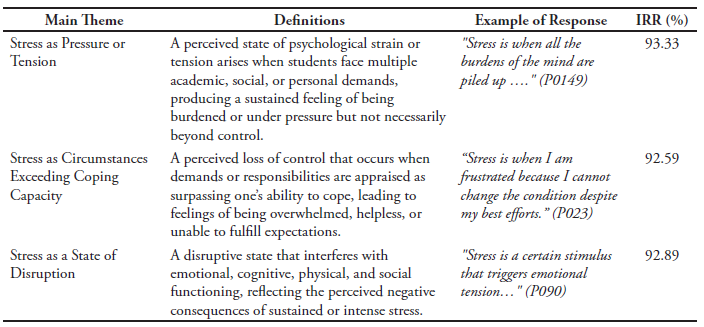
Although studies have documented the prevalence of stress among university students, limited attention has been paid to how students define and experience it. This study, part of a larger investigation into Rileks, a culturally adapted web-based stress management program for Indonesian university students, examined how students conceptualize stress and identify its signs. A total of 68 participants, predominantly female and aged between 19 to 42, participated in the study. They were enrolled in undergraduate to doctoral programs and were recruited through convenience sampling via the Rileks study platform. Thematic content analysis was conducted on responses to open-ended questions in the Rileks’ first module, which asked about students' definitions of stress and the signs they experience. Coding was carried out manually using Excel, and inter-rater reliability checks were applied to enhance analytical rigor. Three main themes emerged in students’ definitions of stress: perceived pressure or tension, circumstances exceeding coping capacity, and stress as a state of disruption. A minor theme was stress as a motivating factor. Each main theme encompassed multiple areas of student life, extending beyond academic concerns, and some responses reflected cultural values such as family expectations and societal demands. Students also described signs of stress across four domains: physical, cognitive, emotional, and behavioral. These findings indicate that students’ perceptions of stress may shaped by personal and contextual factors, offering practical implications for enhancing early recognition and communication of students’ stress through approaches that are both relevant and culturally sensitive.
References
Acharya, L., Jin, L., & Collins, W. (2018). College Life is Stressful Today -- Emerging Stressors and Depressive Symptoms in College Students. Journal of American College Health, 66(7), 655–664. https://doi.org/10.1080/07448481.2018.1451869 DOI: https://doi.org/10.1080/07448481.2018.1451869
Ahmead, M., El Sharif, N., Abuiram, I., Alshawish, E., & Dweib, M. (2024). Depression, anxiety and coping strategies among Palestinian university students during political violence: a cross sectional study. Frontiers in Public Health, 12. https://doi.org/10.3389/fpubh.2024.1436672 DOI: https://doi.org/10.3389/fpubh.2024.1436672
Alivernini, F., Cavicchiolo, E., Manganelli, S., Chirico, A., & Lucidi, F. (2019). Students’ psychological well-being and its multilevel relationship with immigrant background, gender, socioeconomic status, achievement, and class size. School Effectiveness and School Improvement, 31(2), 172–191. https://doi.org/10.1080/09243453.2019.1642214 DOI: https://doi.org/10.1080/09243453.2019.1642214
Amirkhan, J. H., Landa, I., & Huff, S. (2018). Seeking signs of stress overload: Symptoms and behaviors. International Journal of Stress Management, 25(3), 301–311. https://doi.org/10.1037/str0000066 DOI: https://doi.org/10.1037/str0000066
Auerbach, R. P., Mortier, P., Bruffaerts, R., Alonso, J., Benjet, C., Cuijpers, P., Demyttenaere, K., Ebert, D. D., Green, J. G., Hasking, P., Murray, E., Nock, M. K., Pinder-Amaker, S., Sampson, N. A., Stein, D. J., Vilagut, G., Zaslavsky, A. M., & Kessler, R. C. (2018). WHO World mental health surveys international college student project: Prevalence and distribution of mental disorders. Journal of Abnormal Psychology, 127(7), 623–638. https://doi.org/10.1037/abn0000362 DOI: https://doi.org/10.1037/abn0000362
Aziz, M. (2023). Women’s Double burden in the family between culture and discrimination. Potret Pemikiran, 27(2), 227–244. https://doi.org/10.30984/pp.v27i2.2782 DOI: https://doi.org/10.30984/pp.v27i2.2782
Bergin, A., & Pakenham, K. (2015). Law student stress: Relationships between academic demands, social isolation, career pressure, study/life imbalance and adjustment outcomes in law students. Psychiatry, Psychology and Law, 22(3), 388–406. https://doi.org/10.1080/13218719.2014.960026 DOI: https://doi.org/10.1080/13218719.2014.960026
Bettis, A. H., Coiro, M. J., England, J., Murphy, L. K., Zelkowitz, R. L., Dejardins, L., Eskridge, R., Adery, L. H., Yarboi, J., Pardo, D., & Compas, B. E. (2017). Comparison of two approaches to prevention of mental health problems in college students: Enhancing coping and executive function skills. Journal of American College Health, 65(5), 313–322. https://doi.org/10.1080/07448481.2017.1312411 DOI: https://doi.org/10.1080/07448481.2017.1312411
Cameron, L. (2023). Gender equality and development: Indonesia in a global context. Bulletin of Indonesian Economic Studies, 59(2), 179–207. https://doi.org/10.1080/00074918.2023.2229476 DOI: https://doi.org/10.1080/00074918.2023.2229476
Cheung, K. K. C., & Tai, K. W. H. (2021). The use of intercoder reliability in qualitative interview data analysis in science education. Research in Science & Technological Education, 41(3), 1155–1175. https://doi.org/10.1080/02635143.2021.1993179 DOI: https://doi.org/10.1080/02635143.2021.1993179
Deb, S., Banu, P. R., Thomas, S., Vardhan, R. V., Rao, P. T., & Khawaja, N. (2016). Depression among Indian university students and its association with perceived university academic environment, living arrangements and personal issues. Asian Journal of Psychiatry, 23(3), 108–117. https://doi.org/10.1016/j.ajp.2016.07.010 DOI: https://doi.org/10.1016/j.ajp.2016.07.010
Deng, Y., Cherian, J., Khan, N. U. N., Kumari, K., Sial, M. S., Comite, U., Gavurova, B., & Popp, J. (2022). Family and Academic Stress and Their Impact on Students’ Depression Level and Academic Performance. Frontiers in Psychiatry, 13, 869337. https://doi.org/10.3389/fpsyt.2022.869337 DOI: https://doi.org/10.3389/fpsyt.2022.869337
Dessauvagie, A. S., Dang, H.-M., Nguyen, T. A. T., & Groen, G. (2021). Mental Health of University Students in Southeastern Asia: A Systematic Review. Asia Pacific Journal of Public Health, 34(2–3), 172–181. https://doi.org/10.1177/10105395211055545 DOI: https://doi.org/10.1177/10105395211055545
Dressler, W. W. (2022). Culture and the stress process. In M. Singer, P. I. Erickson, & C. E. Abadia-Barrero (Eds.), A companion to medical anthropology (pp. 93–108). John Wiley & Sons. https://doi.org/10.1002/9781119718963.ch5 DOI: https://doi.org/10.1002/9781119718963.ch5
Farnish, K. A. (2021). ``Not now, I had a long day’’: Social withdrawal as a coping strategy for managing stress. The University of Texas at Austin.
Glise, K., Ahlborg, G., & Jonsdottir, I. H. (2014). Prevalence and course of somatic symptoms in patients with stress-related exhaustion: does sex or age matter. BMC Psychiatry, 14(1), 118. https://doi.org/10.1186/1471-244X-14-118 DOI: https://doi.org/10.1186/1471-244X-14-118
Graham, M., Milanowski, A., Miller, J., & Henderson, A. (2012). Measuring and Promoting Inter-Rater Agreement of Teacher and Principal Performance Ratings. Retrieved From https://files.eric.ed.gov/fulltext/ED532068.pdf/
Habibah, U., Syakurah, R. A., Ikhsan, D. S., Zulissetiana, E. F., & Aini, S. (2021). Depression, anxiety, and stress among students of Sriwijaya University. Indigenous: Jurnal Ilmiah Psikologi, 6(3), 23–35. https://doi.org/10.23917/indigenous.v6i3.12629 DOI: https://doi.org/10.23917/indigenous.v6i3.12629
Harry C, T. (2018). Individualism and Collectivism. In Social Interaction and the Development of Knowledge. Routledge. https://doi.org/https://doi.org/10.4324/9780429499845 DOI: https://doi.org/10.4324/9780429499845
Hishan, S. S., Jaiprakash, H., Ramakrishnan, S., Mohanraj, J., Shanker, J., & Keong, L. B. (2018). Prevalence and socio-demographic association of depression, anxiety and stress among university students. International Journal of Engineering & Technology, 7(2), 29. https://doi.org/10.14419/ijet.v7i2.29.13998 DOI: https://doi.org/10.14419/ijet.v7i2.29.13998
Jiang, R., Liu, R., Star, J., Zhen, R., Wang, J., Hong, W., Jiang, S., Sun, Y., & Fu, X. (2021). How mathematics anxiety affects students’ inflexible perseverance in mathematics problem-solving: Examining the mediating role of cognitive reflection. British Journal of Educational Psychology, 91(1), 237–260. https://doi.org/10.1111/bjep.12364 DOI: https://doi.org/10.1111/bjep.12364
Juniar, D., van Ballegooijen, W., Karyotaki, E., van Schaik, A., Passchier, J., Heber, E., Lehr, D., Sadarjoen, S. S., & Riper, H. (2019). Web-based stress management program for university students in Indonesia: systematic cultural adaptation and protocol for a feasibility study. JMIR Research Protocols, 8(1), e11493. https://doi.org/10.2196/11493 DOI: https://doi.org/10.2196/11493
Juniar, D., van Ballegooijen, W., Schulte, M., van Schaik, A., Passchier, J., Heber, E., Lehr, D., Sadarjoen, S. S., & Riper, H. (2022). A web-based stress management intervention for university students in Indonesia (rileks): feasibility study using a pretest-posttest design. JMIR Formative Research, 6(7), e37278. https://doi.org/10.2196/37278 DOI: https://doi.org/10.2196/37278
Kiger, M. E., & Varpio, L. (2020). Thematic analysis of qualitative data: AMEE guide no. 131. Medical Teacher, 42(8), 846–854. https://doi.org/10.1080/0142159X.2020.1755030 DOI: https://doi.org/10.1080/0142159X.2020.1755030
Krys, K., de Almeida, I., Wasiel, A., & Vignoles, V. L. (2025). WEIRD–Confucian comparisons: Ongoing cultural biases in psychology’s evidence base and some recommendations for improving global representation. American Psychologist, 80(2), 247–263. https://doi.org/10.1037/amp0001298 DOI: https://doi.org/10.1037/amp0001298
Kupriyanov, R., & Zhdanov, R. (2014). The eustress concept: problems and outlooks. World Journal of Medical Sciences, 11(2), 179–185. https://doi.org/10.5829/idosi.wjms.2014.11.2.8433
Lazarus, R. S., & Folkman, S. (1984). Stress, appraisal, and coping, Springer Publishing Company
Lee, H., Masuda, T., Ishii, K., Yasuda, Y., & Ohtsubo, Y. (2023). Cultural differences in the perception of daily stress between European Canadian and Japanese undergraduate students. Personality and Social Psychology Bulletin, 49(4), 571–584. https://doi.org/10.1177/01461672211070360 DOI: https://doi.org/10.1177/01461672211070360
Li, X., Wu, H., Meng, F., Li, L., Wang, Y., & Zhou, M. (2020). Relations of COVID-19-related stressors and social support with Chinese college students’ psychological response during the COVID-19 pandemic. Frontiers in Psychiatry, 11, 551315. https://doi.org/10.3389/fpsyt.2020.551315 DOI: https://doi.org/10.3389/fpsyt.2020.551315
Liem, A. D., Lau, S., & Nie, Y. (2008). The role of self-efficacy, task value, and achievement goals in predicting learning strategies, task disengagement, peer relationship, and achievement outcome. Contemporary Educational Psychology, 33(4), 486–512. https://doi.org/10.1016/j.cedpsych.2007.08.001 DOI: https://doi.org/10.1016/j.cedpsych.2007.08.001
Ma, K., Pitner, R., Sakamoto, I., & Park, H. Y. (2020). Challenges in acculturation among international students from Asian collectivist cultures. Higher Education Studies, 10(3), 34–43. https://doi.org/10.5539/hes.v10n3p34 DOI: https://doi.org/10.5539/hes.v10n3p34
Maqsood, S., Bano, S., Goraya, J. T., & Sher, I. (2022). Peer pressure, academic stress and goal adjustment in day scholars and hostelite college students. Journal of Research in Psychology, 4(2), 81–93. https://doi.org/10.31580/jrp.v4i2.2702 DOI: https://doi.org/10.31580/jrp.v4i2.2702
Maulana, H., & Khawaja, N. G. (2022). A Cultural perspective of well-being. In Handbook of Health and Well-Being (pp. 35–49). Springer Nature Singapore. https://doi.org/10.1007/978-981-16-8263-6_2 DOI: https://doi.org/10.1007/978-981-16-8263-6_2
Muthukrishna, M., Bell, A. V, Henrich, J., Curtin, C. M., Gedranovich, A., McInerney, J., & Thue, B. (2020). Beyond Western, Educated, Industrial, Rich, and Democratic (WEIRD) Psychology: Measuring and mapping scales of cultural and psychological distance. Psychological Science, 31(6), 678–701. https://doi.org/10.1177/0956797620916782 DOI: https://doi.org/10.1177/0956797620916782
Othman, N., Ahmad, F., El Morr, C., & Ritvo, P. (2019). Perceived impact of contextual determinants on depression, anxiety and stress: a survey with university students. International Journal of Mental Health Systems, 13(1), 1–9. https://doi.org/10.1186/s13033-019-0275-x DOI: https://doi.org/10.1186/s13033-019-0275-x
Oubaid, V. (2023). Psychological stress and the autonomic nervous system. In Primer on the Autonomic Nervous System (pp. 301–304). Elsevier. https://doi.org/10.1016/b978-0-323-85492-4.00131-9 DOI: https://doi.org/10.1016/B978-0-323-85492-4.00131-9
Ovsiannikova, Y., Pokhilko, D., Kerdyvar, V., Krasnokutsky, M., & Kosolapov, O. (2024). Peculiarities of the impact of stress on physical and psychological health. Multidisciplinary Science Journal, 6, https://doi.org/10.31893/multiscience.2024ss0711 DOI: https://doi.org/10.31893/multiscience.2024ss0711
Pascoe, M. C., Hetrick, S. E., & Parker, A. G. (2019). The impact of stress on students in secondary school and higher education. International Journal of Adolescence and Youth, 25(1), 104–112. https://doi.org/10.1080/02673843.2019.1596823 DOI: https://doi.org/10.1080/02673843.2019.1596823
Ribeiro, Í. J. S., Pereira, R., Freire, I. V, de Oliveira, B. G., Casotti, C. A., & Boery, E. N. (2018). Stress and Quality of Life Among University Students: A Systematic Literature Review. Health Professions Education, 4(2), 70–77. https://doi.org/10.1016/j.hpe.2017.03.002 DOI: https://doi.org/10.1016/j.hpe.2017.03.002
Rizwan, M., Talha, M. A., & Qi, X. (2020). Cultural impact of perceived parental expectations on students’ academic stress. Annals of Social Sciences and Perspective, 1(2), 53–65. https://doi.org/10.52700/assap.v1i2.25 DOI: https://doi.org/10.52700/assap.v1i2.25
Rudland, J. R., Golding, C., & Wilkinson, T. J. (2020). The stress paradox: how stress can be good for learning. Medical Education, 54(1), 40–45. https://doi.org/10.1111/medu.13830 DOI: https://doi.org/10.1111/medu.13830
Selye, H. (1974). Stress without distress. In Psychopathology of human adaptation (pp. 137–146). Springer. DOI: https://doi.org/10.1007/978-1-4684-2238-2_9
Shapero, B. G., Abramson, L. Y., & Alloy, L. B. (2016). Emotional reactivity and internalizing symptoms: moderating role of emotion regulation. Cognitive Therapy and Research, 40(3), 328–340. https://doi.org/10.1007/s10608-015-9722-4 DOI: https://doi.org/10.1007/s10608-015-9722-4
Slimmen, S., Timmermans, O., Mikolajczak-Degrauwe, K., & Oenema, A. (2022). How stress-related factors affect mental wellbeing of university students A cross-sectional study to explore the associations between stressors, perceived stress, and mental wellbeing. PLOS ONE, 17(11), e0275925. https://doi.org/10.1371/journal.pone.0275925 DOI: https://doi.org/10.1371/journal.pone.0275925
Sun-Kyüng, L., Wi-Young, S., & Dong Jun, S. (2015). Association between chronic mental stress and academic performance among korean adolescents. Universitas Psychologica, 14(3), 967–974. https://doi.org/10.11144/Javeriana.upsy14-3.abcm DOI: https://doi.org/10.11144/Javeriana.upsy14-3.abcmJaveriana.upsy14-3.abcm
Szabo, S., Tache, Y., & Somogyi, A. (2012). The legacy of Hans Selye and the origins of stress research: A retrospective 75 years after his landmark brief “Letter” to the Editor#ofNature. Stress, 15(5), 472–478. https://doi.org/10.3109/10253890.2012.710919 DOI: https://doi.org/10.3109/10253890.2012.710919
Tong, A., Sainsbury, P., & Craig, J. (2007). Consolidated criteria for reporting qualitative research (COREQ): a 32-item checklist for interviews and focus groups. International Journal for Quality in Health Care, 19(6), 349–357. https://doi.org/10.1093/intqhc/mzm042 DOI: https://doi.org/10.1093/intqhc/mzm042
Tonon, G. H. (2021). Student’s quality of life at the university: a qualitative study. Applied Research in Quality of Life, 16(4), 1517–1535. https://doi.org/10.1007/s11482-020-09827-0 DOI: https://doi.org/10.1007/s11482-020-09827-0
Uyun, Z., Mahmud, R., & Mahmud, R. (2016). Studi deskriptif mengenai pola stress pada mahasiswa praktikum. Indigenous: Jurnal Ilmiah Psikologi, 1(2). https://doi.org/10.23917/indigenous.v1i1.4970 DOI: https://doi.org/10.23917/indigenous.v1i1.4970
Van Slyke, C., Clary, G., & Tazkarji, M. (2023). Distress, eustress, and continuance intentions for distance learners. Journal of Computer Information Systems, 63(1), 149–161. https://doi.org/10.1080/08874417.2022.2037477 DOI: https://doi.org/10.1080/08874417.2022.2037477
Vogel, E. A., Rose, J. P., Roberts, L. R., & Eckles, K. (2014). Social comparison, social media, and self-esteem. Psychology of Popular Media Culture, 3(4), 206–222. https://doi.org/10.1037/ppm0000047 DOI: https://doi.org/10.1037/ppm0000047
Zhang, X., Wong, G. T. F., Liu, C. H., Hahm, H. “Chris,” & Chen, J. A. (2024). International student stressors and mental health during the COVID-19 pandemic: a qualitative study. Journal of American College Health, 72(4), 1027–1033. https://doi.org/10.1080/07448481.2022.2068015 DOI: https://doi.org/10.1080/07448481.2022.2068015
Zheng, Y., Jiao, J.-R., & Hao, W.-N. (2022). Stress levels of nursing students: a systematic review and meta-analysis. Medicine, 101(36), e30547. https://doi.org/10.1097/MD.0000000000030547 DOI: https://doi.org/10.1097/MD.0000000000030547
Downloads
Submitted
Accepted
Published
How to Cite
Issue
Section
License
Copyright (c) 2025 Indigenous: Jurnal Ilmiah Psikologi

This work is licensed under a Creative Commons Attribution 4.0 International License.